%20%20--%3E%0A%3Csvg%20version%3D%221.1%22%20id%3D%22Layer_1%22%20xmlns%3D%22http%3A%2F%2Fwww.w3.org%2F2000%2Fsvg%22%20xmlns%3Axlink%3D%22http%3A%2F%2Fwww.w3.org%2F1999%2Fxlink%22%20x%3D%220px%22%20y%3D%220px%22%0A%09%20width%3D%2239px%22%20height%3D%2240px%22%20viewBox%3D%220%200%2039%2040%22%20enable-background%3D%22new%200%200%2039%2040%22%20xml%3Aspace%3D%22preserve%22%3E%0A%3Cpath%20fill%3D%22%23FFFFFF%22%20d%3D%22M38.5%2C7H28.2v26h10.3V7z%22%2F%3E%0A%3Cpath%20fill-rule%3D%22evenodd%22%20clip-rule%3D%22evenodd%22%20fill%3D%22%23FFFFFF%22%20d%3D%22M26.1%2C25.5c0%2C5.8-4.1%2C7.5-12.9%2C7.5C3.9%2C33%2C0%2C31.2%2C0%2C25.2v-1.1h11.6%0A%09v2.4c0%2C0.7%2C0.1%2C1.4%2C1.2%2C1.4c1%2C0%2C1.2-0.4%2C1.2-1.3v-0.9c0-1.6-0.9-1.6-3.5-2.2C2.2%2C21.7%2C0%2C19.7%2C0%2C15.3v-0.9C0%2C9.3%2C5.5%2C7%2C12.9%2C7%0A%09c10.2%2C0%2C12.8%2C2.6%2C12.8%2C7.4v1.8h-11v-2.9c0-0.6-0.4-1.1-1.2-1.1c-0.6%2C0-1.2%2C0.4-1.2%2C1.1v0.9c0%2C1.5%2C0.9%2C2%2C3.3%2C2.5%0A%09c8%2C1.6%2C10.5%2C3.3%2C10.5%2C7.5V25.5z%22%2F%3E%0A%3C%2Fsvg%3E%0A)
How One Fan’s Paranormal Encounters Could Help the Seahawks Vanquish Their Ghosts
In this story:
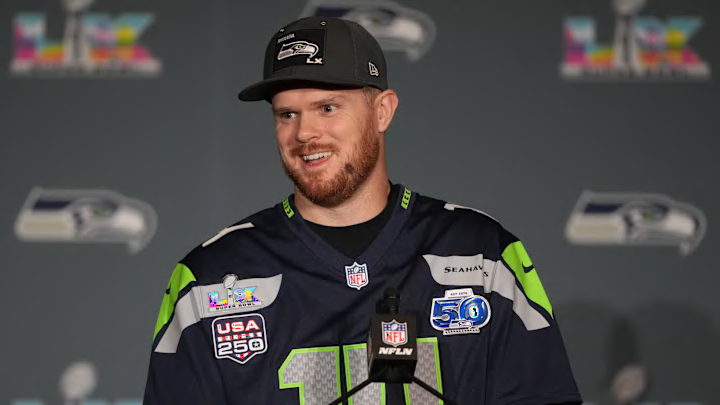
SAN FRANCISCO — Consider this Seahawks season an exercise in exorcisms. All ghosts—Sam Darnold’s reference to seeing them in 2019, Russell Wilson’s Super Bowl XLIX interception, lingering organizational tension from then to now, to cite just three examples—have been busted or can be, in two days, at Super Bowl LX.
This is where Keith Linder enters the conversation. In 2011, he moved from Austin to Seattle, for a job as a software engineer at Microsoft. He rented a house in Bothell, Wa., which is located northeast of downtown. He chose from the offerings on Craigslist. At that point, neither Linder, nor his girlfriend, Tina, knew anything about paranormal activity.
“No,” Linder tells Sports Illustrated in a phone interview last week. “We got baptized.”
The strange started on May 1, 2012. They started hearing this sound, like a baby was coughing, incessantly, day and night. Maybe, they thought, those noises were coming from their neighbors. They were not. They searched every inch of their rental home. And, still, cough-cough-cough.
Then their car keys started to mysteriously vanish. Silverware disappeared. Then the knocking started. Then it really got weird. While they watched television on the couch, a potted plant levitated off the ground, spun in a circle and dropped back in place. Then what Linder describes as a “demonic drawing” suddenly appeared on one wall.
This forced Linder to consider a notion he had never considered previously. Was this house—safe neighborhood, five bedrooms, 2-1/2 baths, constructed only six years earlier—actually … haunted? He thought so. Tina agreed. “But I didn’t want to run,” Linder says. “I felt I deserved this house. I worked hard to acquire it.”
He chose, at that moment, to do what many Seahawks players and coaches have done over the past 11 years. He chose to live with his ghosts. Perhaps then he could understand them.
Where might he go for help? Linder wondered that every single day. There wasn’t an 800 number to call. Real-life Ghostbusters didn’t exist. There was no “I’m haunted” support group.
This club, Linder says, is a tiny one. It’s divided between charlatans and people who sound like charlatans. The latter believe they experienced paranormal activity, and they tell their ghost stories while realizing they sound farfetched. Those stories sound farfetched to them, even.
Linder is a Seahawks fan and a football fan, and after I reached out to him, he did some research in relation to Seattle’s ghosts. He found several instances of Darnold using that phrase, seeing ghosts, that dated back to high school. He figured Darnold wasn’t even aware of that apparent subconscious theme. He also saw Darnold living with the ghosts he saw, in theoretical senses, on football fields.
“I was trying to rationalize [my experience],” Linder says. “Darnold must have felt like that. He was there. He couldn’t make sense of it. But it builds you, internally.”
He also wondered if Darnold would follow the same stages that he did.

One: Deny.
Two: Hunt—for the cause of this activity, for any noise, in any corner of the house; and, soon, for answers, to rid the space of paranormal happenings or reduce them or anything that might end the madness he experienced daily.
Three: Fight.
Four: Flight.
Linder didn’t know that the greater-Seattle area marked something of a haven for paranormal activity, at least for those who believe in that kind of thing. Several companies run “ghost” tours that ferry tourists around downtown. There’s also an underground city, a series of interconnected tunnels, built after a major, crippling fire in 1889. There have been reports of ghost sightings or paranormal activity since then.
The paranormal activity inside that Bothell Hell House picked up, anyway. Loud bangs. Louder crashes. Slamming doors. Flying scissors and airborne kitchen knives, some of which lodged into walls after slicing through them. More violence, the screams closer to existential. Pages torn from Bibles and scattered all over. A burning Bible after that. Plates falling to the ground and breaking. Forks levitating off the table. Blaring fire alarms. Lights all turning off at the same time. Every lightbulb in the house, exploding, at the same time. And that plant! It levitated on a schedule, almost, multiple times a day. Even when they hosted, guests believed they had been touched or grabbed or had their hair pulled by unseen forces.
What else could he do? Linder continued fighting. He hired an exorcist to bless the space and rid it of any evil spirits. This ritual came with two warnings: It might not work and it could anger the very spirits it was supposed to banish. That worked—for all of two days. Then they reached out to Ghost Adventures, a popular reality show on the Travel Channel. That film crew investigated what’s now known as the Bothell Hell House for most of a day, using machines to search for electromagnetic pulses which, for paranormal believers, often identify the presence of ghosts. They found none.
Linder became increasingly, deeply and darkly depressed. He found another paranormal investigator online. Everyone in that world knew Don Phillips, a United Kingdom–based paranormal investigator. He flew to Seattle immediately, with a crew, and lived in the house for roughly a month. He caught—again, there’s no way to prove this in an objectively verifiable sense—more than 400 recordings of … ghosts. Of that tally, 28 recordings were direct responses to the investigator’s questions. Phillips told Linder he made eye contact with the spirits who, yes, haunted his home. One was a small child. Another poltergeist led all the others—an elderly woman, believe it or not. She was a mess—hair pointing in every direction, torn clothes, confused, angry, fearful.
Soon, they uncovered another piece of critical info. There had been Irish settlement near that property more than 100 years earlier, and many families that called that settlement home had also buried their dead nearby. This is where the ghosts—again, can’t prove it!—came from.
At that point, much like Darnold departing the Jets, Panthers, 49ers and Vikings before landing in Seattle, with the Seahawks, Linder chose the flight option. Sometimes, he regrets that decision. He doesn’t regret the alternative reality, worst-case: him, living in a mental institution, his room padded and his food slipped under the door.
This is his advice to those Seahawks who have or are exorcising ghosts: They have two options. They can fly. Or they can fight. They can bury their demons. But it works far better, he says, to reason with them, understand them and work toward resolutions.
In many, significant ways, that is the story of this Seahawks season. Linder now works downtown, where Lumen Field looms outside the window of his office. He says he grew up in a spiritual household but didn’t believe in ghosts at all until he met the ones that haunted him. Now, he says, about half of him believes in the paranormal. “I like that,” he says. “A season of exorcisms.”
I ask to visit the Bothell Hell House. Linder says the current residents do not want visitors, which is understandable, given the wide berth of humanity that shows up at that door. He says not to park too close, which could anger or awaken the spirits that remain inside. He says one person who called him said their car broke down on that block. Others got flat tires, blown-out engines or experienced paranormal activity themselves. He doubted that would happen. But he said that ghosts that haunt houses like the one he rented are always there. They might be dormant more often than not. But they’re there, and they’re there for a reason.
The eerie realization dawned the moment I turned onto the Hell House’s street. You can’t make this up. It’s located on Stafford Way. The Seahawks had vanquished their hated rival, the Los Angeles Rams, twice in the previous five weeks. Another ghost, slayed. Just like the symbols of stick figures that showed up on Linder’s walls, drawn but upside down, Linder could flip “way” and get close to Maye, as in Drake, the Patriots quarterback—the ghost ahead.
“It’s their duty to test you,” Linder says. “The Seahawks have embraced their tests. That’s why they’re in this Super Bowl.” Because of Exorcism Season.

Q&A: Longtime Patriots assistant Dante Scarnecchia
Mike Vrabel’s playing days: “The thing that amazed me is we would have a period for special teams. Mike was on a lot of [special teams units]. But for the ones he wasn’t on, he and Rodney Harrison wanted to be on the ‘look teams’ for those, for [units] that they weren’t going to be involved in. That’s Mike.”
Vrabel’s personality: “He knew I hated it when he would do this. In OTAs or at minicamps, [the defense] would run line stunts. And Mike would always grab one of the offensive linemen, so the defensive tackle could come around them, and we couldn’t get our tackle off of Mike. So he’s grabbing the heck out of our tackle, and he’s looking right at me and just smiling like a Halloween pumpkin, knowing it’s gonna drive me crazy. And I would be like, F—ing Vrabel.”
Bill Belichick assistants or former players and their collective struggles as head coaches: “With Mike right now, it’s original. It’s not Belichick, O.K.? And it’s not anyone else he ever played for. He’s his own guy. He’s not the reincarnation of Belichick at all.”
Vrabel’s softer side: “My first exposure to Mike in his playing career was when we went to West Virginia during training camp and worked against the Houston Texans. Mike was coaching the outside linebackers. And I would look over, across the field, look at him, and he was over there, and they would play this game with a big ball, almost like Four Square. And the next thing I’d see was Mike, out there, with his players. He would take this kind of chest protector, strap it to his body and a rusher or a blocker. Me? I’d get slaughtered.”
Super Bowl XLIX Revisited
One point of clarification on this game that I hadn’t heard, despite years and years of reporting on Wilson’s interception, before. The Seahawks head coach that game, Pete Carroll, has been criticized ever since that attempt left Wilson’s right hand for not taking accountability in the aftermath, whether immediate or long-term. But according to three people who were in the Seahawks locker room that night before it opened to the media, Carroll said the following: “If you’re going to point fingers at anyone, point them at me. I’m sorry.”
Carroll didn’t call the play, throw the pass, run the wrong route or fail to account for Malcolm Butler. Yet he has borne the brunt of the torrent of criticism that resulted from that INT. He should be credited for that. He did take accountability—and he did absorb far more blame than he deserved. His former players, though, see that moment in the locker room as in contrast with every other action or statement that came from Carroll in the aftermath. They see accountability—but only to a point.
Two related nuggets I haven’t seen before. One comes from one of those sources, who voiced what many in the organization felt: That the Seahawks defense should have taken more accountability for that defeat. They gave up a 10-point lead with 10 minutes left, after all.
The other: after the XLIX loss but before the start of the next season, assistant coach Tom Cable had apparently had enough. He called out the defense in one team meeting. Told them to stop complaining. Told them they hadn’t played perfectly that night, either.
Cooper Kupp’s Rams’ Legacy
When Cooper Kupp tore through his final training session in Southern California last spring, before he would head to Seattle and join his Rams’ division rival Seahawks, the depth of his impact on Los Angeles and the Rams’ Super Bowl team from the 2021 was fully revealed.
Quarterback Matthew Stafford dropped by, as did wideout Puka Nacua, as did retired franchise cornerstone Andrew Whitworth. “That just shows you what kind of impact he has had on all these people, man,” says Ryan Sorensen, the trainer who led that session and has worked with Kupp since the 2020 season. “You could tell he just knew. He was going to use all that energy and just completely, utterly dominate.”
Even if Seattle wins this Super Bowl, Sorensen and other members of Kupp’s tight inner circle don’t believe, not for a second, that he will retire.

Jaxon Smith-Njigba’s Multisport Background
Before Canaan Smith-Njigba became a professional baseball player and Jaxon Smith-Njigba became a professional football player, they grew up in Rockwall, Texas. Their father, Maada, loved to “knock out all the sports in one day,” Canaan says. That meant football, basketball, baseball, development for all three and forays into other athletic endeavors.
It also led to what Canaan describes as no less than his brother’s destiny, to do what Jaxon has done this season. Canaan says he knew Jaxon would enter the all-time greats conversation when Jaxon was 3 or 4. “As a toddler, he was able to run, catch, throw early on,” Canaan says. “Always been advanced. Always loved football. You could see it.”
On Background
Sources remain all over the place on the ankle injury Seahawks do-everything safety Nick Emmanwori suffered in Wednesday’s practice, per the pool report that day. Best I can tell: He’ll play Sunday but not at full health.
Only at the Super Bowl
The teams participating in this Super Bowl are staying in Santa Clara and San Jose. The vast majority of the media hoard is bunking in San Francisco. Interviews force long bus rides from one place to the other. If anyone needs an expert on 101-S between those locations …
Quote Without Context
“My dad—that’d be the dream guy to block.”
Context
That’s from Grey Zabel, the Seahawks left guard. He’s close with his father, Mark, who played outside linebacker at the Division II college level.
More Super Bowl on Sports Illustrated
 Add us as a preferred source on Google
Greg Bishop was a senior writer for Sports Illustrated and has covered every kind of sport and every major event across six continents for more than two decades. He previously worked for The Seattle Times and The New York Times. He is the co-author of two books: Jim Gray’s memoir, “Talking to GOATs”; and Laurent Duvernay Tardif’s “Red Zone”. Bishop has written for Showtime Sports, Prime Video and DAZN, and has been nominated for eight sports Emmys, winning two, both for production. He has completed more than a dozen documentary film projects, with a wide range of duties. Bishop, who graduated from the Newhouse School at Syracuse University, is based in Seattle.
Follow GregBishopSI