%20%20--%3E%0A%3Csvg%20version%3D%221.1%22%20id%3D%22Layer_1%22%20xmlns%3D%22http%3A%2F%2Fwww.w3.org%2F2000%2Fsvg%22%20xmlns%3Axlink%3D%22http%3A%2F%2Fwww.w3.org%2F1999%2Fxlink%22%20x%3D%220px%22%20y%3D%220px%22%0A%09%20width%3D%2239px%22%20height%3D%2240px%22%20viewBox%3D%220%200%2039%2040%22%20enable-background%3D%22new%200%200%2039%2040%22%20xml%3Aspace%3D%22preserve%22%3E%0A%3Cpath%20fill%3D%22%23FFFFFF%22%20d%3D%22M38.5%2C7H28.2v26h10.3V7z%22%2F%3E%0A%3Cpath%20fill-rule%3D%22evenodd%22%20clip-rule%3D%22evenodd%22%20fill%3D%22%23FFFFFF%22%20d%3D%22M26.1%2C25.5c0%2C5.8-4.1%2C7.5-12.9%2C7.5C3.9%2C33%2C0%2C31.2%2C0%2C25.2v-1.1h11.6%0A%09v2.4c0%2C0.7%2C0.1%2C1.4%2C1.2%2C1.4c1%2C0%2C1.2-0.4%2C1.2-1.3v-0.9c0-1.6-0.9-1.6-3.5-2.2C2.2%2C21.7%2C0%2C19.7%2C0%2C15.3v-0.9C0%2C9.3%2C5.5%2C7%2C12.9%2C7%0A%09c10.2%2C0%2C12.8%2C2.6%2C12.8%2C7.4v1.8h-11v-2.9c0-0.6-0.4-1.1-1.2-1.1c-0.6%2C0-1.2%2C0.4-1.2%2C1.1v0.9c0%2C1.5%2C0.9%2C2%2C3.3%2C2.5%0A%09c8%2C1.6%2C10.5%2C3.3%2C10.5%2C7.5V25.5z%22%2F%3E%0A%3C%2Fsvg%3E%0A)
Patriots Rematch Digs Up Memories for Seahawks Who Lost 11 Years Ago
In this story:
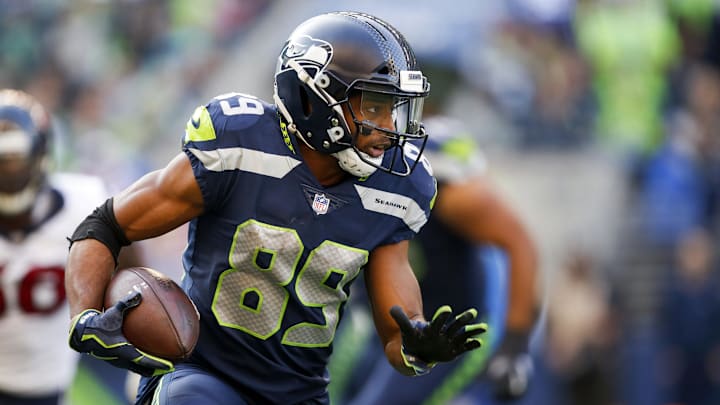
SAN FRANCISCO — Before the Seahawks’ first playoff game this season, in the divisional round, their third meeting with the 49ers this season, Doug Baldwin got the call. The only franchise he ever played for wanted him, a wide receiver who ranks among the greatest players in team history, who powered the offensive side of the Boom era, to raise the 12 flag in the south end zone before kickoff. He raised it. Some 68,000 spread before him roared.
Baldwin didn’t know what to expect. That moment evoked strong feelings. He didn’t necessarily expect those. But, he tells Sports Illustrated, “It was cathartic for me.”
He’s not alone. In the lead-up to Seattle’s first Super Bowl appearance since the interception, the handoff that never happened, the dynasty that unraveled spectacularly in the waning moments of Super Bowl XLIX, five players from that era echoed Baldwin’s sentiment.
Baldwin says that day—Feb. 1, 2015—doesn’t bubble up too often. But that game, and the way it ended—with a Russell Wilson interception in the final minute and Marshawn Lynch playing decoy—still evokes, still maddens, still reverberates, even with 4,003 days between a defeat among the most crushing in Super Bowl history and the night Baldwin raised that flag.
He’s not alone there, either. The tunnel outside the home locker room a week after Seattle bludgeoned San Francisco to advance to the conference championship was crowded with Hawks legends. There was Michael Bennett, behind Lofa Tatupu, next to Ken Hamlin, near Lynch, near Matt Hasselbeck. They weren’t exactly elated, at least outwardly. They were processing—their trauma, their loss, their grief.
“I think a lot of guys feel like this,” Baldwin says. “Especially it being New England [as the Super Bowl opponent], you know, it doesn’t bring up a lot of good feelings, if I’m being honest.”
It’s not like that moment, Malcolm Butler’s interception, faded from the collective memory of every football fan on earth. We’re still talking about it—I’ve written about that play and the aftermath at least six times just for SI—11 years and change later. That owes to the sudden nature of the play, the shifts that accompanied the shock—shifts in legacies, NFL history, the impact drastic and both ways—and all the months that passed from Seattle’s last Super Bowl appearance to this one.
Those deeply embedded emotions only needed a championship game rematch to rise from something most dealt with or buried to the front of so many minds of those participants. This, we know: Offensive coordinator Darrell Bevell called the play. He reasoned that New England’s jumbo goal-line package weighed enough to bust an industrial scale. He knew Seattle had practiced this play for 21 consecutive weeks, without yet using it in a live game.
We know that Wilson could have audibled to a run play. Reports that he approached the line of scrimmage with two options and chose to pass aren’t true, according to three players on that offense. Maybe, they wonder, those espousing the Options Theory, confused Wilson’s ability to audible with a true 50-50 choice. What young quarterback would do that, in this specific situation, anyway?
We know that head coach Pete Carroll could have changed the play, via his headset. Many might not know that Carroll never or almost never changed a play that way, according to two of his longtime confidants. No one can recall a single example. Carroll helped Bevell develop game plans in preparation for each game. His influence on the offense ended on Saturday, or any night before any game. The only person that Wilson heard in his helmet was Bevell.
Anyway, the aftermath endured. Each Seahawk dealt with or ignored that night in their own way. Many struggled. Many are still struggling. For Baldwin, there’s still “that feeling of a missed opportunity,” he says. “I do feel that, still. I don’t hold it against Pete or Bev anymore; like, we all make decisions we wish we could have back. I’m not, like, pulling up about it.”
The rematch took what feelings existed and amplified them or shifted their prominence. The basics—Patriots, Super Bowl—forced “these feelings to bubble up to the surface,” Baldwin says. He hopes the former Seahawks can find healing in the current team. He believes this exercise will be beneficial over time. “But, yeah,” Baldwin says, “it’s a little strange right now.”
It’s not that Carroll banished former Seahawks from team headquarters after the Dynasty that Never Was unraveled in full. Hard feelings made it difficult for some Legion of Boom–era Seahawks to swing by and pretend like that night hadn’t happened. Some team employees remained from that season, which reminded the former players of that Super Bowl, too.
Once Seattle hired Mike Macdonald in early 2024, the bridge between these eras opened once again. Fresh faces helped the former players ease “the tension.” Less-fresh faces helped current players understand that they’re not done yet. In Macdonald, Baldwin saw a head coach who could lead the organization into the future but also welcomed the past—and wanted to build off it.
Baldwin disdained that play call, that ending and everything that happened in the immediate aftermath. But he never allowed one play to define his opinion of Carroll, as a human being or as a coach. “I love Pete,” Baldwin says. “I know what type of team Pete was trying to build, what he was trying to do. The team that is going to the Super Bowl … I see a lot of Pete Carroll in them.”
The receiver called his head coach after another Seahawks team clinched another Super Bowl berth. Baldwin won’t reveal the tenor or contents of their discussion. He does say that there aren’t many people alive who could understand the level of competitiveness that coursed through those Seahawks teams, let alone speak the same language in revisiting that time period. A rich conversation, he says.
Asked if a win or a loss would cull more healing for those Seahawks, Baldwin paused for about five seconds. “I don’t know,” he says. “That’s a good question. I’ll tell you after the game. I want [the Seahawks] to beat the brakes off them. And I still want to beat the brakes off them.”

Q&A: Dean Grosfeld
Today’s conversation is with the head coach at Cerritos College (Cerritos, Calif.), where Patriots running back Rhamondre Stevenson got the second chance he needed.
How Stevenson ended up there: “We got really lucky. His cousin was playing basketball [at Cerritos], and he said, ’Hey, I’ve got a cousin that’s really good at football.’ I looked at one clip, and that was really all I needed [to see].”
Why Stevenson was available: “He had an injury in high school that kept him from producing. They said he was in and out of a foster home. It wasn’t really like that. He had a mentor that moved him in for a little bit in high school. The broken foot really led him to go the junior college path. And he definitely got overlooked.”
At first: “He was very honest, and he was distraught about not getting a [major college] opportunity. He gained a little weight. He was a little out of shape. But the talent was just evident.”
The obvious: “He could play in the NFL. I think he ended up, like, three yards short of [becoming] the [single-season] leading rusher in the history of community college football. Obviously, if we’d known that, we would have rushed him for those yards. The crazy thing is he averaged like 10.2 yards per touch. A first down every time he touched the ball! He left us [for Oklahoma] with tread on the tire, [his] stats were incredibly efficient and productive.”
His Super Bowl LX why: “I texted him when they made the Super Bowl. [This season] has been a big struggle, after losing his dad. I shared with him that I lost my dad when I was his age. I said, ’I’m so proud of you!’ Because of what he did here, the things he learned here.” (Editor’s note: Robert Stevenson died in March 2025, suddenly, at age 54.)
Awe: “We’re not taking credit. It’s his. He’s a phenomenal pass blocker. His game overall, the effect he has, besides just running the football, is immense. And he texted me back. ‘The little things.’”
Super Bowl XLIX Revisited
I wrote about Wilson and the Seahawks in the aftermath of that Super Bowl defeat. He had taken the offensive skill players to Hawaii, to try to heal. I wish I’d parsed the material more, taken a deeper look. But this was the setting back then, before the start of the 2015 season. I should have examined parts like this, below, more closely. Alas …
“Wilson found himself in TMZ’s crosshairs, photographed with a model in Los Angeles. He was criticized for his prolonged contract negotiations. (In July he signed a four-year, $87.6 million extension, with more than $61 million guaranteed.) He was mocked for his insistence—to Rolling Stone and on Twitter—that a recovery water possessing something called “nanobubbles” helped him avoid a concussion following a brutal hit in the NFC championship game.
Still the tension endured. Some players skipped a handful of workouts. And then, on the sixth day, a Friday, that bus turned and drove up toward the cliff. “It was time for tears to be shed and to let it go,” says Ricardo Lockette. “And that’s what we did.” The controversial play call, the interception, the defensive breakdowns, the hurt feelings, the second-guessing, the pain, the embarrassment—Lockette says, “We threw all that over the cliff.”
The next day the Seahawks boarded another 737—this one with Go Russell splashed across the side—and flew back toward Seattle. This time offensive and defensive players mingled throughout the plane as it soared over the Pacific Ocean. “You felt a reassurance,” says Lockette, “that we’re going to start this year on a clean slate and do everything we can to get back to where we were.
Farmer Grey
Among the dozens of fun facts about Grey Zabel, the Seahawks’ prodigious left guard, the best is his passion for agriculture. The dude wants to be a farmer when he retires from pro football, says his father, Mark. Grey already helps maintain the family’s farm, along with some of the farm’s neighbors, when the Zabels cannot make the drive from Pierre, S.D., their hometown. This year, Farmer Grey helped his family grow corn, soybeans and wheat, along with what must be the best garden cultivated, in part, by an NFL player. Grey has always been distinct, his father says. “I mean, we love our three sons equally,” Mark continues. “But Grey will probably be the one that comes back and takes care of us. He’s that kind of person.”
Three repeat participants
There are, by one unofficial count, three participants, for both teams, who partook in Super Bowl XLIX and will also partake in Super Bowl LX. For the Seahawks, that’s general manager John Schneider and longtime equipment czar Erik Kennedy. For the Patriots, that’s Josh McDaniels, their offensive coordinator then and now. He returned this season after two years as the head coach in Las Vegas.
“Josh is second to none,” says his former quarterback, a guy you might have heard of, Tom Brady. “He has great vision for an offense. He’s a great teacher. He makes it simple, but he’s very strategic and complex. He takes his job seriously. And, from a friend standpoint, I couldn’t be happier for him. Drake [Maye] is lucky to have him, and I’m sure Drake would tell you that, too. But Josh has worked so hard to do the right thing and I really love that about him. Respect that about him.”
On background
An NFL executive whose team is not playing in Super Bowl LX mentioned this the other day: Remember, he urged, that almost everyone who even borders on that pundit life has picked the Seahawks. “If the Patriots win, you’ll hear so many of them say they called it,” he said, and he was laughing.
Only at the Super Bowl
One group of 12s fans took a bus down to the Bay. Not just any bus. The Beast Bus, a tricked-out double-decker that belongs in a sports museum, the walls signed by hundreds of Seahawks fans, with a massive neon Seahawks logo stretching the full length of the outside. Keep an eye out for it. Or don’t; you’re not gonna miss this, ahem, Beast, regardless.
Quote without context
“I was watching the big send-off yesterday, and this woman came on [TV], and she goes, ‘We’ve been waiting for this for six years!’”
Context
That’s from Dante Scarnecchia, a brilliant offensive line coach who played a pivotal role in shaping New England’s dynasty. Six years might sound like a long time. But not in professional football, especially not when referring to championships. My, oh my, how Patriots fans have forgotten the team’s history, which has flourished this century but hardly did so in the last one.
More NFL From Sports Illustrated
 Add us as a preferred source on Google
Greg Bishop was a senior writer for Sports Illustrated and has covered every kind of sport and every major event across six continents for more than two decades. He previously worked for The Seattle Times and The New York Times. He is the co-author of two books: Jim Gray’s memoir, “Talking to GOATs”; and Laurent Duvernay Tardif’s “Red Zone”. Bishop has written for Showtime Sports, Prime Video and DAZN, and has been nominated for eight sports Emmys, winning two, both for production. He has completed more than a dozen documentary film projects, with a wide range of duties. Bishop, who graduated from the Newhouse School at Syracuse University, is based in Seattle.
Follow GregBishopSI