%20%20--%3E%0A%3Csvg%20version%3D%221.1%22%20id%3D%22Layer_1%22%20xmlns%3D%22http%3A%2F%2Fwww.w3.org%2F2000%2Fsvg%22%20xmlns%3Axlink%3D%22http%3A%2F%2Fwww.w3.org%2F1999%2Fxlink%22%20x%3D%220px%22%20y%3D%220px%22%0A%09%20width%3D%2239px%22%20height%3D%2240px%22%20viewBox%3D%220%200%2039%2040%22%20enable-background%3D%22new%200%200%2039%2040%22%20xml%3Aspace%3D%22preserve%22%3E%0A%3Cpath%20fill%3D%22%23FFFFFF%22%20d%3D%22M38.5%2C7H28.2v26h10.3V7z%22%2F%3E%0A%3Cpath%20fill-rule%3D%22evenodd%22%20clip-rule%3D%22evenodd%22%20fill%3D%22%23FFFFFF%22%20d%3D%22M26.1%2C25.5c0%2C5.8-4.1%2C7.5-12.9%2C7.5C3.9%2C33%2C0%2C31.2%2C0%2C25.2v-1.1h11.6%0A%09v2.4c0%2C0.7%2C0.1%2C1.4%2C1.2%2C1.4c1%2C0%2C1.2-0.4%2C1.2-1.3v-0.9c0-1.6-0.9-1.6-3.5-2.2C2.2%2C21.7%2C0%2C19.7%2C0%2C15.3v-0.9C0%2C9.3%2C5.5%2C7%2C12.9%2C7%0A%09c10.2%2C0%2C12.8%2C2.6%2C12.8%2C7.4v1.8h-11v-2.9c0-0.6-0.4-1.1-1.2-1.1c-0.6%2C0-1.2%2C0.4-1.2%2C1.1v0.9c0%2C1.5%2C0.9%2C2%2C3.3%2C2.5%0A%09c8%2C1.6%2C10.5%2C3.3%2C10.5%2C7.5V25.5z%22%2F%3E%0A%3C%2Fsvg%3E%0A)
The Seahawks Celebrated After Super Bowl LX Like They Knew They Would Win
In this story:
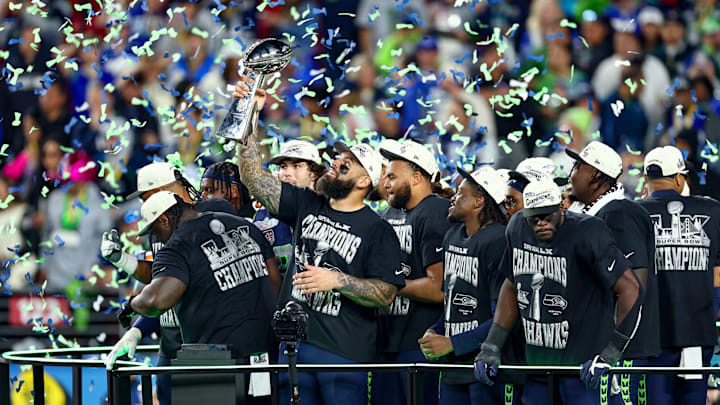
SANTA CLARA, Calif. — First, inhale.
The Seahawks’ locker room is a competing mix of wafting cigar smoke from the various sticks burning between thick knuckles and stamped out in round, black ashtrays. Ashton Martins. Kingmakers. A special box of Meerapfel sitting in Leonard Williams’s locker.
A handful of offensive linemen gathered in a semicircle to organize a group shotgunning of Busch Lights while others played baseball with a crushed can and—what else—a champagne bottle in lieu of the Louisville Slugger.
Some sat quietly on the outskirts, zoning out on their cell phones while sipping tall, thin glass bottles of Don Julio 1942 that retail for more than $140 a pop. A very small amount of gold Armand de Brignac was dotted throughout, though this was decidedly a Coors and Busch kind of party, with two giant laundry carts packed with ice and beer.
General manager John Schneider leaned against the Gatorade cooler with a championship hat tucked just a little sideways on his head and revealed the t-shirt that showed a grainy copy of his father’s high school football picture from 1952. This, while defensive coordinator Aden Durde walked by with his native Union Jack tucked in his back pocket, having just become the first British coach in NFL history to win a Super Bowl.
The playlist was a mix of Future, Drake (“Jumbotron S--- Poppin”) and Kodak Black (“Skrilla”). Players rotated the role of deejay while dancing in front of a line of cell phones live streaming the celebration on Instagram.
However, as one assistant coach described from the back corner of the locker room, there was an eeriness about the entire scene. Some post–Super Bowl locker rooms are parties constantly vibrating on the edge of legality; your first parents-are-gone high school kegger with a little more supervision and police already on the scene. The lights flicker on and off. Mobs move as one throbbing organism on the dance floor.
This—the coach posited—was the right kind of subdued and reflected the confidence the Seahawks had going into the game. It was, following a 29–13 win over the Patriots to claim Super Bowl LX, more expected than anything else.
As much talk as there was about this—the nebulous feeling of beating down an opponent in the Super Bowl, the sleepless night ahead, the confetti snow angels and the hugs that lingered just a little bit longer—was a pride in how it happened. This group was not just more talented. They were smarter. As another assistant coach said, the amount of information that this team downloaded in the week between the conference championship games and the completion of installments early in game week, was staggering. The Seahawks hadn’t played New England before, but in a matter of days had figured out the following:
• New England’s defensive tendency was to play “bigger than you.” For example, if a team came out in a two-tight-end personnel grouping, the Patriots would play their opponents like a team using three tight ends. Mike Vrabel was, after all, a pugilist at heart and loved to beat opponents down, though revealing those habits made it easier for the Seahawks to design an offensive game plan to beat it (some of which involved timing New England’s defensive stunts and running opposite them). It was a big reason why Kenneth Walker III became the NFL’s first running back to win Super Bowl MVP in 28 years. Still, Seahawks coaches were impressed by New England’s game plan, which featured new simulated pressures the team hadn’t seen on film earlier in the week and kept a blowout from occurring until later in the game.
• Seattle watched the Broncos counter New England’s desire to match up Christian Gonzalez on certain wide receivers and crafted a similar plan for the Patriots, who wanted Gonzalez on Jaxon Smith-Njigba as often as possible. So, Seattle had Smith-Njigba moving briskly out of the huddle and motioning from side to side, preventing the Patriots from settling into a role where they could dictate the terms of a play.
• The Seahawks’ defense installed a number of calls for the line throughout the week and gave the team’s vaunted front four the freedom to decide what they wanted to employ. As one coach said, they were able to figure out where the Patriots’ line was sliding its protections and pick the appropriate stunt or “game”—a blanket term coaches use for a series of coordinated movements— based on those predictions.
• The plan for Drake Maye was simple: Mix coverages early and often on the back end. Seattle got a critical sack early in the game by playing man coverage but also slipped in and out of zone concepts, preventing the second-year quarterback from seeing a familiar picture. Seattle called the two Devon Witherspoon blitzes early in the game with purpose, hoping to rattle Maye as soon after kickoff as possible.
Williams stood out front of his locker with a lei around his neck facing a prefabricated wall with the Super Bowl logo that players and staff were using as a backdrop to take pictures. In fitting with the theme, he was less overly emotional and more introspective. The music was at a reasonable volume now. The random screams and high fives that sounded more like rifle cracks were fading.
In his 11-year career, Williams says, other teams he played for felt like an assemblage of grown men. Families, money, age and time complicated the unreplicable bond that he felt here at this moment. He had coaches he could discuss personal issues with and a position room he trusted implicitly.
“I found a home. I found a team that fights and plays for each other,” he said after two and a half seasons in Seattle, adding a little bit later: “That’s what makes this moment more beautiful.”
In the middle of an answer, he looks over at the wall, and a group of people who may never be together again, and cuts himself short, wise beyond his years in knowing that this is a moment he should capture forever. Walking through the smoke, he reaches out to put his arms around someone, anyone.
He, too, wants to take a picture to remember it by.
More NFL From Sports Illustrated
 Add us as a preferred source on Google
Conor Orr is a senior writer for Sports Illustrated, where he covers the NFL and cohosts the MMQB Podcast. Orr has been covering the NFL for more than a decade and is a member of the Pro Football Writers of America. His work has been published in The Best American Sports Writing book series and he previously worked for The Newark Star-Ledger and NFL Media. Orr is an avid runner and youth sports coach who lives in New Jersey with his wife, two children and a loving terrier named Ernie.
Follow ConorOrr