%20%20--%3E%0A%3Csvg%20version%3D%221.1%22%20id%3D%22Layer_1%22%20xmlns%3D%22http%3A%2F%2Fwww.w3.org%2F2000%2Fsvg%22%20xmlns%3Axlink%3D%22http%3A%2F%2Fwww.w3.org%2F1999%2Fxlink%22%20x%3D%220px%22%20y%3D%220px%22%0A%09%20width%3D%2239px%22%20height%3D%2240px%22%20viewBox%3D%220%200%2039%2040%22%20enable-background%3D%22new%200%200%2039%2040%22%20xml%3Aspace%3D%22preserve%22%3E%0A%3Cpath%20fill%3D%22%23FFFFFF%22%20d%3D%22M38.5%2C7H28.2v26h10.3V7z%22%2F%3E%0A%3Cpath%20fill-rule%3D%22evenodd%22%20clip-rule%3D%22evenodd%22%20fill%3D%22%23FFFFFF%22%20d%3D%22M26.1%2C25.5c0%2C5.8-4.1%2C7.5-12.9%2C7.5C3.9%2C33%2C0%2C31.2%2C0%2C25.2v-1.1h11.6%0A%09v2.4c0%2C0.7%2C0.1%2C1.4%2C1.2%2C1.4c1%2C0%2C1.2-0.4%2C1.2-1.3v-0.9c0-1.6-0.9-1.6-3.5-2.2C2.2%2C21.7%2C0%2C19.7%2C0%2C15.3v-0.9C0%2C9.3%2C5.5%2C7%2C12.9%2C7%0A%09c10.2%2C0%2C12.8%2C2.6%2C12.8%2C7.4v1.8h-11v-2.9c0-0.6-0.4-1.1-1.2-1.1c-0.6%2C0-1.2%2C0.4-1.2%2C1.1v0.9c0%2C1.5%2C0.9%2C2%2C3.3%2C2.5%0A%09c8%2C1.6%2C10.5%2C3.3%2C10.5%2C7.5V25.5z%22%2F%3E%0A%3C%2Fsvg%3E%0A)
The Seahawks’ Plan to Contend for More Super Bowls Is Locked Away in a Safe
In this story:
You can check out my full takeaways for this week here, but I wanted to go a little longer on the offseason the defending champs are having in Seattle.
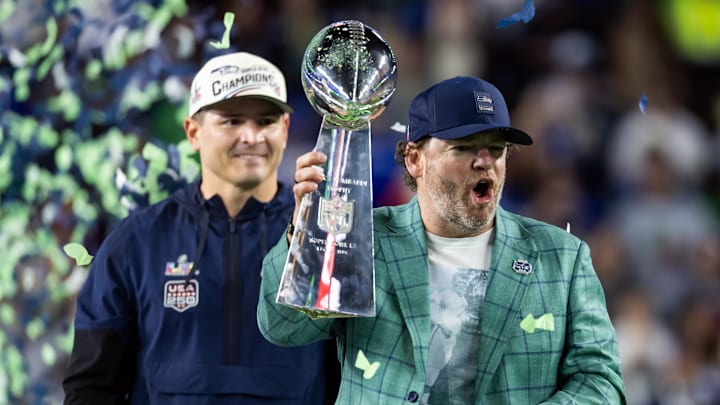
This second group of championship Seahawks is going to be built a little differently than the first. The why and how of that sit in a stack of green lab books, locked away in a safe in the office of Seattle’s two-time Lombardi Trophy–winning GM, John Schneider.
The practice of journaling goes way back for Schneider, all the way to his early days as a young Packers assistant in the 1990s. It’s fallen off, come back, evolved and become therapy for the accomplished roster architect. Now, all these years later, it’s both what Schneider requires of himself on a regular basis and where so many of his team-building secrets live.
“A, it’s a stress reliever,” Schneider said in a quiet moment over lunch at last week’s owners meetings. “And it’s a reminder of how you were feeling in this negotiation, or this period of time. What was going on? You can go right back to the moment instead of having revisionist history. It’s being disciplined enough, say, the night before the draft, knowing, O.K., this is where we picked and this is what it feels like when you’re waiting. Or this is what it looks like when you don't have a second-round pick, what that feels like when however many players are coming off the board.
“You discipline yourself to not be going crazy, to not do something drastic, whether it be for the next year or the back half of the draft. Like, Chill out, everything’s gonna work out.”
It’s not like everything fell apart the last time Schneider was in this position, coming off a win in Super Bowl XLVIII with a roster full of still-ascending young talent.
The Seahawks, in fact, made it back to the Super Bowl the next year, losing by the thinnest of margins to Tom Brady and the Patriots, then returned to the playoffs the next two years after that. The championship came in the second year of a nine-year run through which Seattle missed the playoffs just once and won the NFC West four times.
The easy thing would be to look back on that with satisfaction and there is, to be sure, some of that for Schneider. But he also has taken a critical eye to his construction of those teams—and what prevented that group from adding more Lombardis with such a gifted core.
“Looking back at that group, there was a lot of challenge from the outside, like, You can’t keep all these guys together,” Schneider says. “We had one of the great defensive backfields, and defenses in general, of all time. So we’re going to pay the Mike linebacker, we’re gonna pay the Sam linebacker, we’re gonna pay the strong safety, the free safety, the top corner. What happens there is, A, you can get real top-heavy, and B, you’re taking away from other aspects of the team.”
That isn’t to say that he wouldn’t pay Richard Sherman or Earl Thomas or Bobby Wagner again. He would, of course, keep a lot of those guys. He just might not keep all of them.
And reminders of that are all over those lab books.
The genesis of that journaling, for Schneider, came in the Packers’ Super Bowl season of 1996. He took notes on how GM Ron Wolf and the staff were operating during the season, with this idea: What if we aren’t as good as we think? Turns out, they were. Green Bay won it all, and Schneider, by his own admission, got a little lazy, and the entries into the lab books became more sporadic.
In 2001, at 29, he went with Marty Schottenheimer to Washington, becoming de facto GM for the veteran coach he had worked with in Kansas City. They were both fired after a year, and going through that pushed Schneider, who then returned to Green Bay, to reprise his practice of putting pen to paper. He journaled on everything he observed working for Mike Sherman and Mark Hatley, then Ted Thompson and Mike McCarthy with the Packers.
Some of it would be what you’d expect, all the background on picks and signings. Other things were less so, like what he’d have done were he the Browns’ GM after Kellen Winslow II’s motorcycle accident in 2005. All of it pointed at what he’d do if he got a second shot at running his own shop, after the short-circuited stint in D.C.
In Seattle, it has become an ever-growing road map for him. And this offseason, those lessons on picking his spots were huge, as he and his crew had to choose who stays and who goes.

One clear regret Schneider had from the last time around, as his journals detailed: How the investment in that really special core wound up eroding Seattle’s offensive line.
As a result of paying his offensive skill guys and defensive stars, Schneider had to go young and cheap on the offensive line. It hurt the Seahawks, in his words, “Because you rob Peter to pay Paul, and offensive line’s a hard position to acquire anyway.” He has even told ex-Seattle center Max Unger that he regrets including him in the Jimmy Graham deal in March 2015 (which is not to say he wouldn’t deal for Graham again, just that he should’ve valued Unger more).
“In retrospect, he was such a centerpiece,” Schneider says. “He could’ve helped us through that process where other players couldn’t have because he was such a foundational stud.”
So this time around, the Seahawks looked at players, but positions, too—and which ones would be tougher to replace than others. He hated seeing Coby Bryant, who took one for the team and went through a position change he didn’t initially love (from cornerback to safety), head elsewhere. He also didn’t like losing Super Bowl MVP Kenneth Walker III, who had grown so much in Seattle. Same went for corner Riq Woolen and defensive end Boye Mafe. “That’s the challenge,” he says.
But the journal didn’t just affect defections.
In the case of receiver Rashid Shaheed, it actually caused Seattle to take a U-turn and retain him. Initially, Schneider thought Shaheed would be gone, after he had dealt fourth- and fifth-round picks for the ex-Saint at the trade deadline to get him. In fact, one of the things he had taken from previous entries then written down after the season was, “Hey, we’re trying to get him back, we want him back, but it’s O.K. if we can’t do it.
“Don’t be super passionate about the [trade] compensation.”
But at the same time, Schneider had also jotted down all the different ways Shaheed had affected games down the stretch of the regular season, then into the playoffs, both on offense and on special teams. So as the receiver market settled, Schneider had resolved to stay loose, rather than just coming to terms with an impending departure and, to the surprise of some, worked out a three-year, $51 million deal with Shaheed.
Likewise, going forward, there are lessons learned he’ll take from the Legion of Boom years and apply them to the draft. One is that now that his young players have become more accomplished and gotten paid, he and his scouts and the coaches will have to be even more vigilant in seeing that they bring the right types of competitors into the building to maintain the program.
“Draft-wise, you’d better be damn sure those people coming in that you’re drafting are ready to compete with those players, when you’re saying, that’s the highest-paid player at this position or the third-highest-paid or what have you,” Schneider says. “It’s the ultimate team sport, you’re talking about competing all the time. You have to make sure with the character, they’re not enamored with Earl Thomas or Kam Chancellor—they’re ready to compete with them.”
So now, we’ll get to see how all this comes together, as Schneider keeps scribbling notes out by hand and throwing green lab books into that safe. At this point, nearly three decades of trade secrets are locked in there, as is what amounts to a living history of the Seahawks’ franchise since 2010, around when the detail in Schneider’s entries grew and that safe was purchased.
He knew the value of what was in those books then. And he does even more so now.
More NFL From Sports Illustrated
 Add us as a preferred source on Google
Albert Breer is a senior writer covering the NFL for Sports Illustrated, delivering the biggest stories and breaking news from across the league. He has been on the NFL beat since 2005 and joined SI in 2016. Breer began his career covering the New England Patriots for the MetroWest Daily News and the Boston Herald from 2005 to ’07, then covered the Dallas Cowboys for the Dallas Morning News from 2007 to ’08. He worked for The Sporting News from 2008 to ’09 before returning to Massachusetts as The Boston Globe’s national NFL writer in 2009. From 2010 to 2016, Breer served as a national reporter for NFL Network. In addition to his work at Sports Illustrated, Breer regularly appears on NBC Sports Boston, 98.5 The Sports Hub in Boston, FS1 with Colin Cowherd, The Rich Eisen Show and The Dan Patrick Show. A 2002 graduate of Ohio State, Breer lives near Boston with his wife, a cardiac ICU nurse at Boston Children’s Hospital, and their three children.
Follow AlbertBreer