%20%20--%3E%0A%3Csvg%20version%3D%221.1%22%20id%3D%22Layer_1%22%20xmlns%3D%22http%3A%2F%2Fwww.w3.org%2F2000%2Fsvg%22%20xmlns%3Axlink%3D%22http%3A%2F%2Fwww.w3.org%2F1999%2Fxlink%22%20x%3D%220px%22%20y%3D%220px%22%0A%09%20width%3D%2239px%22%20height%3D%2240px%22%20viewBox%3D%220%200%2039%2040%22%20enable-background%3D%22new%200%200%2039%2040%22%20xml%3Aspace%3D%22preserve%22%3E%0A%3Cpath%20fill%3D%22%23FFFFFF%22%20d%3D%22M38.5%2C7H28.2v26h10.3V7z%22%2F%3E%0A%3Cpath%20fill-rule%3D%22evenodd%22%20clip-rule%3D%22evenodd%22%20fill%3D%22%23FFFFFF%22%20d%3D%22M26.1%2C25.5c0%2C5.8-4.1%2C7.5-12.9%2C7.5C3.9%2C33%2C0%2C31.2%2C0%2C25.2v-1.1h11.6%0A%09v2.4c0%2C0.7%2C0.1%2C1.4%2C1.2%2C1.4c1%2C0%2C1.2-0.4%2C1.2-1.3v-0.9c0-1.6-0.9-1.6-3.5-2.2C2.2%2C21.7%2C0%2C19.7%2C0%2C15.3v-0.9C0%2C9.3%2C5.5%2C7%2C12.9%2C7%0A%09c10.2%2C0%2C12.8%2C2.6%2C12.8%2C7.4v1.8h-11v-2.9c0-0.6-0.4-1.1-1.2-1.1c-0.6%2C0-1.2%2C0.4-1.2%2C1.1v0.9c0%2C1.5%2C0.9%2C2%2C3.3%2C2.5%0A%09c8%2C1.6%2C10.5%2C3.3%2C10.5%2C7.5V25.5z%22%2F%3E%0A%3C%2Fsvg%3E%0A)
Winners and Losers From the 2026 NFL Combine Include QBs, Coaches and GMs
In this story:
While the NFL combine is still very much underway, the public-facing portion of the event has all but concluded. Coaches and general managers speaking at the podium have to deliver what is the first of many performances that obscure true intentions, flatter their own players and instill confidence in a fan base.
More valuable than the banal pre-draft press conference, the combine is often a time for tone-setting and telegraphing if you know where to look. We break down winners and losers from this particular phase of the combine, with an eye on impact for the upcoming NFL offseason and beyond.
WINNERS
Ashton Jeanty
“It’s very important Ashton Jeanty has a wingman,” Klint Kubiak told reporters at the combine, saying that it’s not just going to be one wingman, either. Kubiak was high on my list of head coach hiring grades specifically because I think he’s well-suited to feature a weapon like Jeanty, the 2025 No. 6 pick. The downhill, outside zone system should not be unfamiliar to Jeanty, who worked in both gap and zone concepts at Boise State, and should allow him to not only run with less inhibition but to set up home run opportunities off play action in the passing game (which we saw effectively in 2025 but far too infrequently in the doomed marriage of a Pete Carroll–Chip Kelly offense).
Sean Payton
I think, among any coach who learned lessons from 2025, I’m pleasantly surprised that the most evolved seems to be a 62-year-old possible future Hall of Famer who is known for a pronounced self-confidence. Payton was frank about the fact that Denver won a lot of one-score games this past season (10 of 14 during the regular season and the team’s wild-card victory in the playoffs). Oftentimes, I think a coach can spin that fact into evidence of grit or strength in the waning minutes of the game, rather than the truth, which is that consistent one-score game winners benefit from a ton of high-variance, luck-oriented plays. To that end, Payton giving up play-calling to Davis Webb—a situation that almost guarantees Webb a head coaching job next year if Webb succeeds—is also a two-pronged move from Payton that shows some growth.
On one hand, it shows an acute understanding of Denver’s current “window.” On the other hand, I think this move was also a recognition that the Broncos lost the AFC title game in part because of game-management issues and that Payton may be better served as a CEO on Sundays, as well as during the week.
Whimsey
Todd Monken is one of the great borrowers of play concepts and ideas in the NFL. There is a difference, though, between a coach copy-pasting a crude version of the McVay or Shanahan offense and another coach, like Monken, who understands offensive football on another level and can borrow the flourishes from those schemes and retrofit them for what he’s working on. Predictably, Monken shined during his first leaguewide press conference circuit, with a Bruce Arians–like blend of honesty and brashness. But his insistence on the evolved use of the hook-and-ladder play is what really caught my attention. Monken did a great job of borrowing designed scramble concepts for Lamar Jackson in Baltimore that were sneakily gaining prevalence among the league’s best mobile quarterbacks, and now seems to be honing in on Ben Johnson’s love of hook-and-ladder plays. If a team has a stable of discerning and trustworthy players, a hook-and-ladder can add YAC and explosive potential. We’ve yet to see a coach really make it part of an offense, but it could be the breakthrough offenses are looking for to beat back so many zone-heavy looks that are tamping down touchdowns.
C.J. Stroud
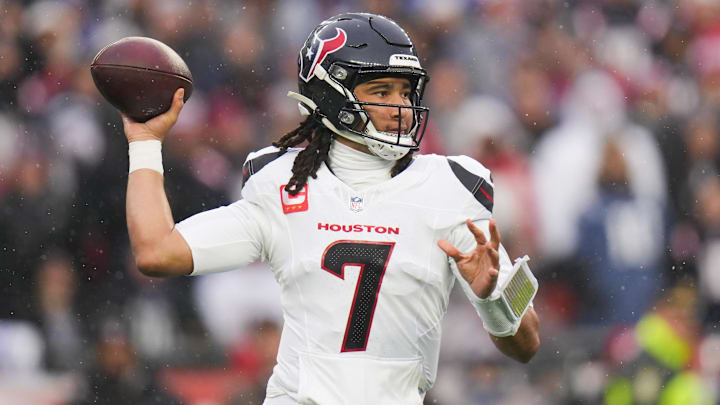
Juxtapose the way that the Dolphins talked about Tua Tagovailoa—openly using podium time to seek out a potential trade partner, all but declaring his time on the roster over—with what Nick Caserio said about Stroud on Tuesday. The Texans’ GM called the idea of trading the former No. 2 pick “moronic,” which was a declaration swiftly followed by the firing of Jerod Johnson, who has been Stroud’s quarterbacks coach since Stroud has been in the NFL. Stroud has now gotten two quarterbacks coaches and two different offensive coordinators (Jerod Johnson and Bobby Slowik were both dismissed in subsequent offseasons) over the course of four seasons, as he approaches an all-important season where Houston will have to decide on committing $60-plus million per year for Stroud, alongside a potential $50 million per year edge defender in Will Anderson Jr., who was selected three picks behind Stroud in the now very consequential 2023 draft.
My thoughts on this are twofold:
• I think that Caserio played this perfectly. Whether he believes the idea of trading Stroud to be moronic, there is no downside to publicly supporting the quarterback. Espousing confidence in a quarterback only to trade him months later has no impact on a general manager’s job security or public persona (remember when Les Snead promised the Rams would not “delete” Sam Bradford before, well, deleting him?). And, if a stunning offer doesn’t materialize for Stroud, it looks like the Texans were in his corner all along.
• I do not think the idea is moronic. If you’re a Texans fan, I’ll ask you this way: Would you turn down two first-round picks from, say, the Jets or Steelers (which I understand are very different firs- round picks in terms of value) and the proposition of having someone like Jimmy Garoppolo reunite with Nick Caley to run more of a ball control, risk-averse offense that feeds DeMeco Ryans’s defense. And with the savings that would have gone to earmarking a gigantic contract, you can, like the Broncos a year ago, add critical pieces to the defense and create an elite, stalwart unit for two years while also making yourself relevant for the treasure trove that promises to be the 2027 quarterback class? This, in a year where every team needs a quarterback but there are none in the draft, thus generating a market? Or, would you rather kick the can down the road a year for Stroud and be, either, unable to trade him because of the volume of quarterbacks coming out, or having to do a Daniel Jones–style blind-faith extension based on some modicum of progress? Stroud could very well take off this season and make us all look foolish, but right now I feel like Houston should at least keep the possibility in its back pocket (though I am a noted moron).
Jesse Minter
I ranked Minter as my No. 1 coaching hire this offseason, and I’m starting to see the real-life materialization of why. Minter had an astute comment on the nature of voluntary workouts, which are a buzzy situation in Baltimore given the attendance, or lack thereof, by franchise quarterback Lamar Jackson. Minter put the onus on the coaching staff to make a voluntary offseason program seem both important and interesting enough to attract players. That means rethinking some of the tired banalities of the sport and, in his words, replacing them with “high-level stuff.” Minter was hired off the fumes of the Mike Macdonald Super Bowl run, which counted less on quarterback play than we’ve seen of most Super Bowl teams in recent years and more on a self-sustaining, cerebral defensive front. Minter setting the tone for a similar vibe, is critical for a smooth takeoff in Baltimore.
LOSERS

Howie Roseman
At the combine, Raiders general manager John Spytek noted that, with all due respect to the Eagles general manager, Roseman’s reputation is such now that when he calls about a potential trade or inquires about a player of yours, a personal antennae is raised, given how successful Philly’s GM has been at pilfering talent off other rosters. Imagine being so good at your job that people won’t trade with you anymore out of fear of being … Rosemanned? In all seriousness, I do wonder if Roseman’s success would impact any forthcoming A.J. Brown negotiations (outside of Brown going to the Patriots, where Mike Vrabel has a familiarity with the player and a broad grasp of Brown’s social/emotional heat map). Still, if the Patriots are the obvious suitor, does the Eagles’ success regarding player evaluation prevent Philadelphia from drumming up an ancillary market for Brown that would drive his price up?
Joe Schoen
I have a unique sympathy for Joe Schoen, and I’ll explain why. When normal adults find out what I do for a living, the default response is less “Wow! What a cool job” and more “So, what do you actually do to pay bills and support your family?” or “Doesn’t your wife get mad that you spend all day talking about fantasy football?” or “Why aren’t you an accountant like Eli’s dad? (drop it, mom).” Any time you have to reiterate that you are, indeed, doing an actual job that people don’t believe is real, it grates on the spirit. So it is not with schadenfreude or glee that I relay the news that Schoen had to tell reporters that he is, indeed, still the general manager of the Giants during his combine press conference. I have to imagine this creates a wildly complex and socially awkward series of events in which agents and fellow executives approach both Schoen and John Harbaugh at the combine (and perhaps even Dawn Aponte, the team’s other new high-ranking executive). There have been reports circulating that the Giants are unhappy with the perception that Schoen’s job is merely a title-only role, though I don’t know exactly how to address that issue in the short term.
Draft intrigue
The stunning admission that about 25% of the Chiefs’ preliminary top 100 got erased when the NCAA’s deadline for players to return to college tolled is one of the few examples of the NFL being powerless to improve a product. This is, by all accounts, a down year for the draft. I’ve had executives tell me it’s about 15 players deep, and then a cliff hits in the middle of the first round. Now, we should not confuse a talented draft and an intriguing draft (see: last year’s Shedeur Sanders debacle). The NFL can still generate something for people to talk about, or have it materialize, like bong smoke, out of thin air. I thought someone such as Trinidad Chambliss, coming off a sparkling NCAA championship run, could have injected some interest into the late first round. However, Chambliss is returning to Ole Miss for his age-36 college season. Instead, it may be a question of whether Ty Simpson can improve his theoretical “stock” enough to warrant being a part of the conversation. Still, with the Sanders boon behind the NFL, I do wonder if the league tries to counter the hoarding of talent in collegiate ranks by deep-pocketed NCAA boosters.
Officiating
The great Mark Maske tracked down NFL VP of operations Troy Vincent at the combine to ask about missed calls from the 2025 season. In an answer that admitted to taking an absolutely, monumentally critical touchdown away from Isaiah Likely against the Steelers—a catch that, if you think about it, has a not-indirect line to the fates of both the Steelers and Ravens and, subsequently, John Harbaugh and Mike Tomlin—Vincent said: “There was the Likely play … Ravens-Steelers in the end zone. And then you had the one—there was a Jets play. But it was the Likely play that you go, that was interesting because of the third step, and they were talking about the ball extended out. So it was: What constitutes that third act?”
The frustration here, which seems to have been echoed by veteran Kyle Van Noy, is: Why the hell are you phrasing that in the form of a question? What constitutes a third act? You need to be able to relay that to the public—and, let’s be real, a trillion-dollar betting and prediction market—with an unshakable confidence. This isn’t a theory we’re testing or an intellectual conversation to be had over rose lattes. This is the cornerstone of a rulebook that is so inconsistently enforced that the league is turning into a walking conspiracy theory. This, amid negotiations between the NFLRA and the league with a possible work stoppage looming.
The tush push
Man, getting upset about that seems kind of wild in hindsight, doesn’t it? I may have—once or twice—gotten pretty hyperbolic on the whole thing. At the combine, Nick Sirianni addressed questions this year about how no one is trying to ban it anymore. The Eagles converted only slightly more than 60% of their attempts this season, as the offense stalled and forced a coordinator change. Sirianni opened the door to “find new avenues to be able to convert on third down or in the red zone,” and pointed out the Eagles’ suite of fake plays that worked off the tush push. Personally, I thought that was the brightest offensive development the team had last year, and I wondered how effective explosive plays off the tush push formation could become if the Eagles doubled or tripled down on mastering the play as its Super Bowl-winning offensive line phased out. As it’s become clearer that Philadelphia was primarily buoyed by a generational offensive line that is now aging to the point where the tush push is probably as much of a safety issue for the Eagles as it is for opponents.

Anthony Richardson
I may be in the minority here, but I don’t think Richardson’s request for a trade this week in Indianapolis is a smart career move. There are the inevitable benefits of being in a new place. Still, our immediate pivot to fantasizing about Richardson playing for Kyle Shanahan or Kevin O’Connell and somehow materializing into the behemoth we all imagine him to be ignores the fact that Shane Steichen is also a destination coach for reviving careers. In fact, I’d put Steichen in that conversation alongside O’Connell, Sean McVay and Shanahan. He designed something that worked for Richardson that Richardson was unable to take advantage of. Interestingly enough, I think we’ve seen the limits of what a quote, unquote quarterback whisperer can accomplish in the NFL. Minnesota saw its hubris challenged a year ago by eschewing eventual Super Bowl champion Sam Darnold for J.J. McCarthy, only to have the Vikings propelled right back into the quarterback market for 2026.
Another quick thought on the subject:
• Do we really believe that Chris Ballard, who is hanging on to this job by a razor’s edge, is going to trade the former No. 4 pick to one of the three best quarterback destinations in the NFL and risk Richardson being a star? I understand there is a human element to all of this, but the mechanics of this trade and, say, the Justin Fields to Pittsburgh trade, where Ryan Poles legitimately wanted the best for Fields, are totally different. Richardson wanting out could end up with him being on the Jets, for example. He may conflate the potential for playing time with a good opportunity when the truly good opportunity is absorbing as much as he can from a coach that other quarterbacks in similar situations (i.e., Daniel Jones) swear by.
More NFL on Sports Illustrated
 Add us as a preferred source on Google
Conor Orr is a Senior Writer for Sports Illustrated with more than 15 years of experience covering the NFL. His work has been cited in Best American Sportswriting and has won a PFWAA award. Prior to Sports Illustrated, he covered both the Giants and Jets for The Star-Ledger. Conor lives in New Jersey with his amazing wife and three children.
Follow author