%20%20--%3E%0A%3Csvg%20version%3D%221.1%22%20id%3D%22Layer_1%22%20xmlns%3D%22http%3A%2F%2Fwww.w3.org%2F2000%2Fsvg%22%20xmlns%3Axlink%3D%22http%3A%2F%2Fwww.w3.org%2F1999%2Fxlink%22%20x%3D%220px%22%20y%3D%220px%22%0A%09%20width%3D%2239px%22%20height%3D%2240px%22%20viewBox%3D%220%200%2039%2040%22%20enable-background%3D%22new%200%200%2039%2040%22%20xml%3Aspace%3D%22preserve%22%3E%0A%3Cpath%20fill%3D%22%23FFFFFF%22%20d%3D%22M38.5%2C7H28.2v26h10.3V7z%22%2F%3E%0A%3Cpath%20fill-rule%3D%22evenodd%22%20clip-rule%3D%22evenodd%22%20fill%3D%22%23FFFFFF%22%20d%3D%22M26.1%2C25.5c0%2C5.8-4.1%2C7.5-12.9%2C7.5C3.9%2C33%2C0%2C31.2%2C0%2C25.2v-1.1h11.6%0A%09v2.4c0%2C0.7%2C0.1%2C1.4%2C1.2%2C1.4c1%2C0%2C1.2-0.4%2C1.2-1.3v-0.9c0-1.6-0.9-1.6-3.5-2.2C2.2%2C21.7%2C0%2C19.7%2C0%2C15.3v-0.9C0%2C9.3%2C5.5%2C7%2C12.9%2C7%0A%09c10.2%2C0%2C12.8%2C2.6%2C12.8%2C7.4v1.8h-11v-2.9c0-0.6-0.4-1.1-1.2-1.1c-0.6%2C0-1.2%2C0.4-1.2%2C1.1v0.9c0%2C1.5%2C0.9%2C2%2C3.3%2C2.5%0A%09c8%2C1.6%2C10.5%2C3.3%2C10.5%2C7.5V25.5z%22%2F%3E%0A%3C%2Fsvg%3E%0A)
Fifty Years of Fight: How the Making of ‘Rocky’ Was the Ultimate Underdog Story

On March 24, 1975, Sylvester Stallone watched Muhammad Ali fight Chuck Wepner. The challenger was an anonymous nobody. A long-shot journeyman from New Jersey whose nickname, the Bayonne Bleeder, suggested that he was better at absorbing punishment than avoiding it. Everyone watching that night knew the fight would be a mismatch—a tune-up for Ali and a payday for a man who had little business being in the ring with the heavyweight champion of the world.
But instead of simply going through the motions like the tomato can everyone thought he was, Wepner kept coming at the champ, round after round. He absorbed Ali’s punches, staggered back to his feet and, in the ninth round, even managed to knock Ali down. Ali would eventually win the bout by technical knockout in the 15th round, but by then Wepner had accomplished something almost as remarkable as winning: He’d made the impossible seem, for a few delirious moments, within reach.
Stallone could relate. In his brief time in Hollywood, the struggling actor had known mostly rejection. He knew what it was like to be underestimated. They were tough years. Stallone knew he just needed a shot, but time was slipping by fast. He was approaching 30 and wondering how much longer he could afford to keep trying to make it. His appearance in 1974’s The Lords of Flatbush, a modest drama about Brooklyn street toughs in the 1950s, had earned him some heat. And he’d recently landed a juicy supporting part in the low-budget sci-fi blood-sport satire Death Race 2000. But neither led to the sort of star-is-born breakthrough he was so desperate for. Making matters worse, his car had just broken down, forcing him to hitchhike to auditions, and while he didn’t know it at the time, his wife, Sasha, would soon be pregnant with their first child. He had $106 in the bank. Things were so tight he had been forced to sell his beloved bullmastiff, Butkus, because he could no longer afford to feed him. “It was either the dog or us,” Stallone told me years ago.

Watching Wepner, Stallone saw a familiar underdog story hiding in plain sight. Wepner was not going to become the greatest fighter in the world. He was a brawler who could neither float like a butterfly nor sting like a bee. He was never going to defeat an artist like Ali. But he could make the champ work for his victory. He could prove that he deserved his shot under the bright lights. “This guy was like a 30-to-1 underdog,” recalled Stallone. “He didn’t have a chance against a perfect fighting machine like Ali. But he won even though he lost the fight. He’d won something for every loser in the world because he showed he could knock down the invincible and go the distance.”
That refusal to be underestimated and dismissed would become the emotional foundation of Rocky, the exhilarating story of a small-time Philadelphia southpaw who gets an improbable, once-in-a-lifetime shot at the heavyweight champion, Apollo Creed, and realizes that even if he doesn’t win, he doesn’t have to be just another loser from the neighborhood. It was a story about boxing, but it was also a story about the gap between the person the world thinks you are and the person you—and maybe only you—believe you could become. It was a film that was more autobiographical than most moviegoers would ever know. Stallone had been trying to persuade Hollywood to take him seriously for years. And now he’d found a character who could embody all of his own frustrations, humiliations and pipe dreams. He named him Rocky Balboa. Little did he know at the time, but within two years, Stallone would be onstage at the Academy Awards in an ill-fitting tuxedo holding an Oscar statuette.

Fifty years ago, on Dec. 3, 1976, to be exact, Rocky opened in theaters across America. Made for roughly $1 million, it would become a sensation, earning roughly $117 million domestically and transforming Stallone into an A-list superstar while kicking off a saga that would eventually encompass six Rocky chapters and three Creed spin-offs. And now, on the 50th anniversary of Stallone’s original Cinderella story, the tale behind the tale will be retold for a new generation at multiplexes with the crowd-pleasing new biopic, I Play Rocky.
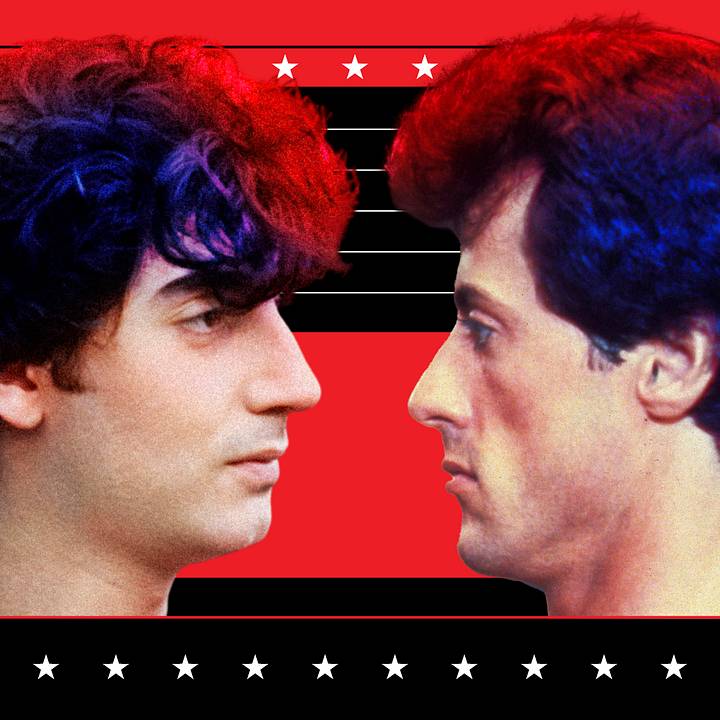
The film, directed by Peter Farrelly and being touted as a serious Oscar contender, chronicles the unlikely rise of the then unknown Stallone (dazzling newcomer Anthony Ippolito) from young and hungry Tinseltown wannabe to overnight megastar. In a lot of ways, the origin story of Rocky is an uncanny reflection of its creator’s own origin story. In fact, Stallone had been underestimated by casting directors so often that few even knew that he could also write. He’d just finished a screenplay for what would become Paradise Alley, which he had sold for $500 when he needed money to keep his landlord if not happy, then at least less angry.
Around that time, Stallone had a quick go-see meeting with producers Irwin Winkler and Robert Chartoff. He was hoping to find work as an actor. As the uninspiring meeting was winding down, Stallone asked if they would read his Paradise Alley script. Winkler later recalled that after reading it he figured Stallone’s real talent might be writing. It certainly wasn’t on-screen. Impressed with Stallone’s writing sample, Winkler and Chartoff told the actor that they were thinking about making a boxing picture. Stallone pitched them his story. They liked the premise, and Stallone went home to his closet-sized apartment in the San Fernando Valley and sat down with a Bic pen and a spiral notebook and wrote the first draft in three days. “It just poured right out of me,” Stallone said. “I think because it was such a metaphor for my life.”

The plot was beautifully simple. Rocky Balboa is a dead-end boxer who works as a knuckle-scraping collector for a local loan shark, eking out a living while his dreams of becoming a serious fighter fade. But when the heavyweight champ (Carl Weathers) needs an opponent, he picks Rocky as a publicity stunt—a populist sop to Philly fight fans—figuring that an obscure local fighter on the ticket will goose ratings for a big Bicentennial brawl.
The initial draft of Stallone’s screenplay was considerably different from the film that eventually made its way to theaters. Adrian was Jewish and modeled on Bette Midler. Mickey was an abrasive racist. Apollo Creed was Jamaican. As for Rocky himself, he throws the fight and uses the money to open a pet shop for Adrian. After rounds of revisions overseen by Winkler and Chartoff, the producers took the script to United Artists, whose head of production, Mike Medavoy, read it on a flight from New York to Los Angeles. He liked it, but he also knew that boxing pictures were a tough sell. Plus, Stallone’s Rocky script didn’t come attached with a star or director with any sort of track record. The studio decided to give the movie the green light, but it had no interest in making it with Stallone in the lead.
The names that were batted around to play Rocky included James Caan, Ryan O’Neal and Burt Reynolds, all of whom seem totally wrong today, but were bankable at the time. United Artists wanted a star … and Stallone couldn’t have been less of one in 1975. If anything, the actor’s insistence that he play the role was a headache the studio didn’t need. Why not just buy the kid out? The negotiations began. United Artists offered Stallone $20,000 for the screenplay if he would agree not to star in the film. To Stallone, that number amounted to a fortune, especially with a child on the way. But Stallone refused. The offers kept going up. “They got to $100,000 to just go away, then $200,000,” Stallone said. “In the end, my agent told me they got up to something like $340,000. It was a dilemma because if I didn’t provide any security for my kid, then it was all about raging ego. But we’d gotten used to being poor.”

Stallone’s gamble might seem irresponsible. But he understood that Rocky was his one chance to become a leading man and act out a story he knew in the marrow of his bones. If he sold the script and let somebody else play the character, he might never get the chance to star in a major studio picture. The script had given him a kind of leverage he’d never had before, and he was determined not to surrender it. Amazingly, Winkler and Chartoff stood by Stallone, agreeing to cut their proposed $2 million budget in half if Stallone could play the lead. In the end, Stallone would receive roughly $20,000 for the screenplay and the Screen Actors Guild minimum of $350 a week for his on-screen duties. A $340,000 windfall had shrunk to $21,000 and change. He was betting on himself.
The director hired to tackle Stallone’s screenplay was John Avildsen, best known for the 1973 Jack Lemmon movie Save the Tiger. Avildsen was not an obvious choice for a boxing picture, but he understood the emotional weight of ordinary people and the importance of placing them in environments that felt authentic. Avildsen and his crew went to Philadelphia, where most of the movie could be made with a gritty realism that would have been difficult to reproduce on a Hollywood back lot. The production used real streets, shops, gyms and row houses.
Rounding out the cast, Avildsen hired Talia Shire, who had played Connie Corleone in The Godfather, as Adrian, the shy pet shop worker who becomes Rocky’s love interest. Shire doesn’t play Adrian like a conventional movie heroine, and their romance is one of the film’s quiet, understated achievements. Rocky isn’t especially articulate and Adrian is almost painfully withdrawn. Their initial conversations are awkward, but their loneliness makes them recognizable to one another. They’re two people discovering that they might deserve more than the lives they’ve settled for.
Grizzled screen legend Burgess Meredith was cast as Mickey, Rocky’s gruff trainer, a man who has spent years watching the fighter waste his potential for a goon’s paycheck. Meredith’s face would serve as a relief map of hard luck, etched with the history of a hundred lost fights. Character actor Burt Young would play Paulie, Adrian’s short-fused drunk of a brother, whose bitterness toward the world makes it difficult for him to accept the possibility that somebody close to him might punch his way out. Then there was Weathers, a former linebacker for the Oakland Raiders who brought the athleticism and charisma necessary to play Creed, a swaggering showboat who understands that a prizefight is as much entertainment as sport.

The production moved quickly, shooting in Philadelphia with a tight, no-frills schedule. With their shoestring $1 million budget, the city’s mean streets would do much of the work for them. The film’s most famous scenes and moments emerged from that lack of resources: Rocky running through the potholed streets as he trains for the fight; or him walloping a frozen side of beef in a subzero meat locker; or his triumphant sprint up the steps of the Philadelphia Museum of Art while Bill Conti’s “Gonna Fly Now” theme swells.
The contrast between Rocky and United Artists’ other major production that year was striking. Having already completed Taxi Driver, Martin Scorsese was now making New York, New York, a lavish old-school musical starring Robert De Niro and Liza Minnelli. At this point, Scorsese was deep into his cocaine period and the film’s troubled production would prove to be an expensive folly. The irony was that the tiny picture would become a commercial sensation, while Scorsese’s shoot-the-works musical would bomb.
When Rocky opened in theaters, it arrived during the final stretch of America’s Bicentennial year, a period when the nation was attempting to celebrate its history while recovering from a decade of political and social turmoil. Vietnam had ended in the country’s first major military defeat. Watergate had exposed the corruption of the Nixon administration and led the president to resign in disgrace. The economy was struggling. The United States was in a gloomy place. People needed some shred of hope and optimism. The Bicentennial had offered a chance to celebrate the American experiment, but all of the red, white and blue bunting and fireworks couldn’t erase the feeling that the nation was just flat-out exhausted. It needed to believe in something. Or someone.
Rocky was an instant hit fueled by wildfire word of mouth. People who saw the movie told their friends, and the film started building the kind of momentum that no amount of studio publicity can stir up. The final slugfest between Rocky and Apollo Creed felt brutal and cathartic. I remember seeing it in the theater with my dad and brother and seeing something I’d never witnessed before or since. The audience was on its feet rooting Rocky on as the fight reached its final round. It was as if people’s own investment in Rocky’s struggle might somehow change the outcome.
Rocky would turn out to be the Hollywood underdog story of the year, both on-screen and off. Stallone had fought to play the role, the filmmakers had fought to make the movie, and the picture itself was fighting for recognition in an industry that had little reason to believe that a small boxing drama could compete with the spit-polished prestige films of Oscar season. The audience embraced both Stallone and his character. Yes, Rocky was a commercial success, but it was also something more—the kind of cultural phenomenon that maybe comes around once a decade. It was the movie America needed exactly when it needed it most.

While some critics, like The New York Times’ Vincent Canby, thought Rocky arrived oversold and was a “sentimental little slum movie,” others like the Chicago Sun-Times’ Roger Ebert saw the film differently. He acknowledged that its story “has been told a hundred times before,” but he argued that Rocky wasn’t really about the story. It was about the hero. Ebert praised Stallone’s performance, saying the actor reminded him of a young Marlon Brando. He recognized the emotional power of the scenes between Rocky and Adrian, particularly their first kiss. Ebert also understood that the final fight with Creed worked because the film had already made its audience care about the people in the ring. That’s why moviegoers were left feeling both thrilled and drained.
Fifty years later, it’s hard to watch (or rewatch) Rocky and not feel the same way. It holds up brilliantly, especially at a time when the country finds itself once again in need of an apolitical hero to root for. Yes, Rocky loses in the end. But he’s also won something much bigger than a fight and a belt. The movie still feels thrilling and triumphant and goose-pimple profound. Rocky would earn a place in the history books as the highest-grossing movie released in 1976. Balboa was no longer just a character; he was a symbol of resilience—an ordinary palooka who accomplished something extraordinary.
On the morning of Feb. 10, 1977, the Academy of Motion Picture Arts and Sciences announced its nominations for the 49th Academy Awards. Rocky emerged with 10. Stallone was nominated for Best Actor and Best Original Screenplay, an extraordinary double feat for a guy who’d been struggling to get work just a short time earlier. The film also received nods for Best Picture, Best Director, Best Supporting Actor for both Meredith and Young, and Best Actress for Shire. The little boxing movie had become a serious contender, even in a field loaded with some of the greatest movies of the decade, including such fellow nominees as All the President’s Men, Network and Taxi Driver.
Like its bruised and battered hero, Rocky was the underdog on Oscar night, March 28, 1977. In the end, Stallone’s million-to-one shot won three statuettes. Stallone didn’t win either of the awards he was up for. But Rocky would end up winning the award that mattered the most to everyone who had taken a leap of faith on it: Best Picture. Less than two years earlier, Stallone was bumming rides to auditions and selling his dog because he couldn’t afford kibble. Now he was standing on the Oscars stage, beaming despite his malfunctioning bow tie, like the undisputed champion of Tinseltown. Stallone had refused to compromise even for a sum most of us would have gladly taken. He wagered on himself. And even though Rocky Balboa may have lost the fight, Sylvester Stallone had already won. He would never have to look back again. Except in the sequels, of course.
 Add us as a preferred source on Google