%20%20--%3E%0A%3Csvg%20version%3D%221.1%22%20id%3D%22Layer_1%22%20xmlns%3D%22http%3A%2F%2Fwww.w3.org%2F2000%2Fsvg%22%20xmlns%3Axlink%3D%22http%3A%2F%2Fwww.w3.org%2F1999%2Fxlink%22%20x%3D%220px%22%20y%3D%220px%22%0A%09%20width%3D%2239px%22%20height%3D%2240px%22%20viewBox%3D%220%200%2039%2040%22%20enable-background%3D%22new%200%200%2039%2040%22%20xml%3Aspace%3D%22preserve%22%3E%0A%3Cpath%20fill%3D%22%23FFFFFF%22%20d%3D%22M38.5%2C7H28.2v26h10.3V7z%22%2F%3E%0A%3Cpath%20fill-rule%3D%22evenodd%22%20clip-rule%3D%22evenodd%22%20fill%3D%22%23FFFFFF%22%20d%3D%22M26.1%2C25.5c0%2C5.8-4.1%2C7.5-12.9%2C7.5C3.9%2C33%2C0%2C31.2%2C0%2C25.2v-1.1h11.6%0A%09v2.4c0%2C0.7%2C0.1%2C1.4%2C1.2%2C1.4c1%2C0%2C1.2-0.4%2C1.2-1.3v-0.9c0-1.6-0.9-1.6-3.5-2.2C2.2%2C21.7%2C0%2C19.7%2C0%2C15.3v-0.9C0%2C9.3%2C5.5%2C7%2C12.9%2C7%0A%09c10.2%2C0%2C12.8%2C2.6%2C12.8%2C7.4v1.8h-11v-2.9c0-0.6-0.4-1.1-1.2-1.1c-0.6%2C0-1.2%2C0.4-1.2%2C1.1v0.9c0%2C1.5%2C0.9%2C2%2C3.3%2C2.5%0A%09c8%2C1.6%2C10.5%2C3.3%2C10.5%2C7.5V25.5z%22%2F%3E%0A%3C%2Fsvg%3E%0A)
In Life and In Sports, Dolly Parton Exuded Both Showmanship and Humility
In this story:
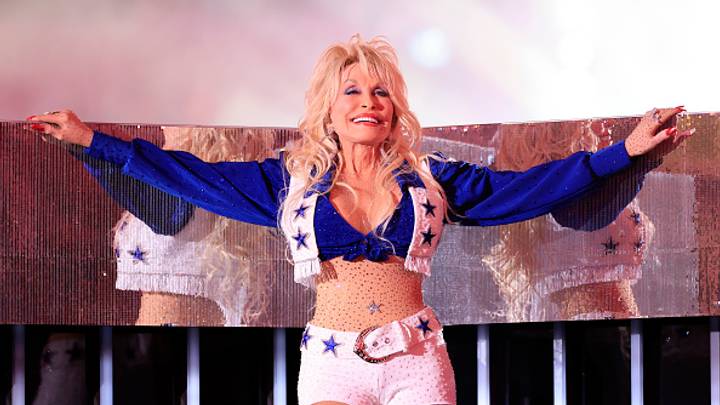
On Tuesday, the world mourned the loss of Dolly Parton, who died peacefully at age 80 in Nashville, Tenn. The beloved American treasure left behind her own inspired legacy in music—as for sports, well, no one could forget her lifelong ties to the Tennessee Volunteers athletics program, nor her dazzling performance at the Cowboys-Commanders game on Thanksgiving in 2023.
Befitting for the all-American holiday, Parton donned a cropped blue-and-white Cowboys cheerleader outfit and put on a wildly entertaining show at AT&T Stadium, belting hits from her own discography like Jolene and 9 to 5 as well as Queen’s We Are The Champions. At 77, she was a total tour de force, as she was for most of her trailblazing career.
“Dolly Parton and turkey legs,” Cowboys owner Jerry Jones said while walking through the stadium’s tunnel, concisely summing up the Thanksgiving Day football game’s festivities.
Her commanding on-stage presence and natural gravitas had both fans and then-CBS announcer Tony Romo fixated on what would become another iconic cultural moment in the sports and music crossover. Here Parton was, in all her blonde-haired, broad-chested glory:
Dolly Parton performs during the halftime show of the Commanders-Cowboys Thanksgiving Day game in Dallas pic.twitter.com/HFkyBBNFby
— philip lewis (@Phil_Lewis_) November 23, 2023
Just days before Parton took the stage for the Cowboys game, the Tennesseean also walked hand-in-hand with Peyton Manning for a memorable rendition of Rocky Top during the Volunteers’ home football game against Georgia.
Parton’s penchant for entertaining swaths of people, even in the sports realm, knew no bounds. But there was another subtle element to her persona that made the 11-time Grammy Award winner perhaps even more endearing to America.
When asked whether she wanted to perform the NFL’s holy grail music event, the Super Bowl halftime show, Parton turned the gig down. Multiple times. Why? She didn’t think she was “big” enough.
“Oh, sure. I’ve been offered that many times,” Parton told The Hollywood Reporter about the halftime show in 2023. “I couldn’t do it because of other things, or I just didn’t think I was big enough to do it—to do that big of a production. When you think about those shows, those are big, big productions. I’ve never done anything with that big of a production. I don’t know if I could have. I think at the time that’s what I was thinking.”
Ignoring the court of public opinion, let’s take a look at the facts: Parton is the third-most nominated woman in Grammy history behind only Beyoncé and Taylor Swift. She won her first Grammy in 1979 for best female country vocal performance in Here You Come Again and would go on to win 10 more Grammy awards across her decades-long, genre-evolving musical career. Parton also received the Recording Academy’s Lifetime Achievement Award in 2011 for her far-reaching influence as a performer and songwriter.
You could argue in recent years that the NFL was trying to shift away from country music to attract a newer generation of football fans, but even as Parton’s fame faded she still embodied a one-of-a-kind rockstar who was beloved by all. (“Who doesn’t like Dolly Parton?” Romo said on-air.)
Back in 2019, Radiolab host Jad Abumrad followed Parton’s career as a “unifier” in his nine-episode podcast series, Dolly Parton’s America, in which he explored how she grew to become the nation’s sweetheart.
“If you look at her Global Q Score, this is a measure of how well people think about your brand globally ... and out of all these different brands that are out there, all these different performers, she is in the top ten,” Abumrad said. “But she’s almost No. 1 when it comes to lack of negatives, if that makes any sense. Like, people have the least amount of negative things to say about Dolly Parton than anyone besides maybe Adele.”
A good chunk of her lovability might stem from her stubbornly apolitical stances. A bigger chunk from her warm-hearted personality and more-than-generous philanthropic efforts. But she also may be universally liked because she can take a joke—and dish it out, too.
During Parton’s golden heyday in the 80s, she served as a kind of public punchline during which talk show hosts—most of whom were male–would comment about her weight and physical appearance, as Abumrad noted in his podcast on the “Dollyverse.”
Here’s an old clip of Johnny Carson discussing Parton’s breasts during her guest spot on his show in 1977:
RIP, Dolly. pic.twitter.com/3dKD8YuTln
— Jimmy Traina (@JimmyTraina) August 25, 2026
The tender subject of Parton’s bosom even found its way into the scientific research sector: After scientists successfully cloned a sheep in 1997, they decided to name the clone Dolly after the country legend for a fairly obvious reason.
“I was flattered,” Parton told The Guardian of learning that a cloned sheep was named after her. “You know, when the scientists cloned Dolly the sheep, they used the mammary glands. That’s what they call them … glands … the boobs. They said: ‘Oh, we have this sheep, Dolly …’ Everybody always played up to these [points to her chest], so that’s why we had Dolly the sheep.”
But never did Parton let the good-natured though borderline-misogynistic chatter get to her, deflecting each time with her signature wit and grace.
“Oh, I know they make fun of me,” Parton said in a 1978 interview with Barbara Walters. “But actually, all these years, the people have thought the joke was on me, but it's actually been on the public. I know exactly what I'm doing. I can change it at any time. I make more jokes about myself than anybody.”
At her heart and soul, Dolly Parton was a dynamic force of nature, a Renaissance woman of all trades. A country singer, an actress, author, playwright, humanitarian, philanthropist, not a feminist (by her definition) but still a fearless supporter and longtime champion of women’s rights—she’s even been rightfully inducted into the Tennessee Sports Hall of Fame. Throughout it all, she always stayed true to herself, and that includes embracing both her flair and her modesty.
R.I.P. to a bona fide American icon, and R.I.P. to the Super Bowl halftime show that she absolutely deserved.
 Add us as a preferred source on Google
Kristen Wong is a staff writer on the Breaking and Trending News team at Sports Illustrated. She has been a sports journalist since 2020 and has a bachelor’s in English and linguistics from Columbia University. Before joining SI in November 2023, Wong covered four NFL teams as an associate editor with the FanSided NFL network and worked as a staff writer for the brand’s flagship site. She is a lifelong Liverpool fan who enjoys solving crossword puzzles and hanging out at her neighborhood dive bar in NYC.
Follow kriscwong