%20%20--%3E%0A%3Csvg%20version%3D%221.1%22%20id%3D%22Layer_1%22%20xmlns%3D%22http%3A%2F%2Fwww.w3.org%2F2000%2Fsvg%22%20xmlns%3Axlink%3D%22http%3A%2F%2Fwww.w3.org%2F1999%2Fxlink%22%20x%3D%220px%22%20y%3D%220px%22%0A%09%20width%3D%2239px%22%20height%3D%2240px%22%20viewBox%3D%220%200%2039%2040%22%20enable-background%3D%22new%200%200%2039%2040%22%20xml%3Aspace%3D%22preserve%22%3E%0A%3Cpath%20fill%3D%22%23FFFFFF%22%20d%3D%22M38.5%2C7H28.2v26h10.3V7z%22%2F%3E%0A%3Cpath%20fill-rule%3D%22evenodd%22%20clip-rule%3D%22evenodd%22%20fill%3D%22%23FFFFFF%22%20d%3D%22M26.1%2C25.5c0%2C5.8-4.1%2C7.5-12.9%2C7.5C3.9%2C33%2C0%2C31.2%2C0%2C25.2v-1.1h11.6%0A%09v2.4c0%2C0.7%2C0.1%2C1.4%2C1.2%2C1.4c1%2C0%2C1.2-0.4%2C1.2-1.3v-0.9c0-1.6-0.9-1.6-3.5-2.2C2.2%2C21.7%2C0%2C19.7%2C0%2C15.3v-0.9C0%2C9.3%2C5.5%2C7%2C12.9%2C7%0A%09c10.2%2C0%2C12.8%2C2.6%2C12.8%2C7.4v1.8h-11v-2.9c0-0.6-0.4-1.1-1.2-1.1c-0.6%2C0-1.2%2C0.4-1.2%2C1.1v0.9c0%2C1.5%2C0.9%2C2%2C3.3%2C2.5%0A%09c8%2C1.6%2C10.5%2C3.3%2C10.5%2C7.5V25.5z%22%2F%3E%0A%3C%2Fsvg%3E%0A)
Formula E Is More Competitive and Faster Than Ever—and What’s Next Could Be Even Better
When Roger Griffiths got an opportunity to work for Michael Andretti, one of the most influential figures in one of the most influential families in motorsports, the decision was easy. It was the spring of 2014, and Griffiths, who’d spent the better part of his past two decades around racing and was the Indycar technical director for Honda at the time, was ready for a change.
But Andretti didn’t want his new hire to keep toiling away in Indycar, a United States–centric racing series without much international reach. He told Griffiths that his organization, Andretti Racing, had decided to get involved in Formula E, an electric racing championship starting later that year in September. Andretti was still unsure of exactly what shape the new series would take and wanted Griffiths to take a look at the potential.
“I was like, ‘Electric racing, really?’” Griffiths tells Sports Illustrated. “Are we crazy here?”
Griffiths was right to be skeptical, just like the rest of his peers in the motor sports world were. Racing purists have a reverence for the roar of an engine and the smell of gasoline (or petrol, as those in the United Kingdom refer to it). To make matters worse, when Griffiths went to the first test to see the cars drive for the first time, his intuition was correct.
“It was bad,” he recalls. “None of us really knew what we were doing with an electric racing car.”
But Griffiths noticed something else. Electric vehicles were attracting some of the biggest names in motor sports. Around the Formula E paddock were figures like four-time Formula One drivers’ champion Alain Prost, who entered as a co-owner at Renault. Renowned motor sports executive Sir Frank Williams, who won nine F1 constructors’ championships in the 1980s and ‘90s, put his hat into the ring. Top-end racing brands like McLaren and Michelin were eager to get involved.
“I started to realize, this was too big to fail,” Griffiths says. “There were too many people with reputations on the line that couldn’t afford for this to fail.
“Come what may, we were going to find a solution.”
A culture of collaboration
Fast forward 12 years and Formula E has come a long way from the days of that first test. In fact, the championship is bound for its most competitive finish since its inception, with nine drivers still in mathematical contention going into the final two races this weekend in London. Just 14 points separate the top four title hopefuls, led by Andretti’s Jake Dennis, the 2022–23 champion.
Griffiths, now the team principal for Andretti, is still at the forefront as one of the very few individuals to be involved in every E-Prix, the name of the championship’s races, since Formula E’s creation. The path forward for the past 12 years hasn’t always been smooth, but progress has been steady and Griffiths credits the collaborative nature of the sport’s top figures for getting it to this stage. Sure, there’s still an air of competition, but teams are cordial, having recognized that Formula E wouldn’t have made the strides it has without everybody trying to make the concept work.
That’s not the case everywhere in motor sports. “I remember my days back in Formula One, over 20 years ago, you couldn’t even talk to somebody on another team at the airport,” Griffiths says. “It was really frowned upon.”
And that collaboration, in part, has led to better competition. Team principals like Griffiths and Jaguar’s Ian James, the top executive of one of Formula E’s other chief title contenders this season, have more direct lines to the FIA, the international governing body for numerous motor sport leagues. The FIA is responsible for creating the regulations that each team must adhere to from a car construction standpoint, and because of the leaner nature of Formula E, teams and individuals have more say in what shape those rules take.
“Don’t get me wrong, I love my time in Formula One as well, but I was a very, very small cog in a large machine,” James, who was previously the team principal with Formula E teams at Mercedes and McLaren before joining Jaguar in October of last year. “I think here, certainly in the role that I’ve got, you have a lot more opportunity to influence the direction of the sport.”
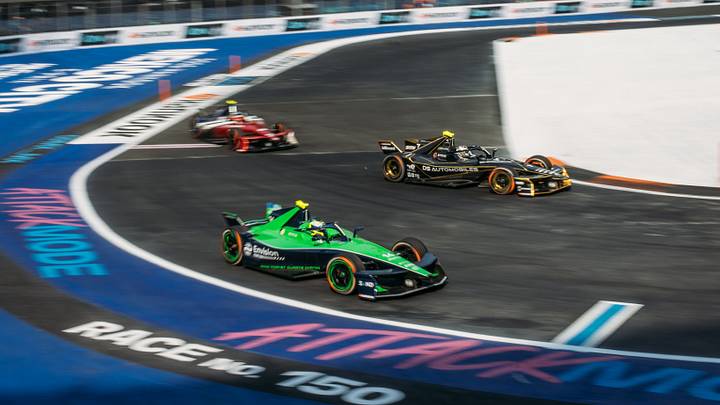
Both James and Griffiths also credit this season’s competitiveness with this being the final year for this generation of Formula E car, the Gen3. By now, teams have more or less agreed on what the best version of this car on these particular Hankook tires can be, leading to more similarities throughout the field. Different teams but similar cars equals similar results across the board—a phenomenon that’s common in other motorsports, like Formula One.

“Unlike other championships, our technical rule set doesn’t allow for massive divergence in performance,” Griffiths says. “It’s not like a combustion engine [championship] where your engine manufacturer can come up with a tweak of the week and keep producing performance, another five horsepower each race.”
Financial constraints help too, with each team not able to spend more than approximately $17.5 million on the development of its car each season. The cost cap has been introduced into other championships, like F1, over the years, but how that plays out in practice is far different, given that F1’s cost cap currently stands at $215 million.
“If the cost cap now is over $200 million, but [teams] don’t have that level of money, it doesn’t matter if you’ve raised the cap,” Griffith says of F1. “You can’t spend it because you don’t have it. In our case, the cost cap is much more modest.”
The result of those various factors have led to back-and-forth racing throughout the 2025–26 season. Five different drivers have led the championship at some point throughout the year, the first time in six years that’s been the case. Those same five drivers are also all a part of different teams, creating the sort of parity most sports leagues dream of.
Reaching an audience
It shouldn’t come as a surprise that one person who’s particularly invested in a chaotic and competitive finale is Formula E’s Chief Marketing Officer, Ellie Norman. “Nine drivers with the potential to become a world champion is like the dream for any sports marketer to have,” she says.
But how exactly Formula E translates a competitive product on track carving out a space for itself among the wide world of sports is something Norman is constantly working toward. A motor sports fan since she was a young girl, Norman boasts ample experience in the industry, but perhaps none so more critical than her time in Formula One, which she joined in 2017. As part of the central executive team that oversaw a vast transformation of motorsports’ most renowned championship, she was involved in projects like Netflix’s acclaimed F1 series Drive to Survive—a key piece for the growth of F1 in the United States.
Formula E has executed a similar miniseries, titled Formula E: Driver, built on closer, under-the-helmet looks around the top athletes in the series, but Norman isn’t racing to follow the same marketing playbook she used in F1. Citing Drive to Survive and ESPN’s Michael Jordan docuseries The Last Dance, Norman says that the long-form docustorytelling is a format that “had potentially been done to the best that it can be done.”
“The level of engagement and it feeling much more peer-to-peer, feels a more current way to really show up in the landscape today vs. us trying to copy exactly the tactics that have helped to make Formula One as successful as it is today,” she explains.
One way in which Formula E has employed that approach is through social media–first content, such as the series Evo Sessions, which pairs creators with Formula E teams to learn how to drive the championship’s cars. Until recently, that also meant an emphasis on accessible viewing of the actual races, though free-to-air broadcasts. That approach has been successful with Formula E reporting a cumulative television audience of 561 million viewers during the 2024–25 season and the expectation of exceeding 600 million this year, upon the conclusion of the weekend’s races in London.
On Tuesday, however, Formula E announced a multiyear agreement with Disney+ and ESPN+ to become the global streaming home of the championship. Norman confirmed the offering will be an addition to Formula E’s existing broadcast partners, not a replacement, and will give an opportunity for every live session and any other sort of created content around the series to live in one place.
“Disney+ is really leaning into sports and they’ve obviously got sort of experts within the family with ESPN,” she says. “So this felt as if it was a natural next step.”
Norman of course isn’t the only one focused on growing Formula E—it’s a group effort.
“Everybody is invested in making the championship work,” Griffiths says. And now that the championship has grown to a level where teams will race a record 21 times in 12 different countries next season, including a debut at the Circuit of the Americas in Austin, is another indication of the sport’s trajectory.”
“We know that at the end of the day, our aspiration is to become a tier one sport,” James says. “We know we’re already there in terms of the fully electric motor racing series, we’re very much at the pinnacle. So we owe it not only ourselves but the fans globally to make sure we approach it in a professional way.”
The next big leap
After the final car reaches the checkered flag Sunday in London, Formula E will quickly turn the page to a new era, as is typical every few years in the world of motor sports. And the move is expected to be the championship’s biggest step forward in performance yet.
Beginning next season, which is scheduled to start in December in Saudi Arabia, Formula E will introduce the Gen4 car, the quickest and most technically advanced electric vehicle seen in the sport thus far. The new car, which is larger and wider than the Gen3, will take a massive leap forward in pure speed and acceleration, with maximum horsepower increasing from 350 kilowatts in the Gen3 car to 600 kilowatts with the Gen4. It’s expected to narrow the gap in performance between Formula E and F1, and the paddock is already abuzz with what that means for the sport’s reach.

Perhaps no one has been as impressed as the typically toughest critics: drivers, both current and former.
“One of our drivers [2021–22 champion Stoffel Vandoorne] was driving the Gen4 car for the first time in Monte Carlo back in March,” James recalls. “And when he took his helmet off, the grin that spread across his face said it all.”
Norman had a similar realization of the potential of the Gen4 car to make a profound impact on how Formula E is perceived while getting a chance to see the reaction of former F1 driver David Coulthard, who tested the Gen4 around Monaco—a track where he won twice while racing in F1.
“He was genuinely speechless when he got out,” Norman says.
“He got out of it and went ‘Bloody hell, this thing’s amazing,’” Griffiths adds.
Though optimism is sky high, no one in Formula E is making promises that this will put the championship on the same level as F1. That also wouldn’t exactly be a fair comparison this early in Formula E’s history, when F1 dates back to 1950. More importantly, the introduction of Gen4 is another sign of progress, and another sign of how large strides are being made within the electric vehicle industry.
“I’m not going to pretend for a second that we’re going to overtake Formula One from a reach or fan perspective in the next two, three, four, five years,” James says. “But the fact that we’re going to get closer and closer over that time is the exciting point.”
Almost exactly 12 years after Griffiths went to his first Formula E test, he had a chance to attend the launch of the Gen4 car this past April at Circuit Paul Ricard in Southeastern France. Formula E brought one of each of its past generations of cars to the launch and had a driver take each one for a spin to show the evolution of how far the series has come. When the Gen1 car left the line, Griffiths said a group of people in the paddock were shocked at how slow it was. He laughs, “It’s a bit embarrassing to be calling it a racing car.”
But gone are the days of fighting for survival as a legitimate motor sports series. Formula E has its sights set on competing as one of the quickest and most competitive racing championships in the world, and if this next step of development can deliver, the potential to do exactly that seems more real than ever before.
“I think what you’re seeing now with the Gen4 car is the wow factor is coming…” Griffiths says. “I think it really is going to be quite the spectacle.”
MORE F1 FROM SPORTS ILLUSTRATED
 Add us as a preferred source on Google
Zach Koons is a programming editor at Sports Illustrated who frequently writes about Formula One. He joined SI as a Breaking and Trending News writer in February 2022 before joining the programming team in 2023. Koons previously worked at The Spun and interned for the Atlanta Journal-Constitution. He currently hosts the “Bleav in Northwestern” podcast and received a bachelor’s in journalism from Northwestern University.
Follow ZachKoons