%20%20--%3E%0A%3Csvg%20version%3D%221.1%22%20id%3D%22Layer_1%22%20xmlns%3D%22http%3A%2F%2Fwww.w3.org%2F2000%2Fsvg%22%20xmlns%3Axlink%3D%22http%3A%2F%2Fwww.w3.org%2F1999%2Fxlink%22%20x%3D%220px%22%20y%3D%220px%22%0A%09%20width%3D%2239px%22%20height%3D%2240px%22%20viewBox%3D%220%200%2039%2040%22%20enable-background%3D%22new%200%200%2039%2040%22%20xml%3Aspace%3D%22preserve%22%3E%0A%3Cpath%20fill%3D%22%23FFFFFF%22%20d%3D%22M38.5%2C7H28.2v26h10.3V7z%22%2F%3E%0A%3Cpath%20fill-rule%3D%22evenodd%22%20clip-rule%3D%22evenodd%22%20fill%3D%22%23FFFFFF%22%20d%3D%22M26.1%2C25.5c0%2C5.8-4.1%2C7.5-12.9%2C7.5C3.9%2C33%2C0%2C31.2%2C0%2C25.2v-1.1h11.6%0A%09v2.4c0%2C0.7%2C0.1%2C1.4%2C1.2%2C1.4c1%2C0%2C1.2-0.4%2C1.2-1.3v-0.9c0-1.6-0.9-1.6-3.5-2.2C2.2%2C21.7%2C0%2C19.7%2C0%2C15.3v-0.9C0%2C9.3%2C5.5%2C7%2C12.9%2C7%0A%09c10.2%2C0%2C12.8%2C2.6%2C12.8%2C7.4v1.8h-11v-2.9c0-0.6-0.4-1.1-1.2-1.1c-0.6%2C0-1.2%2C0.4-1.2%2C1.1v0.9c0%2C1.5%2C0.9%2C2%2C3.3%2C2.5%0A%09c8%2C1.6%2C10.5%2C3.3%2C10.5%2C7.5V25.5z%22%2F%3E%0A%3C%2Fsvg%3E%0A)
FC Barcelona Badge History: The Story Behind the Crest, Colors and Design
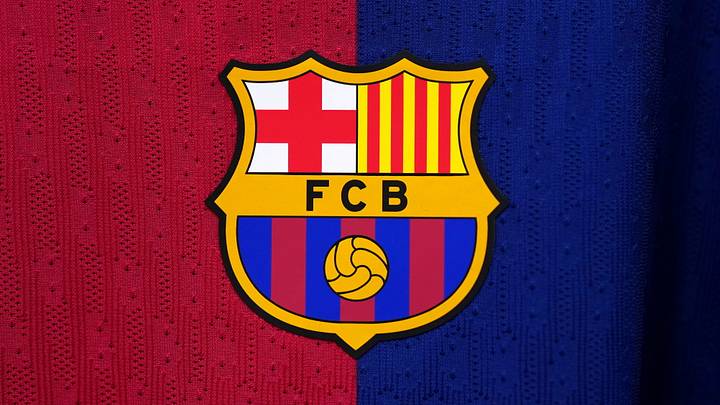
FC Barcelona’s badge is one of the most recognizable symbols in world soccer, instantly associated with the club’s rich history, Catalan identity and iconic blue-and-red colors.
Featuring the famous “FCB” initials, the St. George’s Cross, the Catalan flag, the club’s traditional stripes and the classic soccer ball at its base, the crest has become a global symbol far beyond the streets of Barcelona.
However, the badge seen today is the result of more than a century of evolution. Since the club’s foundation in 1899, Barcelona’s crest has undergone numerous redesigns, with each version reflecting a different era of the club’s growth and identity.
From the original emblem, to the modern design worn around the world today, Sports Illustrated looks back at the history, changes and meaning behind FC Barcelona’s iconic badge.
FC Barcelona Badge Origins

When FC Barcelona was founded in November 1899 by Swiss-born Hans Gamper—better known as Joan Gamper in Catalonia—the club initially did not have a badge of its own.
Instead, Barcelona adopted the city’s official coat of arms as its first emblem. The design featured a diamond-shaped shield containing two of Catalonia’s most important symbols: the red-and-yellow stripes of the Crown of Aragon and the Cross of Saint George.
FC Barcelona’s First Official Badge

As the club grew, Barcelona looked to create an identity that was uniquely its own. In 1910, the club held a competition to design a new crest, with player Carles Comamala’s proposal ultimately being selected.
His design introduced many of the elements that remain associated with Barcelona today: the shield shape, the Catalan flag, the Cross of Saint George, the club’s blue-and-red colors and the “F.C.B.” initials across the center. The bottom section also featured the famous Blaugrana stripes, representing the colors of the team’s early kits.
Alterations
While Barcelona’s crest has evolved over time, the club has rarely made dramatic changes to its overall design.
The first major adjustments came in 1920, when the shape of the shield and the intensity of the colors were altered, while the “F.C.B.” initials were placed on a yellow background. By 1936, that background had changed to black.
The following years brought further changes due to the political climate in Spain. Under Francisco Franco’s regime, Barcelona were forced to alter elements of their identity, including the badge. In 1941, the initials “F.C.B.” were changed to “C.F.B.” after the club’s official name was changed from Futbol Club Barcelona to Club de Fútbol Barcelona.
In 1949, the initials were adjusted again, becoming “C. de F.B.” before “C.F.B.” returned in 1960 alongside several minor cosmetic changes. The traditional “F.C.B.” lettering was finally restored in 1974 as Spain moved toward a new democratic era.
A refined version of the crest was introduced in 1975, keeping the core design intact while making subtle adjustments for symmetry and appearance. This badge remained in use for nearly three decades, carrying the club through some of its greatest moments, including the Johan Cruyff “Dream Team” era.
A New Beginning

At the start of the new millennium, Barcelona decided it was time to modernize their visual identity. In 2002, designer Claret Serrahima was tasked with updating the famous crest.
His approach was to simplify rather than reinvent. The redesign removed unnecessary details, eliminated the dots between the letters and created a cleaner, more streamlined shield. The result was the modern “FCB” badge recognized around the world today.
READ THE LATEST BARCELONA NEWS, TRANSFER RUMORS AND MORE
 Add us as a preferred source on Google
Barnaby Lane, better known as Barney, is a soccer writer for SI FC. With nearly a decade of experience in the industry, he has worked for a range of household-name publications in both the United States and the United Kingdom, and has interviewed some of the world’s biggest athletes—from Usain Bolt and Rafael Nadal to Christian Pulisic (though his favorite interview remains Adebayo Akinfenwa). Barney specializes in Premier League soccer, covering everything from the nostalgia of years gone by to the modern, vastly different landscape of today’s game. He also has experience reporting on La Liga and Major League Soccer, the latter of which he developed a particular affinity for during his university days at Virginia Commonwealth University in Richmond.