%20%20--%3E%0A%3Csvg%20version%3D%221.1%22%20id%3D%22Layer_1%22%20xmlns%3D%22http%3A%2F%2Fwww.w3.org%2F2000%2Fsvg%22%20xmlns%3Axlink%3D%22http%3A%2F%2Fwww.w3.org%2F1999%2Fxlink%22%20x%3D%220px%22%20y%3D%220px%22%0A%09%20width%3D%2239px%22%20height%3D%2240px%22%20viewBox%3D%220%200%2039%2040%22%20enable-background%3D%22new%200%200%2039%2040%22%20xml%3Aspace%3D%22preserve%22%3E%0A%3Cpath%20fill%3D%22%23FFFFFF%22%20d%3D%22M38.5%2C7H28.2v26h10.3V7z%22%2F%3E%0A%3Cpath%20fill-rule%3D%22evenodd%22%20clip-rule%3D%22evenodd%22%20fill%3D%22%23FFFFFF%22%20d%3D%22M26.1%2C25.5c0%2C5.8-4.1%2C7.5-12.9%2C7.5C3.9%2C33%2C0%2C31.2%2C0%2C25.2v-1.1h11.6%0A%09v2.4c0%2C0.7%2C0.1%2C1.4%2C1.2%2C1.4c1%2C0%2C1.2-0.4%2C1.2-1.3v-0.9c0-1.6-0.9-1.6-3.5-2.2C2.2%2C21.7%2C0%2C19.7%2C0%2C15.3v-0.9C0%2C9.3%2C5.5%2C7%2C12.9%2C7%0A%09c10.2%2C0%2C12.8%2C2.6%2C12.8%2C7.4v1.8h-11v-2.9c0-0.6-0.4-1.1-1.2-1.1c-0.6%2C0-1.2%2C0.4-1.2%2C1.1v0.9c0%2C1.5%2C0.9%2C2%2C3.3%2C2.5%0A%09c8%2C1.6%2C10.5%2C3.3%2C10.5%2C7.5V25.5z%22%2F%3E%0A%3C%2Fsvg%3E%0A)
How Arne Slot Compares to Jurgen Klopp After 100 Liverpool Matches
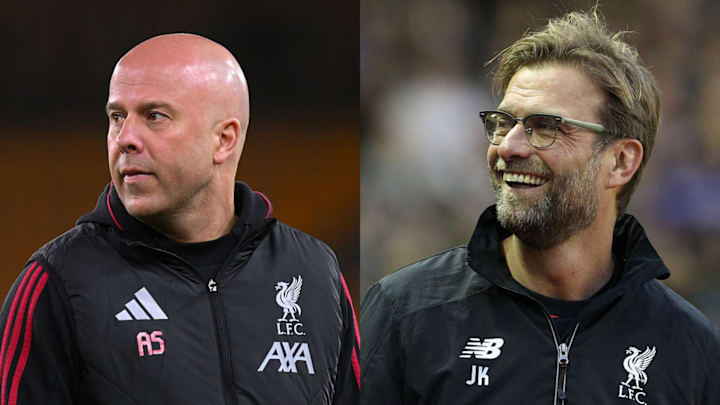
Arne Slot took charge of his milestone 100th match as Liverpool manager on Tuesday night, although a defeat to Galatasaray was not the way he would have wanted to mark it.
Liverpool fell to a single early goal in Istanbul scored by ex-Southampton and Fulham midfielder Mario Lemina. It is the second time the Reds have been beaten by Galatasaray in the Champions League this season and it leaves them a job to do in the round of 16 second leg at Anfield.
Slot had the ideal start at Liverpool when he succeeded modern Anfield legend Jürgen Klopp in the summer of 2024, inheriting the German’s team and immediately delivering only a second title since 1990 to equal Manchester United’s all-time English championship record.
The problems have started since a summer overhaul, spending a world record $599 million (£446 million) in a single transfer window on players largely yet to consistently perform, combined with the downturn of last season’s top performers—including Mohamed Salah and Virgil van Dijk.
It means that at the 100-match mark, Slot has won 62, drawn 15 and lost 23. Alarmingly, as many as 13 of those defeats have come in this still ongoing season alone, with more than two months to run. But, interestingly, his overall career win percentage is only marginally higher at 62.3%.
The thing is, Slot’s record compared to Klopp at the same stage of the German’s time at Liverpool is actually far better. From the first 100 games, which took Klopp from his arrival in October 2015 to August 2017, it was just 50 wins. There were 21 defeats, marginally fewer than Slot, and 29 draws.
Klopp’s Liverpool through 100 games had a slightly meaner defense, but Slot’s has scored more.
Jürgen Klopp, Arne Slot: First 100 Liverpool Matches
Statistic | Jürgen Klopp | Arne Slot |
|---|---|---|
Wins | 50 | 62 |
Draws | 29 | 15 |
Losses | 21 | 23 |
Goals For | 182 | 208 |
Goals Against | 108 | 118 |
Of course, Klopp inherited a very different situation at Liverpool back in October of 2015, the club finishing sixth in the last full season before he arrived.
Under Brendan Rodgers, the Reds had come within a whisker of the Premier League title in 2013–14. But it quickly became apparent the team was being carried by Luis Suárez, with his 2014 departure to Barcelona signaling a rapid fall. It didn’t help that Liverpool’s recruitment record was not yet what it became and the money received for the devastating Uruguayan was mostly frittered away.
Having taken over 12 games into 2015–16, Klopp managed an eighth-place Premier League finish, followed by an improved fourth in 2016–17. It wasn’t until the following campaign, by which time he’d surpassed 100 matches in charge, that Klopp had a team in front of him starting to be capable of meeting the Liverpool expectation and challenging for the highest honors.
Arne Slot: ‘I’ve Been Lucky’

Speaking before facing Galatasaray, Slot openly acknowledged that the situation he was parachuted into at Liverpool was a very healthy one, finding a readymade team.
“I’ve been lucky I’ve been given a very good team last season and this season,” he said. “I have all the trust that these players will perform at the levels they are used to of a Liverpool team.”
Slot also defended his record, insisting his time in charge is being harshly perceived.
“I don’t think I have a bad track record, although sometimes you get a different feeling about that if I have to listen to everything!” he stressed.
The last Liverpool manager who didn’t make it to 100 games was Sir Kenny Dalglish, who took charge of 74 during his second spell from January 2011 to May 2012—he was originally only supposed to be a caretaker appointment and previously had 307 at the helm, from 1985–1991.
Almost all Liverpool managers get time in the job. Klopp eventually managed 491 matches, despite a slow start, while Roy Hodgson’s 31-game spell remains a major exception rather than the norm.
READ THE LATEST LIVERPOOL NEWS, ANALYSIS AND INSIGHT FROM SI FC
 Add us as a preferred source on Google
Jamie Spencer is a writer and editor for SI FC. Jamie grew up in Manchester, England, in the 1990s and fell in love with the game at the same time as the Premier League was taking off. With more than a decade of experience behind him in sports media, he specializes in Manchester United and the overall Premier League, still living in England’s north-west soccer hotbed. Jamie is also an expert on the women’s game and enjoys old school nostalgia, telling stories from soccer’s rich history and culture.