%20%20--%3E%0A%3Csvg%20version%3D%221.1%22%20id%3D%22Layer_1%22%20xmlns%3D%22http%3A%2F%2Fwww.w3.org%2F2000%2Fsvg%22%20xmlns%3Axlink%3D%22http%3A%2F%2Fwww.w3.org%2F1999%2Fxlink%22%20x%3D%220px%22%20y%3D%220px%22%0A%09%20width%3D%2239px%22%20height%3D%2240px%22%20viewBox%3D%220%200%2039%2040%22%20enable-background%3D%22new%200%200%2039%2040%22%20xml%3Aspace%3D%22preserve%22%3E%0A%3Cpath%20fill%3D%22%23FFFFFF%22%20d%3D%22M38.5%2C7H28.2v26h10.3V7z%22%2F%3E%0A%3Cpath%20fill-rule%3D%22evenodd%22%20clip-rule%3D%22evenodd%22%20fill%3D%22%23FFFFFF%22%20d%3D%22M26.1%2C25.5c0%2C5.8-4.1%2C7.5-12.9%2C7.5C3.9%2C33%2C0%2C31.2%2C0%2C25.2v-1.1h11.6%0A%09v2.4c0%2C0.7%2C0.1%2C1.4%2C1.2%2C1.4c1%2C0%2C1.2-0.4%2C1.2-1.3v-0.9c0-1.6-0.9-1.6-3.5-2.2C2.2%2C21.7%2C0%2C19.7%2C0%2C15.3v-0.9C0%2C9.3%2C5.5%2C7%2C12.9%2C7%0A%09c10.2%2C0%2C12.8%2C2.6%2C12.8%2C7.4v1.8h-11v-2.9c0-0.6-0.4-1.1-1.2-1.1c-0.6%2C0-1.2%2C0.4-1.2%2C1.1v0.9c0%2C1.5%2C0.9%2C2%2C3.3%2C2.5%0A%09c8%2C1.6%2C10.5%2C3.3%2C10.5%2C7.5V25.5z%22%2F%3E%0A%3C%2Fsvg%3E%0A)
Mauricio Pochettino Fires Four Huge Warnings to Chelsea Owners
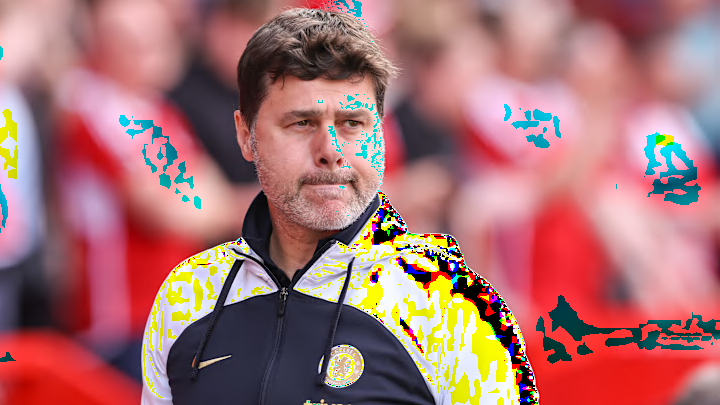
Former Chelsea manager Mauricio Pochettino has opened up on the challenges of working under the current Blues ownership.
Pochettino was the second appointment made by BlueCo when he arrived in the summer of 2023 but, despite a largely impressive season recovering from the turmoil of the group’s first season in charge, he parted ways with Chelsea by mutual consent after just one year.
Now in charge of the USMNT, Pochettino sat down on The Overlap to shed some light on the situation, insisting there are plenty of lessons that the increasingly unpopular ownership group needs to learn.
‘They Need to Explain the Plan’

The arrival of BlueCo brought about a major change in Chelsea’s direction. What was once a win-now team became win-later as the group focused more on young, high-potential signings capable of exploding in value. To date, few success stories have emerged.
“They have a plan that is maybe completely different than what was used to be Chelsea in the past with [former owner Roman] Abramovich,” Pochettino acknowledged. “It’s true that it’s not easy because it’s difficult for people to understand.
“When I’m thinking about a new project, the most important [thing] is how we can translate and to show what is the plan and what we want to achieve with that and how is going to be the process to arrive where we want to arrive. Sometimes, in football, it’s difficult to explain because people don’t listen. They only listen to results.
“And then because there’s too many people making the decisions—football is not an ordinary business—sometimes people struggle. They need to explain the plan.”
‘Lack of Experience Cost the Team’

Fans have long questioned the commitment to young players, highlighting concerns over a lack of experienced signings—Tosin Adarabioyo is the oldest player in the current squad at 28 years old.
Marc Cucurella and Enzo Fernández, two of the more-experienced members of the current squad at 27 and 25 respectively, have increased the pressure on the ownership by echoing issues with a lack of experience that, according to Pochettino, limited his success in the 2023–24 season.
“What I understood [about the plan] didn’t happen after ... and maybe I was wrong,” he continued.
“Chelsea was about winning. In the past, it was winning Champions Leagues, to have experienced players, the best players they can sign, but now it’s a completely different project. People need to accept that it’s different. Different ideas of how to operate.
“When we arrived, the team was 12th in the Premier League. We didn’t play in Europe. [Chelsea] was in the process of all the changes from one ownership to another—things that you need to put in place and to prioritize things.
“Why I think I am disappointed with the internal things is that under our assessment and our vision, [it] was a normal process to create something solid for the future, to assess things and to add quality, but not as quick as people believed it needed to go. The pace wasn’t that. We finished sixth, winning the last five or six games, we’ve arrived to the final of the Carabao Cup, we’ve played the semifinal of the FA Cup against Manchester City—we deserved to win both, but because of the experience, different things, we didn’t win. But we were in a very good trajectory.
“But after, when things didn’t match what was our vision, we said it’s better to split and to give the possibility to the club to do what they want to do.”
‘Managers Need to Be Involved’

Calling the shots behind the scenes at Stamford Bridge is co-owner Behdad Eghbali, assisted by co-sporting directors Paul Winstanley and Laurence Stewart and recruitment chiefs Joe Shields and Sam Jewell.
The group take a data-driven approach to recruitment and have regularly ignored the input of their managers in favor of striking other deals. Most recently, former boss Enzo Maresca saw his public pleas for a new center back ignored, beginning the breakdown in relationship which ultimately led to his departure.
“When we signed, it was already done, all the signings,” Pochettino acknowledged. “I was involved, I said O.K. when we signed [Axel] Disasi because [Wesley] Fofana was injured in preseason, and Cole Palmer. With these two, we were involved in the decisions.
“It’s more about a philosophic idea that the coaching staff ... we need to be involved. We need to be a part—an important part—of the decisions because, if not, it’s not easy. I don’t want to say things that are so obvious but Manchester City works because Pep [Guardiola] is involved.
“For players to perform, they need to be attached to the coaches. If not, it’s difficult. ‘I play for the club,’ no. The players need to play for the club after the coaches. If they play for the coaches, they can play for the club. I’ve never seen a player play for the club, but not for the coach. It’s impossible to perform. You need to connect.”
‘Data Isn’t Everything’

With BlueCo’s love of data yet to offer any real results, Pochettino warned the group that, while analysis does have a part to play in the modern game, nothing can replace a coach’s intuition and opinions on things like passion, ability to cope with pressure and fit for a tactical system—none of which can be shown on a screen.
“In the moment that we arrived, we completely supported the club in all the decisions that they already made,” he concluded. “What happened after, I don’t know. If you accept to go to Chelsea, it is more clear after us, the idea of the management of the club.
“I’m not complaining because it was also my decision to leave the club, but I think to understand the new people that arrive, the new ownership, the new football, the new coaches, the new sporting directors, the new everything, we sometimes underestimate the analog things.
“Football is analog and digital, you cannot put the analog things in the bin, because it’s going to support the digital. In technology, digital is putting analog in the bin, but football is not like this. There are things you cannot measure with data or science. It’s still a game that keeps some mystery that you cannot identify.
“It’s not only data. ‘Do they shoot many times? Run, not run? Throw-ins?’ There are things that you cannot measure through science or numbers.”
READ THE LATEST CHELSEA NEWS, ANALYSIS AND INSIGHT FROM SI FC
 Add us as a preferred source on Google
Tom Gott is an associate editor for SI FC, having entered the world of soccer media in early 2018 following his graduation from Newcastle University. He specialises in all things Premier League, with a particular passion for academy soccer, and can usually be found rebuilding your favorite team on Football Manager.
Follow tomgott2