%20%20--%3E%0A%3Csvg%20version%3D%221.1%22%20id%3D%22Layer_1%22%20xmlns%3D%22http%3A%2F%2Fwww.w3.org%2F2000%2Fsvg%22%20xmlns%3Axlink%3D%22http%3A%2F%2Fwww.w3.org%2F1999%2Fxlink%22%20x%3D%220px%22%20y%3D%220px%22%0A%09%20width%3D%2239px%22%20height%3D%2240px%22%20viewBox%3D%220%200%2039%2040%22%20enable-background%3D%22new%200%200%2039%2040%22%20xml%3Aspace%3D%22preserve%22%3E%0A%3Cpath%20fill%3D%22%23FFFFFF%22%20d%3D%22M38.5%2C7H28.2v26h10.3V7z%22%2F%3E%0A%3Cpath%20fill-rule%3D%22evenodd%22%20clip-rule%3D%22evenodd%22%20fill%3D%22%23FFFFFF%22%20d%3D%22M26.1%2C25.5c0%2C5.8-4.1%2C7.5-12.9%2C7.5C3.9%2C33%2C0%2C31.2%2C0%2C25.2v-1.1h11.6%0A%09v2.4c0%2C0.7%2C0.1%2C1.4%2C1.2%2C1.4c1%2C0%2C1.2-0.4%2C1.2-1.3v-0.9c0-1.6-0.9-1.6-3.5-2.2C2.2%2C21.7%2C0%2C19.7%2C0%2C15.3v-0.9C0%2C9.3%2C5.5%2C7%2C12.9%2C7%0A%09c10.2%2C0%2C12.8%2C2.6%2C12.8%2C7.4v1.8h-11v-2.9c0-0.6-0.4-1.1-1.2-1.1c-0.6%2C0-1.2%2C0.4-1.2%2C1.1v0.9c0%2C1.5%2C0.9%2C2%2C3.3%2C2.5%0A%09c8%2C1.6%2C10.5%2C3.3%2C10.5%2C7.5V25.5z%22%2F%3E%0A%3C%2Fsvg%3E%0A)
The 50 Best Arsenal Players of All Time—Ranked
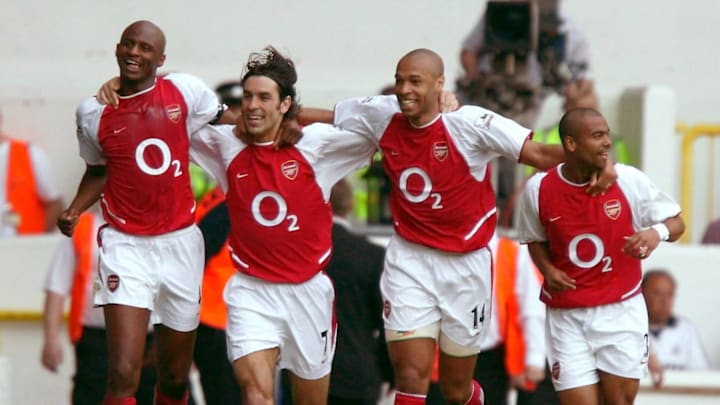
With no fewer than 50 major honors to their name, Arsenal are the third-most successful club in English soccer history, with only Manchester United and Liverpool having lifted more silverware.
From their all-conquering side of the 1930s through to Arsène Wenger’s famous “Invincibles” of 2003–04, the Gunners have been blessed with some truly outstanding players, each leaving their own mark on the club’s long and storied history.
Mikel Arteta’s current generation has now begun carving out its own place in that legacy, ending Arsenal’s 22-year wait for a top-flight title and ushering in a new era of success. Alongside the legends of previous generations, a fresh crop of modern icons is already making its case for a place among the club’s greatest ever.
These are the 50 players who stand above the rest.
Arsenal Legends: The Best Arsenal Players of All Time
50. Jens Lehmann

Jens Lehmann set the standard in his very first Premier League season, winning the Golden Glove as Arsenal went unbeaten to claim the 2003–04 title.
The veteran German was known for his excellent shot-stopping and command of the box, as well as a famously cantankerous personality.
He never won another league title, but remained a dependable presence between the posts over the next four seasons, most notably during Arsenal’s run to the 2006 Champions League final.
49. Michael Thomas

Michael Thomas etched his name into Arsenal folklore with one of the most iconic moments in the club’s modern history. With the final game of the 1988–89 season heading into injury time, Thomas raced through on goal at Anfield and calmly found the net, snatching the First Division title away from Liverpool with virtually the last kick of the season.
He was only 21, and it was the sort of moment that would be almost impossible to top. Yet Thomas went on to enjoy a hugely productive Arsenal career, winning another league title two years later and making more than 200 appearances for the club.
Versatile, dependable and willing to fill almost any role, the Lambeth-born midfielder could slot into central midfield or even drop back to right back whenever required.
48. Olivier Giroud
Giroud vs Crvena Zvezda 🤤#UEL pic.twitter.com/g3qRmFsr4m
— UEFA Europa League (@EuropaLeague) February 26, 2026
Olivier Giroud was a beautiful soccer player—and we’re not just talking about the handsome Frenchman’s face.
Everything about his game had a certain elegance. The silky touches, delicate footwork and wonderfully inventive finishing made Giroud look like he was playing at a different tempo to everyone else. Watch his Arsenal highlight reel and you’ll see overhead kicks, outrageous volleys and, of course, that famous scorpion kick against Crystal Palace. For a moment, you could be forgiven for thinking you were watching the greatest striker Arsenal had ever seen.
That might be stretching it a little, but you wouldn’t exactly be miles off. Giroud scored 105 goals in 253 appearances for the Gunners and won three FA Cups during his six-year spell in North London.
47. Declan Rice

There’s a reason Declan Rice is so often spoken about as Patrick Vieira’s heir at Arsenal. The two midfielders are very different players, but both possess that rare ability to impose themselves on a game through sheer personality as much as talent.
Rice arrived in North London with Arsenal having endured nearly two decades without a Premier League title. Three years later, he had helped deliver the trophy, establishing himself as one of the most important figures in Mikel Arteta’s side along the way.
He isn’t a carbon copy of Vieira. The Frenchman was a more explosive box-to-box destroyer, while Rice has traditionally operated deeper, shielding the back four, dictating play and increasingly adding goals to his game. In that sense, there are perhaps shades of Emmanuel Petit in his style.
But the similarities that matter most are harder to measure: the aggression, resilience, leadership and sheer competitive edge. Rice has become the kind of midfielder who drags Arsenal through difficult moments, and that mentality has made him a worthy successor to Vieira in the heart of the Gunners’ midfield.
46. Ted Drake
Morning all! On this day in 1935, Ted Drake scored twice as @Arsenal won 6-0 against Tottenham at White Hart Lane pic.twitter.com/fclqLsSyI0
— Arsenal (@Arsenal) March 6, 2014
Among the select group of Arsenal players to reach 100 goals, nobody found the net more efficiently than Ted Drake. His remarkable scoring rate of 0.75 goals per game remains unmatched by any Gunners player to hit that milestone.
Drake was the archetypal classic No. 9: strong, powerful and fearless, with little interest in overcomplicating things. He played with a directness that perfectly matched the traditional English view of the center forward—get into the box, fight for the ball and put it in the net.
That approach worked spectacularly well. Drake scored 128 goals in just 171 appearances for Arsenal, including an astonishing seven against Aston Villa in December 1935. That remains the record for the most goals scored by a player in a single top-flight game in English soccer.
A two-time First Division champion with Arsenal, Drake later enjoyed success from the dugout, guiding Chelsea to the club’s first-ever league title as manager.
45. Mesut Özil

Mesut Özil was a special, special player. The German could do things with a soccer ball that most players simply couldn’t replicate, combining outrageous vision with a trademark passing technique and an almost effortless touch.
His famous “Özil bounce” summed him up perfectly: striking down on the ball to create an awkward bounce or spin that could leave defenders and goalkeepers completely wrong-footed.
At Arsenal, Özil became the face of an era defined by technical brilliance and creativity. His later years were far more complicated, with criticism of his defensive work, questions over his physicality and a public falling-out with Mikel Arteta eventually leading to his departure in 2021.
Perhaps he wasn’t perfectly suited to the Premier League, but at his best, Özil was an absolute genius.
44. Nigel Winterburn

Few Arsenal defenders could match Nigel Winterburn for longevity and consistency. Across 13 years at Highbury, the left back became one of the most reliable figures of his generation and a hugely important part of the club’s success.
Winterburn had already collected two First Division titles before the Premier League era began, but there was still more silverware to come. He added another league championship to his collection in 1997–98 as Arsène Wenger’s first Arsenal side completed the Double.
A year later, Winterburn was named Arsenal’s Player of the Season, recognition for just how dependable he remained. His opportunities eventually became more limited following Sylvinho’s arrival, but he still departed Highbury as a true club great, having made 555 appearances in all competitions.
43. Alan Ball

Alan Ball arrived at Arsenal five years after England’s famous 1966 World Cup triumph, having been the youngest member of Sir Alf Ramsey’s squad and one of the standout players of the tournament.
He was 26 and arguably at the peak of his powers, both physically and technically, when he made the move to Highbury in 1971. Unfortunately for Ball, he joined an Arsenal side whose fortunes were beginning to decline. Still, the midfielder was a rare spark of quality, bringing energy, experience and class to a team that badly needed all three.
Ball spent five years in North London, becoming a hugely influential figure in the middle of the park and scoring more than 50 goals for the Gunners.
42. Martin Keown

Best remembered for leaping all over Ruud van Nistelrooy in 2003 after the Manchester United striker missed a penalty, Martin Keown summed up that moment in a single image: feisty, relentless, aggressive and absolutely obsessed with winning.
That was Keown in a nutshell. He was never one to back down from a battle, bringing the sort of intensity and defensive stubbornness that made him a nightmare for opposing forwards.
And he did plenty of winning himself, collecting three Premier League titles and three FA Cups during a glittering spell at Highbury.
41. Lauren

Lauren endured a difficult first season at Arsenal, but quickly turned things around to establish himself as a trusted starter under Arsène Wenger.
The Cameroonian full back became a key part of two Premier League-winning sides, including the legendary unbeaten campaign of 2003–04. He may not have been known for piling up assists or making a huge impact in the final third, but that was never his job.
Lauren was an old-school defender: fiercely competitive, tactically sharp and incredibly reliable.
40. Bukayo Saka

There’s a reason Arsenal supporters call Bukayo Saka the “Golden Boy.”
Since, as Micah Richards would say, “bursting onto the scene” in 2018, the academy graduate has gone from promising youngster to one of the most important players in North London.
Saka has been a constant presence for the Gunners, consistently producing at the highest level and establishing himself as one of the finest wide players in world soccer. His combination of a wicked left foot, explosive acceleration and underrated strength makes him a nightmare to contain, particularly when he cuts in from the right and bends a shot toward the far corner.
That’s where the Arjen Robben comparisons come in. Like the Dutch great, Saka has made a trademark of cutting inside from the right onto his favored left foot before whipping the ball into the bottom corner. The remarkable part is that defenders often know exactly what is coming and still struggle to stop it.
A Premier League champion and already an Arsenal icon, Saka’s story is far from finished.
39. David Jack

David Bone Nightingale Jack, better known simply as David Jack, was a player of many firsts.
He became the first soccer player ever to command a transfer fee of more than £10,000 when Arsenal signed him from Bolton Wanderers in 1928, and had already made history by scoring the first-ever goal at Wembley in the 1923 FA Cup final.
Jack also became the first player ever to score 100 top-flight league goals for two different clubs, reaching the landmark with both Bolton and Arsenal. At Highbury, he found the net 124 times in 208 appearances, winning three First Division titles and an FA Cup during Arsenal’s golden era of the early 1930s.
38. Charlie Nicholas

Charlie Nicholas was dubbed “Champagne Charlie” during his Arsenal career after twice being caught drink-driving. It’s hardly the sort of nickname anyone would want to earn, but, rather ironically, it also captured something about the way Nicholas played the game.
The Scottish forward was never the most reliable goalscorer, particularly for a player operating as a second striker, but he brought an unmistakable flair to Arsenal’s attack. Nicholas had the kind of extravagant skill and swagger that could turn a routine possession into something worth watching, regularly getting the Highbury crowd off their feet whenever he had the ball at his feet.
And while the goals didn’t always come consistently, there were certainly some memorable ones. He announced himself in style with two goals against Tottenham on Boxing Day during his first season at the club, before becoming a genuine Wembley hero in 1987, scoring twice in the League Cup final to fire Arsenal to victory.
37. Kolo Touré

Long before his name became immortalized in one of the Premier League’s greatest chants alongside his brother Yaya, Kolo Touré had already established himself as a seriously accomplished defender.
The Ivorian was a key figure in Arsenal’s legendary 2003-04 campaign, bringing a blend of athleticism, reliability and versatility to Arsène Wenger’s back line. Whether deployed at center back or pushed out to right back, Touré rarely looked out of place, giving Wenger the freedom to move him around without sacrificing defensive stability.
He may have been remembered just as fondly for his infectious personality, but make no mistake: Touré was a formidable player in his own right.
36. Bob Wilson

Bob Wilson may have taken a while to become a professional, but once he did, he became one of Arsenal’s most trusted goalkeepers, combining bravery, intelligence and commanding leadership between the posts.
The Scot-born, England-raised keeper was in goal for Arsenal’s Fairs Cup triumph in 1970 and the legendary 1970–71 Double, playing every match during that historic campaign and winning the club’s Player of the Year award.
He later returned to play a role in Arsenal’s success from the sidelines, coaching David Seaman during two more Double-winning seasons. A true one-club servant, Wilson’s influence stretched far beyond his 308 appearances.
35. Kenny Sansom

Kenny Sansom arrived at Arsenal in one of the stranger deals in the club’s history, joining from Crystal Palace in a swap for Clive Allen, whom the Gunners had signed just weeks earlier.
Odd as the circumstances were, Arsenal soon had no reason to regret the decision.
Sansom went on to make nearly 400 appearances for the club, establishing himself as one of the most dependable players of his generation. Quick, intelligent and an excellent reader of the game, he was also surprisingly strong in the air for his diminutive frame and quickly became a firm favorite with the Highbury faithful before eventually taking on the captaincy.
His consistency was the real calling card, though. Sansom was named in the PFA Team of the Year at left-back for eight consecutive seasons, a remarkable record that still stands today.
34. Nwankwo Kanu
23 October 1999: The Arsenal beat Chelsea 2-3 courtesy of a Kanu Hat Trick
— The N5 History (@TheN5News) October 23, 2025
"Can you believe it?!"@Arsenal @papilokanu
pic.twitter.com/0tIdYAOxLX
Nwankwo Kanu was never about racking up gaudy numbers at Arsenal. His 44 goals in 198 appearances tell only a fraction of the story, because the Nigerian brought a wonderfully unpredictable edge to the Gunners’ attack that statistics simply can’t capture.
Tall, elegant and utterly unconventional, Kanu was a nightmare for defenders to read. He was a brilliant link-up player, possessed remarkably soft feet for a man of his size and could glide through even the most organized defenses with a mixture of clever movement, outrageous technique and improvisation.
He was also part of Arsenal’s unbeaten 2003–04 side, but his defining moment in North London had arrived years earlier against Chelsea. With the Gunners trailing 2–0, Kanu produced one of the greatest individual comebacks in Premier League history, scoring three times in just 17 minutes to turn the game on its head. The hat-trick was completed by a ridiculous solo effort, as he rounded Ed de Goey before somehow squeezing the ball into the top corner from an almost impossible angle.
33. Lee Dixon

Take away that one infamous own goal—the moment Lee Dixon somehow managed to lob his own goalkeeper, David Seaman—and the right back’s Arsenal career was about as close to flawless as it gets.
For well over a decade, Dixon was one of the most reliable figures in the Gunners’ defense, rarely facing any serious competition for his place. He wasn’t the flashiest player on the pitch, but that was never really the point. Dixon was Mr. Consistent: positionally sound, fiercely dependable and remarkably difficult to catch out.
Which is perhaps why that one spectacular lapse has lived on in Arsenal folklore for so long.
32. Santi Cazorla

Santi Cazorla was the kind of player who seemed to have a solution for problems that didn’t even have solutions. Blessed with two superb feet, the diminutive Spaniard could slither out of the tightest spaces, dance through challenges and leave defenders wondering how on earth they had failed to get near him.
Arsène Wenger knew exactly what Arsenal had in their hands, once simply saying: “It is a pleasure to watch him.”
Cazorla never got the Premier League winner’s medal his talent arguably deserved, but he still played a starring role in two FA Cup triumphs during his six years in North London. Sadly, his Arsenal career was cut short by a devastating run of injuries, including a horrific battle with gangrene, bringing the curtain down far too early on a modern club great.
31. Eddie Hapgood
Morning. On this day in 1939, club legend Eddie Hapgood made his final @Arsenal appearance: https://t.co/irKIyJ1lrQ pic.twitter.com/tXKi8V7usM
— Arsenal (@Arsenal) May 6, 2016
Former England captain Eddie Hapgood won five league championships and two FA Cups during his Arsenal career, making 393 appearances for the Gunners.
A dogged and determined left back, Hapgood was renowned for his hulking physique, defensive grit and, perhaps less conventionally, his good looks—he even worked as a model away from the pitch.
He was also remarkably versatile for his era, occasionally deputizing in goal when Arsenal needed him.
30. Emmanuel Petit

Arsène Wenger handed Emmanuel Petit his professional debut at AS Monaco before bringing the Frenchman to Arsenal in 1997, where he formed a formidable midfield partnership with Patrick Vieira.
While Vieira was the box-to-box destroyer, Petit was the yin to his yang: a more reserved deep-lying playmaker who could unlock defenses with laser-guided passes while using his superb reading of the game to snuff out danger.
Together, they helped Arsenal win the Premier League and FA Cup Double in Petit’s debut season in 1997–98.
29. John Radford

Only three players have scored more goals for Arsenal than John Radford, who racked up 149 strikes during his 12 years in North London.
An old-school, no-frills forward, Radford loved the physical battles, chased lost causes and did plenty of the dirty work that allowed those around him to flourish.
His unselfishness was perfectly summed up in the 1971 FA Cup final, when he set up both of Arsenal’s goals as the Gunners completed the Double.
28. Gilberto Silva

When Arsenal went unbeaten to win the Premier League in 2003–04, the spotlight naturally fell on Thierry Henry, Dennis Bergkamp and Robert Pirès. But Gilberto Silva was every bit as important.
Nicknamed the “Invisible Wall,” the Brazilian quietly shielded Arsenal’s defense, breaking up attacks with intelligent positioning and impeccable discipline rather than flashy tackles.
He rarely grabbed the headlines, but Gilberto provided the platform for Arsenal’s attacking stars to shine.
27. Marc Overmars

Despite being naturally right-footed, Marc Overmars was so comfortable with both feet that he could operate on either wing, either cutting inside to shoot or burning past his man and whipping in a cross.
Add his blistering pace to that two-footed ability and you had a winger who was an absolute nightmare to defend. Just ask Gary Neville, who once described Overmars as the best winger he came up against during his Manchester United career.
Across three seasons with Arsenal, the Dutchman scored 41 goals and played a starring role in the 1997–98 Premier League and FA Cup double.
26. Robin van Persie

If this were a list of the best left foots in Arsenal history, Robin van Persie would be sitting right at the top.
Quite simply, no Gunners player has ever struck a ball quite like the flying Dutchman, particularly when it came to volleys. Van Persie possessed outrageous technique and had a knack for making the extraordinary look almost routine.
We’ll conveniently ignore the fact that he eventually joined Manchester United for the purposes of this list ...
25. Alan Smith

There is something inherently unassuming about Alan Smith. A respected, unflashy professional who dutifully got about his business while being wilfully outshone by some of his more front-facing teammates. Even his name is dutifully nondescript.
Yet that façade masks a player who twice finished as the top-flight’s leading goalscorer and winner. Smith also added an FA Cup trophy to his haul in 1992 and, unlike any other Arsenal No. 9 in the club’s entire history, can lay claim to a winning goal in a European final for the Gunners.
24. Ray Parlour

Few players in soccer history have ever been compared to the legendary Pelé, but Ray Parlour was one of them.
Nicknamed the “Romford Pelé” because of his Essex roots and elegant, skilful playing style, Parlour was a dynamic force in the middle of the park. He could skip past players with ease, thread tidy passes, and find the back of the net, just as Pelé did.
Though even he would admit he wasn’t quite at the level of the Brazilian icon, Parlour was nevertheless a vital figure for an Arsenal side that dominated English soccer in the late 1990s and early 2000s.
23. Paul Merson

When talking about Paul Merson, his off-field struggles with alcoholism and gambling addiction often dominate the conversation, which makes his achievements and performances for Arsenal in the late 1980s and ’90s even more remarkable.
A two-time league title winner and the 1989 PFA Young Player of the Year, Merson was a magician—capable of creating moments of brilliance and unlocking opposition defenses with mazy dribbles, cutting through balls, and precise finishes. He was also a tireless worker, known for his relentless pressing from the front.
Even the man himself is willing to admit that he could have been even better if it weren't for his struggles, especially for England, for whom he made only 21 appearances.
“I was drinking so heavily; if I hadn’t, I could’ve nicked myself another 20-odd caps and done better for England,” he told FourFourTwo in 2006. “I blame myself; I don’t blame the managers at all.”
22. Pat Rice
5 December 1967. Pat Rice’s first start for Arsenal in the League Cup against Burnley.
— The N5 History (@TheN5News) December 5, 2025
Arsenal won 2-1 with goals from Radford and Neil@Arsenal pic.twitter.com/AR9rWh4JaR
Before Arsenal had Declan, they had Pat Rice––who made over 500 appearances for the Gunners between 1964 and 1980, helping them clinch a famous league and FA Cup double in 1971, as well as another FA Cup in 1979 as club captain.
A tireless worker and no-nonsense right back, Rice later went on to serve as Arsène Wenger's assistant manager, helping guide the club to even more major honours, including two more league and cup doubles, before stepping down from the role in 2012, ending a cumulative 44-year association with the club.
His namesake hopes to one day replicate those achievements.
21. Ashley Cole

Ashley, or “Cashley” as he’s known now in north London, Cole, will forever be in the bad books of Arsenal fans due to his decision to secretly engineer a high-profile move to Chelsea in 2006.
Suspect behaviour aside, however, there is simply no denying that the Englishman is Arsenal’s, and the Premier League’s, greatest-ever left back.
Instrumental in both of Arsenal’s Premier League title wins this century and voted into three consecutive PFA Teams of the Year from 2003–05, Cole was a bona fide superstar, with even the great Cristiano Ronaldo naming him his toughest-ever opponent.
Need we say more?
20. George Armstrong

Trying to find a bad word about George Armstrong is almost as difficult as locating a defender who managed to muzzle the diligent winger. Famed for his willingness to track back as well as hare forward, “Geordie” was a cherished favourite of the fans and his teammates.
The Highbury faithful had 16 years to laud Armstrong’s efforts, as the remarkably durable winger ended his career in north London in 1977 as the club’s record caps holder at the time.
19. Frank McLintock

Signed from Leicester City in 1964 as an ambitious all-action midfielder, Frank McLintock would be shaped into an uncompromising central defender, captaining Arsenal to the cherished feat of the league and cup double in 1970–71.
That treasured campaign would feature the maverick talents of Charlie George, Ray Kennedy’s prolific edge and the unerring reliability of goalkeeper Bob Wilson. Yet it was McLintock who would be recognised as the Footballer of the Year.
18. Cesc Fabregas

If this list were based purely on ability, Cesc Fàbregas would be much, much higher.
A product of Barcelona’s prestigious La Masia academy, Fàbregas was one of the most gifted central midfielders of his generation. A creative mastermind, the Spanish playmaker finished the 2007–08 Premier League season with 17 assists—while in 2009–10, he racked up 15 goals and as many assists in just 27 appearances.
Unfortunately for Arsenal, Barcelona, realising it was wrong to ever let him go, came calling in 2011 with an offer too enticing for Fàbregas to turn down, stripping the Gunners of the superlative Spaniard at the peak of his powers.
17. David Rocastle

The late David Rocastle was a gentleman off the field, who, according to his former Arsenal teammate Michael Thomas, “had time for everyone.”
On it, he was both a competitive, committed force to be reckoned with and a trailblazer in more ways than one.
The English winger—who scored 34 goals and won two league titles in seven seasons with the Gunners—was one of the standout Afro-Caribbean stars of his generation, following in the footsteps of pioneers like Cyrille Regis and Laurie Cunningham in helping break down racial barriers.
A player ahead of his time, he also combined pace, grace, and dazzling flair in an era when physicality was often prioritised over finesse.
16. Freddie Ljungberg

In terms of debuts, Freddie Ljungberg’s Arsenal inauguration in 1998 was as good as they come, with the Swedish winger, sporting his famous faux hawk, coming off the bench to score a brilliant lob against rivals Manchester United in an emphatic 3–0 win.
Although it took a little while for Ljungberg to find his rhythm after that, by the turn of the century, he had firmly established himself as one of the club’s key players.
During Arsenal’s 2001–02 double-winning season, the Vittsjö-born star scored 17 goals in all competitions, including six in the Gunners’ final eight Premier League matches, helping them secure the title and earning himself the division’s Player of the Season award.
15. Liam Brady

Known as “Chippy” due to his love for fish and chips, Liam Brady may have been born in Dublin, but he was Arsenal through and through.
After rising through the Gunners’ academy, the extraordinarily gifted attacking midfielder—blessed with a wand of a left foot—went on to make over 300 appearances for the north London club, scoring 59 goals and playing a crucial role in their 1979 FA Cup triumph.
Following his successful stint at Highbury, Brady moved to Juventus, where he won back-to-back Serie A titles, cementing his legacy as Irish soccer’s first global superstar.
14. Pat Jennings

After coming up against Nottingham Forest during the height of Brian Clough’s tenure in the Midlands, Arsenal’s legendary goalkeeper Pat Jennings found himself bombarded by objects from the City Ground crowd. A dart was thrown which lodged itself into Jennings’s arm.
The Northern Ireland icon dutifully carried on with the game but made a point of informing his manager who raged at Clough after the match. A few days later, Jennings received a letter from the man himself which read:
“Dear Pat, I have absolutely no sympathy for you whatsoever.
“Every time you come to the City Ground you stop everything that comes in your direction, so it’s of no surprise to me that you stopped the dart on this occasion.
“Lots of love, Brian.”
Jennings would keep the letter in his breast pocket for decades to come as a reminder of how highly rated he was by one of the sport’s most esteemed managers. Many shared Clough’s overriding sentiment, even if he, as ever, expressed it best.
13. Sol Campbell

Sol Campbell caused quite the stir when he left rivals Tottenham Hotspur to join Arsenal in 2001, having previously vowed he would never commit such an act of betrayal.
Spurs fans have never forgiven him, but Gunners supporters have been thanking him ever since. The English defender only grew stronger at Highbury, serving as the rock-solid backbone of one of the most successful periods in the club’s history.
Campbell won three FA Cups and two Premier League titles with Arsenal, the latter of which came in the legendary “Invincibles” season. That year, the team went unbeaten, conceded just 26 goals, and, in a twist of fate, sealed the title with a 2–2 draw against his former club Spurs.
12. Charlie George

The scorer of one of the most important and memorable goals in Arsenal’s history, Charlie George etched his name into club folklore with his stunning extra-time winner against Liverpool in the 1971 FA Cup final. Latching onto John Radford’s square pass, he unleashed a thunderous strike from 20 yards, securing the trophy for the first time in the club’s history.
However, George was far more than just that one iconic goal. He also found the net in the fourth, fifth and sixth rounds of that same competition and scored five times in 17 league appearances as Arsenal also won the First Division title.
Had it not been for a series of injuries and his tendency for ill discipline, his legacy at Highbury could have been even greater.
11. Alex James
Alex James leading out arsenal at Highbury in the 1930s. pic.twitter.com/5wGBbrdtYx
— Les Easterbrook (@LesEasterbrook1) March 12, 2019
The final piece in Herbert Chapman’s trophy-winning machine arrived at Arsenal in 1929. A deft operator between the lines, Alex James greased the wheels of the counter-attacking weaponry forged by Chapman’s transformative tactics.
The Scotland international would spend eight years in north London and amass four top-flight titles which were bookended by a pair of FA Cups.
10. David O’Leary

David O'Leary spent almost his entire playing career at Arsenal, retiring in 1995 as the club’s record appearance holder with 722 matches played between 1975–93.
During his nearly two decades in north London, the Irish defender won two league titles, two FA Cups, and two League Cups, and was named to the PFA Team of the Year three times.
Impressively, he finished his professional career without ever receiving a red card for either club or country, a testament to his composure and ability to remain calm under pressure in the heart of defense.
9. David Seaman

David Seaman: Great ponytail, even better goalkeeper.
Dubbed “Safe Hands” for good reason, Seaman’s lightning-fast reflexes and dependable handling helped Arsenal secure three league titles, four FA Cups, and a League Cup during his 13 years in North London.
His legendary save against Sheffield United in the 2003 FA Cup semifinal, where he unbelievably scooped Paul Peschisolido’s close-range header off the line, has gone down in goalkeeping folklore.
8. Robert Pires

If we had to pick just one word to describe Robert Pires, it would be “classy.”
Thankfully, we have more than one word to capture the essence of the talented French winger, who spent the first half of the noughties tearing apart Premier League defences.
From his deft first touches and nonchalant lobs to delicate side-footed finishes and deceptively quick stepovers, Pires did everything with style and panache. The results were devastating, as “The Duck” (so named for his unique running style) scored 84 goals and provided 63 assists in six trophy-laden seasons under Arsène Wenger.
7. Ted Drake
On this day 90 years ago, Ted Drake scored seven goals in a single match for Arsenal — a record that still stands in English top-flight football. ⚽🔥 pic.twitter.com/mR1UwU92Dp
— The Extreme Football Enthusiast (@ExtremeFootbal4) December 14, 2025
To reduce Ted Drake’s 11 years at Arsenal down to a single game would overlook much of his best work for the club. Yet, his unprecedented seven-goal haul against Aston Villa in 1935—a feat that had never before been achieved or has since been repeated in England’s top flight—represents the apex of his brilliance.
After being solely responsible for Arsenal’s 7–1 at Villa Park, the beaten and bruised Villa player queued up to sign the match ball for Drake, who was left to lament the eighth goal he missed. “I smacked the ball really hard and it hit the bar and bounced down. I think it was over the line but the referee disagreed,” he recalled.
Drake would have to settle for seven on the day and 139 across his entire Arsenal career.
6. Cliff Bastin
Remembering Cliff Bastin, who died on this day 1991 in Exeter at the age of 79. If not the Second World War, the 'Boy' could easily be the record goalscorer for The #Arsenal. In competitive games Cliff scored 178 goals and during the wartime 70 more. Here pictured in 1946: pic.twitter.com/Esysh6oKT3
— 𝖍𝖊𝖓𝖙𝖊 (@hente_afsc) December 4, 2025
The Gunners’ third-highest scorer of all time, Bastin racked up 178 goals in 395 games for the club—a remarkable tally, made even more impressive by the fact that he spent much of his career playing as a left winger rather than a traditional striker.
A key figure in a dominant Arsenal side that won five First Division titles and two FA Cups during the 1930s, Bastin was inducted into the English Football Hall of Fame in 2009.
5. Tony Adams

Arsenal’s greatest-ever captain, Tony Adams was a towering figure whose presence was simply impossible to ignore.
Though not the most technically gifted of central defenders, Adams was brave, physical, and fully committed, often putting his body on the line to stop the opposition, while his vocal leadership and menacing demeanour didn’t just intimidate opponents, but also his own teammates—whom he wasn’t afraid to give a stern word to when they failed to meet his high standards.
A centre back from a bygone era, yet one that many clubs would snap their fingers for today, Adams led the Arsenal defense with such valour that, without him, the Gunners might not have been the dominant force they were throughout the 1990s.
4. Ian Wright

Adored by Arsenal fans for his brilliance on the field and universally loved off it for his charismatic, humble demeanour and charity work, Ian Wright is a soccer legend in every sense of the word.
A true goal-scoring machine, Wright netted 185 goals in 288 games across all competitions for the Gunners—finding the back of the net in every way imaginable, whether through a cheeky 30-yard lob, a close-range tap-in, or a fierce strike from the edge of the box.
Beyond his goals, which helped Arsenal win several major honours—including a first-ever Premier League title in 1997–98—Wright, a born showman, was a joy to watch. His unpredictable, tenacious style of play was matched only by his theatrical goal celebrations, which made him all the more iconic.
3. Patrick Vieira

As close to being a “complete” midfielder as they come, Patrick Vieira was a monster in the middle of the park, who struck fear into the hearts of Premier League teams across the country during the 1990s and noughties.
A towering presence both physically and metaphorically, the Frenchman was both a powerful runner with the ball––almost impossible to dispossess once on a trademark run through the midfield––and ferocious and combative off it, never backing out of a challenge and often leaving a bit on his opposing number for good measure, too.
Named in the Premier League PFA Team of the Year for six consecutive years from 1999–2004, Vieira epitomised everything that was good about Arsène Wenger’s Arsenal at the peak of their powers––a perfect blend of strength, technique, and leadership that helped the Gunners dominate the English game.
2. Dennis Bergkamp

Dennis Bergkamp is your favourite player’s favourite player.
“I honestly didn’t think a professional player could be that good,” his former Arsenal teammate Paul Merson once admitted.
Manchester United legend Peter Schmeichel echoed the sentiment: “He played football like it was all a dream—you couldn’t even imagine some of the things he was capable of doing with a football.”
To prove their point, just look at Bergkamp’s otherworldly turn and finish against Newcastle United in 2002, widely regarded as the greatest goal in Premier League history. Or his ridiculous touch and volley against Leicester City. Or his audacious chipped finish against Bayer Leverkusen. Or his stunning control and strike against Argentina at the 1998 World Cup.
The list goes on—Bergkamp was simply a magician.
1. Thierry Henry

The greatest player in Arsenal history—and arguably in Premier League history—Thierry Henry was a devastating force of nature in the final third, yet he made it all look so effortless.
Whether sprinting past defenders with the grace of a gazelle, juggling the ball on his knees while gliding through midfield, or slotting goal after goal into the bottom corner with his trademark curled finish, Henry had an almost supernatural ability to make those around him look completely inferior.
From his first Arsenal goal—a stunning strike against Southampton in 1999—to his last, a dramatic winner against Leeds United in the FA Cup during his brief yet unforgettable loan return in 2012, Henry left an indelible mark on the club, cementing his legacy as the Gunners’ greatest-ever player.
 Add us as a preferred source on Google

Sports Illustrated’s FC team bring you the latest news, transfers and match coverage.