%20%20--%3E%0A%3Csvg%20version%3D%221.1%22%20id%3D%22Layer_1%22%20xmlns%3D%22http%3A%2F%2Fwww.w3.org%2F2000%2Fsvg%22%20xmlns%3Axlink%3D%22http%3A%2F%2Fwww.w3.org%2F1999%2Fxlink%22%20x%3D%220px%22%20y%3D%220px%22%0A%09%20width%3D%2239px%22%20height%3D%2240px%22%20viewBox%3D%220%200%2039%2040%22%20enable-background%3D%22new%200%200%2039%2040%22%20xml%3Aspace%3D%22preserve%22%3E%0A%3Cpath%20fill%3D%22%23FFFFFF%22%20d%3D%22M38.5%2C7H28.2v26h10.3V7z%22%2F%3E%0A%3Cpath%20fill-rule%3D%22evenodd%22%20clip-rule%3D%22evenodd%22%20fill%3D%22%23FFFFFF%22%20d%3D%22M26.1%2C25.5c0%2C5.8-4.1%2C7.5-12.9%2C7.5C3.9%2C33%2C0%2C31.2%2C0%2C25.2v-1.1h11.6%0A%09v2.4c0%2C0.7%2C0.1%2C1.4%2C1.2%2C1.4c1%2C0%2C1.2-0.4%2C1.2-1.3v-0.9c0-1.6-0.9-1.6-3.5-2.2C2.2%2C21.7%2C0%2C19.7%2C0%2C15.3v-0.9C0%2C9.3%2C5.5%2C7%2C12.9%2C7%0A%09c10.2%2C0%2C12.8%2C2.6%2C12.8%2C7.4v1.8h-11v-2.9c0-0.6-0.4-1.1-1.2-1.1c-0.6%2C0-1.2%2C0.4-1.2%2C1.1v0.9c0%2C1.5%2C0.9%2C2%2C3.3%2C2.5%0A%09c8%2C1.6%2C10.5%2C3.3%2C10.5%2C7.5V25.5z%22%2F%3E%0A%3C%2Fsvg%3E%0A)
2026 Roland Garros: Tips for Enjoying the French Open
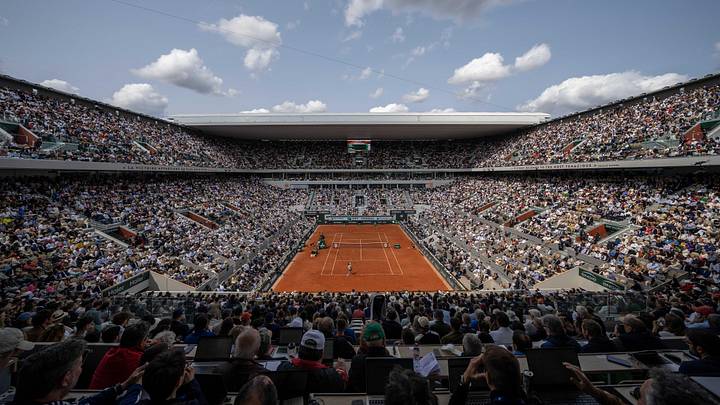
Wimbledon is a lovely sporting event, awash in charm. But it’s played in a village, a healthy commute from central London. The U.S. Open is a rollicking lollapalooza, awash in sweaty energy. But it’s played far from the beating pulse of New York City, reachable from Manhattan only by bridge or tunnel.
Roland Garros, on the other hand, is a city event. The venue is barely a mile from the Arc de Triomphe. In this bike-friendly city, you could leave the tennis venue, pick up a Vélib (Paris’s answer to Citi Bike) or motorized Lime bike (available on your Uber app), and be at the Eiffel Tower in 15 minutes. If you can’t walk from the tennis to your Paris hotel or Airbnb, you’re a short ride away on the Metro.
There are some drawbacks to staging an urban event. For one, in terms of real estate, Roland Garros is, far and away, the smallest of the majors. The venue is closing in on 100 years old and occasionally shows its age. It also has the tensest relationship with the neighbors, challenged as it is to expand its footprint, much less tap into public funds to do so.
Still, there is undeniable charm to the tournament, not least its color scheme, the orange of the courts, paired with green surroundings and the Paris-in-the-spring sky.
And befitting a sporting venue named not for an athlete but for a military pilot, there is undeniable quirkiness as well. The gems and touches come in large and small sizes. There’s a court that doubles as a greenhouse. There’s the neighborhood, wedged, as the event is, among parks, gardens and upscale residential apartment buildings. There are small touches, too, like the on-site orange trees or the secret passageways.
Clay-court play demands a different skill and mentality from asphalt tennis. And the French Open tends to feature some of the year’s fiercest and most demanding battles—not least the most recent played there, the instant-classic 2025 men’s final. But even if you’re watching a blowout, you could do worse than spending a few days in the late spring watching tennis in Paris.
Here are some tips for attending the French Open.
Getting there
• Get tickets, but don’t sweat tickets. The scalpers may have been cleared from the nearby Metro stops, but this event is much closer to the U.S. Open than to Wimbledon. You may have to pay various fees online. You may have to struggle through French-language websites. But few sessions are fully sold out, and you should be okay to get through the gates. I’ve even heard stories of hotel concierges helping, too.
• Taking the Metro, which is clean, safe, punctual and generally outstanding, to Porte d’Auteuil is your best bet. Download the “Navigo” app and you can buy Metro tickets with AppplePay.
• After the Metro, biking is the best way to get around. There are tons of bike lanes—a great source of local debate; on which the last mayoral election swung. Velib is the Citibike equivalent. And your Uber app works for Lime e-bikes.
• As for cabs and cars, if you must….the event borders the Périphérique (the beltway), but don’t let Google Maps deceive you. It’s tucked into a residential neighborhood, so streets are either closed or snarled with traffic. You’ll pay for trying to get too close. If you’re taking an Uber or a cab, get off at Hotel Molitor and walk the 100 yards or so.
• Paris has Uber but it’s unreliable. A lot of two-minute waits turn into 10-minute waits. Order in advance and odds are 50/50 the driver cancels right before your appointed pick-up. Again, Metro, walk or bike.
• For will call especially, bring I.D., preferably a passport. I’ve heard stories of people coming to pick up tickets and—even armed with the same credit card used to make the purchase—having trouble because they cannot identify themselves.
On the grounds
• Note the Rafael Nadal statue. (Hot take: It says as much about Nadal’s character as his tennis that the event felt comfortable immortalizing him with a statue before his retirement.)
• There is no finer tennis venue than Court Simonne-Mathieu. Full stop. Trust us. Long story short: The event wanted to expand into the adjacent botanical gardens. Paris said, Are you kidding? We’re not moving our greenhouses. The event said, No worries, we’ll put the third show court IN the greenhouse.
• As always, the practice schedule is your friend. (And the event is awfully good about posting times and location.) Stars often favor Courts 5. Fans in the know are there waiting.
• Cheer for your favorite players. And for those who could use it or deserve it for reasons beyond their games. The Ukrainians. Stefanos Tsitsipas. Dasha Kasatkina. You will no doubt be reminded, but note this is Gaël Monfils’s last go-round. Same for former champ Stan Wawrinka.
• Check out the apiary behind Suzanne Lenglen. Yes, you read right. And they use the honey as a condiment in the hospitality tents.
• The upper reaches of Court Philippe-Chatrier double as vistas to see much of the Paris skyline, such as it is, including the Eiffel Tower.
• The ramasseurs—the ballkids—play a starring role. Most mornings an hour before match play, they charge down the concourse, singing their theme song.
• The same holds for Wimbledon, but Americans are often surprised how late the sun goes down. It’s June. Paris is deceptively far north. It’s entirely possible that day matches will go until 9:30 p.m. local time. Consider that when making dinner plans.
• A related note: The night sessions are controversial for the absence of women. As the only match in the big stadium, they come across more as an awkward tack-on than a legit session. But it’s a way to spend a day in Paris and still get to see tennis.
• Speaking of money grabs … the Sunday start used to be a “soft open,” a day when few top players were on the concert bill. More and more, it’s a proper session with stars.
• Hydrate. And Perrier > Vittel > Evian.
• The food on site is … fine. Not embarrassing, not extortionately priced. And the croque monsieur draws rave reviews. (It ain’t cheap but the lobster roll—garnsihed with apple?—is a five-star offering.) But you might want to bring your own baguettes, pastries and sandwiches. Room for improvement here, especially for a city known to have a decent restaurant. Or 10,000.
• Just stroll the grounds and note the small (and again, quirky) touches. Surely this is the only major sporting event that offers complementary Haribo gummy bears in some of the restrooms. There is an orange tree. There is a back path between the two show courts on which you might cross wild birds. The botanical gardens that abut Court Simonne-Mathieu are lovely.
• Actually, better than lovely. At least in past years, the event has been good about re-entry. If you need a break or a nap, buy a baguette and spend 45 minutes or so in the botanical gardens or the Bois de Boulogne before heading back to the tennis.
• If a French player is in action, stop by. Note the rabid fans … and how quickly they can turn on their players when they start losing.
• Insider tip: A number of players (including Roger Federer in his day) would practice on their off days at the courts across the road in the Bois de Boulogne. Before you enter the stadium, it might be worth poking around.
Nearby
• The Bois de Boulogne is one of Paris’s secrets hiding in plain sight. Detour through it on the way to Roland Garros. It’s on the other end from Roland Garros, but get really ambitious and make a reservation at the Fondation Louis Vuitton.
• Again, because we cannot stress this enough, to the dismay of drivers, especially cabbies (and to the joy of many of us), Paris has become a wonderful bike town. There are bike lanes everywhere and paths along the Seine.
• Want a parlor game? The residents allegedly pay to remove it from Google Maps, but walk by Villa Montmorency—not far from the complex in the 16th arrondissement—is a gated community, where celebrities like Celine Dion and Nicolas Sarkozy keep homes.
• Again, the Metro is terrific. Reliable. Clean. Frequent. The stops are (too) close together. Don’t worry when you see your hotel is a dozen stops from Porte d’Auteuil. It won’t take that long.
• Because you needed another reason to like France … showing a media card or a student ID gets you into most museums and galleries for free.
Misc.
• There’s a joke that Parisians like the Eiffel Tower for one reason only: If they climb the steps they finally get a panoramic view of Paris unimpeded by the Eiffel Tower. This is the encapsulation of jaded. The Eiffel Tower is awesome. It’s centrally located. It’s a few bucks to ascend. Be a tourist and do it.
• Everyone has a favorite restaurant and recommendation but here’s the truth: You can’t go wrong. The neighborhood bistro near your Airbnb or hotel (remember hotels?) is just as good as the Michelin joint your lawyer’s sister’s dentist recommends so lustily. (But if you really want a rec, shout-out to this unassuming, authentic joint in my neighborhood.)
• Le Relais de l'Entrecôte is terrible and touristy, and has bad quality beef and must be avoided at all costs. (Unless you’re online, in which case please hold my spot.) Seriously, it’s mediocre, sometimes leathery steak in divine sauce. Like put-it-in-our-veins divine. And it’s fun and reasonably-priced. Tip: The Montparnasse location is farthest from the tennis but tends to have shortest lines.
• Contrary to reports, the French are, collectively, awesome. And they don’t regard the English language as a sound the devil makes. Most of the country speaks it; and speaks it well. Which helps those of us who are not conversant in French. Acknowledging that any linguistic shortcoming is our fault, not theirs? It goes a long way. Starting by saying, Ex-Koos Em-Wa. Parlay-Vu Ong-Glay? goes a long way toward eroding any language barrier.
• Seriously, hydrate.
More Tennis from Sports Illustrated
 Add us as a preferred source on Google
Jon Wertheim is a senior writer for Sports Illustrated and has been part of the full-time SI writing staff since 1997, largely focusing on the tennis beat, sports business and social issues, and enterprise journalism. In addition to his work at SI, he is a correspondent for “60 Minutes” and a commentator for The Tennis Channel. He has authored 11 books and has been honored with two Emmys, numerous writing and investigative journalism awards, and the Eugene Scott Award from the International Tennis Hall of Fame. Wertheim is a longtime member of the New York Bar Association (retired), the International Tennis Writers Association and the Writers Guild of America. He has a bachelor’s in history from Yale University and received a law degree from the University of Pennsylvania. He resides in New York City and Paris with his wife, who is a divorce mediator and adjunct law professor. They have two children.
Follow jon_wertheim