%20%20--%3E%0A%3Csvg%20version%3D%221.1%22%20id%3D%22Layer_1%22%20xmlns%3D%22http%3A%2F%2Fwww.w3.org%2F2000%2Fsvg%22%20xmlns%3Axlink%3D%22http%3A%2F%2Fwww.w3.org%2F1999%2Fxlink%22%20x%3D%220px%22%20y%3D%220px%22%0A%09%20width%3D%2239px%22%20height%3D%2240px%22%20viewBox%3D%220%200%2039%2040%22%20enable-background%3D%22new%200%200%2039%2040%22%20xml%3Aspace%3D%22preserve%22%3E%0A%3Cpath%20fill%3D%22%23FFFFFF%22%20d%3D%22M38.5%2C7H28.2v26h10.3V7z%22%2F%3E%0A%3Cpath%20fill-rule%3D%22evenodd%22%20clip-rule%3D%22evenodd%22%20fill%3D%22%23FFFFFF%22%20d%3D%22M26.1%2C25.5c0%2C5.8-4.1%2C7.5-12.9%2C7.5C3.9%2C33%2C0%2C31.2%2C0%2C25.2v-1.1h11.6%0A%09v2.4c0%2C0.7%2C0.1%2C1.4%2C1.2%2C1.4c1%2C0%2C1.2-0.4%2C1.2-1.3v-0.9c0-1.6-0.9-1.6-3.5-2.2C2.2%2C21.7%2C0%2C19.7%2C0%2C15.3v-0.9C0%2C9.3%2C5.5%2C7%2C12.9%2C7%0A%09c10.2%2C0%2C12.8%2C2.6%2C12.8%2C7.4v1.8h-11v-2.9c0-0.6-0.4-1.1-1.2-1.1c-0.6%2C0-1.2%2C0.4-1.2%2C1.1v0.9c0%2C1.5%2C0.9%2C2%2C3.3%2C2.5%0A%09c8%2C1.6%2C10.5%2C3.3%2C10.5%2C7.5V25.5z%22%2F%3E%0A%3C%2Fsvg%3E%0A)
Alexandra Eala Is the Pride of the Philippines and Tennis’s Next Great Superstar
They flap in the breeze, ringing the courts below. They adorn scoreboards and websites, and if flags represent the countries of players, they also stand as four-cornered emblems signifying just how relentless international professional tennis has become. There is le drapeau tricolore of France and il tricolore of Italy. There are the Stars and Stripes and the Union Jack. The green and gold of Brazil. The red and gold of Spain. The minimalist flag designs of Switzerland and Japan.
Here’s a deeper cut, at least in tennis: a white equilateral triangle set off by a horizontal blue stripe (denoting peace, truth and justice) and a horizontal red stripe (for patriotism and valor) below. It’s the flag of the Philippines, flown at tennis events because of one player and one player only.
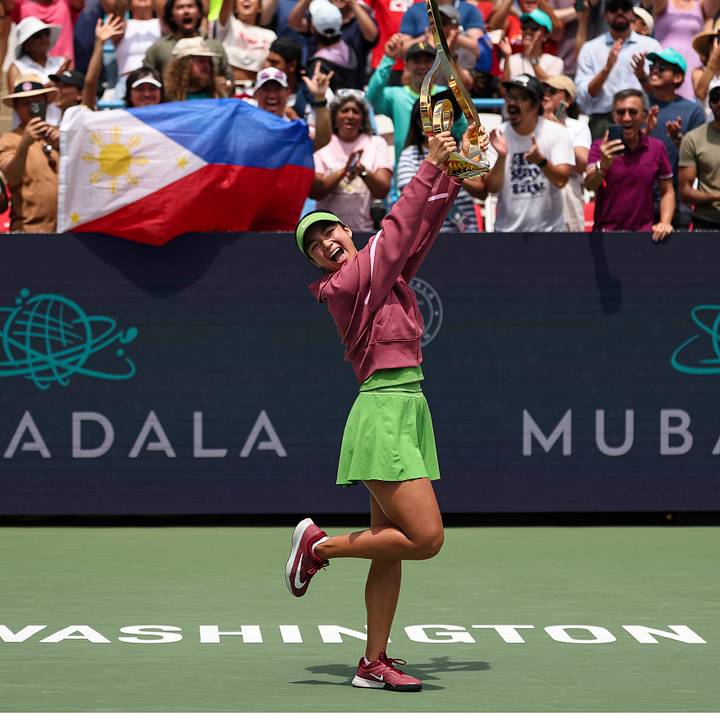
Alexandra Eala enters the U.S. Open as the No. 17 seed, and fresh off winning the prestigious Washington, D.C., tune-up event and defeating the defending champion at Wimbledon, the previous major (more on that shortly). She comes to New York with a jet stream of momentum. But as the most luminous Filipino sports star since boxer Manny Pacquiao, she also carries the hopes and expectations of a country of more than 113 million people, deeply thirsty and hungry for an international sports star.

Before Eala, the Philippines had never minted a top-100 tennis player in the Open Era. Now, as Eala ascends to cruising altitude, tennis is swept up in something the sport has never seen before.“You mean Eala mania?” says Jessica Pegula, the top-ranked American, whom Eala beat in the D.C. final. “It’s crazy, right? Don’t get me wrong, I think it’s great. But it’s crazy!”
When Eala enters an event, tournaments must reconsider their court assignments to accommodate her army of fans. They must reconsider their broadcast schedules, accounting for the time difference to the Philippines—12 hours ahead, in the case of the U.S. Open. They must reconsider the deployment of security, for the force field around her is so intense.
Yet, for all the young athletes who have had attention thrust upon them, the 21-year-old Eala is the rare sports star who runs to it. If the Filipino public has embraced her, she has hugged them back. Most players compete for their countries every four years at the Olympics. Eala does it every match, acknowledging the sea on those blue, red and white flags; winking at the fans yelling Pinoy Power, often stopping at the local Filipino restaurants after her on-court work is done.
“I take it with so much pride to wear my flag,” Eala says. “I’m always super grateful because they’re able to heighten my experience. It’s definitely a give-and-take. I do my best when I can. People tell me that I’m a role model for people back home. So I do my best to put on my best attitude, I know that for a lot of the people, I’m known as the Filipina on tour, and I’m the only Filipina that people really see in high-level tennis. So when they think of the Philippines in regards to tennis, they think of me. So I really do my best to be on my best behavior, to represent the best of the Philippines.”
Eala was born in 2005 in Quezon City, the country’s population center, half an hour from Manila, the capital. The daughter of a telecom executive (mom, Rizza, a national champion swimmer and once the CFO of a publicly traded company) and an entrepreneur (dad, Mike), she grew up in relative privilege.
With her parents working, it sometimes fell to her late grandfather, Robert, aka Lolo Bob, to entertain her and her older brother, Miko. A recreational tennis player and Pete Sampras fan, Lolo Bob taught his grandkids the sport. This was not a country club existence. Sometimes they played on pockmarked basketball courts, cordoned off with a rope for a net. Other times, they played on a tennis court of proper dimensions, but surfaced with crushed seashells. “It was kind of like clay,” Alexandra recalls.
Eala and her brother took to the sport and its unique set of demands: the marriage of power and control, the blend of self-sufficiency and self-reliance and the few physical barriers to entry. (The best Filipino tennis player before Eala was Felicisimo Ampon, a men’s national star in the 1940s and ’50s, who stood at 5' 3".) Soon, the grandkids were beating the grandpa. Lolo Bob knew that if he were going to continue coaching them, he would need to step up his game. So, he devoured every book, magazine and YouTube video he could find, and imparted what he learned.
Next came what Eala calls “a rigorous routine.” She would rise at 4:40 a.m., head to the gym from 5 a.m. to 6 a.m. for strength and cardio. After that, she’d be in school by 7:30 a.m. When classes were over at 3 p.m., she’d train on the court until 7 p.m. “Then,” she says, “homework and dinner and go to sleep. And do it again the next day.”
Eala and her brother got good. At 12, she won Les Petits As, the top international tournament for players 14 and under. And then they got out. At 14, Eala headed to Rafael Nadal’s namesake academy in Mallorca, a Spanish island bobbing in the Mediterranean Sea. It is impossibly far from the Philippines (8,500 miles, and 24 hours’ worth of flights, to be precise). But culturally, it felt quite akin to home. Here was an island infused with unfussy, underdog sensibilities that places a premium on family loyalty and hard work.
“I learned so much from Mallorca in general,” she says. “And then there’s Rafa. Specifically, his ability to suffer is something that is unmatched. There are some aspects of tennis and being a professional athlete that aren’t as enjoyable as others. So being able to stick through it and want to do it, it is something that he embodies very well.”
Miko Eala ended up going to Penn State on a tennis scholarship. Alexandra was an echelon higher. It was at the Nadal Academy that she began working with Joan Bosch, a measured Spaniard in his 50s, who would become her full-time coach. When Eala graduated from the academy, Iga Świątek, who keeps a base there, was on hand to distribute diplomas. It was then that Eala decided to strike out on her own and play professionally full-time.
Possessing a crafty lefty game, she won matches with consistency and versatility. The tennis equivalent of Pacquiao, she was short on brute knockout power, but was an opportunistic fighter who could toggle gracefully from offense to defense, and wasn’t going to make any concessions. “Tennis is super physically demanding, a very physical sport,” Eala says. “But it’s not only that. It’s very emotional. It’s super tactical, and I love tennis because of that.”
Eala’s big breakthrough came at the Miami Open in 2025. At the time, she was ranked No. 140. She was only in the tournament because she was gifted a wild card by her management agency, IMG, which also owns the tournament. No matter. Eala won five matches, three of them over former major champions. In the round of 32, she defeated Madison Keys, who’d won the Australian Open just a few weeks prior. In the quarterfinals, she beat Świątek, the diploma dispenser who was then ranked No. 2. By the time Eala finally lost in a tight three-set semifinal to No. 4 Pegula, tennis had a new star.
She left Miami having nearly halved her WTA ranking to No. 72. More significantly, she backed it up. Eala won matches on clay, and she reached the final of the Eastbourne event in England, held on grass. At last year’s U.S. Open, she took down the No. 14 seed in her first match. A week later she won the Guadalajara Open. By January of this year, she was in the top 50. By July, having just turned 21, she was in the top 30—and a full-fledged sensation.
In tennis, fame and talent are seldom distributed evenly. Plenty of players have received attention out of proportion to their achievements. At the beginning of this century, Anna Kournikova famously never won a singles title but was an A-list star—assigned to big courts, marketed to the hilt, and raking in millions in sponsorships—owing to her sex appeal. Nick Kyrgios has never been in the top 10, but his sneering, punk-rock indifference to both the tennis establishment and his own talent has put him on the biggest courts. Eala mania is something altogether more wholesome.
That Pinoy Power—a sort of national rallying cry—starts, of course, in the Philippines, but it also extends to the 15 million-plus Filipino expats worldwide, making it one of the largest national diasporas. Regardless of where Eala plays, from Melbourne to Montreal, she is assured a local fan base.
It’s also brought a new cohort of tennis fans. To generalize, Eala’s supporters project a trait not always in evidence in the Republic of Sports: gratitude. They are happy for her existence and to watch her play, and overjoyed when she poses for photos. There’s no impatience. No animosity for the opponent. No social media bile when she loses.
“There’s never any booing. That’s not our thing.” Eala says. “I think we’re just there as a community because we have this shared sense of pride of being Filipino, and seeing other Filipinos succeed makes us so happy. For example, when Manny Pacquiao was still very active, when we’d have fights, it was like a holiday. Crime rates would go down. Everyone would gather. We say kapwa in Filipino. It’s like a sense of community or family.”
At 2026 Wimbledon, she came tantalizingly close to whipping up that same type of fervor. Looking as though she had come of age on grass—not clay or seashells—she won her first two matches with relative ease. In the third round, she was pitted against Świątek, the 2025 champion. They were assigned to Centre Court, the sport’s cathedral. Before the match, Eala did a dry run, walking around the catacombs and practicing on the lawn. “It was a way,” she says, “of being respectful and taking it all in, but not being nervous when the match started.”
It worked. For her next match, impromptu Eala watch parties were staged throughout the Philippines. And we’re not talking about living rooms and sports bars. Arenas, usually used for basketball games, showed Eala’s match on their jumbotrons. “It’s hard to describe to people how popular she is in the Philippines,” says Dyan Castillejo, a sports broadcaster in the Philippines, who, in the 1980s, reached a WTA ranking of No. 403. “It’s like she’s already won Wimbledon.”
Eala has also come to realize that if there is a burden that comes with being the first Filipino, it’s offset by freedom. By definition, being a trailblazer and a pathbreaker means no one before you has traveled down this path. There’s no precedent, no one against whom you’re measured or judged.
At her career-high ranking of No. 18, Eala arrives at the U.S. Open—just the seventh major of her career— swollen with expectation. Regardless of how she fares, she’s guaranteed a full crowd at her court and robust viewership at home, time of day be damned. She’ll take the court clad in Nike apparel adorned with sponsor patches, emblems of her popularity. Later this year, in the offseason, she’ll headline an exhibition tour in Southeast Asia, capitalizing on popularity and spreading the gospel of tennis. And she’ll appreciate it all.
“I feel so blessed because a lot of this pride obviously comes from being the first to do it from my country,” Eala says. “It makes me feel so special that in a sea of all these Europeans and all these Americans— these powerhouse tennis countries—there’s a girl from the Philippines who made it somewhat big.”
 Add us as a preferred source on Google
Jon Wertheim is a senior writer for Sports Illustrated and has been part of the full-time SI writing staff since 1997, largely focusing on the tennis beat, sports business and social issues, and enterprise journalism. In addition to his work at SI, he is a correspondent for “60 Minutes” and a commentator for The Tennis Channel. He has authored 11 books and has been honored with two Emmys, numerous writing and investigative journalism awards, and the Eugene Scott Award from the International Tennis Hall of Fame. Wertheim is a longtime member of the New York Bar Association (retired), the International Tennis Writers Association and the Writers Guild of America. He has a bachelor’s in history from Yale University and received a law degree from the University of Pennsylvania. He resides in New York City and Paris with his wife, who is a divorce mediator and adjunct law professor. They have two children.
Follow jon_wertheim