%20%20--%3E%0A%3Csvg%20version%3D%221.1%22%20id%3D%22Layer_1%22%20xmlns%3D%22http%3A%2F%2Fwww.w3.org%2F2000%2Fsvg%22%20xmlns%3Axlink%3D%22http%3A%2F%2Fwww.w3.org%2F1999%2Fxlink%22%20x%3D%220px%22%20y%3D%220px%22%0A%09%20width%3D%2239px%22%20height%3D%2240px%22%20viewBox%3D%220%200%2039%2040%22%20enable-background%3D%22new%200%200%2039%2040%22%20xml%3Aspace%3D%22preserve%22%3E%0A%3Cpath%20fill%3D%22%23FFFFFF%22%20d%3D%22M38.5%2C7H28.2v26h10.3V7z%22%2F%3E%0A%3Cpath%20fill-rule%3D%22evenodd%22%20clip-rule%3D%22evenodd%22%20fill%3D%22%23FFFFFF%22%20d%3D%22M26.1%2C25.5c0%2C5.8-4.1%2C7.5-12.9%2C7.5C3.9%2C33%2C0%2C31.2%2C0%2C25.2v-1.1h11.6%0A%09v2.4c0%2C0.7%2C0.1%2C1.4%2C1.2%2C1.4c1%2C0%2C1.2-0.4%2C1.2-1.3v-0.9c0-1.6-0.9-1.6-3.5-2.2C2.2%2C21.7%2C0%2C19.7%2C0%2C15.3v-0.9C0%2C9.3%2C5.5%2C7%2C12.9%2C7%0A%09c10.2%2C0%2C12.8%2C2.6%2C12.8%2C7.4v1.8h-11v-2.9c0-0.6-0.4-1.1-1.2-1.1c-0.6%2C0-1.2%2C0.4-1.2%2C1.1v0.9c0%2C1.5%2C0.9%2C2%2C3.3%2C2.5%0A%09c8%2C1.6%2C10.5%2C3.3%2C10.5%2C7.5V25.5z%22%2F%3E%0A%3C%2Fsvg%3E%0A)
How Félix Auger-Aliassime Pulled Off a Career Renaissance
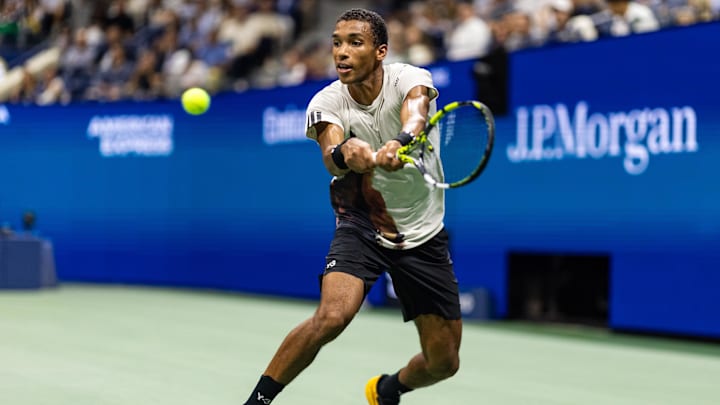
Félix Auger-Aliassime reached the semifinals of Dubai on Feb. 27 before losing to Daniil Medvedev, which enabled him to depart for Indian Wells before airspace closures caused by war in the Middle East stranded travelers, including Medvedev, for days.
It’s as good a metaphor as any for tennis, an endeavor filled with mixed and disguised blessings.
Which is why it pays to keep a pragmatic, measured and long-game approach. Victories can be Pyrrhic. Defeats can be a springboard to greatness. As coaches say, don’t get too high or too low. A year ago, Auger-Aliassime was struggling to find full form and health, losing as often as he won and ranked outside the top 20, leaving the salon to wonder if the sport was passing him by.
Then, in a span of three months, he ripped off two dozen wins, finished deep inside the top 10, and, at 25 years old, is back on track to fulfill the bold predictions that accompanied the start of his career. This year, he withdrew from his first match at the Australian Open due to cramping. Then, he recovered to win the ninth title of his career at the Open Occitanie. So it goes.
It’s all leveled what was already one of tennis’s more level heads. This maturity, coupled with his soaring tennis, makes the Canadian popular with fans, colleagues and brands. (Just this week, he announced a partnership with Polestar, the Swedish electric car brand.)

He spoke with Sports Illustrated on the eve of Indian Wells, where he is seeded No. 9.
The interview is lightly edited for clarity and brevity.
Sports Illustrated: First things, first. How’d you manage to get out of Dubai?
Félix Auger-Aliassime: Yeah, well, I got pretty lucky to get out of Dubai just in time. I mean, it was business as usual when I got to the airport. So, yeah, just a coincidence, really. Very unfortunate, obviously, for the players that were still there, you know, and for the rest of the world in that region. But for me, it was fine. So when I landed in L.A. I was quite relieved to find that I was able to get out on time.
SI: So far my year has been … blank?
FA-A: So far, my year has been very positive. I feel like I’m playing the tennis that I want. My level is good. My level of fitness is also in a good place right now, two months in. So I’m very happy with the start.
SI: We talk a lot about your success indoors. Help us understand why your success over-indexes so heavily when you leave the great outdoors?
FA-A: So yes about my success indoors, I feel like, obviously, with the way I play, my serve being one of the pillars of my game. When I’m able to get in the rhythm indoors, you don’t have to take into account the sun and the wind and every outside factor. So I’m able to get, you know, in a good rhythm. But I do find that in other tournaments as well, and on hard courts in general, I feel like it’s a surface that I play well on. We don’t play so much grass during the year, so it’s not always easy to get used to the grass. But I feel like hard court is the surface I grew up playing on and I feel like once you get into a rhythm, it’s mostly about you, yourself, and you control more of the environment.
SI: Coming out of the Olympics, assess your hockey skills. Modesty aside: If, as a kid, you had funneled your athleticism and training into hockey, what level would you be playing?
FA-A: Yeah, I really got into the hockey during the Olympics. I think we all did as Canadians, and we all pride ourselves with that. But my level? I always skated every winter. So I think if I played hockey, I think I’m an explosive athlete also on the tennis court. So I guess, yeah, I could have brought my athleticism to the ice as well. Also I have, again with tennis, pretty good hand-eye coordination and that is also required big time in hockey. So I feel like I could be a decent hockey player.
SI: Your mom once said that she observed a key to tennis is not letting your match results determine your happiness level in life/off the court. How good are you at following this maternal advice?
FA-A: Yes, my mom did say that—one of the keys was to not let the tennis result dictate your happiness in life. And I think as the years go by, I’m better at that. I feel that obviously the first years on tour, I took every loss really personally and affected my mood for maybe a day or two. And as the years went on, I was able to find more perspective and see that, to understand that you’re not going to be at your best every day, every week.
Sometimes, as a competitor, you want to be as good as you can be every day, but you just learned that it’s not going to be the case, and to accept that you’re going to have to sometimes play matches not feeling your best. You try to win as much as you can in those circumstances. And when you feel good, you try to capitalize on that. But, yeah, I feel that I have a pretty good balanced home life and family life.
JW: In Australia, you seemed genuinely confused by what had happened re: the cramping. Have you gotten some answers? Just a fluke?
FA-A: Yeah, in Australia, the cramping was quite confusing, especially for the fact that it’s not something that’s happened to me a lot in my career, and there’s circumstances that you can understand if you’re deep in a Grand Slam, or it’s very humid, or there’s high level of stress in a match. A first round of a Grand Slam, just in the third set? It was not something I thought would happen. I was very confused on the court when it was happening, and then I couldn’t really get it to go. I just couldn’t get back to a good level physically. So yeah, I guess we thought that maybe we had too short of a preparation leading up to the event, something like that. But once I got back to the practice court and to training back home after Australia, I felt much better when I started competing again.
SI: Do you respond positively or negatively to the term winning ugly?
FA-A: It’s not the best, but I don’t respond negatively to it. I think we all need it. You know players, you play most matches, and you don’t play your best. It’s not necessarily ugly, but you don’t play your best. So I think that it is something positive when you’re able to win, not playing your best.
SI: It’s often the subject of jokes and one-liners, but in all seriousness: What’s been the impact of marriage [on] your tennis?
FA-A: It’s not that simple. I mean, if it was that simple: A positive thing happens in your life, and then just start winning. It helped my life in general. It’s a positive thing that happened in my life outside of tennis or any professional thing, but I think it’s mostly credit to all the work that we’ve done as a team, that I’ve done myself. You know, that you just keep on reinventing yourself, keep on improving, keep on finding ways to be more precise on the court. And I think it’s more credit to all the work that we’ve done and and maybe there’s, yeah, a few percentage of it, that is, you know, the mood that you’re going to be in and the happiness that you’re going to have in your life, but most of it is the work.
SI: Do you want to say a few words about Milos Raonic on the occasion of his recent retirement announcement?
FA-A: Yeah, we’re 10 years apart, and he was really a role model for us in Canada growing up as kids. I remember meeting him the first time. I was probably 12, and he was starting on a tour, and he was kind of the first player from Canada to break through … at such a high level and have high standards and also commit to a level of precision in his work and ambition that we hadn’t really seen before in Canada. So as a teenager, to see him in the final of Wimbledon being No. 3 in the world, I think he was just a good example to follow. And as I got on the tour, he was always very kind with me giving me his experience. I could always call him if I needed some advice, or if I needed to talk about a few things and still can today. So he’s been a really good, good person to have around. And it’s been really good for tennis in Canada.
SI: Strictly aesthetics, who is your favorite player to watch, male and female?
FA-A: Male, I would say Roger Federer, for sure. I mean, I don’t think we’re going to see anything like it again. So that would be, that would be my take. And female, I think Ash Barty was special to watch. She just had all the tools, all the games. You could just feel like every shot had an intention behind it.
SI: If I’m in Montreal and need a dinner spot, can I do better than Monarque?
FA-A: Probably better to ask my sister, she knows all the spots. But I mean, you could do better by eating at my mom’s place. I mean, she cooks really well. My whole family does. I’m very lucky. I’m better at music than cooking.
More Tennis on Sports Illustrated
 Add us as a preferred source on Google
Jon Wertheim is a senior writer for Sports Illustrated and has been part of the full-time SI writing staff since 1997, largely focusing on the tennis beat, sports business and social issues, and enterprise journalism. In addition to his work at SI, he is a correspondent for “60 Minutes” and a commentator for The Tennis Channel. He has authored 11 books and has been honored with two Emmys, numerous writing and investigative journalism awards, and the Eugene Scott Award from the International Tennis Hall of Fame. Wertheim is a longtime member of the New York Bar Association (retired), the International Tennis Writers Association and the Writers Guild of America. He has a bachelor’s in history from Yale University and received a law degree from the University of Pennsylvania. He resides in New York City and Paris with his wife, who is a divorce mediator and adjunct law professor. They have two children.
Follow jon_wertheim