%20%20--%3E%0A%3Csvg%20version%3D%221.1%22%20id%3D%22Layer_1%22%20xmlns%3D%22http%3A%2F%2Fwww.w3.org%2F2000%2Fsvg%22%20xmlns%3Axlink%3D%22http%3A%2F%2Fwww.w3.org%2F1999%2Fxlink%22%20x%3D%220px%22%20y%3D%220px%22%0A%09%20width%3D%2239px%22%20height%3D%2240px%22%20viewBox%3D%220%200%2039%2040%22%20enable-background%3D%22new%200%200%2039%2040%22%20xml%3Aspace%3D%22preserve%22%3E%0A%3Cpath%20fill%3D%22%23FFFFFF%22%20d%3D%22M38.5%2C7H28.2v26h10.3V7z%22%2F%3E%0A%3Cpath%20fill-rule%3D%22evenodd%22%20clip-rule%3D%22evenodd%22%20fill%3D%22%23FFFFFF%22%20d%3D%22M26.1%2C25.5c0%2C5.8-4.1%2C7.5-12.9%2C7.5C3.9%2C33%2C0%2C31.2%2C0%2C25.2v-1.1h11.6%0A%09v2.4c0%2C0.7%2C0.1%2C1.4%2C1.2%2C1.4c1%2C0%2C1.2-0.4%2C1.2-1.3v-0.9c0-1.6-0.9-1.6-3.5-2.2C2.2%2C21.7%2C0%2C19.7%2C0%2C15.3v-0.9C0%2C9.3%2C5.5%2C7%2C12.9%2C7%0A%09c10.2%2C0%2C12.8%2C2.6%2C12.8%2C7.4v1.8h-11v-2.9c0-0.6-0.4-1.1-1.2-1.1c-0.6%2C0-1.2%2C0.4-1.2%2C1.1v0.9c0%2C1.5%2C0.9%2C2%2C3.3%2C2.5%0A%09c8%2C1.6%2C10.5%2C3.3%2C10.5%2C7.5V25.5z%22%2F%3E%0A%3C%2Fsvg%3E%0A)
Jannik Sinner’s Shock Upset Blows Open Roland Garros Draw
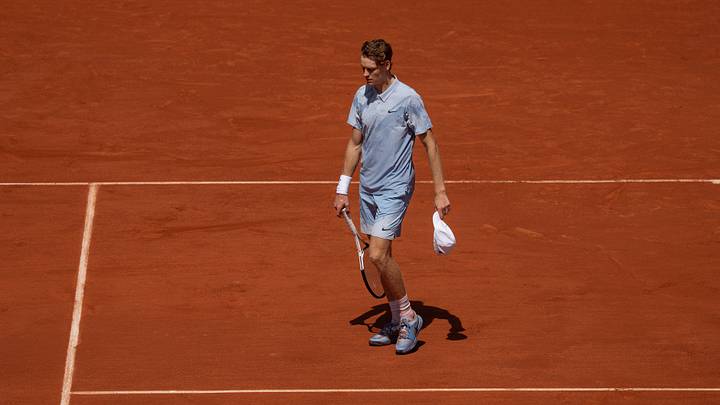
Heading into the 2026 French Open, one question hovered over the men’s draw: Could anyone—or anything—defeat Jannik Sinner, the top-ranked Italian and overwhelming favorite?
Today, on Court Philippe-Chatrier, we got the answer. In what was less a tennis match than something resembling a UFC fight held in a sauna, Sinner fell to Juan Manuel Cerúndolo of Argentina. Sinner was also done in by a game opponent, felled by physiology that—as we know from the past—does not always accommodate brutal conditions.
Playing this second-round match in 90-plus-degree heat and kiln-like conditions, Sinner took the first two sets and was up two breaks in the third set. He was minutes away from winning, and more importantly, vacating the court heading to the ice bath.
But at 5–2 in the third set, he began to wobble, visibly unsteady and uncomfortable. He left the court mid-game to be treated for heat-related symptoms (sure to be a source of controversy in the postmortem).
Let’s pause here for some history. In the Cincinnati final, in brutal Ohio heat last August, Sinner could barely post against his rival, Carlos Alcaraz, and didn’t complete the first set before retiring. In Australia, against American Eliot Spizzirri, Sinner was similarly woozy. Fortunately for him, the heat index reached the threshold for a roof closure, and he was able to finish the match in Melbourne indoors, with air conditioning.
He had no such luck on Thursday at Roland Garros. Though the conditions were oppressive, they did not trigger a roof closure. Playing al fresco tennis, Sinner missed shot after shot, struggled to move around the court, and looked nothing like a player on a 30-match win streak.
This is the point where we stop talking about conditions and praise the opponent. In the biggest match of his life—ironically with his brother, Francisco, playing simultaneously (he won, too)—Cerúndolo did what was necessary to win. He prolonged points, kept the ball deep and did not wilt, literally or metaphorically—a task easier said than done, especially for such an underdog on the cusp of such a significant win.
Highlights from Juan Manuel Cerundolo’s second-round win over Jannik Sinner ↘️#RolandGarros pic.twitter.com/BsriNNGop2
— Roland-Garros (@rolandgarros) May 28, 2026
In the end, with Sinner barely mobile, Cerúndolo pulled off the greatest men’s tennis upset in years, prevailing 3–6, 2–6, 7–6, 6–1, 6–1. If this did not have the classic ring of a sports upset—David standing toe-to-toe with Goliath, giving as severely as he was getting—it doesn’t matter. The result stands. Cerúndolo advances. Sinner is still left with no French Open title, the one major he has yet to win.
A year ago here in Paris, we were treated to one of the greatest matches of all time, as Sinner held match point but eventually lost to Alcaraz. Today was a much different type of disappointment, one that may not inflict as much mental scar tissue, but will perhaps have him analyzing his physiology and sweat and heading to the lab.
As for the tournament, the draw has now become a vast canyon of possibility. With his two tormentors out, Alexander Zverev, the highest remaining seed, is trying to win his first major. A function of the dominance of the Sinner-Alcaraz duopoly, 10 days from now, we will either get a Novak Djokovic win (and a 25th major for a 39-year-old), or a first-time major winner.
Heat and humidity won’t appear in any record books, but they will factor into the outcome as much as any forehand or backhand.
More Tennis from Sports Illustrated
 Add us as a preferred source on Google
Jon Wertheim is a senior writer for Sports Illustrated and has been part of the full-time SI writing staff since 1997, largely focusing on the tennis beat, sports business and social issues, and enterprise journalism. In addition to his work at SI, he is a correspondent for “60 Minutes” and a commentator for The Tennis Channel. He has authored 11 books and has been honored with two Emmys, numerous writing and investigative journalism awards, and the Eugene Scott Award from the International Tennis Hall of Fame. Wertheim is a longtime member of the New York Bar Association (retired), the International Tennis Writers Association and the Writers Guild of America. He has a bachelor’s in history from Yale University and received a law degree from the University of Pennsylvania. He resides in New York City and Paris with his wife, who is a divorce mediator and adjunct law professor. They have two children.
Follow jon_wertheim