%20%20--%3E%0A%3Csvg%20version%3D%221.1%22%20id%3D%22Layer_1%22%20xmlns%3D%22http%3A%2F%2Fwww.w3.org%2F2000%2Fsvg%22%20xmlns%3Axlink%3D%22http%3A%2F%2Fwww.w3.org%2F1999%2Fxlink%22%20x%3D%220px%22%20y%3D%220px%22%0A%09%20width%3D%2239px%22%20height%3D%2240px%22%20viewBox%3D%220%200%2039%2040%22%20enable-background%3D%22new%200%200%2039%2040%22%20xml%3Aspace%3D%22preserve%22%3E%0A%3Cpath%20fill%3D%22%23FFFFFF%22%20d%3D%22M38.5%2C7H28.2v26h10.3V7z%22%2F%3E%0A%3Cpath%20fill-rule%3D%22evenodd%22%20clip-rule%3D%22evenodd%22%20fill%3D%22%23FFFFFF%22%20d%3D%22M26.1%2C25.5c0%2C5.8-4.1%2C7.5-12.9%2C7.5C3.9%2C33%2C0%2C31.2%2C0%2C25.2v-1.1h11.6%0A%09v2.4c0%2C0.7%2C0.1%2C1.4%2C1.2%2C1.4c1%2C0%2C1.2-0.4%2C1.2-1.3v-0.9c0-1.6-0.9-1.6-3.5-2.2C2.2%2C21.7%2C0%2C19.7%2C0%2C15.3v-0.9C0%2C9.3%2C5.5%2C7%2C12.9%2C7%0A%09c10.2%2C0%2C12.8%2C2.6%2C12.8%2C7.4v1.8h-11v-2.9c0-0.6-0.4-1.1-1.2-1.1c-0.6%2C0-1.2%2C0.4-1.2%2C1.1v0.9c0%2C1.5%2C0.9%2C2%2C3.3%2C2.5%0A%09c8%2C1.6%2C10.5%2C3.3%2C10.5%2C7.5V25.5z%22%2F%3E%0A%3C%2Fsvg%3E%0A)
Tennis Mailbag: Craig Tiley’s Future Looms Over Australian Open
Hey everyone, happy first week of the year’s first major …
• As it is written, Wednesday is mailbag day.
• Here’s the Served Australian Open draw show. No brutal losses so far, but a lot of cuts and scrapes.
Now, on to your questions …
Jon, what’s the deal with Craig Tiley? Is he coming to run the U.S. Open or not? And if so can he be successful?
P.E., Hollywood
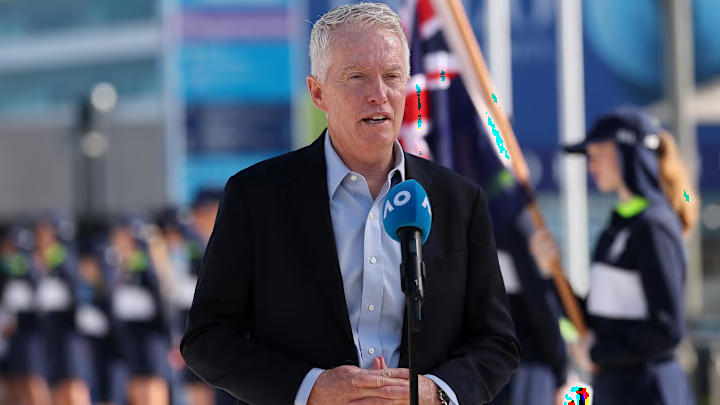
• Keep your “Can Carlos Alcaraz win without Juan Carlos Ferrero?” or “Can Jannik Sinner three-peat?” or “Can Coco Gauff overcome her technical defects?” This, to me, is one of the great intriguing storylines of the tournament. We know Stan Wawrinka, Gaël Monfils and (likely) Venus Williams are enjoying their final Australian Opens. Is Craig Tiley, CEO of Tennis Australia, also doing this drill for the final time?
Tiley—and this is meant in an unambiguously complimentary way—is a sort of benevolent despot of tennis. Firmly but mensch-ily (it’s an Australian term), he has transformed the Australian Open into a major sporting event. It’s grown exponentially during his tenure. Some of this is reflected in the balance sheets, with attendance eclipsing 100,000 in a session, revenue spikes and an increase in impressions. Some of this is seen in the smaller touches and the immeasurable buzz and vibes.
Last fall, word trickled out that the USTA was making a run at Tiley, hoping to poach him and make him the chief executive. It wasn’t the first time. But in the past, these rumors were met with quick and firm dismissals.
At September’s Laver Cup—which is basically staged by Tennis Australia, thanks to the infrastructure Tiley has built—I asked about this rumor. Some sources vigorously denied it, likening Tiley to the well-regarded coach whose name reflexively surfaces whenever there is a vacancy. Others said it was definitely a possibility, and talks were proceeding.
In December, Scott Soshnick of Sportico published this story, stating the USTA was near a deal to tap Tiley as the next CEO. Tiley declined to confirm or deny the report. I had one source tell me “it’s a done deal,” noting—as others have—that Tiley’s wife is an American and that the timing was right.
Meanwhile, an Australian source told me that Tiley has a strict non-compete that would make leaving difficult if not impossible, even if he were inclined. One source said, “I bet you dinner he’s running things by the U.S. Open.” Another source said, “I bet you dinner he’s still in Australia by 2027.” I would just as soon remove myself and let them bet each other.
Here in Melbourne, the mystery persists, and the plot thickens. Friends employed by Tennis Australia have asked us (Americans, U.S. tennis media and U.S. coaches) what we are hearing about Tiley’s potential departure. When Tiley was asked about his plans this week, he was coy saying, “Everything has an end.”
Informed speculation: Tiley wants to avoid being a distraction. He will wait for the tournament to play out before announcing any potential plans. This time seems different from past overtures. Today? The tournament is humming. There isn’t necessarily a pipeline of future Aussie major champions. His family situation is different from what it was in the past. He’s been here for two decades. He’d leave on top.
Could he be as successful in the U.S. as he’s been in Australia? Well, it depends less on him than on the circumstances. As a tennis coach at the University of Illinois, which he transformed into a tennis powerhouse (full disclosure, also where we first met), as a player development director in Australia and as the CEO of Tennis Australia, his track record speaks for itself. He is a consummate politician. He has driven revenue and growth. He has recovered from some COVID-19-era missteps. He hires brilliantly. He delegates. His appetite for work is bottomless.
The question: Can he leverage the demand for his talent and steer clear of the obstacles that make the USTA so maddening? People ask about the USTA’s sluggishness, snarl, dysfunction and political infighting. My response: It’s not that there are bad actors, bad-faith merchants, or nefarious people; it’s the governance structure of bureaucracy that is untenable and impedes growth. This leads to frustration.
As virtually everyone who encounters this says, in so many words, in a USTA exit interview: I was set up to fail. I was put in an impossible position. The organization makes success impossible.
In a perfect world, Tiley (or his agent) says, Yes, he’ll take the position. But we will need a measure of autonomy and insulation, room to operate, innovate, spend and work magic in a way that the structure and governance model doesn’t currently allow. And I ain’t moving to Orlando.
Happy New Year!! Although it’s almost mid-January, I send you my best wishes for you and your family in 2026.
One single thought about the great Novak Djokovic:
I really hope he is training very seriously and very hard to finally conquer the elusive 25th Grand Slam of his career. Imho, I don’t see any other chance of accomplishing this in the following Grand Slams. He has won the Australian Open 10 times, it’s Nole’s Slam. Unless— and I truly hope this doesn’t happen because they are so great to the sport—Carlos Alcaraz and Jannik Sinner don’t enter a Grand Slam at the same time.
Best regards,
Carlos Acosta
• Same to you. Again, Djokovic finds himself in a familiar position, and yet, a strange, unfamiliar, almost existential position. Twenty (gulp) years ago, he was stuck in third place behind two legends. But then, he was the youngest of the three. Today, he is again consigned to the role of third-party candidate. The difference: He is 15 years older than the other two.
It’s a cruel dilemma. He has also been to the semifinals of four majors running. Rankings be damned, he is the third best player in the world. Why on earth retire? Then again, when you’ve won 24 majors, and the chances of a 25th get vanishingly smaller with each passing tournament, what is the motivation?

Yes, I know Sebastian Korda is still only 25. I understand he has had issues with injuries at times. That being said, after another first-round loss in a Grand Slam tournament, is it time to say that he was highly overrated years ago. It is one thing to lose to a ranked player, it is another to lose to a qualifier. When I have watched his matches, it appears he has the physical gifts (big serve) to do well but too often finds a way to lose the match. Your thoughts.
Bob Diepold
• As some of you periodically remind me, I have picked Sebastian Korda to do big things. As Bob notes, it’s been a disappointing run, and it didn’t get better in Australia. In the first round, he lost the first two sets to Columbia senior (and NCAA champion) Michael Zheng, who had to qualify to make the main draw. Though Korda has never won a match down 0–2 sets, he has levelled it. Then, Zheng pulled through. Korda—who beat Daniil Medvedev in Melbourne three years ago—left on Day 1.
What’s going on? For all this talent and easy power, he is prone to lapses where he struggles to find the court. He is also so injury-prone that one is never sure if he’s paying at full health. And even so, you wonder if he’s throttling back because he fears another breakdown, especially aggravating his wrist injury, which is just devastating to players.
As you say, Korda is still 25. He’s still 6’ 5”. He still has a lot of game. But the salon is, rightfully, restless. And his stock is trending in the wrong direction right now.
Jon, did you know since 2010 there still have only been two male players born in the 1990s who have won Grand Slams? They are Dominic Thiem and Daniil Medvedev. What happened to that generation of players? It’s like time passed them by, and now we are having players born in the 2000s winning.
Kyle Edgeworth
Newport, RI
• This is one of the more extraordinary tennis stats. We talk about the “sandwich generation” in life, those who have kids and also have aging parents. Tennis also has a sandwich generation: those players jammed between Roger Federer, Rafael Nadal and Djokovic (and Andy Murray, Wawrinka and Marin Čilić, all born in the 80s) and the 2000s kids, Sinner and Alcaraz.
As you note, with Thiem’s retirement, one active male player born in the 90s has won a major. How many women born in the 90s have won majors? Nine. (Who can name them?)
Hi Jon,
I love watching Alejandro Davidovich Fokina. Solid game that takes him deep into matches and tournaments. It is so heartbreaking to see him not pull it out when push comes to shove at the business end of matches.
Has the scar tissue from the multiple failures become so hardened he might never overcome it? I hope he can. I would so enjoy seeing him take flight.
Have fun down under. And best of luck with the Served draw!
Best,
Jenny
• Thanks on all counts. The Served draw is hopeless.
I’m with you on ADF. There is so much to like about his game, style, as well as substance. He has so much speed. He’s on the verge of the top 10, has won more than $10 million in prize money and still seeks his first title. Funny, I just caught his semifinal match against Ugo Humbert in Adelaide the other night and it was his career in miniature. There was some top-shelf shotmaking. Some slick transitions from offense to defense. Then some shaky play in a third-set breaker and another defeat—not crushing, but stinging.
Andy Roddick and I were talking about this recently. It would be great if he won a small event, and thereby lost the “never-won-a-title” label. But if he continues to climb the ranks, reach the second week of majors, and win scores of matches each season, it’s probably worth the tradeoff.
Hi Jon,
I really enjoy the Served podcasts and watch them whenever I can. I’m glad you devoted quite a bit of time to Stan Wawrinka. You rightfully focused on his three grand slam titles and perseverance to break through at 28 years old.
What I think was left out was his dedication to Davis Cup. Switzerland would not have won the Cup in 2014 without him. I believe his winning the Australian that year is what persuaded Federer to commit to Davis Cup for the full year. Wawrinka won 4.5 points during their Cup run, including a critical win down 1–2 against Kazakhstan and a crucial win in the final over [Jo-Wilfried] Tsonga. I watched that final and thought Wawrinka was the outstanding player on court in the doubles match that set the table for Federer to clinch the title. I’m a Federer fan, but I feel that Wawrinka was the MVP of that tie. If you get a chance to discuss Wawrinka more on Served, I would like to know both yours and Andy’s thoughts on that.
Thanks very much!
Andrew Krouse, Hummelstown, PA
• Well put. And duly noted.
Garbo laughs! Rybakina smiles!
Barbara
• I’m telling you, Elena Rybakina is winning the tournament.
Enjoy the tennis, everyone!
More Tennis on Sports Illustrated
 Add us as a preferred source on Google
Jon Wertheim is a senior writer for Sports Illustrated and has been part of the full-time SI writing staff since 1997, largely focusing on the tennis beat, sports business and social issues, and enterprise journalism. In addition to his work at SI, he is a correspondent for “60 Minutes” and a commentator for The Tennis Channel. He has authored 11 books and has been honored with two Emmys, numerous writing and investigative journalism awards, and the Eugene Scott Award from the International Tennis Hall of Fame. Wertheim is a longtime member of the New York Bar Association (retired), the International Tennis Writers Association and the Writers Guild of America. He has a bachelor’s in history from Yale University and received a law degree from the University of Pennsylvania. He resides in New York City and Paris with his wife, who is a divorce mediator and adjunct law professor. They have two children.
Follow jon_wertheim