%20%20--%3E%0A%3Csvg%20version%3D%221.1%22%20id%3D%22Layer_1%22%20xmlns%3D%22http%3A%2F%2Fwww.w3.org%2F2000%2Fsvg%22%20xmlns%3Axlink%3D%22http%3A%2F%2Fwww.w3.org%2F1999%2Fxlink%22%20x%3D%220px%22%20y%3D%220px%22%0A%09%20width%3D%2239px%22%20height%3D%2240px%22%20viewBox%3D%220%200%2039%2040%22%20enable-background%3D%22new%200%200%2039%2040%22%20xml%3Aspace%3D%22preserve%22%3E%0A%3Cpath%20fill%3D%22%23FFFFFF%22%20d%3D%22M38.5%2C7H28.2v26h10.3V7z%22%2F%3E%0A%3Cpath%20fill-rule%3D%22evenodd%22%20clip-rule%3D%22evenodd%22%20fill%3D%22%23FFFFFF%22%20d%3D%22M26.1%2C25.5c0%2C5.8-4.1%2C7.5-12.9%2C7.5C3.9%2C33%2C0%2C31.2%2C0%2C25.2v-1.1h11.6%0A%09v2.4c0%2C0.7%2C0.1%2C1.4%2C1.2%2C1.4c1%2C0%2C1.2-0.4%2C1.2-1.3v-0.9c0-1.6-0.9-1.6-3.5-2.2C2.2%2C21.7%2C0%2C19.7%2C0%2C15.3v-0.9C0%2C9.3%2C5.5%2C7%2C12.9%2C7%0A%09c10.2%2C0%2C12.8%2C2.6%2C12.8%2C7.4v1.8h-11v-2.9c0-0.6-0.4-1.1-1.2-1.1c-0.6%2C0-1.2%2C0.4-1.2%2C1.1v0.9c0%2C1.5%2C0.9%2C2%2C3.3%2C2.5%0A%09c8%2C1.6%2C10.5%2C3.3%2C10.5%2C7.5V25.5z%22%2F%3E%0A%3C%2Fsvg%3E%0A)
Tennis Mailbag: Novak Djokovic’s Miami Withdrawal Sparks Debate
Submissions have been lightly edited for brevity and clarity.
Hey everyone …
• Here’s this week’s Served podcast:
• If you missed last week’s Served episode with Larry Stefanki, I highly recommend it. I’m not sure we’ve ever gotten such uniformly strong reviews (all on account of the guest). My favorite Larry Stefanki story we didn’t get to in the interview: In 1998, Stefanki coached Marcelo Ríos to the world No. 1 ranking. Ríos abruptly fired Stefanki because he wanted to go in a different direction. And he did. Within a year, Ríos had fallen out of the top 10.
• Daniil Medvedev, the long March:
Hi @united…need a little help. Flew from PSP to Florida yesterday and none of my bags arrived. Kind of need them to play in the @MiamiOpen 😉….can you help?
— Daniil Medvedev (@DaniilMedwed) March 17, 2026
Onward …
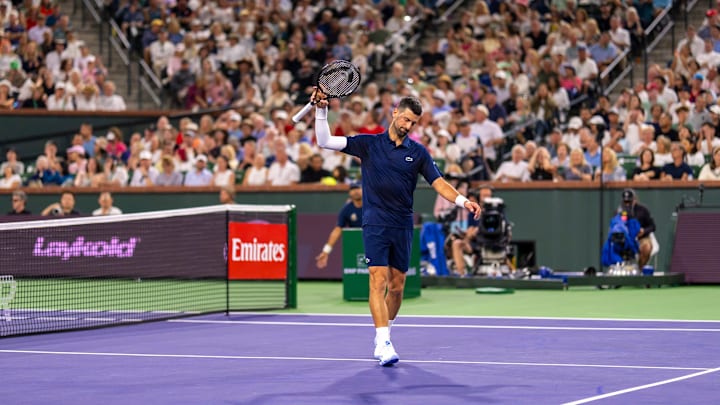
Jon, as a South Floridian, I was disappointed to see Novak Djokovic pull out of the Miami Open. I know he’s not retired. But should we come up with a term for a player who plays when they want, shows up for majors but is not reliable otherwise?
Name withheld by request
• I get the frustration, but:
A) When you’re pushing 39—and have Djokovic’s track record—you reserve the right to play when (and only when) you want.
B) Indian Wells gets the grandfather clause, but this is a peril of the extended Masters 1000s. Djokovic lost in Indian Wells in the Round of 16. He’s supposed to spend two weeks an ocean away from home, playing Minecraft and watching Love Story until his next match? As soon as he lost at Indian Wells, a former player (correctly) texted me “there goes Miami.”
Jon, thoughts on the Tennis Channel Coco Vandeweghe/Chris Eubanks Tennis Channel segment? Or can’t you talk about it?!?
R.G., New York
• I can. (For the record: I can’t recall ever being told what to say or write.) I just don’t have much to add. I work with both of them, and I like them both. They’re cool with each other. Live TV can be a dangerous beast. Onward we move.
One of you asked about another exchange, this one between a commentator and a fan who used an obscure statistic the broadcaster provided without attribution. To me, this is a far more interesting and nuanced discussion.
Brett Haber, the announcer in question, is a friend as well as a colleague, so know that in advance. But this is a deeply interesting—and not entirely settled—larger legal/philosophical discussion. Is data proprietary? Or is it, effectively, a public good?
This has gone to litigation. This has been used in sports to try to both thwart and support sports gambling. Can tennis (the ATP and the event) say, Jannik Sinner wins a tournament, that’s our framework, our scoring system, our sanctioned competition that makes this possible, our paid chair umpires and supervisors … We own that, and all the information it generated?
Or can someone, i.e., a sportsbook, say, Sinner winning a tournament—and hitting X aces and Y unforced errors and breaking serve in the third game—is factual. Bam Adebayo scoring 83 points is factual. No one owns facts. You can no more claim to own a sports fact than you claim to own the fact: Budapest is the capital of Hungary, or the fact that it rained today. (If this interests you further, give the great Ryan Rodenberg a read.)
And do note the larger stakes: If data is proprietary, a sport like tennis would have much more leverage taking a stance against sports gambling, UTR and the other “data providers.” (Hey folks, no more real-time betting on challenger events, ripe for corruption and fixing. We own that, and it’s not in our interest to make it available.)
In this case, I see both sides. You work to find a quirky tennis statistic no one else has uncovered. Yes, technically, it is a fact. But it might not have surfaced had it not been for your legwork, and you would like attribution or acknowledgement. Why not extend the courtesy of attribution? On the other hand, the viewer says, This isn’t an original thought, a piece of music, a piece of writing or anything else subject to copyright and ownership. It’s a statistic, a fact, owned by the universe.
Jon, I loved the podcast with Larry Stefanki. But it got me thinking about what tennis coaches are paid. Any thoughts here?
• In other sports, coaches’ salaries are public record. In tennis, it’s very hush-hush. As for the numbers? Well, it really depends. The old rule was that star coaches negotiated a fee, and bonuses were discretionary. Then, bonuses were included in the contracts.
Meanwhile, less heralded coaches for less heralded players received what they would make at their clubs or academies—say $1,500 a week, maybe $2,000—plus business and travel expenses.
As prize money and player purses increased, so did coaches’ wages. And bonuses, too. I know of one player who won the U.S. Open and paid—happily, but by contract, not discretion—her coach a $350,000 bonus.
A few scattered thoughts:
A) Coaches aren’t buying jets, but it’s a good living, the travel notwithstanding. There are credits and minimal debits. On the road, coaches can go days without opening their wallets. Transport, meals and hotels are covered. They’re earning and not really spending.
B) Sometimes players’ federations, including the USTA, can cover coaching salaries. One might ask, Does, say, the USTA really fulfill its mission when it pays the coaching fees of players already making millions? On the other hand, if the federation’s goal is to mint champions, taking care of financial stresses and obligations might serve that goal.
C) You can imagine the instability for a coach. One day you’re traveling the world, hanging in lounges, poised to earn a six-figure salary. Then, the player releases you, and you’re … back at the academy? Back home at the club? Back at the federation and hoping to get a new gig? Some of this instability is probably priced in.
D) Conversely, imagine the stress of a player, even a top one. Paying their coach $5,000 to $10,000 per week when they’re averaging $50,000 in weekly wages is a cost of doing business. Fine. Paying a coach $5,000 to $10,000 per week when you’re injured, idle or losing early is a tough outlay to swallow.

Hi, Jon,
What a high quality Sabalenka-Rybakina final. Did my eyes deceive me or there were actually many empty seats for such a high stake match? Not sorry for not being sorry about low occupancy on a Sunday = eye sore. Solution: Price ticket adjustment needed?
Regards,
Lourdes Pereira
British Columbia, Canada
• The bigger Indian Wells eyesore—and this needs fixing ASAP—was the new policy requiring a separate ticket for Stadium 2, which meant that tasty matches were played before vast oceans of empty seats. One of you pointed me to a photo from Victoria Mboko and Amanda Anisomova’s match, and I have no doubt the players had more fans at their practice sessions than at the match itself.
To your point, this is a persistent problem in tennis. Whether it’s the prime federation seats behind the baseline going unoccupied while the fat cats are eating canapes in suites, a flawed pricing model, or selling out to markets like Saudi Arabia where the fan base just doesn’t exist yet, the optics of empty seats are terrible. You’re trying to sell your product as this smashing, vibrant global sensation. You send breathless press releases about shattered attendance records. The casual fan at home sees your sport’s biggest stars taking the biggest courts at the biggest events … and it’s tumbleweeds.
Quick story time: When I covered the NBA, former commissioner David Stern—whose powers verged on unchecked—grew furious watching Miami Heat games. Why? Because fans with prime courtside seats arrived late, stayed in the club lounges well after halftime and left early. So on television, you had the unfortunate visuals of action unfolding before empty seats. And, worse, the seats were painted yellow, so the lack of bodies was more pronounced.
Stern not only told the owner this was unacceptable but also demanded that the yellow seats be replaced with a more neutral color. Tennis needs a David Stern sometimes.
Hi, Jon,
As usual, I always enjoy Mailbag. It’s really great to have someone consistently sharing ideas about tennis.
That said, I found your comment about “cowardly” deferring to the players’ wishes to keep five sets at the slams a little weird. As someone who has advocated, rightly so as you have done often, for the players’ needs and wants to be given more consideration, I’m not sure why that would be a cowardly position. I personally like the idea of standing up for what the players want, which doesn’t seem to happen very often these days. Of course, the flip side is that everyone does have an opinion on what’s best for the sport, especially in the broadcasting realm, and I imagine broadcasters and many commentators would prefer shorter matches than what we get with five sets. And, of course, therein lies part of the problem with all of tennis: Everyone—networks, players, fans, officials, agents, etc.—has a position and it’s hard to wrangle them altogether into something cohesive. Still, I don’t think siding with the overwhelming majority of players is cowardly at all.
Keep up the good work. You are appreciated!
Jim Barber, Atlanta
• Thanks, that’s kind of you.
Probably not the best answer I’ve given. To be clear, this was self-effacing. Here’s what I meant by “cowardly”: Like you, I lament the lack of players’ rights and representation and voice in decision-making. (Discussion for another time, but, sadly, it’s become clear to most players that the PTPA ain’t the solution.)
By the same token, my fallback of “Let’s give the players what they want” is … if not cowardly, maybe lazy? Input doesn’t mean the discussion is over. I’m sure the players want lots of things; some are reasonable. Some less so.
Players’ voices should be heard and considered. But we should not be making policy simply because of players’ desires. Simply saying (as I did) “If the male players want best-of-five matches, best-of-five it is!” is like saying “If the college kids want no Friday classes, well, there you have it, I guess we’re now a three-day-weekend institution!”
I really enjoy the Tennis Channel App … nice to be able to watch every match, have 15-minute recaps, interviews, pressers, etc. but I don’t understand why the match streams can;t be five minutes longer to include the post-match interviews instead of ending abruptly with the handshake/embrace at the net and the quick wave to the crowd?
Alan K., Greensboro, NC
• Duly noted. At the risk of sounding too cheerleader-like—and obvious conflicts of interest notwithstanding—I think you can expect some significant upgrades coming on the Tennis Channel tech front.
HAVE A GOOD WEEK, EVERYONE!
More Tennis from Sports Illustrated
 Add us as a preferred source on Google
Jon Wertheim is a senior writer for Sports Illustrated and has been part of the full-time SI writing staff since 1997, largely focusing on the tennis beat, sports business and social issues, and enterprise journalism. In addition to his work at SI, he is a correspondent for “60 Minutes” and a commentator for The Tennis Channel. He has authored 11 books and has been honored with two Emmys, numerous writing and investigative journalism awards, and the Eugene Scott Award from the International Tennis Hall of Fame. Wertheim is a longtime member of the New York Bar Association (retired), the International Tennis Writers Association and the Writers Guild of America. He has a bachelor’s in history from Yale University and received a law degree from the University of Pennsylvania. He resides in New York City and Paris with his wife, who is a divorce mediator and adjunct law professor. They have two children.
Follow jon_wertheim