%20%20--%3E%0A%3Csvg%20version%3D%221.1%22%20id%3D%22Layer_1%22%20xmlns%3D%22http%3A%2F%2Fwww.w3.org%2F2000%2Fsvg%22%20xmlns%3Axlink%3D%22http%3A%2F%2Fwww.w3.org%2F1999%2Fxlink%22%20x%3D%220px%22%20y%3D%220px%22%0A%09%20width%3D%2239px%22%20height%3D%2240px%22%20viewBox%3D%220%200%2039%2040%22%20enable-background%3D%22new%200%200%2039%2040%22%20xml%3Aspace%3D%22preserve%22%3E%0A%3Cpath%20fill%3D%22%23FFFFFF%22%20d%3D%22M38.5%2C7H28.2v26h10.3V7z%22%2F%3E%0A%3Cpath%20fill-rule%3D%22evenodd%22%20clip-rule%3D%22evenodd%22%20fill%3D%22%23FFFFFF%22%20d%3D%22M26.1%2C25.5c0%2C5.8-4.1%2C7.5-12.9%2C7.5C3.9%2C33%2C0%2C31.2%2C0%2C25.2v-1.1h11.6%0A%09v2.4c0%2C0.7%2C0.1%2C1.4%2C1.2%2C1.4c1%2C0%2C1.2-0.4%2C1.2-1.3v-0.9c0-1.6-0.9-1.6-3.5-2.2C2.2%2C21.7%2C0%2C19.7%2C0%2C15.3v-0.9C0%2C9.3%2C5.5%2C7%2C12.9%2C7%0A%09c10.2%2C0%2C12.8%2C2.6%2C12.8%2C7.4v1.8h-11v-2.9c0-0.6-0.4-1.1-1.2-1.1c-0.6%2C0-1.2%2C0.4-1.2%2C1.1v0.9c0%2C1.5%2C0.9%2C2%2C3.3%2C2.5%0A%09c8%2C1.6%2C10.5%2C3.3%2C10.5%2C7.5V25.5z%22%2F%3E%0A%3C%2Fsvg%3E%0A)
Tennis Mailbag: What Iga Świątek’s Coaching Change Means
Submissions have been lightly edited for brevity and clarity.
Hey everyone …
• Here’s this week’s Served podcast wrapping up the Miami Open:
• Here’s a new angle to the Wimbledon expansion saga.
• Story No. 1 to watch: Even before the Iran war, there had been considerable opposition within the WTA to the Finals being held in Saudi Arabia. Now, the event is looking for a new home. As lawyers review the force majeure clause of the deal (i.e., unforeseen events beyond the parties’ control that prohibit one side from fulfilling a contract), watch for other markets to emerge with bids to hold the event in the future, if not in 2026. There is a lot to discuss here. What happens to the Saudi-funded maternity policy? Did the WTA get played, giving Saudi Arabia an entree into tennis that they parlayed into a 56-draw ATP 1000 slot without a women’s event attached? Can a U.S. promoter make the math make sense?
• Story to watch No. 2: Here is the WTA’s policy on eligibility from October 2024. It will be interesting to see if this will be revisited after the IOC banned transgender women athletes from women’s events. Tennis, of course, has an interesting history here. Renee Richards is a transgender pioneer in the sport, and after going to court to secure her right to play, she played on the WTA Tour and cracked the top 20. She has firm views here.
• Congrats to Ray Benton, honored with the NJTL Founders’ Service Award during the 2026 USTA Annual Meeting & Conference, held in Orlando.
Onward …
There were a lot of questions this week about the state of the Miami Open (which were really complaints about everything from the venue to the weather to the price of parking and nostalgia for Key Biscayne). I want to acknowledge this chatter. But also—to some extent—defend the event.
• Almost 100 years ago, a prominent Miami family, the Mathesons, donated land on Key Biscayne to Dade County on the condition that a causeway/bridge be constructed, connecting Key Biscayne to the city on the mainland.
The donated land essentially became Crandon Park, where the Miami Open was staged for decades. As a condition of this donation, the deed included a clause stating that only one stadium would be built and that the land would be used “for public park purposes only.”
Matheson heirs, Bruce Matheson in particular, spent years suing the event and seeking to block any expansion, renovations and upgrades. Admittedly, it’s hard to argue that an IMG-owned tennis event was consistent with “public park purposes only.” It’s also hard to argue that an annual tournament that creates jobs, goodwill, and community isn’t a net positive, something akin to a public trust, that one of Miami’s founding families would want to support (or at least not try to block). Nevertheless, when courts found in the family’s favor, the event was cooked—at least on Key Biscayne.
IMG, the owners, could probably have made off quite nicely, selling to an overseas promoter. Instead, it looked for a creative local alternative venue.
The solution, such as it is, to hold the event inside a football stadium (Hard Rock Stadium), is not perfect. Nor is the South Florida weather in March. And everyone, Bruce Matheson notwithstanding, wishes the event had been allowed to grow and flourish on Key Biscayne.
But the tournament has to play the hand it was dealt, and I’m not sure that there was a better play.
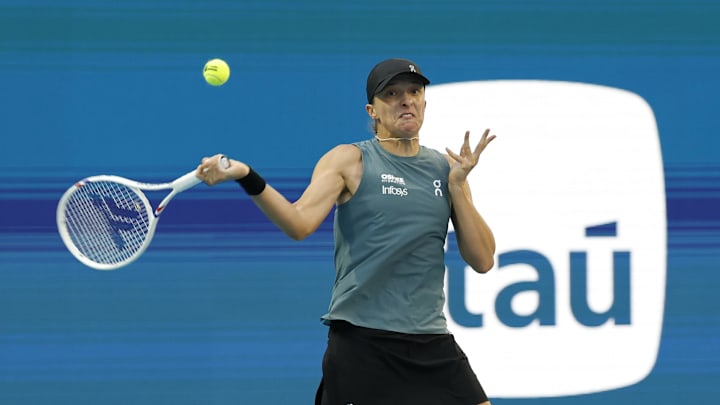
There were also a lot of questions about Iga Świątek this week. Following her early defeat in Miami, she announced she was parting with coach Wim Fissette. A number of you asked variations of “How concerned should we be?” and “Where does she go from here?”
I’m of two minds here.
1) Calm down, folks. She is 24, has won six majors on three different surfaces. She is the defending Wimbledon champion, charging to victory after a sub-par clay season that prompted many of the same questions and concerns. She’ll go to the Rafa Nadal Academy and prepare for clay, her chosen surface. She’ll find a calming veteran coach (Michael Joyce?) and reset. Careers are not straight lines.
2) But more concerningly, Świątek’s self-assessment was so harsh and personal. It was hard not to feel sympathy for her travails and admiration for her withering honesty. But I was also thinking, Wait, you have a psychologist who has long played a considerable role in your career. And you are saying things like “Tennis feels complicated in my head” and “I’ve always been an overthinker; lately it’s just been really intense.” And “I just must—I don’t know; unconsciously or consciously it’s hard for me to say—change things, and then my tennis kind of collapses.” This is problematic.
And how is firing the coach the solution? This is like a player with a highly present physiotherapist continually struggling with injuries and conditioning, then parting ways with the stringer or biomechanics expert.
A provocative question. The ATP and WTA don’t recognize Russian and Belarusian flags due to the aggressive war against Ukraine. Should they also do the same for U.S. players? Double standard?
@kevinbeaujolais
• Sure, I’ll bite here. I’ll start by differentiating between an unprovoked invasion of a sovereign democratic neighbor and a war against a repressive theocracy that massacred 30,000 citizens protesting for democracy. I say this not to defend the aggressors, but to stress the differences between Ukraine and Iran.
But your point is well-taken. Tennis’s decision to protest Russia—Vladimir Putin, really—by deciding not to acknowledge the flags of players from Russia and Belarus may have been well-intentioned. However, a sanction, even a symbolic one, imposed on individuals for a collective act, is morally debatable. And it launches us down the slipperiest of slopes, into the bouncy castle of whataboutism. Russia’s actions are blameworthy. But China’s crimes against humanity against the Uyghur population don’t meet the bar? Or the U.S.’s military intervention in Venezuela? Or Israel and the U.S.’s attacks in the Iran war? Or the Saudi-led intervention in Yemen?
Let’s acknowledge that this is tricky for both athletes and sports governing bodies. Keep politics out of sports is a naïve and hollow catchphrase. Sports and geopolitics are entangled, whether we like it or not, whether we prefer the benign diversion of sports to weightier issues. Athletes (and governing bodies) may feel pressure to avoid divisive hot-button topics. They also can feel pressure to “use their platform and privilege” and speak out in ways others can’t.
Tennis administrators may have been trying, admirably, to take a stand against unprovoked aggression that violates the social contract (perhaps especially against Putin, who uses sports success as a symbol for larger national triumphalism and has already soiled and sullied international sports with a systematic doping campaign at the 2014 Sochi Olympics), but it comes across as performative. It shames and implicates athletes who have nothing to do with matters of state and, in some cases, oppose the actions. And it opens the door to whataboutism, bad acts by other countries, which grow ever harder to defend.
So to Kevin’s question: I’d propose no flag bans, not more flag bans.

Does a soft-hitting or even moderate-hitting player have a chance at a major today? Or is power a must? Just a few years ago Ashleigh Barty was winning without crushing the ball ...
Jim Bartle
• It’s funny, I read the first sentence and immediately thought of Ashleigh Barty. You beat me to the punch. I guess what I would say is it’s really hard for a player without military-grade weapons to win majors. You can have an admirable, honorable top-10 career. But winning seven matches without the easy points on serve, the whipcrack power from the baseline and the ability to dictate play? That’s a lot to ask.
I have three caveats.
1) On the women’s side in particular—more a function of best-of-three matches than anything else—there are more avenues to win without power. Sofia Kenin won a major and reached the final of another. Ons Jabeur reached three major finals. (Same for Casper Ruud, a “moderate hitter” in your phrasing.) Emma Raducanu won a major, showing ample power but not exactly by blasting the ball.
2) Extra gears can compensate for modest power. Barty was a three-time major winner because she had so much variety. She could volley, slice and kick her serve so dramatically it required a turn signal. You can win with a power deficit, but it requires a plus factor.
3) Two trends I’ve noticed in the past 25 years: Heavy hitters move better. Serena Williams never got enough credit for her ability to prolong a point. Players like Aryna Sabalenka and Elena Rybakina are athletes, not just forces. The wisdom was that heavy hitters could be beaten by getting them on the move. Andre Agassi used to say that when he played Greg Rusedski, Richard Krajicek or Goran Ivanišević, he could turn the match into a track meet and know he’d likely be O.K. That’s no longer the case.
Also, heavy hitters have more margin built into their strokes. The flat slugging has given way to more nuance. Look at Sabalenka. She used to be a study in winner-or-error polarity. Now, she has kept her power but, using spin and shape, her unforced errors are fewer and farther between.
You have always defended Venus Williams getting wild cards for every tournament she wants to play for the last several years because she is a legend. I understand tournaments may want her to play because she can still attract a crowd. That being said, have you ever thought that a younger player could use the first round money (example around $25,000 in Miami Open) more than a multi-millionaire. At this stage, a younger player also has a better chance to advance than Venus Williams. Wonder if you ever thought of the financial angle of these wild-card entries for Venus over young players.
Bob Diepold, Charlotte NC
• To an admittedly irrational degree, I am offended by wild cards. Some of this is fundamental. Sports are predicated on fairness, tennis in particular. Here we have an artificial device that lets players jump the line. Some of this is seeing how wild cards are dispensed in practice. IMG owns an event, so it is able to hand out wild cards to IMG players and, in some cases, even their relatives? Come on.
I also concede that wild cards are necessary. Tournaments need a mechanism to bend the rules on occasion, accommodating fans (and balance sheets) by offering slots to stars, late entries, up-and-comers with heat, etc.
Your question is fair. In Venus Williams’s defense, she is a legend. Future generations will both hear and tell stories about her. She is north of 40, so there’s the rage-against-the-dying-of-the-light storyline. Is this not exactly why wild cards exist? Yes, she has won one match since Cincinnati 2023. I don’t care.
It would be one thing if there were a firm policy here. If, to Bob’s point, wild cards were distributed as a way to prop up the finances of struggling players. But since wild cards are used, abused and distributed arbitrarily, I feel like we’ve forfeited the right to question Venus Williams’s situation.
HAVE A GOOD WEEK, EVERYONE!
More Tennis from Sports Illustrated
 Add us as a preferred source on Google
Jon Wertheim is a senior writer for Sports Illustrated and has been part of the full-time SI writing staff since 1997, largely focusing on the tennis beat, sports business and social issues, and enterprise journalism. In addition to his work at SI, he is a correspondent for “60 Minutes” and a commentator for The Tennis Channel. He has authored 11 books and has been honored with two Emmys, numerous writing and investigative journalism awards, and the Eugene Scott Award from the International Tennis Hall of Fame. Wertheim is a longtime member of the New York Bar Association (retired), the International Tennis Writers Association and the Writers Guild of America. He has a bachelor’s in history from Yale University and received a law degree from the University of Pennsylvania. He resides in New York City and Paris with his wife, who is a divorce mediator and adjunct law professor. They have two children.
Follow jon_wertheim