%20%20--%3E%0A%3Csvg%20version%3D%221.1%22%20id%3D%22Layer_1%22%20xmlns%3D%22http%3A%2F%2Fwww.w3.org%2F2000%2Fsvg%22%20xmlns%3Axlink%3D%22http%3A%2F%2Fwww.w3.org%2F1999%2Fxlink%22%20x%3D%220px%22%20y%3D%220px%22%0A%09%20width%3D%2239px%22%20height%3D%2240px%22%20viewBox%3D%220%200%2039%2040%22%20enable-background%3D%22new%200%200%2039%2040%22%20xml%3Aspace%3D%22preserve%22%3E%0A%3Cpath%20fill%3D%22%23FFFFFF%22%20d%3D%22M38.5%2C7H28.2v26h10.3V7z%22%2F%3E%0A%3Cpath%20fill-rule%3D%22evenodd%22%20clip-rule%3D%22evenodd%22%20fill%3D%22%23FFFFFF%22%20d%3D%22M26.1%2C25.5c0%2C5.8-4.1%2C7.5-12.9%2C7.5C3.9%2C33%2C0%2C31.2%2C0%2C25.2v-1.1h11.6%0A%09v2.4c0%2C0.7%2C0.1%2C1.4%2C1.2%2C1.4c1%2C0%2C1.2-0.4%2C1.2-1.3v-0.9c0-1.6-0.9-1.6-3.5-2.2C2.2%2C21.7%2C0%2C19.7%2C0%2C15.3v-0.9C0%2C9.3%2C5.5%2C7%2C12.9%2C7%0A%09c10.2%2C0%2C12.8%2C2.6%2C12.8%2C7.4v1.8h-11v-2.9c0-0.6-0.4-1.1-1.2-1.1c-0.6%2C0-1.2%2C0.4-1.2%2C1.1v0.9c0%2C1.5%2C0.9%2C2%2C3.3%2C2.5%0A%09c8%2C1.6%2C10.5%2C3.3%2C10.5%2C7.5V25.5z%22%2F%3E%0A%3C%2Fsvg%3E%0A)
Tennis Mailbag: What’s Next for Novak Djokovic After His Early U.S. Open Exit?
As it is written, Wednesday is mailbag day.
• Reminder: The Served podcast’s “Quick Served” episodes wrap up the U.S. Open action every day.
• The Tennis Channel’s pregame show runs 9:00 a.m. to 11:30 a.m. ET every morning.
• We’re trying a new feature at Sports Illustrated in conjunction with Subtext. It’s a free SMS channel where you can get exclusive insight, behind-the-scenes stories, match analysis and direct access throughout the U.S. Open, all delivered straight to your phone. Check it out here.
Onward, with some scattered U.S. Open chatter …
Hi Jon,
Novak [Djokovic] made his U.S. Open debut in 2005, playing Gael Monfils in the first round when both were 18. What are the chances that 21 years later, he’d still be competing at the Open and see his very first opponent in the draw as well?
Ted Cornwell, Minneapolis
• There were a lot of questions this week about when to say when and about older players facing the excruciating decision to end a career. You don’t want, in the sports parlance, “to leave anything out there.” You also don’t want to compete below the standard you set. Sometimes (Roger Federer and Rafael Nadal spring to mind) the body decides for you. Sometimes you leave on your terms and never look back (like Steffi Graf and Pete Sampras). Most athletes end up doing a more delicate dance, or, to change metaphors, try to time the market, which, of course, is nearly impossible.
Stan Wawrinka did this right. He announced this was his final year, remaining competitive and even dipping to the Challenger level to resume playing and regain form. He has received wild cards but has comported himself well. He lost in the U.S. Open to Matteo Berrettini (for the second consecutive major) and got his send-off. Next stop, Newport. Gaël Monfils is not Newport bound but, now 40, is still delighting in his final major.
OH NO, HE DIDN'T! 🤯
— US Open Tennis (@usopen) September 2, 2026
The good old ELEVATION SENSATION 🚀 pic.twitter.com/nGFfXqyr3u
Venus Williams, at 46, was defeated by Sofia Kenin in the first round at the U.S. Open, marking Venus’s (yikes) 15th consecutive singles loss (and this likely signifies her last singles match at a major). She is a star. She is—literally, for a term often overused—a legend. Her longevity is another twist in a singular career. But I’m told that multiple big tournaments will adopt an “enough is enough” policy and are not inclined to offer her a singles wild card in 2027.
You’d love to take a pickax and miner’s helmet and excavate here. Why is Venus doing this? How is a woman always synonymous with pride, tolerating 15 (!) straight losses? Does she genuinely think she can win matches? Is the competition alone nourishing her? Perhaps we’ll never know. It’s a fascinating chapter for a player who once bragged about retiring in her early 20s to pursue other pursuits. But it seems the end is upon us. Sorana Cîrstea has announced that this is her last year. Suddenly, she’s playing better than ever and has yet to reconsider her decision.
Which brings us to Novak Djokovic. Since 2024, he’s been in purgatory. He is good enough to be a major contender and play deep at the four big events, but not quite good enough to surmount both Jannik Sinner and Carlos Alcaraz. Why retire when you’re still challenging for major titles? Why continue when you are 39, have won 24 majors and are no longer getting on the board?
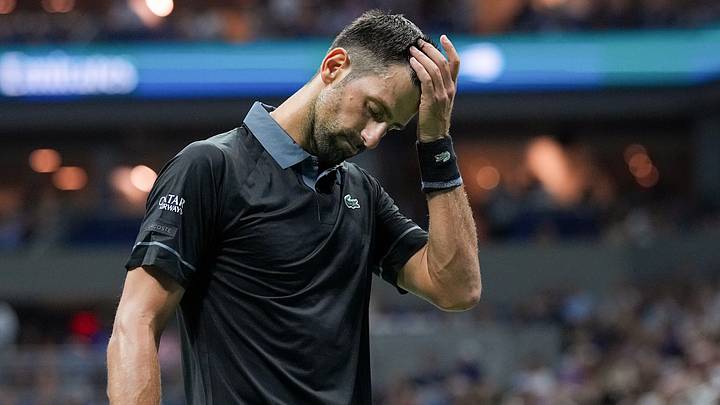
Yet, I think we might now have entered a new phase, a new ring of hell if we keep with the purgatory theme. Djokovic lost first-round matches in Cincinnati and New York. (Both, ironically, to Argentines, Thiago Agustín Tirante and Mariano Navone, respectively.) Both times he took ill on the court. Both times, it was hot and humid, but hardly oppressively so. Both times, his body simply didn’t execute as his mind wanted it to. Both times, he looked—and conceded he felt—miserable.
For years, we have said, It’s Djokovic. So long as he gives himself a fighting chance and catches a few breaks, heck yes, he could win No. 25. Well, at this event, he came in knowing Sinner (who beat him at Wimbledon) wasn’t in the draw and Alcaraz (who beat him in Australia) was nursing that wrist injury. Even João Fonseca (who beat him in Paris) was out. And Djokovic failed to advance beyond the first round at a major for the first time in two decades?
Djokovic being Djokovic, he can turn his mystery illness into another challenge to overcome, another perceived slight, another source of motivation. He can use the “silence the doubters” trope as ammunition. He can still hold the 2028 Olympics as a goal, though it’s 22 months away and he’ll be 41.
The great ones, they aren’t wired like us–doubt them at your peril. And no one should encourage athletes in individual sports to leave. It’s their decision. But looking at the Djokovic situation objectively, it’s hard to envision him winning another major. Losing to Sinner or Alcaraz at the business end of a major is one thing. Losing in the first round to Navone (no shade!), gassing out in the fourth and fifth sets is another. And if he’s not realistically competing for majors, will it be enough to sustain him? Especially when he’s not having fun on the court.
We had a few inquiries about Nick Kyrgios and his suspension after testing positive for cocaine.
Stefanos Tsitsipas, Kyrgios’s longtime nemesis, weighed in, as did Karen Khachanov. I don’t have much to add; however, I can report that Kyrgios is in a drug treatment program and that his positive test for a recreational drug was deemed out-of-competition, so that will likely equate to a three-month suspension, much of which has already been served.
Now what? Let’s leave tennis out of this. I was thinking that if I were his agent (or friend), I would connect him with Matt Barnes, or at least hold him up as an example. Here is an athlete who made some regrettable choices, self-sabotaged, faced suspensions and arrests. Then, he course-corrected, made better choices, found his voice, and now, in his mid-40s, is a well-regarded former NBA player who has built a successful media company.
Hi Jon, It is patently, stupifyingly, astonishingly, dumbfoundingly, flabbergastingly idiotic to begin a tennis match at 12:13 am. And like Forrest Gump, that is all I have to say about that.
Well actually, no, it isn’t. I’ve had the misfortune to be at one or two of these marathons, and despite the commentators cheerleading “this is what it’s all about,” “the crowd loves it,” “this is New York,” etc. and so forth, the crowd can get pretty thin as the clock strikes midnight and beyond.
This isn’t good for anyone, the fans, the players, who after all, are athletes not bar tenders, and how about the ball kids? I know, it’s all in the pursuit of filthy lucre … What was I thinking? … but at some point doesn’t common sense have to take over? Perhaps reduce the cost of a ticket to the night session … gasp! … and just play one match, like Roland Garros? (In Oz, of course, they play two, and they’ve had the same problem.)
Stop the insanity!
Gavin, NYC
• The word I use is unserious. Saying the match is the “latest start ever” is no record to trumpet proudly. It’s an embarrassment, a chronological expression of a sport that doesn’t have its act together. Through three days, all three night sessions have gone past midnight.
Something has to give. You want to start a night session at 7 p.m. local time. You also want two matches, a best-of-five format for men and refuse to play women first. If those are the nonnegotiables, there is nothing to prevent the absurdity of Sunday night.

I would nominate Karolína Plíšková as the best women’s player to never win a major. She made two Grand Slam finals (Wimbledon, U.S Open) losing both finals in three sets. Losing to Ash Barty and Angelique Kerber is not a bad loss and Pliskova was ranked No. 1 for eight weeks. She also has made SF or better in all four Grand Slam events. At 34, she is climbing back in the rankings but is past her prime. Having watched her play all these years, she had big serve and groundstrokes but her mobility seemed to be her downfall. Your thoughts on her career.
Bob Diepold, Charlotte NC
• Do you mean active (which Plíšková is) or ever? You could definitely make a case for her as the best active player never to have won a singles major (though I would probably take a different Czech Karolina—Muchová—over her). Jessica Pegula would be my second choice. As far as the best all-time women’s player never to have won a major? I think you make a compelling case. Helena Suková? Jelena Janković? But yes, any player who reached No.1 and advanced to multiple major finals has to be considered.
Jon,
Give me the most ridiculous stat in tennis. I would say miles per hour. Who cares if a player hits it hard if they can’t keep it in the court. And without naming names, who cares if you hit a 135 mph serve if the opponent gets it back.
• Well said. I was visiting an NFL team last month, and we were talking about the difference between counting and measuring. That is: Is the metric actually telling a relevant story, or is it just a number? A 40-yard dash time is a popular metric, but when does a football player run 40 yards in a straight line in a dead sprint? (Answer: Most commonly, when there’s a potential pick-six, which is rare and suboptimal.) Measuring a player’s ability to take the correct angle on a tackle, block, or run is harder but ultimately more valuable.
To some extent, this is a similar case. Miles per hour tells us something about power (and technique), but raw mph can be deceptive. How often are you hitting absolutely max speed? Placement, spin, and recognizing the returner’s pattern are much more important than raw speed.
What about the first-serve percentage? If my serve is a point-starter, I might have a 90% first-serve percentage, but what does that get me? Other times, players will barely make half of their first serves, but when they hit their spots, it can be devastating. Also, especially since aces are included, a winner count can be of limited use.
ENJOY THE U.S. OPEN, EVERYONE!
 Add us as a preferred source on Google
Jon Wertheim is a senior writer for Sports Illustrated and has been part of the full-time SI writing staff since 1997, largely focusing on the tennis beat, sports business and social issues, and enterprise journalism. In addition to his work at SI, he is a correspondent for “60 Minutes” and a commentator for The Tennis Channel. He has authored 11 books and has been honored with two Emmys, numerous writing and investigative journalism awards, and the Eugene Scott Award from the International Tennis Hall of Fame. Wertheim is a longtime member of the New York Bar Association (retired), the International Tennis Writers Association and the Writers Guild of America. He has a bachelor’s in history from Yale University and received a law degree from the University of Pennsylvania. He resides in New York City and Paris with his wife, who is a divorce mediator and adjunct law professor. They have two children.
Follow jon_wertheim