%20%20--%3E%0A%3Csvg%20version%3D%221.1%22%20id%3D%22Layer_1%22%20xmlns%3D%22http%3A%2F%2Fwww.w3.org%2F2000%2Fsvg%22%20xmlns%3Axlink%3D%22http%3A%2F%2Fwww.w3.org%2F1999%2Fxlink%22%20x%3D%220px%22%20y%3D%220px%22%0A%09%20width%3D%2239px%22%20height%3D%2240px%22%20viewBox%3D%220%200%2039%2040%22%20enable-background%3D%22new%200%200%2039%2040%22%20xml%3Aspace%3D%22preserve%22%3E%0A%3Cpath%20fill%3D%22%23FFFFFF%22%20d%3D%22M38.5%2C7H28.2v26h10.3V7z%22%2F%3E%0A%3Cpath%20fill-rule%3D%22evenodd%22%20clip-rule%3D%22evenodd%22%20fill%3D%22%23FFFFFF%22%20d%3D%22M26.1%2C25.5c0%2C5.8-4.1%2C7.5-12.9%2C7.5C3.9%2C33%2C0%2C31.2%2C0%2C25.2v-1.1h11.6%0A%09v2.4c0%2C0.7%2C0.1%2C1.4%2C1.2%2C1.4c1%2C0%2C1.2-0.4%2C1.2-1.3v-0.9c0-1.6-0.9-1.6-3.5-2.2C2.2%2C21.7%2C0%2C19.7%2C0%2C15.3v-0.9C0%2C9.3%2C5.5%2C7%2C12.9%2C7%0A%09c10.2%2C0%2C12.8%2C2.6%2C12.8%2C7.4v1.8h-11v-2.9c0-0.6-0.4-1.1-1.2-1.1c-0.6%2C0-1.2%2C0.4-1.2%2C1.1v0.9c0%2C1.5%2C0.9%2C2%2C3.3%2C2.5%0A%09c8%2C1.6%2C10.5%2C3.3%2C10.5%2C7.5V25.5z%22%2F%3E%0A%3C%2Fsvg%3E%0A)
How Climate Change Is Threatening to Melt Away the Future of the Winter Olympics
As the sun beamed down on the Navigli, the canal system that runs throughout Milan, tourists flocked into the shops along the water, wearing little more than light jackets to shelter from brisk conditions. This doesn’t seem like the Winter Olympics of the past.
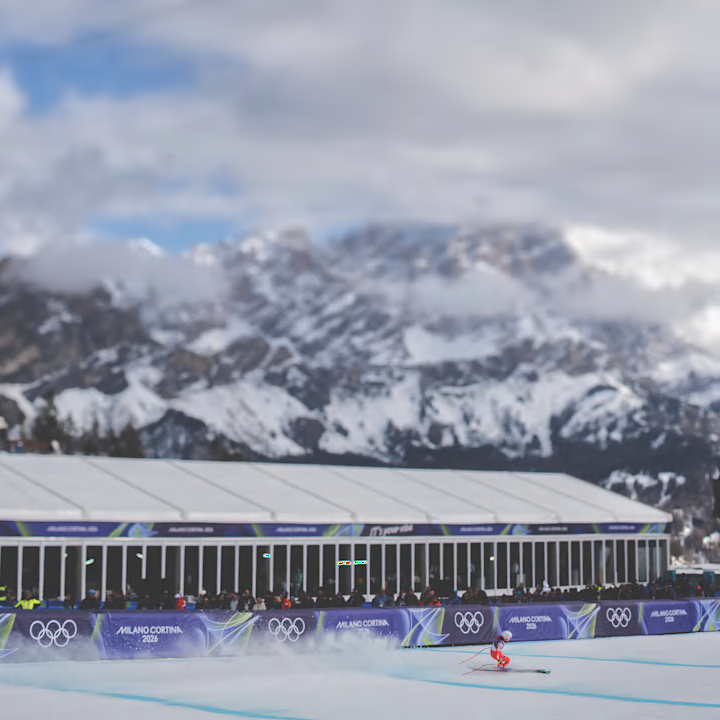
Off on lengthy drives into the mountains, five other host municipalities of the 2026 Milan Cortina Olympics saw varying conditions. British skier Andrew Musgrave raced shirtless amid high temperatures in cross-country skiing in Tesero, while organizers made the most of man-made snow to showcase Olympic competition.
This is mid-February, a time when the Italian Dolomites are historically flush with powder, attracting some of the world’s most famous athletic competitions. Yet for these Olympics, nearly all the snow was man-made, drawn from high-elevation water reservoirs, including at the Livigno Snow Park where a basin capable of holding about 200 million liters of water was constructed. Meanwhile, the final days of the Winter Olympics in Milan featured high temperatures of 65°F, potentially contributing to several short-track speedskating crashes in the final session.

When the Games close in four years’ time, it won’t be your typical winterscape. Instead, the closing ceremony of the French Alps 2030 Olympics will be held along the Nice beachside promenade of the French Riviera, a distinct symbol of the rapidly changing dynamic of the Winter Games.
Simply put, the Winter Olympics don’t have enough winter anymore. It’s melting away, dripping from the forefront of the Olympic movement and threatening the future of winter sports. And unless something drastically changes, potential host cities will continue to diminish each year due to climate change.
For American moguls skier Jaelin Kauf, who won two medals at Milan Cortina 2026, the stark situation is clear. Kauf is an athlete representative of Protect Our Winters, an advocacy group pushing sustainability efforts in winter sports.
“For the most part, the courses that we’re skiing on and competing on are man-made snow, that’s just kind of a reality of a lot of our sport,” she says. “It takes a lot of snow to build a moguls course, or to build a halfpipe or freeride venue.”
In 2022, 339 Olympic winter sports athletes and coaches across 20 countries were surveyed in a study that found 94% of participants feared that climate change would adversely impact the future development of their sport.
In 2023, with signatures from over 420 athletes, including U.S. stars Mikaela Shiffrin and Jessie Diggins, Protect Our Winters submitted an open letter to the International Ski and Snowboard Federation (FIS) demanding a strategy to achieve its climate commitments in the United Nations Sports for Climate Action Framework, asking for further transparency on climate action.
“It’s a very special position to be in when you’re an athlete in winter,” says Norwegian Alpine skier Atle Lie McGrath, who was among the signatories. “Winter sports are my life, and if we lose our winters, I would lose my passion and everything I love, so it’s super important that we all come together ... trying to find small changes that make a big impact to make winter sports and the Winter Olympics safe and long-lasting.”
Kauf, who earned a degree in environmental and sustainable studies from the University of Utah, has seen climate conditions deteriorate firsthand every year since debuting on the World Cup circuit in 2017.

The circuit often stops in previous Olympic host cities, with one of the season’s marquee events held at a 2002 Olympic venue in Deer Valley, Utah. The venue will welcome the Winter Games again for the statewide 2034 Utah Games; however, this season the Deer Valley event had to be moved to Lake Placid, N.Y. Instead of a flush snowpack, specks of dirt and grass poked through the snow, and high temperatures made conditions too warm to allow for an adequate snow-making effort.
“Being a mogul skier, you see it all in front of you, and this season has just been a small snapshot of the larger, and really growing issue,” Kauf says from Livigno during the 2026 Olympics.
“Deer Valley was one of our best and most reliable venues, so to not be able to put on a World Cup event there, it really just speaks to the larger scale of things and our other events. … We’ve had rain at almost every single World Cup this season.”
Future of the Games in Doubt
For many Olympic events, there is a requirement for man-made snow and adapted artificial cooling techniques to combat warming temperatures across host venues. Artificial snow made its debut at the 1980 Lake Placid Olympics, and since then, its use has increased at nearly every Games.
At the Vancouver Games in 2010, snow had to be trucked in from higher altitudes for freestyle venues, and at Sochi in 2014, with temperatures rising into the mid-60s, 80% of the snow was artificial.
At PyeongChang in 2018, up to 98% was man-made, and the 2022 Olympics in Beijing became the first to use entirely man-made snow, requiring 100 snow generators, 300 snow cannons and as much as 343 million gallons of water, according to Business Insider.
Overall, snow and cold conditions have become increasingly unreliable. February temperatures in every Olympic host city since 1950 have warmed by an average of 4.8 degrees, according to data from research non-profit Climate Central.

The Dolomites in northern Italy have offered a slight reprieve. Despite their historical reliability, they still require significant mechanical support to be ready for competition.
It all paints a rather dire outlook on the future, according to Daniel Scott, a strategic director for climate change education in environment at the University of Waterloo and the lead author of a paper researching the impact of climate change on snow sports. The study, initially published in 2024, examined the future suitability of previous Winter Olympic and Paralympic sites, using climate projection models to predict continued warming and snow probabilities in host cities into the 2050s and 2080s.
Scott was then invited by the International Olympic Committee to analyze a greater selection, expanding to 93 areas, including past and potential future hosts. As a key prognosticator, it used the Paris Agreement, which was signed by 195 countries but currently does not include the U.S.
The study assessed a potential host’s climate reliability based on the probability of minimum daily temperatures of 0° Celsius or lower and the probability of snow depth exceeding certain thresholds. At the same time, it looks at the reliability of making and maintaining a snowpack and the area’s energy infrastructure needed to provide those abilities. The study found that 52 of the possible 93 locations could reliably host the Olympics in February by the 2050s.
While the best-case scenario of every country meeting its commitments under the Paris Agreement is unlikely, it also does not appear that the worst-case scenario is approaching either, Scott says. In that high-emissions, worst-case scenario, Scott says only 27 locations in Europe, North America, and Asia could host the Games in 50 years.
The most plausible forecast is what he calls a “current policy scenario.” This projection outlines the potential path forward for the Olympics in mid-February, should countries stay on current climate trajectories, even if they are sliding away from the Paris Agreement.
“Some people have said, ‘Why don’t we just go to places where we don’t need snow-making?’ ” Scott says, with the study showing only four potential hosts without man-made snow as soon as the 2050s, including Niseko, Japan; Terskol, Russia; and Val-d’Isère and Courchevel in France.
“Many of those potential options are at high elevations, and the usability from an athlete’s perspective is a little bit more challenging. So that’s just a non-starter,” Scott says. “It’s like saying we’re going to move hockey back outside. We’re not, and we can’t. Otherwise, we’re going to lose the snow sports from the Winter Olympics, and I don’t think anybody wants that.”
Infrastructure Defines the Future
Energy infrastructure also plays a critical role here. For example, France’s snowmaking and cooling capabilities rely on a national nuclear energy grid that provides about 70% of its energy.
The 2030 French Alps Games, therefore, offers a more sustainable outlook than the efforts of 2034 Olympics in Utah, which, as of 2024, relied on 45% coal and will, according to Scott, have a “16- to 20-times difference in their carbon emissions footprint.”
Beyond initial concerns, the need to spread out the Games, akin to Milan Cortina, could evolve. While previous Winter Olympics could rely on shorter distances between venues, the 2026 Games spanned more than 8,000 square miles.
“The snow sports venue is getting further and further from the primary hosting area for the Games,” Scott says, noting the 2010 Vancouver Olympics, which sparked his initial 2024 study, had roughly 75 miles between Vancouver and the alpine village of Whistler where the ski racing and sliding events were held.
For European locations this means looking at higher elevations, while North America could become more reliant on the Rocky Mountains, further emphasizing the importance of previous host cities, including Salt Lake City and Calgary.
Unpredictably, not all plausible venues from a climate perspective can be used once facilities, costs and geopolitical factors are taken into consideration.
“There are some great cold areas of Russia, but geopolitically, that can’t happen right now,” Scott says, unable to share the entire list of potential host cities, while adding some parts of the world that have “really high elevation, really good, reliable, cold,” but a lack of winter sports culture.

While former Salt Lake City mayor Rocky Anderson, who helped lead hosting efforts in 2002, has cast doubt on whether the state could successfully put on another Winter Olympics, Utah 2034 should be reliable. The study shows it has a 90% reliability for the Games in the current policy scenario.
The IOC and the International Paralympic Committee see the need for evolution in planning in a similar light and have shifted the requirements on host cities. This allows for greater venue reuse, a more spread-out Games and other adaptable factors that were previously not applicable.
Technology adaptations have also been key over previous eras and will continue to be. Previous technological developments include shifting hockey and figure skating indoors to artificially cooled arenas and transitioning sliding events to artificially cooled tracks. Those adaptations will become even more critical as new hosting areas are considered, including the possibility of events in the Middle East. Saudi Arabia had shown interest in winter events and was initially awarded the 2029 Asian Winter Games, before construction delays on the modern city of Neom forced the event to relocate to Almaty, Kazakhstan.
“Sustainability is about taking action, which translates into results, and Milano Cortina has been trailblazing what is a new model,” said Olympic Games Executive Director Christophe Dubi. “Sustainability is a priority. We don’t have a choice but to make a positive impact on the three spheres of sustainability.”
With competition dates traditionally set in mid-February, the Olympics face a more positive future than their co-event, the Paralympics, which, since 1992, has been held two weeks after the Olympics in the same host city in mid-March.
For the Paralympics, the threat of climate change is more pressing. According to the Waterloo study, only 17 to 31 of the 93 examined options could reliably host the Paralympic Games. As such, there may need to be adaptations for both—whether moving the Olympics earlier or shifting the Paralympics to a different timeframe.
“It’s time to explore everything and anything,” IOC president Kirsty Coventry said ahead of Milan Cortina. “It’s impacting us as a group, and as a sports movement together, and we have to have these conversations on how we foresee things in the future and how we are going to adapt the historical timing of things to ensure that we can still hold our sports events around the world.”
Athletes Push for Change
The pressure for change is not lost on the athletes. Yet, one Canadian aerialist has taken the focus to a new level. Marion Thénault is one of the most outspoken athletes on climate change and has tracked her personal carbon footprint since winning a bronze medal at Beijing 2022.
In 2024–25, she expanded her tracking to every team on the aerials World Cup circuit, with the aim of showing FIS how it could evolve to reduce flight distances and carbon emissions across the board. She has since started cycling to and from the training facilities when possible, while substituting plane travel for trains, busses and carpools, even as a North American competing in a largely European-based circuit.

Although Kauf hasn’t taken mathematical measures when it comes to competing on the moguls circuit, the emphasis on switching her routines to reduce her carbon footprint has also become a focal point. While she too has switched her methods of travel when possible and has worked to eliminate single-use plastics, she says it’s also evident that individual changes are not the key to saving winters.
“It’s the bigger issue at hand; it isn’t entirely on us as individuals. It’s about really advocating for holding these fossil fuel companies responsible for what they’re doing,” Kauf says. “I really hold out hope that there are enough of us working toward these changes and believe that if enough of us start to really come together to advocate, to hold people and companies responsible, that we can really make these changes.”
For now, athletes and organizers at the Milan Cortina Games have brought some of the magic back to the Winter Olympics, after years away from traditional venues and picturesque mountainscapes, even if the atmosphere around Milan itself may not define winter.
What is clear, though, is that for an event designed to showcase the snowy season, a changing world is shaking it to its core, and the need for change and adaptations will be an ever-growing challenge.
Without adaptation, the Winter Olympics will do nothing more than what snow does in the spring—simply melt away.
More Winter Olympics on Sports Illustrated
 Add us as a preferred source on Google
Ben Steiner is an American-Canadian journalist who brings in-depth experience, having covered the North American national teams, MLS, CPL, NWSL, NSL and Liga MX for prominent outlets, including MLSsoccer.com, CBC Sports, and OneSoccer.
Follow BenSteiner00