%20%20--%3E%0A%3Csvg%20version%3D%221.1%22%20id%3D%22Layer_1%22%20xmlns%3D%22http%3A%2F%2Fwww.w3.org%2F2000%2Fsvg%22%20xmlns%3Axlink%3D%22http%3A%2F%2Fwww.w3.org%2F1999%2Fxlink%22%20x%3D%220px%22%20y%3D%220px%22%0A%09%20width%3D%2239px%22%20height%3D%2240px%22%20viewBox%3D%220%200%2039%2040%22%20enable-background%3D%22new%200%200%2039%2040%22%20xml%3Aspace%3D%22preserve%22%3E%0A%3Cpath%20fill%3D%22%23FFFFFF%22%20d%3D%22M38.5%2C7H28.2v26h10.3V7z%22%2F%3E%0A%3Cpath%20fill-rule%3D%22evenodd%22%20clip-rule%3D%22evenodd%22%20fill%3D%22%23FFFFFF%22%20d%3D%22M26.1%2C25.5c0%2C5.8-4.1%2C7.5-12.9%2C7.5C3.9%2C33%2C0%2C31.2%2C0%2C25.2v-1.1h11.6%0A%09v2.4c0%2C0.7%2C0.1%2C1.4%2C1.2%2C1.4c1%2C0%2C1.2-0.4%2C1.2-1.3v-0.9c0-1.6-0.9-1.6-3.5-2.2C2.2%2C21.7%2C0%2C19.7%2C0%2C15.3v-0.9C0%2C9.3%2C5.5%2C7%2C12.9%2C7%0A%09c10.2%2C0%2C12.8%2C2.6%2C12.8%2C7.4v1.8h-11v-2.9c0-0.6-0.4-1.1-1.2-1.1c-0.6%2C0-1.2%2C0.4-1.2%2C1.1v0.9c0%2C1.5%2C0.9%2C2%2C3.3%2C2.5%0A%09c8%2C1.6%2C10.5%2C3.3%2C10.5%2C7.5V25.5z%22%2F%3E%0A%3C%2Fsvg%3E%0A)
How Scoring Works in Olympic Curling
The Winter Olympics are officially underway, and that means it’s time for more curling. One of the most unique and oldest sports in the world, curling has a rich history that dates all the way back to Scotland in 1716.
Curling is often referred to as chess on ice for the strategic elements of the sport. The strategy of curling makes it both an intriguing—and sometimes confusing—watch.
So with plenty of Olympic curling on the schedule at the Milan Cortina Olympics, here’s a brief explainer on the rules of curling, including how scoring works.
How does curling work?
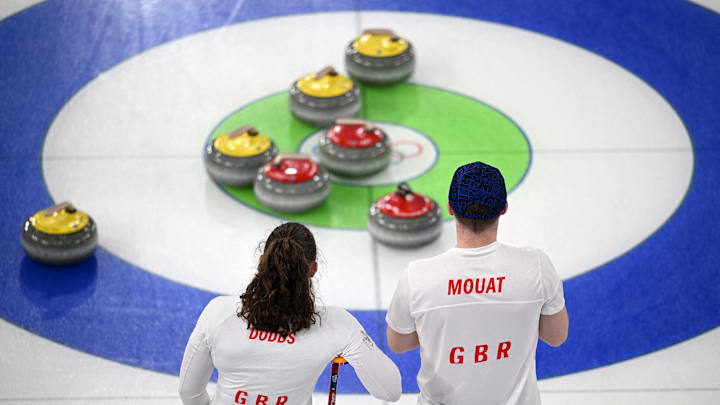
Curling is a winter sport played on ice where teams of players compete by sliding granite stones (weighing 17 to 19 kilograms or 37 to 41 pounds) down the ice towards a target known as the house. Curling is normally played by two teams of four players each, but mixed doubles curling sees teams of two, a male and female player, compete against each other.
Games of curling are 10 rounds, also known as ends. In each end, teams throw a total of eight stones, taking turns one at a time. In the mixed doubles event, the two teams throw a total of five stones per end, culminating in a total of eight ends played.
How is curling scored?
Both teams enter each end with a chance to score, but only one team can score per end. The team with the stone closest to the center of the house, known as the button, scores a point after each end and also scores one additional point for every stone closer to the button than their opponent’s closest stone.
There are no points awarded for stones that end up outside the house, and no points are scored if neither team’s stones are touching the house at the conclusion of an end.
Extra ends may be played in the event of a tie.
What does sweeping in curling do?
As the stones hurtle down the ice, athletes will glide alongside the object with a specialized broom, sweeping the ice in front of the stone. Players can control the trajectory and distance the stone travels by sweeping the ice in front of it, creating friction which then melts the ice.
There are three different types of shots in curling:
Shot | Explanation |
|---|---|
Guard | A shot that protects a stone in the house |
Draw | A shot that attempts to score, or land a stone in the house |
Take Out | A shot that attempts to knock an opponent's stone out of the house |
What does the hammer mean in curling?
The hammer is essential to victory in curling. It refers to the advantage gained by delivering the final stone in a given end. This allows the team to formulate the best possible strategy for the final throw while evaluating all previous moves that occurred.
Because the scoring of an end is not determined until the final stone has been played, having the hammer, and thus being able to get the final chance to affect the board, is a huge advantage.
Before the match, two players from each team deliver two stones towards the house. The team with the shortest average distance to the center of the house (the button) wins the hammer for the first end. From then on, whichever team loses the end will get the hammer on the ensuing end.
In men’s and women’s events, a scoreless end results in the team that had the hammer retaining it for the next end. In mixed doubles, a scoreless end results in the opposite team receiving the hammer in the next end.
What is a power play in curling?
In mixed doubles, teams are allowed to call a power play once a game. A power play allows a team to decide on the placement of pre-positioned stones, potentially allowing them to score multiple points in an end.
A team must be in possession of the hammer to use a power play, and it cannot be utilized during extra ends.
Listen to SI’s Olympics podcast, Daily Rings, below or wherever you listen to podcasts.
More Winter Olympics on Sports Illustrated
 Add us as a preferred source on Google
Tim Capurso is a staff writer for Sports Illustrated, primarily covering MLB, college football and college basketball. Before joining SI in November 2023, Capurso worked at RotoBaller and ClutchPoints and is a graduate of Assumption University. When he's not working, he can be found at the gym, reading a book or enjoying a good hike. A resident of New York, Capurso openly wonders if the Giants will ever be a winning football team again.
Follow TimCapurso