%20%20--%3E%0A%3Csvg%20version%3D%221.1%22%20id%3D%22Layer_1%22%20xmlns%3D%22http%3A%2F%2Fwww.w3.org%2F2000%2Fsvg%22%20xmlns%3Axlink%3D%22http%3A%2F%2Fwww.w3.org%2F1999%2Fxlink%22%20x%3D%220px%22%20y%3D%220px%22%0A%09%20width%3D%2239px%22%20height%3D%2240px%22%20viewBox%3D%220%200%2039%2040%22%20enable-background%3D%22new%200%200%2039%2040%22%20xml%3Aspace%3D%22preserve%22%3E%0A%3Cpath%20fill%3D%22%23FFFFFF%22%20d%3D%22M38.5%2C7H28.2v26h10.3V7z%22%2F%3E%0A%3Cpath%20fill-rule%3D%22evenodd%22%20clip-rule%3D%22evenodd%22%20fill%3D%22%23FFFFFF%22%20d%3D%22M26.1%2C25.5c0%2C5.8-4.1%2C7.5-12.9%2C7.5C3.9%2C33%2C0%2C31.2%2C0%2C25.2v-1.1h11.6%0A%09v2.4c0%2C0.7%2C0.1%2C1.4%2C1.2%2C1.4c1%2C0%2C1.2-0.4%2C1.2-1.3v-0.9c0-1.6-0.9-1.6-3.5-2.2C2.2%2C21.7%2C0%2C19.7%2C0%2C15.3v-0.9C0%2C9.3%2C5.5%2C7%2C12.9%2C7%0A%09c10.2%2C0%2C12.8%2C2.6%2C12.8%2C7.4v1.8h-11v-2.9c0-0.6-0.4-1.1-1.2-1.1c-0.6%2C0-1.2%2C0.4-1.2%2C1.1v0.9c0%2C1.5%2C0.9%2C2%2C3.3%2C2.5%0A%09c8%2C1.6%2C10.5%2C3.3%2C10.5%2C7.5V25.5z%22%2F%3E%0A%3C%2Fsvg%3E%0A)
At Home on the Podium, Jordan Stolz Learns That Silver Doesn’t Have the Same Shine
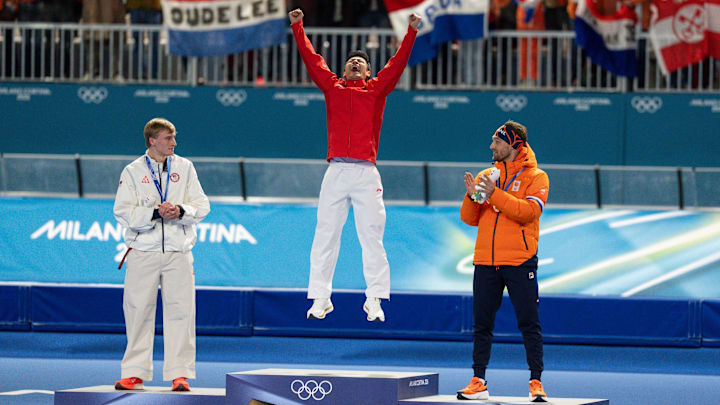
MILAN — The seemingly unshakeable Jordan Stolz finally got knocked off balance—first by the clock, and then by reality. Stolz has approached this whole Olympics with the deliberate intensity of a hired assassin. He came here to win at least three gold medals but was careful not to predict it. He spoke respectfully of other skaters but did not overdo it. Then he looked up on Thursday afternoon and saw 1:41.98.
China’s Ning Zhongyan had set an Olympic record at 1,500 meters. Stolz knew Ning was a threat. But he did not expect a sub-1:42 time from anyone.
“I thought I could probably beat it,” Stolz said later.
Stolz does not seem like the kind of athlete who thinks about what he can probably do. Yet here he was. Stolz is the best in the world at finishing races. His modus operandi is to start just well enough, stay right around the first-place pace for most of the race and then use his unparalleled closing burst to win. When Stolz saw 1:41.98, he knew that this time, starting just well enough would not be good enough.
Jordan Stolz and Ning Zhongyan respect on and off the ice. 🥇 pic.twitter.com/WDeimgrRSJ
— NBC Olympics & Paralympics (@NBCOlympics) February 19, 2026
His 300-meter pace was the fifth-best of the day. So was his 700-meter pace. At 1,100 meters, he was in fourth place.
“I saw a five, four, and I thought I was pushing a bit harder than that,” Stolz said, “so I didn’t quite feel it in the legs.”
He was 1.35 seconds behind Ning’s pace. Stolz closes fast, but not that fast. He finished in 1:42.75, good enough for a silver medal that he probably never envisioned.
On the medal podium, Stolz looked like he was breaking down. By the time he took reporters’ questions, he was Jordan Stoic again, calmly punctuating his answers with “yeah.” He claimed he was not really that emotional on the podium. All he would say was that “I was thinking it would have been nice to have gold.”
He was still trying to process 1:41.98.
“Yeah, I was pretty surprised,” Stolz said. “Yeah. I mean, 1:41 that’s really quick, but it also could be, like, Ning was super fast today, and I think he was.”
In the Olympics, unexpected results immediately arouse suspicions—especially in speed-based sports, where outlying times are easy to spot. Stolz was a heavy favorite in the 1,500, especially after winning gold in the 500 and 1,000. Then 1:41.98 happened: It also could be, like, Ning was super fast today, and I think he was.

Put the suspicions to the side: There are some perfectly reasonable explanations for what happened. Ning’s time was surprising, but it was not stunning. Stolz said, “If anybody [else] was going to win, I thought Ning would be the one to do it, and I was happy for him.” Stolz had said during the entire Olympics that the ice at the temporary oval here was faster than he expected. The Olympic record was in reach.
Also: Through 1,100 meters, Ning was not the only one ahead of Stolz’s pace. Two Dutch skaters were also in front of Stolz—and one of them, Kjeld Nuis, is 36 years old.

Stolz said, “I would have had to have a perfect race” to beat Ning. Instead …
“I didn’t have it today,” Stolz said. “So, not sure why. Probably just, you know, from all the events leading up to this one, it’s been kind of a while, so I’m sure there’s different factors that go into that that affected my body. …
“I mean, I didn’t have my best race. There’s nothing I could do about it. Ning had his best race, and I’m happy, you know, he was able to get it. He tries really hard, and, yeah, he’s always trying to be on the podium, and now he was able to win. So that’s super cool for him.”
More Winter Olympics on Sports Illustrated
 Add us as a preferred source on Google
Michael Rosenberg was a senior writer for Sports Illustrated, covering any and all sports. He writes columns, profiles and feature stories and has covered almost every major sporting event. He joined SI in 2012 after working at the Detroit Free Press for 13 years, eight of them as a columnist. Rosenberg is the author of “War As They Knew It: Woody Hayes, Bo Schembechler and America in a Time of Unrest.” Several of his stories also have been published in collections of the year’s best sportswriting. He is married with three children.
Follow rosenberg_mike