%20%20--%3E%0A%3Csvg%20version%3D%221.1%22%20id%3D%22Layer_1%22%20xmlns%3D%22http%3A%2F%2Fwww.w3.org%2F2000%2Fsvg%22%20xmlns%3Axlink%3D%22http%3A%2F%2Fwww.w3.org%2F1999%2Fxlink%22%20x%3D%220px%22%20y%3D%220px%22%0A%09%20width%3D%2239px%22%20height%3D%2240px%22%20viewBox%3D%220%200%2039%2040%22%20enable-background%3D%22new%200%200%2039%2040%22%20xml%3Aspace%3D%22preserve%22%3E%0A%3Cpath%20fill%3D%22%23FFFFFF%22%20d%3D%22M38.5%2C7H28.2v26h10.3V7z%22%2F%3E%0A%3Cpath%20fill-rule%3D%22evenodd%22%20clip-rule%3D%22evenodd%22%20fill%3D%22%23FFFFFF%22%20d%3D%22M26.1%2C25.5c0%2C5.8-4.1%2C7.5-12.9%2C7.5C3.9%2C33%2C0%2C31.2%2C0%2C25.2v-1.1h11.6%0A%09v2.4c0%2C0.7%2C0.1%2C1.4%2C1.2%2C1.4c1%2C0%2C1.2-0.4%2C1.2-1.3v-0.9c0-1.6-0.9-1.6-3.5-2.2C2.2%2C21.7%2C0%2C19.7%2C0%2C15.3v-0.9C0%2C9.3%2C5.5%2C7%2C12.9%2C7%0A%09c10.2%2C0%2C12.8%2C2.6%2C12.8%2C7.4v1.8h-11v-2.9c0-0.6-0.4-1.1-1.2-1.1c-0.6%2C0-1.2%2C0.4-1.2%2C1.1v0.9c0%2C1.5%2C0.9%2C2%2C3.3%2C2.5%0A%09c8%2C1.6%2C10.5%2C3.3%2C10.5%2C7.5V25.5z%22%2F%3E%0A%3C%2Fsvg%3E%0A)

01:40:09 |
Up Next
Aaron Rodgers Is Helping Build the Steelers’ Future
Aug 18, 2026

Lakers Sale Drama Gets Messier & More Offseason Trades
9 hours ago

Trevor Lawrence Is Picking Up Right Where He Left Off
Aug 19, 2026

Will Any Of The CFB Title Contenders Flop This Season? | Others Receiving Votes
3 hours ago
Aaron Rodgers Is Helping Build the Steelers’ Future
Aug 18, 2026
Lakers Sale Drama Gets Messier & More Offseason Trades
9 hours ago
Trevor Lawrence Is Picking Up Right Where He Left Off
Aug 19, 2026
Will Any Of The CFB Title Contenders Flop This Season? | Others Receiving Votes
3 hours ago

Amanda Serrano Continues to Chase History in Pursuit of Knockout Record
14 hours ago

Jayden Daniels Looks Ready to Air It Out in 2026
16 hours ago

Albert Breer on Potential in Pittsburgh, New Coach in Buffalo, Tyson Injury
Aug 18, 2026

A Day in Houston With NFL Superstar Will Anderson Jr.
Aug 18, 2026

Season Preview with Pat Forde & Gene Wojciechowski | Others Receiving Votes
2 hours ago

Extend CJ Stroud or Wait for Loaded 2027 QB Class?
Feb 25, 2026

Tom Verducci Explains What Makes Konnor Griffin’s Swing Elite
Feb 27, 2026

UFC Middleweight Reinier de Ridder Calls for Major Weight Cutting Reform
Mar 5, 2026
Transcript
Hello and welcome to Sports Illustrated's Daily Rings, SI's daily Olympics podcast.
I'm Mitch Golddi here as always with Dan Gartland.
Gart, it is day -2.
The sports have started, the Olympics are actually here, we're inching closer to the opening ceremony.
How are you doing today?
Yeah, it's exciting.
Like you said, the sports have started, it feels like the Olympics have started in earnest, and I'm really ready to get going here.
Yeah, so welcome everyone.
This is our 3rd official episode since these games have started.
Uh, if you're brand new here, we previewed every sport on Monday.
I would definitely recommend checking that out.
That's a great, uh, sort of primer for the entire Olympics.
Yesterday, we had 3 guests come on and go a little bit deeper on a few topics.
Today we have another guest heavy show.
We've got 3 more interviews, uh, that we just, uh sports we wanted to go a little bit deeper on, uh, to get you prepared for the Olympics.
Yeah, I feel like these are 3 really great interviews, top to bottom, really informative.
Um, first up is John Cullen.
He's a former pro curler, a CBC commentator in curling for the Olympics.
Um, he's a stand-up comic and a podcaster, um, really a renaissance man, a really a great guest.
We had a really good conversation with him.
I feel like Mitch and I both learned so much about curling with him.
Uh, the same goes for our second.
Guest Ken Childs, who like John is a, is an expert in their field.
In this case, it's sliding sports, the bobsled skeleton and luge.
Ken's fantastic, um, really, really, like I said, really well spoken on, on all the sliding sports.
It's just so informative.
Um, I feel so much more prepared going into the Olympics on those sports, and I know you're gonna feel the same way at home.
Yeah, I think both of those interviews ran longer than the 3 interviews.
In our Tuesday show.
And I think that was because you and I just had a million questions and they answered our basic questions, storylines and favorites, but we also really nerded out.
Like, you're gonna hear about pebbling of the ice and uh all kinds of questions about uh ice quality on the sliding sports and, uh, crashes we got into and questions about sleds and things.
I thought those were two great conversations.
Yeah, nerding out was the phrase that I was gonna use.
That was that's exactly how I would describe it.
Yes, and then our third interview, uh, this one might be a little surprising, um, based on sort of, uh, how our Monday show went, but, uh, we talked about, about Nordic combined being a bit of a controversial sport this time around, uh, largely because of the fact that women don't compete at the Olympic level.
Um, so we actually had a guest, we had Jill.
Brebeck, the president of US Nordic combined and had a really interesting conversation about the sport itself.
And she did talk a lot about the fact that women are not competing.
As you'll hear, her daughter competes in the sport, um, at a world-class level.
And I, I gotta tell you, I, you know, it was sort of, uh, I'd say a little lower on my priority list when we were first doing the research and previewing, um, but she sold us on it and definitely I came away thinking it was more exciting and interesting.
Than I expected to feel.
I think I also may have mentioned on Monday that some people might not be interested specifically because of the uh gender inequity in the sport.
She made a really interesting point about how that is actually counterproductive and that like doing a boycott on behalf of the women who can't compete would not be helpful.
They want attention for the sport to go up.
So she had a lot of interesting things to say and uh definitely learned a lot more about Nordic combined.
Uh, I know a lot more than I did 48 hours ago.
That's 100% the case.
Yeah, she was a great, uh, salesperson, so to speak, for, for the sport in order combined.
Um, I know, you know, neither of us knew very much about it going in, but learned a lot from her.
Um, she spoke, you know, pretty frankly about the challenges that it faces, and I think people are gonna really enjoy that conversation.
Yeah , so before we get to uh the interviews, you're quickly daily reminder.
We would love it if you follow and subscribe to the show.
We're in Apple Podcasts, we're on Spotify, we are on YouTube if you want to see what we look like, see what our backgrounds are in our apartments .
Um, and, uh, I guess, uh, the other thing actually that I wanted to say a little bit earlier in the week is I would love for this to be sort of an interactive show.
Um, when we've done this in the past, we've gotten great Notes from listeners.
If you're an expert in a sport , if you know something we don't know, or if you want to clean up, uh, maybe something that we butchered, uh, or weren't quite precise on, um, or if you just have anything to add that you think our audience would love, I would love to hear from you.
Um, we, uh, as you can probably tell, we have a lot to learn about some of these sports.
So if you've got info that you're hoarding, send it our way cause we would love to hear from listeners and be able to share that and pass all that along.
Um, because, yeah, the 1st 3 episodes have been a lot of fun, and we're gonna have a lot more fun the next 3 weeks, uh, as these Olympics get going for real.
So, uh, with that, let's get right to those 3 interviews and hope you enjoy our Wednesday show.
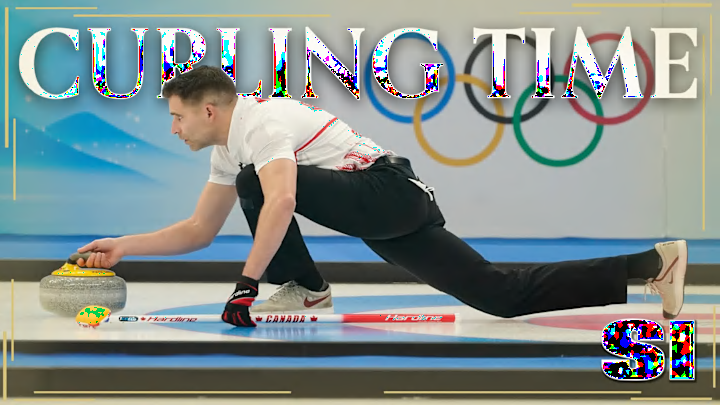
We're joined now by John Cullen.
John is a former professional curler, a stand-up comedian, a podcaster, and he'll be doing Olympic commentary for the CBC in Canada during these Olympics.
John, thanks for having us.
No, we're having you.
You're welcome.
Uh, thank you so much for joining me on the, uh, the Daily Rings podcast , uh, live from my home studio in Calgary.
Hey, John, honestly, you are much more accomplished athlete than anybody here.
So I think maybe that's the, that we should keep that take and just, uh, you know, because you, if anybody should be hosting a sports podcast, I think it's you.
Hey, we, if anything, it's, we've proven over the last few years, you don't have to be qualified for a job to do it.
So.
So why not, I say.
So I think a lot of our listeners out there, they might look at curling and they might think, why is this an Olympic sport?
It seems very unathletic, but you, as somebody who's done it at a high level, what would you say to those people?
Uh, I would say just like, look at a, look at a curler right now.
Just look at what, just look at what they look like, doesn't take a genius to see.
I, I sort of use the phrase, it's maybe a little crass, but I say curlers are hot now.
Uh, it's just kind of a very basic way of describing it, but yeah.
Yeah, the curling became a part of the Olympic program in 1998, and that got a lot of countries involved in it that maybe previously wouldn't have, you know, been a curling, I guess, superpower for lack of a better word.
And with all of that has come more money, more research into the game, and Yeah, you pretty much can't do the sport anymore unless you are training for it like you would any other Olympic sport.
So yeah, for some reason, curling has this aura around it that people watch it during the Olympics, and they think, well, if I start doing this tomorrow, then I could go to the Olympics in 2030, um, and that just couldn't be further from the truth anymore, or it was never true, but it's even less true now, uh, than it would have been 25 years ago or whatever.
Mhm, I think that actually leads into something I wanted to ask.
Uh, you mentioned 1998, so it is still a relatively new sport in the Winter Olympics.
It feels like it has gotten a lot more popular also.
Have you been surprised as someone who's been curling for a long time, uh, just at the popularity we've seen around the sport?
I think so, yeah, I mean, I think when I started curling, it was sort of, yeah, like Dan kind of alluded to, like an unathletic sport for losers is sort of the, the view that everybody had of it.
I mean, I didn't, but I was like Dan said losers, but I, I'm saying losers, Mitch, I'm saying losers, but yeah, I think I said dweebs.
Nerds, geeks, I mean, you know, we'll take it all.
Uh, but yeah, I guess I am a little bit surprised.
I, I, I guess in, in some ways I'm not because I love the sport, and I come from the world of hockey and baseball, like, I come from a sort of more traditional sports world and Um, and then I got into curling when I was like 12, and I love it, so I guess in some ways it doesn't surprise me, but, but yeah, the sport is definitely growing.
In the Olympics, it's actually the most watched sport.
I mean, it helps that it's on every single day.
It actually starts before the Olympics starts, um, so that helps too, but yeah, it is, generally speaking, become one of the most popular sports in the Olympics, and I guess I, like I say, I am a little surprised, but I think a lot of the changes that the game's undergoing with curlers being more athletic, with some of the things that are happening outside of the Olympic schedule, like curling's first ever professional league is going to start in April .
Like, there are these things that are happening where, again, more money, more eyeballs, more interest.
I think it's, um, yeah, I think curling is on the, on the precipice of a moment, if you will.
All right, so let's, uh, let's learn a little bit more.
I think we, so, uh, Gart and I did a preview where we talked about every sport in like 3 to 5 minutes, I think.
Um, but one of the reasons we wanted to go in depth on curling is to give people an idea of what they're watching, how it works, and we'll get to some of the storylines.
But we talked a little bit about the skip's role.
On the team.
Can you tell us a little bit more about sort of the makeup of the roster and the different roles people have, and, um, you know , what, what we should be watching, uh, sort of how the, the curlers on a team work together?
Sure, it's a great question, and I'll, I'll start by saying this, cause most people who don't watch curling don't know this, but uh, the most common question you get asked as a curler is, do you throw or do you sweep?
And I'm here to tell you, everybody does both.
Minds blown across America as they learn this fact.
But yeah, other than the skip, so, you brought up the skip, but basically how it works is, you have two teams of 4 players, everybody throws 8 rocks, or each team throws 8 rocks, each player throws 2 rocks.
So when you go to throw, you're throwing, you're in the hack, you're getting ready to throw, that's the like start.
Block looking things.
You have two of your teammates who are sweeping your rock, and then you have the skip at the other end, and they're calling the strategy.
So, curling often gets referred to as chess on ice.
You know, there's a lot of strategy in terms of rock placement.
So, it's not just, it's kind of like pool in a way.
It's not about necessarily just the shot you make, it's also about the shot.
You leave.
And so the skip is, is calling the strategy and they're also calling the line .
So the skip reads the ice.
So, every ice sheet is also not the same.
And once you get to the Olympics, it'll be relatively the same from start to finish, but it can change from day to day, like minor changes in terms of how fast or slow the ice is, how much it's curling.
So that's what the skip is kind of managing.
They're, they're kind of saying, this is where you need to aim to get the rock in the spot we want, and then this is also the spot I want the rock to end up from a strategic perspective.
And so, yeah, so each team throws 8 rocks.
Once the 16th rock has settled, the team that has the rock closest to the middle of the target, we call it the house, they score.
If the next close.
The rock is also their rock.
They get another point until the next closest rock is their opposition rock, and then the scoring stops, if that makes sense.
So, if you've ever played bocce, it's a very similar scoring method.
So, like, if you have 8, all 8 of your rocks in the house, but your opposition's rock is the closest one to the button, they get 1 point, you get 0.
So, it's only 1 team scores per end, which is like an inning.
Baseball, we play 10 of those, and that's kind of the role.
So, so, it's like, it goes lead, 2nd, 3rd, skip, and then, yeah, if you're the lead, you throw 2, you sweep 6.
If you're the 2nd, you sweep 2, throw 2, sweep 4, etc.
through the lineup, and then, yeah, the skip, they get a little lucky, they don't have to sweep, they just get to stand down there and call the game.
So that's kind of the, that's kind of how it works.
Is that, did that sound clear?
Was that good?
It did.
I now wonder, sort of, uh, and maybe this is the difference between a good team and a bad team, but, uh, it sounds like you've given a lot of power to the skip.
So I guess how comfortable are the other players on the team, uh, if they disagree with the strategy, how much room is there to sort of go back and forth on, on those kinds of things?
There's room for sure.
So the, the teams are under time pressure, so you have a certain amount of time to play the game.
So, the game takes 10 ends.
But when you are in control of the house, so we call it thinking time, cause your skip has to think, uh, you only get a certain amount of that per game.
So in the Olympics, I believe the teams will have, I think it's 38 minutes to play their 10 ends.
Um, so, yeah, so you, there is some room for disagreement, but on some level, you kind of have to give your skip.
Like at some point you go, OK, we've wasted too much time, so skipper , you just make the call and we'll do whatever you say.
But yeah, I mean, certainly there are disagreements, and that's one of the more fun parts of curling as well.
It's when everybody disagrees with the skip, and the skip says, no, this is what we're doing, and you kind of just have to say, well, whatever, that's why we pay you the big bucks.
So John, you mentioned reading the ice and something that occurred to me just now, so.
Uh, I've had two jobs in my life.
I've been a writer at Sports Illustrated, and I was a caddie at a country club.
So it sounds to me a little bit like reading a green, you know, in, in, in golf.
Is, is that an apt, uh, comparison?
Very much so, yeah.
So, uh, uh, the one thing is it's nice, you really only have to read the, the curl, right?
So the rocks sort of travel in like a parabola or an arc, and you just kind of have to decide how much the rock is going to curl, as opposed to a green where you also have to measure slope and.
Speed, right?
So, uh, the skip doesn't really measure the speed, that's usually cause the sweepers have a, a pretty good feel of the speed of the ice, cause they're actually traveling with the rocks down the ice.
So typically the skip will leave the, the speed equation to the rest of the team, uh, but yeah , they're the ones in charge of sort of, yeah, reading the slope, like a, or sorry, reading the curl, like a caddie would read the break on a green, yes, definitely.
And I actually, I went curling a few years ago, and one of the things that, that surprised me when I went was the, the ice is pebbled, right?
It's got these little dots on it.
And so when you mentioned the ice, you know, reading the ice, does that change over the course of the match as as more rocks travel down the ice?
Definitely, it can, yeah.
So for the listeners who don't know what Dan's talking about is, yeah, curling ice is not like hockey ice, so it's not just like, uh , we throw water on the ground and freeze it and happy birthday.
Uh, there's like a very lengthy process to layer the flooding, and then on, on the very top layer, we sprinkle this sort of like treated water on top, and it freezes, and we call it pebble, because if you were to look at the profile of the ice, it almost looks like there's little pebbles sitting on the ice.
And so that's actually what allows the rocks to travel further, and what Allows them to curl.
Like, if you tried to throw a curling stone on hockey ice, it's actually very difficult, um, because the friction between the rock and the ice is greatly increased without the pebble there.
Um, and so, yeah, so as more rocks travel, as you sweep down the ice, you gradually break down that pebble, and yes, it can happen towards the end of the game.
Uh, and usually what will happen is the less pebble there is, the heavier the ice gets.
So, the harder you have to throw the rock to make a, a draw shot, which is where you're trying to make the rock end up in play, you're not taking anything out , so.
I love how technical we're getting.
So now we, we did have questions about like the storylines and the teams, but let's, let's stay on this, uh, curling is a science lesson often , so don't worry about it.
Yeah.
So tell us about the sweeping, um, different techniques, uh, basically like how, how it works.
Are they, they are speeding up the rock or slowing it down or able to.
Do both, like what, uh, what kinds of, uh, strategies and techniques are there, um, while the, uh, while the rock is going down the sheet?
Well, it's a great question because sweeping has really changed in the last like 10 years, and I won't go into all of that, but I can plug my podcast Broom Gate, which goes through the whole scandal that, uh, we went through 10 years ago to figure out what the brooms could do.
Uh, but yeah, so basically we talk about that pebble, and so, essentially, what the sweeping is doing is it's sort of like, melting is the wrong word, but it's heating up the pebble, so that reduces the friction between the rock and the ice.
And so, yes, typically for years and years and years, we thought the only things we could do with sweeping were keep it straighter , so you're trying to like, fight against the curl basically, and to make it go further.
Uh, and then we learned, uh, through trial and error and some new broom technology kind of got us to this point that you can actually make the rocks curl.
And so what you will see now, if you're, if you're just tuning into the Olympics and watching curling, is often you'll have one sweeper who is kind of managing the straight side, so you'll see them go if the rocks.
Needs to stay straight, and they're sweeping against the curl.
So let's say the rock is curling like clockwise towards the middle, they'd be curling against the clockwise direction.
If you want the rock to curl, then you'd see the other sweeper come in , and they start sweeping it with the curl, and then that can sometimes help the rock curl more.
Now, Can you slow the rocks down is a big question.
I think we still don't really know.
There's like a lot of physics stuff that we still need to learn, and as you might imagine, science labs aren't pouring thousands of dollars into learning the science of curling.
Uh, but there was a sweeping technique that people were believing could slow the rock down , which curlers kind of feel like goes against the spirit of the game, and so that technique was actually banned about 3 weeks ago.
So where it's, they thought we can't get to the Olympics and have this kind of slowdown technique used, and so World Curling, the, the governing board for curling, decided to put this rule in place before the Olympics, and so yeah, you're in theory, not allowed to slow the rock down.
All right, quick shout out to one of my favorite things in my closet right now, Cozy Earth.
First off, their bamboo pajamas, ridiculous.
These are hands down the softest pants I own, like unbelievably soft.
I wear them when I'm working from home, running errands, even just lounging on the couch.
They somehow feel cozy without being too warm, and they actually look good enough to leave the house in, which is rare for pajamas.
Whether it's for someone special or just for yourself, Cozy Earth makes it easy to bring comfort and care into your everyday life.
This Valentine's Day season, we are offering a buy one, get one pajama deal you won't see any other time of year.
These viral PJs are so good, they sold out during the holidays, and now they're back with an exclusive deal only available January 25th to February 8th.
Head to cozyEarth.
com and use my code Daily Rings BOGO, that's Daily Rings B O G O to get these PJs for you and someone you love.
And if you get a post-purchase survey, be sure to mention you heard about Cozy Earth right here.
Celebrate everyday love with comfort that makes the little moments count.
This was on our list too, to ask you about because I, I touched on this.
I, the news surprised me, you know, yeah, a month before the Olympics, let's introduce a new rule about types of sweeps.
I also, I saw an article that this might have been directly aimed at Team Casper from the US, uh, but I saw a quote where Danny Casper was kind of cool about it and, and seems like it wasn't a big deal.
Do you think this is uh a big deal coming into the Olympics, or is it just sort of, uh, it sounds like this was a new technique anyway, and they're just kind of going back to how they did things, but I guess like how big of a story is this for those of us casuals who are gonna hop into curling here, uh, just for a couple of weeks?
Yeah, I mean, it's funny you use the word hop, cause that is kind of part of the problem, but We'll get to that in a second.
To, to answer your question, it's not that big of a deal.
Um, it is just one sweeping technique.
It doesn't really change the overall game.
It just means that if you throw it bad, you don't have this option to slow it down.
And again, some curlers will tell you they're not even convinced the technique was slowing the rock down.
I think the reason why people felt like Team Casper was the target of this is because they introduced a version of the technique that involved, like, jumping in the air and doing this, like, downward.
So, so, basically, the sweeping technique itself was one hard single downstroke.
Um, so, you know, usually if, if even if you have Watched curling twice in your life, you'll notice, like, the sweeping is usually pretty vigorous, right?
It's like, one or two brooms and they're kinda , they're going pretty fast.
And what they had figured was if you kind of put all of your body weight on the broom and really gave it this one single downward stroke, it almost would create like a little ridge in the pebble, and the idea would be that that would almost act like a speed bump and the rock would sort of slow down.
This is all happening at a microscope.
Scopic level, by the way, but that's kind of what the thought was.
So, teams have been using a version of this technique for a couple of years, and then Danny Casper, uh, who is a great guy and very laid back, so I'm not surprised that he didn't care that much, but they kind of made the optics bad, like the, it was very obvious what they were trying to do.
So the teams who were doing this before.
You know, they kind of made it look like it was just part of the rest of their normal sweeping techniques, whereas Danny and his team, as I say, they were fully jumping in the air to put all of their weight on the broom, and then make that, like, singular downward stroke, and They also used an unfortunate word choice to call for this sweeping technique, so they were sponsored by a company called Ditch Witch.
I don't even know what they do, but their, their idea was, let's call it Ditch, so that we're like shouting out our sponsor as we're saying this technique.
Now, you two know, if you have a passing familiarity with the English language, a ditch is also like a trough.
So then people heard ditch and they're like, wow, Casper is saying like, make a trench in the ice, like, that's crazy.
So, I honestly think it was cool, it was a cool idea to like use a weight call to shout out your sponsor, but I actually think in some ways they kind of screwed themselves because the viewer at home went, OK, there's guys jumping in the air and the skips at the other end saying, ditch it, ditch it, uh, and then.
World curling went, whoa, whoa, whoa, we don't want to get to Cortina and have this team saying like, hey, yeah, guys, create a trench in the ice, like the optics were bad.
And so I think that's a lot of the reason why they acted on it, and then people were blaming Team Casper, but realistically, other teams were doing it before them and it wasn't their fault completely.
It sounds very much like there were uh decades of quarterback sneaks that nobody.
had a problem with and then the push push came along and they said, well, the optics are bad and we know that a bunch of teams are doing this, but this is the team ruining it for everyone and, and it sounds, sounds a little bit similar.
It might be a stretch.
It got very much compared to the tush push, and again, I think, uh, I, I think again , is it partly that it had a name?
Like, yeah, kinda, like you said, quarterback sneaks are happening forever.
It wasn't the first.
The time that linemen were getting behind the quarterback to try to make the quarterback sneak work, but then all of a sudden someone called it the tush push, and then everyone went, wait a minute, he is pushing his tush.
Uh, we all like that, you know, and it was very similar, I think with Danny.
It was like, are they saying ditch?
I don't like that at all.
So yeah, sometimes if things get a name, it brings more attention to it, and then everyone goes, wait a minute, I don't think we like this very much.
So I think this is a good, a good opportunity to transition to talking about these Olympics and, and the teams that play, right?
Because Danny Casper, his team, they're represented the US.
The way it works in curling, right, is they have each, each country has a, a, a team that, you know, goes through the qualification process.
The Casper team emerged to represent the US.
What can you tell us about team Casper beyond the sweeping technique, you know, what are their chances?
What can we expect from them in, in Milan?
I love those guys, young team, uh, they're all 27 and under.
Danny himself is 24, um, and they dethroned John Schuster, who, you know, even if you have a passing interest in curling, you probably know who John is.
Uh, he won the gold medal in 2018, was kind of a shock gold medal winner, to the point where they're making a movie about it currently.
Uh, they're currently filming like a Hollywood movie about his run to the 2018 gold medal.
Uh, I believe it's coming out in the fall, but, uh, but anyway, that was the storyline going into the Olympic trials.
So the, for the US they have a, a four team tournament, winner of that tournament gets to represent the US at the Olympics, or in theory, cause Danny did have to go through the Olympic qualifying event, that's all, doesn't matter.
They had to beat John Schuster first.
So, yeah, Schuster's won the last five US Olympic trials, won gold in 2018, won bronze in 2006.
He's probably the greatest American curler of all time, facing this young team of upstarts, and yeah, it was sort of all year, Danny was kind of emerging, like he was moving up in the world rankings.
He was moving ahead of Schuster in the world rankings, but Everyone will always tell you, one of the best curling teams on earth is John Schuster at a US National Curling championship.
There's just something about it when he gets to a trials or a US Nationals, he turns it on and he's unbelievable.
And yeah, Danny Casper played played amazing, uh, uh, dethroned them and they earned it.
Like, one thing I said after the trials was, Schuster didn't lose it, you know, sometimes that happens.
Teams, they've been there a bunch of times, they have a bad tournament, there's a young team there to take advantage of an older team playing bad.
That was not the case.
Schuster played great and Casper played just that much better.
Um, as far as their chances.
Going into the Olympics, I would say they're like a mid-pack team for me.
Um, they are currently 8th in the world, so, um, they're, they're up there, but that's not to say like, uh, you know, 125, and 6 in the world are all in the Olympics as well, so.
You know, it's, they're, they're kind of a , a mid-pack team.
I think if they play super well, they'll have a chance to make the playoff round.
So it's a 10 team round robin, 4 teams make the playoffs, they just play 1 game semifinals, 1 game finals.
So, if you make the playoffs, you'll be in a medal game, it's just which one of those medal games will you be in.
I would have a very hard time imagining that they will make the Um, that they will make the gold medal game.
I think a lot of things would have to break right for that to happen, but could they be in the bronze medal game?
Yes.
This to me feels a little more like a building Olympics though.
This is sort of a like, you get to go, you're young.
There aren't amazing teams coming up behind them in the US, so I feel like this is a chance to just kind of get their feet wet, and then 2030, 2034, that's kind of where you're looking at where they might become a serious contender.
Yeah, especially a 24-year-old skip.
I mean, we talked about the importance of that role.
It seems like that makes sense.
This could be an opportunity for them to kind of get the experience that will benefit them down the line.
Yeah, I think so for sure.
And, and, you know, you look at their overall record and they've had a really good year.
They're 43 and 25, but the number that gives me pause is they're 6 and 14 against top 10 opposition.
So, the Olympics , like I said, they're gonna have to face 4 or 5 of those teams that are in the top 10, and they've sort of shown this year that They can't beat those teams on a regular basis.
So, yeah, I think they're going to have great opportunities to beat teams below them in the world rankings, Czechia, China, Norway, you know, I think those are all winnable games for Danny.
But yeah, when faced with having to play Scotland, Sweden, Switzerland, Canada, um, yeah, I, I think it's a little too much for them right now, but, but yeah, definitely will be a huge part of their development over the, over the coming years.
And on the women's side , the US is represented by Team Peterson, which, uh, you know, what can you tell us about them and, and, and, you know, is that also, you know, how they stack up experience-wise, you know, what's the, what's the deal with them?
Tougher, tougher sled for, for Tab, I would say.
Um, yeah, they're, they're they're more experienced.
This is the 3rd Olympics for Tab, um, I believe it's the 2nd for her sister Tara, it's the 1st for, um, for, uh, Taylor Anderson Heidi, who's their lead.
Again, they're a solid team, but the, yeah, they, they're, they're 20th in the world right now, so they're, well, 20th on the rankings, I prefer.
There's like, I don't, you know, Ken Pomeroy, the college basketball, uh, reporter, he's a huge curling fan, uh, so he.
Kind of realized the world rankings that we use are a little bit flawed, and he made his own ranking system for curling that I think is better than the world rankings.
It's all based on strength of competition and stuff.
Um, and so, yeah, it's at doubletakeout.
com, but he has tab at 20th in the world, and pretty much almost all the teams in the Olympic field are above them in, in Ken Palm's rankings.
So, I think they're gonna be in tough.
Again, they're an experienced team.
I do think Tab is, is a really good player.
Um, she can make big shots when she needs to, but she also has her third, Corey TC is playing in the mixed doubles competition beforehand and is one of the favorites in mixed doubles.
So, let's say she wins a medal in mixed doubles, is she gonna be able to then refocus and go another 10 days with the women's team?
It's gonna be a challenge, I think, for that team.
So, yeah, I would say expectations are lower.
Could they sneak into the playoffs?
Look, anything is possible.
The last Olympics, the gold medal game was played between the teams ranked like 7th and 8th in the field coming in, so.
The Olympics does weird things to people, the pressure does weird things to people.
Could Tab kind of sneak her way in there?
Yes, uh, but I wouldn't expect it.
I, I, I think she's a team that, that finishes in that sort of 6 to 8 range in the, in the round robin, most likely.
Now, admittedly, we tend to focus on an American perspective here, but you're Canadian , and so we're gonna let you, you know, how about you, we're gonna give you a chance to, to shout out the Canadian teams and anybody else who, who we might have an eye on because it seems like the Americans are, are, uh, kind of long shots for the medals.
And and shout out to our Canadian listeners too.
Well, I'm sure there are a bunch.
It's fine.
I mean, we can talk about the American program all day if you want.
I mean, it's, I don't mind, but, uh, yeah, the, the Canadian teams, you know, I think there is still this expectation in curling that Canada is the dominant curling nation and therefore they should win gold and Again, we're, we're maybe the deepest nation, we have the most teams in the top 30, 40, 50 in the world, however you want to count that up, but You can't send 10 teams to the Olympics, unfortunately, you only get to send 1, and our best teams are are very, very good, but so are other countries' best teams, you know, and so I think on the women's side, Rachel Homan is the favorite.
Uh, she's had two of the best curling seasons of all time, these last two seasons, like, we usually think of around 80 to 84%, is like, that's your elite.
Elite like that.
Usually the number one team is around an 80 to 84% winning percentage on the season.
The last two seasons, Rachel's been 90+.
Uh, so she was 91% winning percentage two years ago, she was 92% last year, back to back defending, uh, world champion.
The storyline with them though, is that Rachel herself has had problems at the Olympics.
So, she was the favorite in 2018, she was the defending world champion.
Uh, and she stumbled.
She missed the playoffs, she looked a little bit cowed by the moment, um, and yeah, it was, it was very unexpected that she didn't even give herself a chance to compete for a medal, which was the first time that had ever happened to a Canadian women's team missing the playoffs.
And then in 2022, she went and mixed doubles, missed the playoffs there as well.
So, that's the storyline for her is, you know, can she get over the Olympic sort of bugaboo.
Um, and her main rival, Silvana Tirinzoni from Switzerland is playing as good as she's ever played, has a better record than Rachel this season.
They've won the last two Grand Slam of curling events, which are our biggest events, those are our majors.
Um, so, yeah, that, that to me, I think is the most fascinating battle on the women's side.
On the men's side, Brad Jacobs, the Canadian team .
He looks good.
Um, he's 3rd ranked of the teams that are in the Olympics.
Bruce Mallett from Scotland is the favorite.
He's not quite as good as Rachel as far as just the overall dominance, but pretty close.
Has a very, very good winning percentage.
He's been world number 1 for the last couple of years.
He's the defending world champion.
You also have Jannik Schwaler from Switzerland, who's been very, very good.
They just won a slam, uh, 2 events ago back in December.
So, yeah, I think Jacobs, again, they're a medal favorite, but going in, you're, you're not thinking really for either Canadian team, oh, they're just gonna show up and, and dominate.
And the reality is Canada hasn't.
We won both golds in 2014 and since then we have one bronze.
So, in the four-person.
We won gold in mixed doubles in 2018, but in four-person curling, we have won bronze in the last four competitions played between men and women, so.
No guarantees, and like I say, when these teams get to the Olympics, it does some funny, funny things to people and it's easy to sit here and go, well, Rachel Holman is the best team in the world, so they're gonna win, but anything can happen, man.
Um, I, I think our podcast, uh, will tend to, uh, enjoy sort of fun and unusual storylines.
Uh, I remember like a couple of cycles ago, Team Norway had just like outrageous pants that everyone loved.
So it doesn't have to be fashion related, although if you do have an update on Team Norway's pants or anyone else, but any other like fun under the radar storylines that that you're excited about that, uh, that our listeners should be, should be aware of?
Well, I do, I feel bad for the current Team Norway.
That's.
Magnus Ramsfeel, uh, really great guys and they have a great sense of humor, and I feel like they can't go anywhere without people being like, why don't you wear the pants?
And they're just like, well, it was the other team's thing.
It wasn't, it's not like a Norway thing.
It was the other , can we just wear regular pants if we want, guys, please.
Uh, so, so, unfortunately, they will, uh, I think the pants have been retired.
I mean, unfortunately, the skip of that team, Thomas Ulsrud, passed away, uh, a couple of years ago from, from cancer.
Um, but yeah, that was a great story in 2010.
Uh, I, I was doing some research into that for, for my book , and they, like, someone started a Facebook group in 2010 for the pants, and it got like 500,000 followers overnight.
Remember when the internet used to be like that?
You just saw some funny pants on TV and all of a sudden you got half a million people joining a Facebook group because of the pants.
Uh, as far as the sort of like fun storylines.
I just think for me, uh, I, I mean, I think, honestly, Danny Casper's whole team, not to necessarily have to, I'm, I trust me, I'm not feeling like I have to bring it back to the Americans, but they're just like, they're just goofy dudes, uh, you know, they, they just really, and I mean that complimentary, they're very, very nice guys, but they're also like, they just have a bit of a A bit of a weird spirit, like, lead Aiden Oldenburgg wears a Karate Kid headband when he plays.
It started as a joke to, like, dunk on another team and then they started winning, and so now he's just like, stuck doing it, so he's, he wears this like Karate Kid headband.
He's also like an accomplished juggler, and he's like taught.
Other guys on this team had to juggle, so they warm up for, you know, how some teams in other sports will warm up for games by like playing soccer, they'll play like sewer ball, kick a ball around, whatever.
They warm up by juggling with each other, um, which is odd.
Uh, you just see them behind the sheet and they're like throwing juggling balls back and forth at each other and Um, yeah, they're very interesting characters.
So for me, like if you're talking about like a pants type situation or like a really fun team to follow in the field, uh, I think for me it's Danny Casper.
They, they are the most fun team in the field, and I think they're a team that's not going to think like, ah, it's the Olympics, we gotta be more serious.
Like, I think that they think of like what brought them to the dance is just like having fun and being goofy.
And I think that they'll continue that.
So, I, I believe they're gonna have a lot of American watchers, viewers fall in love with them, cause they're young guys and they're really fun.
So I think that's great.
And then for the women's side, it's maybe not like a fun, quote unquote, fun storyline, but like, there really is like a very solid and friendly rivalry between Homan and Tirinzoni.
So like last year they played in the world championship final.
Uh, Homan beat Tirinzoni, and then they partied together after the game, and there was like all these videos coming out of them just like, yeah, basically, Team Tirranzoni went to Team Homan's like private gold medal winning celebration, essentially.
And so, her the 4th rock thrower for Tirinzoni is Alina Pets, and her and Rachel are very close, they're really good friends.
So there is this like, I think it's what people think about curling, right?
They think it's like sort of this.
Nice and sportsmanlike sport, and I don't know if it's always like that, but when you consider that these teams are 1 and 2 in the world, and they're 1 and 2 by a lot, like, they're way ahead of their competition, and the fact that they're really good friends, like on and off the ice, it's made for a very fun kind of rivalry, and I think that'll be really interesting to watch in the Olympics when the stakes are the highest.
So, John, this has been great.
I feel so much more informed for the curling as we get ready to get going here.
Um, you mentioned offhand your Broomgate podcast.
I just want to reinforce that, an amazing, amazing project you did for the CBC, uh, last year or the year before, just a really fantastic project.
I think if anybody had any, if they found anything you said here interesting, they will love that podcast.
It's so fascinating about this, this scandal with the brooms that Rocks, the curling world.
Um, is there anything else that you should, we should know about you, where to find you, where to find your work, things like that?
Yeah, I wrote a book as well.
I mentioned that, and it's, uh, coming out in the States in officially like a couple of days.
So it's been out in Canada since October, but the US release date is February 3rd.
I don't know exactly when this podcast is going up, but it's called Curling Rocks, Chronicles of the Roaring Game, and it's, uh, essays about My own personal experience as a pro curler, but then there's just a lot about the pro game as well.
Some of my like favorite moments of all time.
There's some fun chapters in there.
I do have an entire chapter about curling fashion.
I rank curling fashions in history from worst to best.
I've got a chapter that sort of imagines if you had to make curling teams, where everyone on the on the team had to have the same first name, who would be the best teams of all time.
Time, things like that.
So it's kind of just like a fun sort of look at curling, and I think it's one where, yeah, if you're just kind of getting into curling, I designed it for you.
It's, it's curling fans can enjoy it, but people who know nothing about curling, I think can also enjoy it as well.
So yeah, it's available wherever you, wherever you get your books.
I'd prefer if you buy it from an indie bookstore, but you can get it from all the big, all the big sites as well.
So, it's called Curling Rocks, and it's out very soon.
Very cool.
Well, thanks a lot for joining us.
Thank you so much for having me.
Thanks, and I'll just echo what Dan said.
I've learned a ton from you and this was great , and I hope everyone feels a little more ready to watch curling at the Olympics now.
So thanks.
That's my hope.
That's, that's always the hope.
Please watch our sport.
Thank you so much.
Our next guest is an expert on all things sliding sports.
He owns and manages a website called sliding on Ice.
com, covering all things bobsled, luge, and skeleton.
We are very excited to have him here.
It is Ken Childs.
Ken, welcome to SI's Daily Rings.
Man, thanks.
Glad to be here.
Thanks for having me.
Uh, yeah, great to have you here.
First, can you just tell us about your background and how you got into covering these three sports?
Man, it's kind of a wild ride.
I actually was working part time for a motorsports website, and I've always been kind of into bobsleds, skeleton luge and all that.
I saw when I was like 9, the '88 Olympics in Calgary was a thing, and I was into race cars, I saw bobsleds, I'm like, man, that's kind of like race cars, they're pretty awesome.
So I'd be on Wide World of Sports and things like that, uh, for a while, Speed Channel had, um, the World Cup coverage every, you know, every race.
And I went, decided I was gonna go ahead and go up to an event, went online to find some information.
There wasn't much.
And in a moment of either brilliance or stupidity, depending on what, what day you ask me, I was like, yeah, I'll do it myself, sure.
And kind of fired things up, and I've been doing this for over 15 years now, and every day is an adventure.
So there's 3 sliding sports, right?
You got the luge, the skeleton, and the bobsled.
Can you tell us what, you know, obviously they're, they're, they're quite different, but what appeals to you about each one?
Man, so they're all a little different, obviously.
Um, luge is a little more precision.
Uh, bobsled and skeleton, your runners are rounded, some people don't know that that like they don't actually have a sharp edge to either skeleton or bobsled runner.
Luge, they're sharper, so that you can make these more tight curves, a little more precision, a little more speed in that way as well, um.
Skeletons kind of like a nice happy medium between the two.
and, you know, what I've found over the years and what you learn is that a lot of these athletes come from a wide variety of sports and skeleton.
You have people that come, uh, Tabitha Stoker is a former trapeze artist.
Um, you have, yeah, you have, um, people that have done equestrian, people that have played softball, people that have played field hockey, any sport imaginable , you just end up with somebody that does skeleton, that that's the thing they did beforehand.
Um.
But, and then Bob says just a lot of power on the start.
The start is the big thing when you go like whenever people ask you, I wanna go to an event, what should I go to?
I'm like, first heat, go up to the top, go see the start.
It's especially for forming, there's nothing like it.
Um, so that's kind of what appeals to me.
Obviously the speed is great, I love that, um, and then as you get into the sport more, like a lot of these sports, it's the people, um.
You know, at the end of the day, we're watching people sledding , right?
Um, aside from that, it's all these people are just generally speaking, really lovely people, really wonderful people, you know, some people may not, but, you know, by and large, everyone's really dedicated to their craft, loves the sport, and there's a camaraderie that you get, that you get in a lot of these Olympic sports that you may not get in some other sports.
Um, we had a, uh, an episode where we previewed all 16 sports, and so we've already done some of, sort of the basics.
Uh, our listeners who've been following all week know about, you know, the events and 4-man, 2-man, 1 man, and the basic differences, but, uh, getting a little bit more in depth, which I realize is tough because you have not heard our previous conversation, but I know that, um, like they start at different spots on the track.
Can you tell us about some of the other sort of technical differences on just like length of the course and speeds and, and things like that, how the three are different?
Yeah, so luge starts to obviously has a different start, bobsled and skeleton both start with uh cut grooves that are cut for bobsled, uh, so the parallel grooves and skeleton, you can start in one or the other, um, bobsled, obviously they start with both, luge doesn't have that luge, because of the sharper runners, they just pull off and go.
Um, women's in doubles, luge starts at once, usually like one start down from the men.
Um, that's just a tradition thing.
There's a lot of talk about whether or not we should keep doing that or whatever.
The women are kind of split 50/50 on it.
Some, like it, some don't.
Um, in Milan Cortina, it's actually gonna be not that much difference.
It's maybe 30 m difference.
Um, I believe one curve, sometimes it is a significant difference, you know, we're talking 200 300 m.
In this case, it's 11 start down, it's not that big of a difference.
Uh, bobsled and skeleton, usually your tracks you have bobsled kind of runs this way and then lose just kind of comes in from the side a little bit.
That's how it is in Lake Placid Park City, just about all those tracks, the, the men's start especially starts almost parallel to the bobsled start.
Uh, Calgary was a little different where they had a couple curves before you got into the track, but.
Um, yeah, technically wise, that, that's really the big difference as far as the track.
The track we're looking at is about a little over 1400 m, um, which puts it right in the middle length of some of your longer tracks, some of your shorter tracks.
Um, Eagles is and some of those tracks are 1200 m, kind of your shorter end.
Um, I, I found the track in Cortina to be a nice combination of a mid-distance track.
But also very technical, um, which is gonna really play to a lot of things, a lot of strings, um.
And I, I, one of the things you'll see is like in Park City where the early parts of the track are kind of the more tricky parts.
Uh, we had that in Pyeongchang where curve 2 was a big issue for some people because there's a big curve with not a lot of pressure.
Um, you're gonna see that there's a, a couple transitions early in that race that will abs early in the track that will absolutely cost you if you make mistakes early on.
So it, it's gonna be a, and it's gonna be like that for all three.
the track is the same for everybody once you get past that start.
And a lot of the, a lot of the trouble spots are going to be the same for everybody.
OK, yeah, I wanted to ask about the track, um, and I know how important that is to be familiar.
One of, I'm, I'm contractually obligated to talk about Cool Runnings in every episode of this podcast.
Well, the same when they're in the bathtub practicing the turns in their heads.
So I guess, um, how familiar are they with this track, and I, you just mentioned one trouble spot, but Um, tell us a little bit more about the track and just the importance of it, the familiarity they might have, how it could impact these games.
So like, like every Olympic venue, there's a test event ahead of time.
Um, for bobsled and skeleton, it's always, almost always the first race of the World Cup season.
So bobsled and skeleton have had a points peeing race at that track.
Um, Luge usually does like a big test period ahead in a test race, but it usually doesn't count toward anything.
Due to some issues with the tracking Konigie being rebuilt that was not quite ready in time due to some issues with cooling.
The race in Cortina ended up not being a World Cup race, but it did count toward your Olympic qualifying.
So, everyone's already showing up a little bit familiar to the track, um, everyone's got notes from those test events.
The big difference is gonna be, they were there in November.
Um, it's a little warmer, the track's a little the ice is a little softer, the track's a little slower.
Um, the track workers have had months to prepare for this now.
Um.
The track is gonna be a lot different.
Um, people have asked me before, you know, kind of what's your top speed you're getting there, and you're looking.
Prior to this, about 75 miles an hour, um, on average, you know, between the different disciplines somewhere between 70 to 75, I'd anticipate at least 3 or 4 miles an hour faster come, uh, race day, you're, you're gonna see those, uh, everyone wants this track to be in pristine shape, it should be, it should, the weather should be pretty good for it, um.
So yeah, I, I, everyone's got runs there.
Obviously the Italians have got a lot more, uh , practice on this track now.
Uh, the luge team skipped a World Cup event in hole, and everyone just went and practice at the track.
They've got.
A lot more runs there, um, and you, you see that at every, uh, Olympics, um, the home team does have a, an advantage here where because they just have more time to learn the track and know the track.
Um, your next few Olympics, maybe not so much, um, 2030s France, 2030, uh, 2034 is gonna be in Park City.
People already know these tracks because they already exist.
Um, but generally speaking , when you have a new track, the home team does have a big advantage.
You mentioned this track being highly technical.
I, I'm, I'm wondering if you can expand on that.
Like, you know, does that mean that this is more of a, it's a track that's going to favor more, uh, precision, you know, slutters than, than power.
So.
Every race, especially in bobsled and skeleton, power off the starts big.
Um, even luge, your bigger starters have an advantage, you're going faster immediately.
Um, it, it's that simple, bobsled and skeleton, um , there's a, and luge for that matter, when you get into the sled, there's like a velocity on top of your start speed that may vary depending on how well you get in the sled.
There's a whole science in getting onto a skeleton sled, getting into a bobsled, um, cause obviously everything needs to be going forward.
Um, any, any pressure left, right, whatever, you're not going forward, you're slowing something down.
Um, so there's that, but as far as the track goes itself, a lot of what you see in these more technical tracks are just, um.
Trickier transitions between curves.
Anybody that knows how to do these sports can handle any kind of curve, whatever, even your most basic sliders can get down the track if it's a pretty easy track.
There's some Winterberg, Eagles, Park City to a point, um, that are generally known as kind of easier tracks, what they call starters tracks, where everyone is gonna kind of drive at the same, so the faster you can get off a start, the faster you're gonna be at the bottom.
Um, you have other tracks, Lake Placid, Altenburg, um, according, when it gets, uh, rebuilt, um, some of those tracks are a little more tricky, and those are your more, a lot of times you have just tighter transitions, uh, quicker transitions, um.
Curves where the transition, if you come off one curve the wrong way.
You're basically set up wrong for the next two curves, um, and there's a lot to that where some of your easier tracks just.
You know, there, there's some tracks that are almost always to a person .
This is the track people learn on.
If, if you, if you're in Europe, you go to Eagles.
It's the easiest track on the on the circuit.
Um, there are other tracks people will not go to for us.
Some experienced athletes, if they don't have to race in those courses, they won't.
Altenburg's one, Lake Placid is one.
so it's just a matter of those, those transitions mostly.
It's they're just, they're a little trickier, they're a little harder to come off, and if you come off of them wrong, there's a better chance for.
If not a crash, at least you hit the curve wrong, you come out, your rear end comes around, you have a long skid, and that just murders your time.
Um, we spoke a little bit in our preview about just like as I was doing some research, I saw some notes about like how the ice, how the track changes over the course of the day.
Um, are there advantages?
I know that they sort of, they, uh, change the order of the heats from like the first heat to the second.
Like, are there big advantages in like the time of day that you run or does that stuff sort of come out in the water?
Wash, like how if I'm settling in to watch an entire day of lose your skeleton, uh, like, will I see a noticeable impact of the track throughout the day?
Like, uh, tell us about the impact of , of at least for the Olympics, not so much, um, because there's basically one event per day, uh, a couple spots where you have two events in a day, but it's usually morning, night, that kind of thing, so.
Um, generally speaking, nighttime sliding, the track doesn't degrade as much.
The temperature is just cold, it's not gonna get warmer, that's usually where you run into issues is as it gets warmer, the ice gets softer, you hear from that like in hockey a lot where like ice varies wildly, um, you have some that are, you know, some ice is faster, some ice is slower, some ice is softer, some ice is harder.
And your softer ice.
Is especially informing on bobsled, um, a bit in luge because you just have more cutting into the ice, the track will degrade more and as that degrades.
You just go slower.
Um, like you could, you could have the exact same run from the exact same sled from the 1st starting spot and the 20th starting spot.
And if it's, you know, 40 °F outside, they're running the, they're running the, uh, refrigeration a little harder.
The harder they run the refrigeration, and a little bit of humidity in the air that causes frost, frost causes friction, friction causes a slower track.
Um, so.
There are benefits going first compared to 20th.
Um, so a lot of times, Bob said it skeleton, your, your start draws will be based off of your, uh , season points.
So Hansi Lager will go first in both, uh, 2-man and 4 man.
He is your World Cup champion, um, and both of those.
Generally speaking, you kind of wanna go early on in those ones.
Um, and then obviously with in a 4 heat event, they have ways that they do it where they flip flop 20th the 1st and then whatever on after that to kind of make it a little more fair.
Um, so it, there is a benefit to going at an earlier time when the ice is going to be changing a bit.
Um, some of your tracks, they're just better at making ice and better at hold that ice, and you'll see races where.
You get 35 sleds down and sled 30.
Is keeping up with sled number 10, and they're both quality athletes or whatever.
Um, it's just, it's really gonna depend, and that's one of the big wild cards here is we haven't had.
A race in these conditions at this track ever, so no one really knows what to expect, um, but that's the fun of it.
By the time we get to.
Uh, 2 women and 4 men, we're gonna have a much better idea.
So, I think we've laid a pretty good foundation here on, on how everything works, the, the technicalities of it all.
Let's try to get into a little bit more of, of teams and, and athletes to watch, you know, I know there's a, there's a lot of, a lot of races here, obviously, all the different disciplines, the different, you know, bobsled combinations and stuff, but can you give us some idea of, you know, are there top nations to watch?
Are there any, you know, kind of all-time legends who are racing these big, you know, dominant athletes?
Who are the people that we should be keeping an eye on?
Get to know the German national anthem.
Um, it's gonna, it's gonna come up, um, especially two-man and 4-man.
The best 3 teams all season have been Johannes Lochner, Francesco Frederick, Adam Amo, all German, um, they've, they swept gold medals in both 2-man and 4-man.
They won almost all the medals in 2-man and 4-man, save for a couple.
Um, they're just really good, and, and part of that is sled technology.
FES makes a very good sled, um, but also Francesco Frederick's literally the greatest bobsledder to ever live.
Ever.
You're watching, you're gonna watch probably his last few runs of his career coming up in a couple weeks, and there has been literally nobody better.
He's won medals in like over 2/3 of the races he's ever competed in.
Um, he's won gold.
I mean he's won more gold medals than anybody, um.
He's just, he's he.
Undeniably the best that's ever done it.
Right behind him and the World Cup, the best slider in the last two years is Johannes Lochner, and Hansi was almost gonna retire about 3 or 4 years ago, um, got this absolute mountain of a human being, uh, George Fleischauer, on the back of his sled and started winning races again, won the 2023 world championship in two-man at uh St.
Moritz, and just has been gone from kind of.
He's one of these guys that you, you look back at his career, and he's been sliding behind, literally the greatest to ever do it his whole career.
And like, man, if Friedrich isn't racing those races this whole time.
Wagner's whole life is different, cause he has won, he would have won so many more races.
Um, he's been, he's just been behind him this whole time, but the last two years, especially this this season especially, um, nobody's been better than, um, than Lochner.
Uh, a more as a young dude, expected, expect to hear from him for the next at least 4 years after this.
Um, young dude, young team, um, really good slider, still figuring some stuff out, a little more prone to making mistakes that his senior teammates wouldn't.
Um, so that, that's Germany in, uh, in 2 and 4-man bobsled.
Behind that is where things get a little wild.
Um, USA's Frankie Del Duca has been a monster in 2-man bobsled this year.
Uh, he's been in top 6 every race just about except for one.
Um, USA bobsleds got great two-man sleds, they're, um, they're made in-house, they've been really good, um, they're really fast, uh.
Foreman, we've struggled a little bit, um, as a country in that, but two man, he'll be right there.
Um, Brad Hall from Great Britain is gonna be there and everything.
Um, he's been Not even arguably, he's been the best non-German over the last 4 years, uh, in, in men's bobsled.
Um , and then you have a lot of other guys.
Marcus Troika of Austria last year had a career year ago and was competing for medals, was winning medals, blew out his knee, uh, came back and has been sliding well again, and at every race his team's been giving him better starts, he's been driving better and He'll be in the hunt, um, Italian Patrick Baumgartner's been a great driver forever, finally has some help behind him pushing the sled, and all of a sudden he's top 3, top 4, especially in 4 man.
Um, so expect to hear a lot of those guys, uh, some of the stuff you'll also hear, obviously the Jamaicans, everyone's super excited the Jamaicans are there.
Shane Pitter is the real deal.
This isn't a flash in the pan kind of thing.
I remember I was only placid 2 years ago for a World Cup event.
And one of the forerunners that they'll send a few slides before the the race slides start, just to make sure the timing works, the track's OK and all that.
And this kid comes sliding by in the oldest bobsled I have ever seen.
It is this giant, it looks like the sled from Cool Runnings before they put the decals on it.
It is just this monster.
I look across the track and um this guy Jimmy Reed, he used to be a bobsledder, he does photography now.
Him and I look at each other like, Jimmy, where did that sled come from?
He's like, I have never seen that thing in my life, and it's an old.
But that kid's been working hard, and he won 8 medals or 8 gold medals between 2-man and 4 man on the North America Cup circuit.
Um, he, he won't be contending for medals in the Olympics, but he's going out there and he's gonna beat some people, and he's probably gonna beat a few sleds that people do not expect him to beat.
Um, so that's something to watch alone, just that.
The, the kid's legit and he's young and he's got Joel Furon on his brakes.
Joel's been around a long time, uh, racing for Great Britain, um, has a Jamaican passport, he's racing for Jamaica and he's.
They they're gonna, they're gonna surprise some people at the start as well.
They're really gonna have some big starts and really slide well.
Um, so that leads into something.
So speaking of Jamaica, people know this from Cool Runnings that bobsleds a sport where, um, you can have some unexpected countries, uh, show up, and I know that, uh, Trinidad and Tobago will be there.
I saw, I forget who it was, but somebody on Blue Sky called them Trinidad and Toboggan.
Which I appreciated.
I love that, uh, I know Team Israel is gonna be there and people are calling that schul runnings.
Uh, are there any other like unexpected countries, uh, not your typical powerhouses that'll be there, uh, in the, in the field this year in any of these sports?
Kind of the gist of them for the most part.
You're gonna have a few more in a women's mono bob.
The way that they do the points in men's bobsled is just overall rankings is a, a combined list of two-man and 4 man.
And that combined ranking is what they pick everybody off of.
So there's like 10 number of sled nations that get 3 sleds, X number of nations that get 2 sleds, and then they're going to get 1 sled, um.
Women's bobsled is a little different.
They've set up Moobob in a way where other small nations will have a chance to race that otherwise they don't have, it's Great Britain who has been very good in bobsled and skeleton for a long time.
That only has 3 women's bobsled athletes , um, so you, you don't expect.
Uh, Taiwan to have a big program, they, they got a sled in.
Um, you know, some of these smaller nations, um, do have those sleds in especially monob Bob.
Um, Jamaica's actually got a women's mono bobsled.
Mika Moore, who is Mika's gonna surprise some people as well, I believe.
Um, she's a little powerhouse.
She used to be a brakewoman for Great Britain, uh, has been piloting for a few years, just missed the cut in two women, but does have a, a 4 women s or does have a mono bobsled.
And she'll be, she'll be probably surprised a few people as well.
Um , and not a lot of these Caribbean nations in bobsled, um, those are, those Trinidad and Tobago, and, um, and Jamaica are gonna be here too.
Uh, AJ Edelman will be doing a double, well, not double duty, he'll be a two-time Olympian, uh, 2018 in skeleton, and then now in bobsled, um.
And he was, he was the last team in.
He actually got in because Great Britain did not send one of their, uh, they got two slides in.
hosa only sent in one, so on that rankings list, up pops Israel and they're in.
Um, a lot of your small nations that you're going to see in Mana Bob are mostly European, um, you have Belgium and Poland and things like that, that they'll be in, um, some of them are pretty good as well, um.
So yeah, the, the women's side is a little different.
It is, it should be a lot of fun, unlike the, the men's side, there's a lot more of a mix up on the women's side, especially in Mama Bob, as far as who's going to be contending for medals there.
So in our big mega preview episode, Mitch got me with some trivia.
He asked me to name who was second behind Germany in all-time luge medals, and the answer is, of course, East Germany.
So we heard about Germany's dominance in the bobsled.
We know they're great at luge.
What's responsible for Germany's dominance in these sliding sports?
Uh, a few things.
Um, for one, at least more recently, the government pays for a lot of their stuff.
Um, they've got better funding.
It's a big sport there.
There's 4 tracks in Germany, 3 right now.
The fourth one will be rebuilt.
Koenigie got lost in a mudslide in 2021.
By 202,020, right around there, um, and they're rebuilding it.
It was supposed to be ready to go this season, and there was just some issues with the cooling.
It'll be ready to do it next year.
Um, so they've got four tracks that are very differing.
Altenberg is a very difficult track.
Winterberg is a pretty easy track.
Oberhoff is mostly a luge track, but it's a little more technical.
Koenigsie also built as a luge track, but is a much more technical track, but it's a thing people do there.
They, the kids start in luge.
Almost all of your bobsled athletes probably started in luge when they're like 8.
And so they start young, they learn at the, you know, they don't start at the top, obviously, they start down low, but they learn how to understand how curve, you know, how curves are on the track, how, how to, I'm gonna say read a track like it's almost like reading a putt in golf.
They kind of understand on a track walk, this is how the way the exit is, this is what I need to do to set up for the next curve.
They've just got a head start.
Um, that's why you see Austria luge is also very good.
They also start very young, they've got a small track in Blue dens.
Where people start again, like 56 years old, they're out there just sliding down the track, um.
So it's kind of those two things in particular, uh, yeah, and really just boils down to Germany as a nation loves those sports, uh, those sports matter there all, all the time, um, and people grow up wanting to do bobsled or wanting to do luge, um, you know, or even if they don't necessarily grow up doing it, George Fleischauer is a 400 m hurdler, but no, you know, when that kind of that ship finished sailing.
He, you know, he got into pushing sleds, and a lot of these people will do summer sports and then push sleds in the winter.
Um, also, on top of that, they have, uh, national programs both in Austria and Germany, where you can study to be a police officer or be in the army or something like that, and you work in the summer and then in the winter, you're an athlete.
And so there's just.
There's just more money thrown into it from a lot of different ways, uh, in the United States, everything is donated by corporations, by companies, by individuals, you know, there's the government has no say in anything.
That's why whenever you hear some politicians saying somebody in an Olympic sport should be doing something else, it's like, man, when you guys start giving them money, go ahead, cool, but until then, you really, you got, you know, you got no say in it, you know, um.
So it's a, it's just, it's different there, and obviously accessibility to tracks is really easy too here, Park City, Lake Placid, that's what you have, those are very far away from each other and the bulk of the population doesn't live near those places.
In Germany, you got 4 tracks, you're not terribly, terribly far from one of them at any point.
So that those are really the big things.
That's why Germany is just so dominant in these sports.
Um, there's just, there's more attention to them and there's just more, it just matters more there, it's like the SEC.
Um, I like helping our listeners just, uh, feel smarter when they're watching an event.
So, obviously, don't bang into a bunch of walls.
You can tell when a run is going really badly, but what else are you looking for?
Um, it feels like some of the differences are so microscopic, but when you're watching on TV, uh, like how are Are you watching?
What are the things you're looking for as they're going through turns?
How can we tell besides just like the checkpoints and the times that come up on the screen?
How can we tell when a run is going well versus poorly?
So generally speaking, um, hitting walls is a big one, but not all of it.
There's some places that you come off a curve and hitting the wall is actually the faster way to correct you if you come off a little off, rear end comes out a little bit, you go.
You hit the wall, especially in bobsled, the bunks, the little bumpers you see on the front side is that uh on the back ones are what helps the uh push athletes get into the sled.
They hit those on the, if, if you catch them just right, it'll help straighten out your sled.
So instead of turning, every time you turn a runner in a bobsled, anytime you, you know, anytime you cut uh and luge, anytime.
When you steering skeleton, it's, uh, they call it head, shoulders, knees and toes, as far as how you steer the, the more, the farther down your body you go trying to use that part to help steer, the slower you're gonna go cause the harder of a steer you're doing.
Uh, a toe tap is really slowing something down, um, whereas if you kind of just lean a little bit with your head or whatever, not as much.
Um, but all those, if you can avoid doing any of that in any of these sports and just kind of maybe tap a wall a little bit, it's fine, but what you're looking for.
Obviously not hitting a wall, not, uh, you know, in luge, they call it cutting ice again, little skids here or there.
Um, you hear it more luge again because of the sharper runner, but bobsled the skeleton as well, you see him kind of drifting off a little, a little sideways, um.
Going coming out of a corner, you're gonna see people, if they, if they hit it right, they come out nice and smooth.
They can come out a little too early and they'll hit the wall opposite side that they came out, if they come out a little late, a lot of times they're gonna flop out.
So you're coming here, come here, and you come off and effectively you've got a runner off the ice for a second and then you drop down.
Um, anything like that is gonna be a problem, um, you know, the cop.
Coming off of a curve like that, if you come off nice and smooth, uh, generally speaking, it's gonna set you up.
If you come off a little early, you might start skidding a little bit.
And though really the skids are the big ones, uh, again, they're very obvious ones after hitting a wall, just seeing the back end come around in skeleton, you'll notice more because just the feet start kind of drifting out a little bit, and they'll try to tap their feet a little bit or whatever to try to straighten it back out.
Um, that's the easiest way to tell if something's going good or bad.
Um, it's gonna just be those are the big ones.
Um, there's a lot of other smaller things that you can see again, when you're listening to luge, um, you'll hear sometimes it's like, it looks like it's good, but you can kind of hear just with them dragging on ice.
It sounds a little bit like when a hockey player, you know, stops, the same little bit of a noise, and you'll hear it more in um luge just cause the blades are a little sharper.
I think that's that's a really interesting, you know, perspective on, on how it is when you're watching on TV.
But I'm very curious because you mentioned covering some of these events in person.
What do you, you know, how is it as an in-person spectator sport and what are people looking for in that instance?
Uh, so a lot of times it depends on what you're there for.
Um, you watch the races in, um, or just in Oberhaf for a luge.
And they've got a Krisel there, which Krisel is a curve, it goes, you know, basically 360 degrees, anywhere from 270 to 360.
And in Oberhof, there's always an Opa band in the middle of that chrysal.
And if you ask some of the athletes there, Altenburg for bigger events, you'll have them.
The athletes will tell you, they'll be sliding along and they're going along, and they, and then they hit the curtain they hear boom boom boom boom boom boom boom boom, and off they go.
And um, so some people are there for a party, um, you, they've usually got screens.
If you go to an event, a lot of times there's big screens at various places.
So you can watch whatever happening, and then, you know, they're coming to you.
There's usually a track announcer saying, uh, you know, where the sleds coming through, what part, you know, and reading off sometimes and things like that.
And Um, I again, I always tell people for bobfooted skeleton, get us, go up to the start at least once, cause you can, you can watch and really hear, and then again there's, there's always screens that show are showing the event, so you can see in here and everything at the same time.
So it's like watching on TV, but also you get that in-person thing, um, so being down to the finish is always cool cause you get to see all the emotion of somebody coming up the outrun as the leader, things like that, um, that's always just super cool, um, again, this whole thing is people, right?
It's.
Otherwise it's just dudes sledding and and women's, it's just people sledding and, um, but it's the emotion and all that there, and you get that at the finish, uh, some good, some bad, but, um, and then at the finish as well, you also get to see the leader's box, which is on TV when you see them celebrating or whatever if they've moved up a spot or whatever, um, and you can usually see them from where you're sitting at the finish.
Um, and so, but I always tell people kind of walk around the track a little bit.
Um, there's a lot of different spots where you can kind of see.
Both, you know, see them coming through, but also you can get right up on the track.
I mean, you can get within almost arm's length of the track, and so you can.
Watch them come by, but you can feel them come by, and it's just, there's nothing like it.
Um, with what I do, obviously, I'm fortunate I get to do photography and stuff as well, so I get to stand almost right on top of the track, and there's a spot in Lake Placid right out of curve 11 going into curve 12 where I, I like to shoot, and they're coming almost at top speed there, and man, if, if they're coming out right, they are flying, and you just, you almost feel it as they come by, and it's just, it's, there's nothing like it.
Um, this might be my final question for you.
Of course, we are rooting for all of the athletes to do their best and be very successful in their runs.
I think some people might be excited about the idea of a crash, uh, and definitely the, uh, knowledge that there's danger that there might be a crash makes the sport more thrilling and exciting.
I think I saw you post on Blue Sky that bobsled might be the worst crash for the athletes who do.
Is that, is that true?
Which do you think is, is the worst, or, or how do you want to compare?
So I'll start with the easy one.
Skeleton, while it looks like crashing in a skeleton sled is the worst thing in the world, cause you're going face first, you're that far off the ice.
Being that far off the ice is actually the thing that helps.
Um, you know, you're 3 inches off the ice.
If you tip over on the sled, you're only 3 inches off the ice.
And, uh, and also that lower center of gravity, you don't see a lot of skeleton crashes.
Something has to have gone horribly wrong for you to really end up crashed, um, on the IBSF TV there's a, there's one shot in Konigsie, there's a set of the Canadians call it the doodles.
It's like a quick little left, right, left part, and that's the one spot in skeleton that used to just kind of get people because it's so quick and you don't have that ability to turn real sharp in those and people would hit them and kind of bounce through.
Um, but skeleton, generally speaking, you're not gonna see a lot of crashes, if any.
Um, sometimes you'll see somebody, they know they're going off late, they'll kind of land on their shoulder, but they end up kind of writing it back up.
Um, bobsled and luge, it really depends.
Um, bobsled, there's more weight, um, and that's the big thing, especially like in 4man, you go over, you've got 1300 pounds of pressure.
That if you come off a curve, and you go off the curve, there's only one way to go and it's back down, and if your head head sticking out, you're about to headbutt a wall with 1300 pounds of pressure popping that wall.
Um, now you, you try to get down, but again in forming, you got 3 dudes behind you, you can only get so low.
Um, so as a pilot, you see a lot of these times when you see guys' heads like kind of just, you know, um, you know, tilted over or whatever, and it's really, it's a, it's rough, um.
Couple of guys got really hurt in Altenburg because the sled actually came back down and hit them after a crash, um.
Luge is a little different because your crashes tend to be a little harder into the wall, because they have sharper blades, they have more control as far as how hard they can steer.
Um, so you'll have athletes that just kind of overcorrect, catch a runner, and then they'll just kind of shoot hard into a wall.
So that's how you see a lot of like injured feet, injured ankles, uh, things like that.
Emily Sweeney in 2018, now Emily Fischnoller, um.
She, uh, overcorrected in Pyeongchang and went up and broke her neck, cause she went up the track feet first and then came back down head on into the wall and fractured her neck a little bit.
Um, so luge tends to be, if something goes wrong, it's like really wrong, it goes wrong real hard, real fast.
Uh, bobsled, usually you, you tilt, you tip over first, you're not gonna have a hard initial impact.
It's gonna be that subsequent going down the track on your side.
Flipping over, um, there's a couple tracks in a couple places we could really have a nasty time, but generally speaking, that the initial flip isn't too violent, it's the rest of it going down, where luge, your initial contact is gonna be the, the violent part.
Now a luge, if you do crash, you're not necessarily out of it, you can get back on the sled as long as you're still touching the sled.
So you'll see if somebody does go over, you're gonna see them kind of slide down on their butt with their hand on the sled trying to get back onto the sled, because in a, in a 4 heat race especially.
Just cause you went over, doesn't mean some other people aren't gonna go over.
You still want to get down, you still wanna have the best finish you can, and you still kind of, you wanna go out there and show, hey, I can do this, and, you know, kind of have a little redemption run later on.
Uh, you probably won't move up the rankings at all, but it it it's nice to get back out there.
Yeah, well, we'll hope that people will make it down the track in one piece.
Yeah, no, talking about games gets, yeah, yikes.
Yeah, I will say, um, the, probably the, the thing I'm most excited about is gonna be skeleton in this one , Luge, it's gonna be a lot of Austrians and a lot of Germans.
Um, you're gonna see a lot of guys, you, you do have some people like Felix Locke, who's one of the best in men's luge, uh , to do it.
He's looking for a 3rd gold medal.
Um, you, you, you, you have a lot of Germany and Austria in that one.
the American women are gonna be phenomenal though.
Um, some of Richard Emily Sweeney, or I mean, sorry, Emily Fischer, she got married, um, and Ashley Farquharson have been contending for medals all season.
Uh, but skeletons pretty wide open in both men's and women's skeleton.
Um, the Germans have not dominated.
You do have a couple here or there.
Christopher Grothi is your defending champion, um, actually Jung has been right there as well.
Uh, Jaka Pfeiffer has not slid great the last 3 or 4 years, and all of a sudden 2nd in the World Cup.
Uh, but behind around that, um, Kim Maleman's from Belgium, she's your World Cup champion.
You have just um her wife, uh, Nicole Silvera, also racing in this race.
She's been, she's won a few medals, like you've got, you've got, it's gonna be really wide open.
I have a lot of people that have a chance for a medal in that, it's gonna be a lot of fun.
Um, don't sleep on a skeleton this year, it'll be a good time.
All right, well, I, uh, plugged your website at the top, but, uh, before we get out of here, do you wanna just tell us where people can find you and what they should be looking to check out from you during these Olympics?
Oh yeah, yeah.
So sliding on ice.
com is the website.
I'll have results, stories, as much as I can get up there.
Um, I won't be in Italy this year, but I will be trying to do some other work on the side of that as well.
Um, blue sky at the Ken Childs.
com.
I will have, like I've had for the last couple of seasons with air and on Twitter for the last, however long before that.
Um, Kind of almost like a play by play kind of deal.
I will, and I really do try to do my best for, it's not for me.
I, OK, some of the posts are for me, absolutely for me.
There's gonna be a couple of them, you're gonna look at and go, what in the hell is he talking about?
Those are for me.
Um, but most of them are, I'm doing my best to try to explain some stuff, kind of, you know, and as you've seen, some of the things I've tried to do as far as explaining why some things happened the way they did.
How they're happening, kind of what to expect, um, things like that.
And I mean, I'll be for every single event, I'll be up if during the World Cup season, I'm up at 2:30, 3 o'clock in the morning covering this stuff.
So I think the earliest morning I have this for the Olympics is 4:00 a.m. Uh, I'm thrilled.
Cannot wait.
Sleep.
We're calling that sleeping in.
Um, but yeah, but yeah, so I'll have that on Blue Sky, um, at the ken Childs.
com, and then.
Slidenitis.
com will have all the results.
Um, I've got all the results up there from the full World Cup seasons for everything, including natural track luge, which we didn't even get into because it's not an Olympic event.
It's amazing.
Check it out sometime.
Um, but then otherwise, uh, Europe Cup, North America Cup, uh, junior luge, all of them have got results for everything on there.
Um, it's a, it's a labor of love, but I love it.
All right, well, I feel much more prepared now having talked to you, so I'm glad we did this.
I hope our listeners feel the same way.
Thanks so much, Ken.
This was fun.
Thank you so much.
Thanks, Ken.
Our next guest is the president of Nordic Combined USA.
Her LinkedIn bio describes that job as quote, shouting from the rooftops how cool the sport of Nordic Combined is and gathering support to make the US Nordic Combined team the best in the world.
She is Jill Brebeck.
Jill, welcome to SI's Daily Rings.
Thank you.
Thanks for having me.
Sure thing, and it sounds like we caught you on an exciting day, if you want to tell us about that right off the top.
OK, I'm glowing, yeah.
So we literally just walked in from um the first day of the, what's called the Seefeld Triple World Cup here in Seefeld, Austria, and Alexa Brebeck won her first World Cup podium.
So it was a proud mama moment, and I'm psyched that I was able to see her, see her in person do it, and yeah, it was pretty exciting, pretty exciting for the US.
Um, it's been a long time since we've had a US athlete on the podium.
And uh I think it speaks volumes for where women's Nordic combined is going.
Mhm.
Yeah, and we did um speak on our preview episode Monday, um, about the unusual fact that Nordic combined is the one Olympic sport that uh at these Olympic Games that will have men competing and not women competing, and so I know that that's a topic we're going to get into here during this conversation.
Um, but I think we should start with just your background.
Can you tell us, um, your involvement with the sport and how you first got involved, um, getting to your current role as a president of US Nordic?
Yeah, so I.
I've really entered this to be sport mom.
Um, I, I'm a lawyer by trade, and my kids, just like all kids, um, wanted to be out there in the winter having fun.
They tried a bunch of different sports, and both of my daughters fell in love with Nordic combined, and, um, I just Got involved and kept doing more and more, and when we hit a little funding.
Hurdle two years ago.
We needed to form a new organization to create some leadership and fundraising for the sport here in the US and I, along with a number of conveniently enough other moms, jumped in and made it happen.
So that's really how I ended up where I am today.
I'm not an expert in sports.
I never did Nordic combine myself, but, um, my daughters love it, and when your kids love something, you love it with them.
And obviously, you know, this is, this is a busy year for you in Olympic year, but day to day, what does that job look like?
So, we work hand in hand with US ski and snowboard.
Um, most people have heard of US ski and Snowboard.
That is the, what's called the NGB or the national governing body for the most ski sports here in the US, and it is the NGB for Nordic combined.
So, there is a staff person there that handles the sport angle of things.
What we do at Nordic Combined USA is a much, um, broader focus, and we are focused on raising money because US ski and snowboard does not directly fund.
The sport at the moment.
Um, we're working in partnership with them and hoping that that will evolve and change in the future, especially as the sport becomes more popular.
Um, So, with that, my day to day is a lot of fundraising and a lot of working on development of the sport, working to just encourage, um, the growth at the club level and get more youth into the sport.
So, It's always something different.
We, we heard in our discussion with, uh, our sliding sports expert Ken Child, about how, um, a lot of the European nations, they, the government invest directly in those sliding sports.
We know that's not the case here in the US.
So when you talk about fundraising, where do those funds come from?
So some.
A small amount, to be honest, comes from corporate sponsorships.
Um, those are hard to get, right when you're not.
Uh, the NFL or soccer or one of those big sports, um, those corporate sponsorships are, are really challenging, uh, but The majority of our funds actually come from individuals, from private donors, people that just love the sport, want to see athletes succeed, and so we've been incredibly lucky to have people, um, come forward with that.
Without it, we wouldn't, we wouldn't.
We wouldn't be here.
We wouldn't be in.
Austria winning the World Cup.
Um, along those lines, can you tell us what you love about the sport?
I know we, we previewed all 16 of them, and we're trying to give our listeners reasons to be interested in all of them.
Um, what to you makes Nordic Combined something that, uh, our listeners should flip over, uh, make sure they're tuned in when, when it's on.
I think it's probably the, the diversity, um, and the fact that you have these two contrasting sports, um, all in one, and basically you get the absolute thrill or terror, depending on how you look at it, of ski jumping, right?
Where if you've ever, um, if you've ever skied a black diamond, Imagine pointing yourself straight down the black diamond.
So, you're basically going about 55 to 60 miles an hour, and then at just the right moment, you launch yourself into the air, and the athletes try to fly the length of, basically the length of a football field.
So, you get that, right?
So you've got the, the focus and the power and the thrill of ski jumping, and then they completely switch gears 180, and they dive into an endurance sport where they're going to put on skate skis, and they are going to go just all out, and what um Jessie Diggins fondly coined the pain cave.
And they are gonna suffer it out and use their strategy and their endurance to basically try to cross the finish line first.
So you get that thrill of watching a ski jump and And then you get the strategy and the excitement of a race where you're just cheering for your person and hoping, you know, watching them try to come in first.
So to me, the combination is the absolute best.
Um, yeah, I know there's an interesting scoring system too, where they sort of take points for the jumps and convert that into time for the race.
Do you think, uh, do you think the sport does a really good job capturing those two aspects equally, so that really like the most well rounded, um, are the people we see at the top of the podium.
I think so.
There's always arguments both ways, depending on what country has a stronger set of athletes in ski jumping or cross country.
And they're always looking to adjust.
They want to adjust the, the scoring a little bit to work to their benefit, but I think that right now it's probably in a pretty happy mix, um, and they have multiple different formats that allow for some different opportunities and some athletes to do better in, for instance, a compact.
Where it's just a 6 2nd interval start versus uh Gunderson that is set out basically with your starting times fully dependent upon how you did in ski jumping.
So, it creates some different opportunities and um, Yeah, I think the sport's progressed a lot in how they're scoring, so that it is audience friendly, and that's, that's kind of the key for sports.
I think that's where things are moving.
I'm curious, you know, we, you mentioned how different these sports are, the different skills required, and I'm wondering if we can go all the way back to the beginning.
Why did they decide to combine them like this?
And, and in, and in turn, obviously it's been, it's been successful because this is a sport that's been at every, every Winter Olympics since 1924.
So, how did they get the idea to do this and then how did it become such a mainstay of the Olympic Games?
My understanding, and I kind of wish I was there back in the day, is the Nordic combined was actually the way of determining the best.
Overall winter athlete, um, because you had these two diverse, diverse sports, and bringing them together, you really saw an athlete that had the depth and the flexibility to be able to, um, you know, excel at two completely different sports.
So that was the concept is that it was really determining the best winter athlete at the time.
Um, so I guess, um, pivoting now, and I know when we talked the other day about how, um, women are not competing at these Olympics, and also it's possible that, uh, Nordic combined itself is on the chopping block where, um, maybe the entire sport, including the men, won't be competing moving forward after these games.
Um, you know, one of the stories we talked about was, um, Annika Molainsky, who, um, I'm guessing you, you maybe know even, I'm sure she's competed against your daughter, um, but she had, uh, a video really blow up and go viral, get a lot of attention.
Um, what was your reaction when you saw how much attention that story was getting?
I think it's time.
I think I wish we would have had the attention.
24 years ago.
Um, but yes, Anika is one of our team members.
Um, so she is on the US national team, um, and an amazing, she's actually an amazing athlete.
She had her personal best today in 6th place.
So, um, she is excelling as well, and, and she's a fabulous spokesperson.
So, She got out there.
She made the statement, and people listened because In today's age, it's a message that resonates.
I mean, we've watched women's sports fight these issues for so many years.
I followed women's soccer for so long and watched the equal pay issue.
And I hear these same arguments again and again and again.
So I'm grateful that Anika and a lot of the athletes that are out there have raised, um, the visibility of it.
Yeah, that's one of the things that surprises me so much here is that the IOC seems to have done a really good job in recent years of um achieving gender equity across sports and Um, adding all sorts of mixed gender, um, competitions, and I've used wrestling as an example where they've added women's weight classes and they've, uh, it feels like they've looked for a lot of opportunities to increase the number of female athletes and, and women's events.
And so that's why it's so surprising that, that, uh, this is a sport where they just have this sort of glaring hole, like missing where, where it's like, it, it clearly, um, you know, I think looks bad for the IOC also, um, but in an area that's been a priority for them.
So, You know, are those conversations that um you mentioned, you, uh, your organization works with US ski and snowboard, are they the ones having those kinds of conversations or people from your organization talking to the IOC?
Like, what are they telling you about this issue?
I think we're all trying to send the message up to the IOC and, you know, I spent a lot of time thinking about it, unfortunately.
But I think they just missed the mark.
I think they Uh, you know, we can spend a lot of time kind of beating up on them, but the fact of the matter is, they just missed the mark, right?
And They now have the chance to fix it.
It's a complete win-win that will put them at full gender equity for the Winter Olympics.
All sports then would have a, a women's and a men's event.
It seems to me to be a win-win, so I'm hoping that for the decision for 2030, which will come from them this spring.
That they will see where the sport is today, um, and see that there's just an opportunity to, to fix that mistake and bring it in and And then they can celebrate and I will happily celebrate with them.
One thing that I was surprised to learn during my research before we started recording these, these podcasts is they didn't have women's ski jumping in the Olympics till 2014.
And so I'm, I'm assuming that that's part of the reason why Nordic combined has, has lagged behind in the gender equality regard.
Do you, what's your understanding of what the IOC's aversion to women's ski jumping has been?
So, it's funny if you pull up those stories from women's ski jumping in 2014, you could almost do a search and replace and drop in Nordic combined.
Um, it's that similar.
It's so, you know, it was, it was the same arguments that the sport hasn't developed, that, um, it didn't have the visibility, it didn't have the viewership.
Well, duh, if you don't make it available, it's not gonna have much viewership yet.
Um, and there were some unfortunate statements made prior to the women's ski jumping about, uh, women's bodies and perhaps that they weren't made for ski jumping and flying through the air.
Hopefully, 12 years later, we've gotten past that and we recognize that women's uterus will not fall out of their body if they ski jump.
Um.
Or run marathons or any of the other things that men have traditionally decided women can't do.
So, yeah, it's, it's almost identical, the same argument.
Um, it follows the same pathway.
And I think if we look at where women's ski jumping is and what happened after they were admitted, the sport took off, it's strong.
Um, women's order combined is, is queued to be exactly the same.
Yeah, it does seem, and I say this as someone who does not ski and does not like heights.
It seems like it would be easier to take someone who already ski jumps and recruit them and say, hey, do you want to try cross country skiing afterwards, then it would be to go the other way around and find a cross country skier and say, you know what else you might enjoy, uh, but maybe that's just my own personal opinion about how terrifying, uh, ski jumping.
Sounds like, but, uh, yeah, like, is, is there a big effort just to recruit people, um, like ski jumpers and, and I guess and cross-country skiers and say, hey, why don't you give this a try?
Um, you know, what does that look like?
There must be just a bigger pool of people interested now that, uh, like Dan just mentioned, more people are, more women are doing ski jumping.
Um, like, what does that recruitment look like finding that pool of athletes?
You know, the funny thing is, a lot of the, our youth athletes grow up doing Nordic combined.
So, if you look at the programs here in the US, particularly in Steamboat Springs, Colorado, in Park City, Utah, in Lake Placid, New York, those programs, the, the young kids actually start out doing ski jumping and cross country skiing.
Instead of You know, taking ski jumpers and turn them into Nordic combined skiers or cross country skiers and turn them into Nordic combined.
It's the opposite.
We have kids that are very balanced in Nordic combined.
They, they love to jump.
It's the natural thing for kids.
They love to jump off stuff and they love to race.
Um, so they have fun doing it, and as they grow up, that's where they often then make a decision, OK, I'm gonna do Nordic combined, or I'm gonna split off to ski jumping, or I'm gonna split off to cross country skiing .
We see a lot of kids actually split off to cross country skiing because it's a college program, and they can, um, They can get a scholarship in skiing college.
I think maybe this might be my last one, but I, I read your op ed in sports business journal, you know, making the case for an order combined as an Olympic sport.
And one thing you mentioned in there was that, um, there's a sustainability aspect to this sport.
I wonder if you can expand on that and, um, and speak to how that helps strengthen your case to be included in future Olympic programs.
Yeah.
So, I think, you know, the, the media has definitely covered the fact that, um, it is becoming much more challenging and expensive for countries to hold the Olympics, right?
I don't think there's any shocking story there.
And so, for Nordic combined, it makes perfect sense that it is a sustainable, efficient use of resources because those both of those facilities are already there, right?
Ski jumping, we use the exact same ski jump that ski jumping uses.
We use the exact same cross country course that cross country uses.
So, we don't have to build an additional facility.
We don't need Um, any kind of new venues put together.
Um, and I think it's gonna work really well in Pradazzo in Italy, where you're gonna have ski jumping, cross country, and Nordic combined there in the same valley, and using all, all the same facilities.
And I guess my final question, I don't know if, uh, if you feel like I'm putting you on the spot here, but if you want to make a prediction, uh, I mean, I, I, uh, 4 years from now, do you think it's more likely we'll be talking about both genders being represented in the Olympics or potentially the sport being cut entirely, like, based on the momentum of how things are going, uh, you know, can you care to venture a guess on, uh, on how this may end up playing out 4 years?
Oh, depends on whether you wanna go with the jinx theory that if I'm positive, am I gonna jinx it?
Um.
You know, I It Six months, a year ago, I would have said I was, I was putting it at 50/50.
I think at this point, I would, I would lay odds on the Nordic combined is going to be in 2030 and that the women will be in it.
I think the momentum is moving in the right direction.
I think if we can get the IOC to Truly look at the sport in, in a real comparison to other sports, it's a no-brainer.
So, um, I think the visibility helps.
I think Anika out there talking it up on TikTok, um, carries the message.
And, you know , I appreciate, uh, you guys having us on so that we can keep talking about it.
And, um, the more people watch, The sport, the better that is.
Um, some people wanted to, um, Protest for women's Nordic combined by not watching the men, but in fact, that works to our detriment.
So we want people watching men's and Nordic combined in the Olympics.
We love, um, we love our teammates, and we wish them, you know, we want everybody to be in there together.
It's not one or the other.
So, I hope that my optimism plays out and uh yeah, we'll be talking in 2030.
OK, well, thanks so much.
I appreciate all of your insight on this, and it was great to have you on the podcast.
Thank you guys so much.
I appreciate it.
Thanks, Jill.
All right.
Well, that'll do it for the interviews for today.
Just like Mitch said at the top of the show, we wanna hear from you.
So, you know, reach out.
Mitch is on Twitter, we're both on Blue Sky.
Also feel free to email us.
Uh, our email address is just our first name and last name, uh, first name.
lastname@ SI.
com.
So Dan.
Gartland, Mitch.
Golddi.
Feel free to let us know anything we missed or any info you might have, we're welcome to hear it.
Yeah, shout out to all of our co-workers.
You just gave everybody's email address out to the public.
That's fill up those inboxes, but it's true, we'd love to hear from you.
Um, absolutely, that's always a fun part of the show.
Um, we've already met some experts on sports who have a lot to offer, um, and the games haven't even fully started yet.
Um, so thanks everybody, and again, we appreciate following, subscribing, word of mouth.
If you've enjoyed the show, tell your friends, it's gonna be a ton of fun once we get started on the true daily cadence, recapping every single day of the Winter Olympics.
It's gonna be a good time, so thanks.
We're glad you're here with us and we're looking forward to more .