%20%20--%3E%0A%3Csvg%20version%3D%221.1%22%20id%3D%22Layer_1%22%20xmlns%3D%22http%3A%2F%2Fwww.w3.org%2F2000%2Fsvg%22%20xmlns%3Axlink%3D%22http%3A%2F%2Fwww.w3.org%2F1999%2Fxlink%22%20x%3D%220px%22%20y%3D%220px%22%0A%09%20width%3D%2239px%22%20height%3D%2240px%22%20viewBox%3D%220%200%2039%2040%22%20enable-background%3D%22new%200%200%2039%2040%22%20xml%3Aspace%3D%22preserve%22%3E%0A%3Cpath%20fill%3D%22%23FFFFFF%22%20d%3D%22M38.5%2C7H28.2v26h10.3V7z%22%2F%3E%0A%3Cpath%20fill-rule%3D%22evenodd%22%20clip-rule%3D%22evenodd%22%20fill%3D%22%23FFFFFF%22%20d%3D%22M26.1%2C25.5c0%2C5.8-4.1%2C7.5-12.9%2C7.5C3.9%2C33%2C0%2C31.2%2C0%2C25.2v-1.1h11.6%0A%09v2.4c0%2C0.7%2C0.1%2C1.4%2C1.2%2C1.4c1%2C0%2C1.2-0.4%2C1.2-1.3v-0.9c0-1.6-0.9-1.6-3.5-2.2C2.2%2C21.7%2C0%2C19.7%2C0%2C15.3v-0.9C0%2C9.3%2C5.5%2C7%2C12.9%2C7%0A%09c10.2%2C0%2C12.8%2C2.6%2C12.8%2C7.4v1.8h-11v-2.9c0-0.6-0.4-1.1-1.2-1.1c-0.6%2C0-1.2%2C0.4-1.2%2C1.1v0.9c0%2C1.5%2C0.9%2C2%2C3.3%2C2.5%0A%09c8%2C1.6%2C10.5%2C3.3%2C10.5%2C7.5V25.5z%22%2F%3E%0A%3C%2Fsvg%3E%0A)
Breaking Down the WNBA’s Best Half-Court and Transition Teams
Take three different plays.
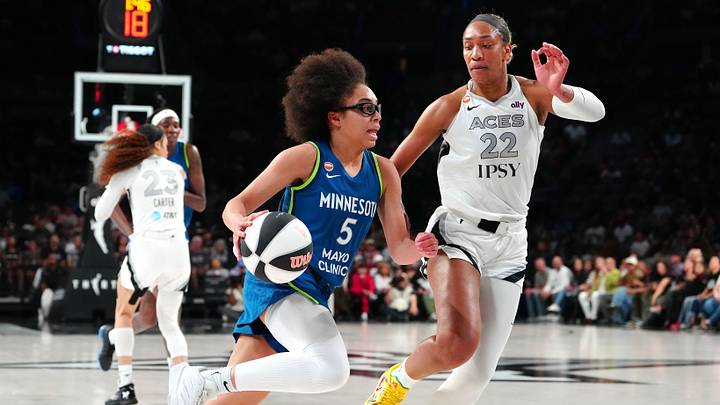
One: Lynx guard Olivia Miles tries to attack the paint, but she’s cut off and retreats. She passes to Kayla McBride, stationed in the right corner, who then dumps the ball off to Natasha Howard in the low post. The clock is ticking. Wings guard Arike Ogunbowale hedges toward Howard, but she loses McBride in the process. Howard finds McBride, now open on the wing. She hits a three with six seconds left on the shot clock.
Two: Tempo guard Marina Mabrey quickly receives the ball after a made basket. As the Sky jog back, Brittney Sykes darts past all five defenders, runs the length of the floor, corrals a full-court pass from Mabrey and lays it in. She does so in four seconds flat.
Three: Liberty center Jonquel Jones pulls down an offensive rebound after Pauline Astier’s floater glances off the rim. Jones attempts a putback, misses, rips an offensive rebound again, and finally makes her shot. All in quick succession.
Three different plays, three different offensive contexts. A half-court shot is different from a transition opportunity, which is different from a putback scenario. It would help to have statistics that provide clearer language about where and how teams and players are succeeding or struggling, rather than lumping all three states into a single flattened number.
Cleaning the Glass does exactly that for the NBA. It splits the game into distinct phases and reports plain, per-play numbers for each. Those same raw, easy-to-understand numbers for half-court, transition and putback contexts have not been publicly available in the same way for the WNBA.
So, let’s fix that. How? It turns out that there are simple if-then rules that help identify each of those play contexts. One rule might say that if a play starts after a live-ball turnover and ends in fewer than five seconds, then the play should be classified as transition. There are more. Once these rules, 20 in all, are bundled together, an algorithm can operate on play-by-play data and accurately—more on the methodology later—derive whether a play should be classified as a half-court, transition or putback (called scramble from here on out, to include quick kickouts) opportunity. From there, it’s easy to calculate stats for each of those scenarios.
Here is how every team’s offense and defense has performed in those contexts. (All stats are current through June 15.):
The top half-court teams
Half court: A play that occurs once the opponent’s defense is set (or organized) following a change in possession.

Here is Cheryl Reeve’s magic at work: Despite losing Jessica Shepard, Alanna Smith, Bridget Carleton and Natisha Hiedeman and not having Napheesa Collier while she recovers from surgery, the Lynx are still the league’s best team in offensive and defensive half-court efficiency. On offense, it doesn’t hurt when Courtney Williams is shooting lights out from midrange, Howard is doing everything well and Miles is playing at an all-WNBA level. (Have you seen the way she works the pick-and-roll and attacks the basket or dishes to open teammates?) On defense, Minnesota is forcing opponents to shoot poorly from everywhere. Especially so in the paint, where the Lynx are allowing a 45.4% field goal percentage in half-court situations, just behind the Valkyries for second best in the league.
What might be a surprise is to see the Dream ranked 13th in half-court offensive efficiency. Atlanta’s ranking is partially explainable by two factors, both of which should solve themselves over time. Without Bri Jones, the Dream have the second-worst half-court field goal percentage at the rim (54.8%) and don’t have a dominant post presence who can draw attention from opposing defenses. Atlanta is also shooting just 30.7% from three in half-court situations—only above Chicago, Connecticut and Washington—which should improve given the sharpshooters on their roster.
The top transition teams
Transition: A play that occurs before the opponent has set its half-court defense following a change in possession. (This follows the FIBA Statisticians’ Manual, as well as the NCAA Basketball Statisticians’ Manual definitions for a fast-break opportunity. It’s also close to Synergy’s definition.)

The Tempo have the league’s best transition offense, in part because they are scoring a WNBA-best 1.24 points per play after opponents’ misses. (That’s 30% more efficient than league average on such plays.) Credit Brittney Sykes. She has scored the most coast-to-coast transition buckets in the league and has generated 1.60 points per transition play after securing a defensive rebound. In fewer numbers: The Tempo frequently get down the floor fast after misses and convert their opportunities at a high rate.
Who else is noteworthy? The Dream, who have the second-most efficient transition offense, rank second in transition three-point attempt rate (29.3%) and first in three-point shooting percentage (41.8%). Rhyne Howard has hit the most transition threes (11, which is more than five WNBA teams) and is shooting 61.1% on such plays.
The top scramble teams
Scramble: A play that occurs following an offensive rebound, before the offense and the defense reset. Scramble plays don’t include all second-chance opportunities, and do include plays like quick kickout threes. (This hews close to Cleaning the Glass’s definition for putback plays.)

The Aces are a menace in scramble scenarios, and their success can be broken down into three parts. First, NaLyssa Smith has feasted after A’ja Wilson misses. Smith has scored 31 scramble points—tied for sixth-most in the league—and 22 of those points have come after a Wilson missed shot. Second, Wilson is dominant down low. She draws fouls at a high rate and is the league’s fourth-most efficient scorer in scramble scenarios. Third, Chelsea Gray has torched teams on kickouts. She is shooting 72.7% on 11 scramble threes, which is by far the highest percentage in the league. Only one player with at least five such attempts is above 40.0%. (Small sample size caveats apply.)
Meanwhile, both the Sky and Fire struggle in scramble scenarios. Chicago is shooting 13-for-31 (41.9%) on rim attempts soon after an offensive rebound—17.1 percentage points below league average—and then turns around and allow a 75.5% field goal percentage on those same shots. The Sky are both struggling to finish second-chance opportunities at the rim and allowing opponents to convert in close with ease. Portland has a slightly different problem: While the Fire defend relatively well once scramble opportunities happen, they surrender the highest opponent offensive rebounding rate in the league.
Why should you trust the labels?
Half-court, transition and scramble labels are inferred from play-by-play data and may not perfectly match reality 100% of the time, but every effort was made to ensure the predicted labels were accurate.
Here are the details: I watched 14 WNBA games from this season and manually labeled 2,538 plays as half-court, transition, scramble or other. To ensure consistency, I used the definitions listed above to chart each play. (Shot clock thresholds were not used in the manual labeling process.)
There are ambiguities in those definitions, though. Whether the defense is actually set can be fuzzy. Sometimes, especially in seven-seconds-or-less style plays where the offense quickly attacks, it isn’t clear whether the play should be classified as half-court or transition. Those ambiguities were accepted as part of the game.
With the human labels in hand as a source of truth, those 14 games were split into two sets. The first set contained five games and 892 plays; it was used to construct and tweak a litany of if-then rules, which produced the predicted labels. The rules were frozen in place after a satisfactory level of performance was reached. The second set, which had nine games and 1,646 plays, was then used to test how well the algorithm performed on games it had never seen before, and to see if the derived labels were worth trusting.
The predicted labels achieved 94.8% overall accuracy when compared to the human labels. We can also quantify how precise the predicted labels are by answering a simple question: When the algorithm predicts that a play is, say, a transition play, how often is it correct? Higher levels of precision indicate lower false positive rates. By that measure, the rules hit 96.3% precision on half-court plays, 88.4% on transition and 93.2% on scramble.
Remember, the actual labels were based on “soft” boundary questions, like “is the defense set?” Play-by-play data doesn’t contain that visual information. It only provides answers to “hard” boundary questions, like “how much time has elapsed since the last play?” or “did this play begin after a make, miss or something else?”
Even without that information and with the ambiguities in the definitions, the if-then rules still had a 93.0% overall precision score. That outperforms a variety of machine learning models and indicates the rules capture the intended play contexts with relatively few false positives. The remaining error means that about nine plays per game might get misclassified, and about half of those errors happen when a play is actually a transition play and the algorithm predicts that it’s a half-court play. (In other words, the rules slightly undercount transition plays.)
Point being: It’s best to read the contextual stats as estimates, useful ones at that.
More WNBA from Sports Illustrated
 Add us as a preferred source on Google
Dan Falkenheim is a fact checker for Sports Illustrated, where he may inundate you with numbers when he writes women's hoops. He joined the SI staff in September 2018 and also produces Faces in the Crowd for print. A graduate of Montclair State, Dan first got hooked on women’s basketball when covering the Red Hawks’ run to the 2015 Division III Final Four for the student newspaper. He lives in New Jersey with his wife and sweet rescue dog, Hari.
Follow thefalkon