%20%20--%3E%0A%3Csvg%20version%3D%221.1%22%20id%3D%22Layer_1%22%20xmlns%3D%22http%3A%2F%2Fwww.w3.org%2F2000%2Fsvg%22%20xmlns%3Axlink%3D%22http%3A%2F%2Fwww.w3.org%2F1999%2Fxlink%22%20x%3D%220px%22%20y%3D%220px%22%0A%09%20width%3D%2239px%22%20height%3D%2240px%22%20viewBox%3D%220%200%2039%2040%22%20enable-background%3D%22new%200%200%2039%2040%22%20xml%3Aspace%3D%22preserve%22%3E%0A%3Cpath%20fill%3D%22%23FFFFFF%22%20d%3D%22M38.5%2C7H28.2v26h10.3V7z%22%2F%3E%0A%3Cpath%20fill-rule%3D%22evenodd%22%20clip-rule%3D%22evenodd%22%20fill%3D%22%23FFFFFF%22%20d%3D%22M26.1%2C25.5c0%2C5.8-4.1%2C7.5-12.9%2C7.5C3.9%2C33%2C0%2C31.2%2C0%2C25.2v-1.1h11.6%0A%09v2.4c0%2C0.7%2C0.1%2C1.4%2C1.2%2C1.4c1%2C0%2C1.2-0.4%2C1.2-1.3v-0.9c0-1.6-0.9-1.6-3.5-2.2C2.2%2C21.7%2C0%2C19.7%2C0%2C15.3v-0.9C0%2C9.3%2C5.5%2C7%2C12.9%2C7%0A%09c10.2%2C0%2C12.8%2C2.6%2C12.8%2C7.4v1.8h-11v-2.9c0-0.6-0.4-1.1-1.2-1.1c-0.6%2C0-1.2%2C0.4-1.2%2C1.1v0.9c0%2C1.5%2C0.9%2C2%2C3.3%2C2.5%0A%09c8%2C1.6%2C10.5%2C3.3%2C10.5%2C7.5V25.5z%22%2F%3E%0A%3C%2Fsvg%3E%0A)
The Art of the Sweet Science: Stunt Coordinator Clayton Barber Talks Bringing ‘The Greatest’ to Life
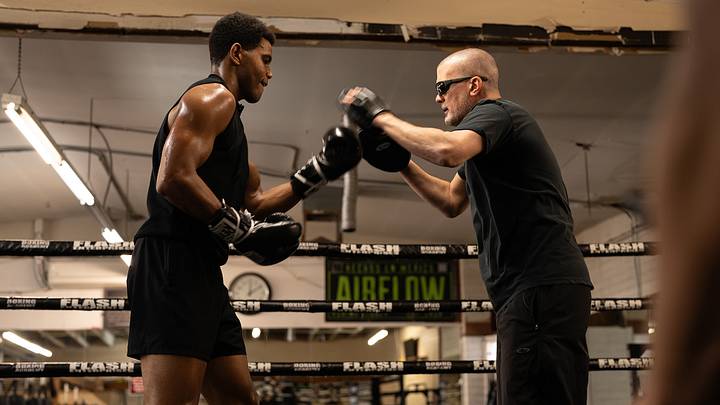
If a movie where boxing or fighting is an essential element has been made in Hollywood over the past two decades or so, chances are that Clayton Barber has been a part of it.
Barber, a Dallas native, has more than 100 film and television credits to his name in all kinds of behind-the-scenes capacities—the bulk of which have to do with stunts and their coordination. The 1995 world featherweight silver medalist in taekwondo’s c.v. is riddled with notable titles: Creed, Black Panther, Judas and the Black Messiah and others.
Ahead of the Nov. 4 premiere of Prime’s The Greatest—on which Barber worked as supervising stunt coordinator—he spoke to SI about the peculiarities of bringing boxing icon Muhammad Ali’s formative years in the sport to life.
This interview has been lightly edited for clarity.
SI: Tell me a little bit about your background. How exactly does one become a boxing consultant, per se?
BARBER: Well, my background is not so much as a boxing consultant, but I’m a stuntman by trade and a previous fighter. I grew up fighting, doing amateur sports like taekwondo, where I was on the U.S. national team.
As I got into the [entertainment] business, you start to branch out into many different things, and do as much as everything you can. For me, story is story whether you’re kicking or punching. Whether you’re using two hands or two feet or two knives or two guns, you’re telling the story, and the story is the king. I’ve always looked at boxing as sort of balletic, a violent ballet. I kind of derive my mentality through that. Boxing is like a dance to me.
SI: I think when people hear the word “choreography,” they picture dance. What are the similarities and differences between fight choreography and dance choreography?
CB: Not much, to be honest. You’ve got a partner in front of you. It’s like salsa, or fencing, you’re moving back and forth, you’re going through these motions of an algorithm of punches, and feints, and moving out of the way, and circling, and dancing, and coming together, and pushing away. They’re very similar in the rhythm—the only difference in boxing is you’re trying to punch someone. There’s a little bit more relevance to the heightened stakes of the dance, because actions have consequences, and there could be consequences to those punches.

SI: What specifically attracted you toward working on The Greatest?
CB: Muhammad Ali, of course. Anytime you think of boxing, you think of him. I had previously done a fictional version of characters like Adonis Creed. When this came along, I was like, “Well, now you got to tell the truth to this character,” because it hadn’t been done. Not in the way that it was approached to me by [creator] Ben Watkins.
SI: You started the story in Rome at the Olympics in 1960, and by the end you got to the first Sonny Liston fight in 1964. Four years is a pretty healthy length of time in boxing years. How did you capture in the choreography the evolution of Ali’s technique, from being a teenager to an accomplished professional?
CB: We started him out young and raw, you know, and he has all that talent. When he’s at the Rome Olympics, he’s presented in one way, and no one was really expecting him to do what he did in the way that he did it. That sort of laid our foundation—we have to have somewhere to go, from `60 to `64, and that’s exactly what we all did. I started him out raw, and then he puts on a little weight by the time he gets to the heavyweight version fighting Sonny Liston.
In my eyes, sort of the predetermined thing about Ali is that I always knew the engine was there—you just have to cultivate the moves and what you have to do. So we started from here, and we ended up there.
SI: It’s interesting how we see, in the run-up to the [Henry] Cooper fight, Ali, or Clay at the time, he’s very confident and [trainer Angelo] Dundee’s trying to impress on him, “Hey, you gotta take this guy seriously.” And then we have the climactic moment with the punch. How important was it to get that single punch right and kick off that dream sequence?
CB: It’s super important, because it did come out of nowhere, but remember, Ali was warned multiple times by Dundee historically. Ali was so confident, and so good, and his style—you’ll notice he’ll fight a lot of times with his hands down, because he was one of the only guys that could get away with that. He was a dancer. He was the ultimate dancer in the history of boxing.
Over the course of the fight, Cooper’s doing that left hook constantly, and it just inches closer and closer and closer. And I think it’s just one of those things where for a split second—Ali just probably lost his concentration for a half a second, and the left hook finally found its mark. And that’s how he got caught.
And it can catch the best of them. Obviously, he survived it, he got up, he did what he did, and you know, Cooper really respected Ali and Ali respected Cooper. Styles make fights, and that fight, for me, was a very interesting fight.

SI: How hard was it to teach Jaalen Best the specifics of Ali’s footwork?
CB: Not hard at all. He walked in and he was a Ferrari. He’s the greatest, most talented person I’ve ever worked with in a boxing movie. It really surprised me, to be honest with you, because you have no idea what you’re getting yourself into, and you never do. He shows up, and I vet him, I test him out, and within 30 seconds I just said, “OK, well, I’m gonna go home. I’ll see you guys later. We got our Ali.”
Within 15 minutes, I started teaching him how to fight for film, and he was the first subject in a boxing movie that made my blood pressure go down from the start. He was just the best I’ve ever seen. He walked in already doing his homework for a long time, for almost a year. So he walked in as the character, as opposed to trying to find the character. He walked in as Ali.
SI: With the climax of the first season being the first Liston fight, what was the most satisfying part of seeing that come to life?
CB: The end product, to be honest with you, and the fact they committed all the way to the end. When we finished that fight—and it’s an epic fight, it’s gonna come out at the end of the season. It’s probably the best stuff that I’ve ever been a part of in my career, in my life, doing a boxing movie.
I remember, we were about to finish the last few takes, and I brought both of them [Best and Amin Joseph, who plays Liston] in the middle and I said, “Both of you have come so far. This is it. This is the end. Let it all out.” And I remember both of them asking, “Can we just punch each other this time in the face?” I’m like, “No, you can’t do that.” And they did the last couple of takes, and they both collapsed, as if they were holding something in. And that’s the beauty of it. They gave their all. I collapsed too—I literally cried.
It was just beautiful. That’s the greatest thing I got out of it. Watching them go all the way, almost like at the end of a marathon, and the runners go through the line and then they collapse—that’s exactly what happened to both of them, to Jaalen and Amin. It was amazing to see.
 Add us as a preferred source on Google

Patrick Andres is a staff writer on the Breaking and Trending News team at Sports Illustrated. He joined SI in December 2022, having worked for The Blade, Athlon Sports, Fear the Sword and Diamond Digest. Andres has covered everything from zero-attendance Big Ten basketball to a seven-overtime college football game. He is a graduate of Northwestern University's Medill School of Journalism with a double major in history .
Follow PAndres2001