%20%20--%3E%0A%3Csvg%20version%3D%221.1%22%20id%3D%22Layer_1%22%20xmlns%3D%22http%3A%2F%2Fwww.w3.org%2F2000%2Fsvg%22%20xmlns%3Axlink%3D%22http%3A%2F%2Fwww.w3.org%2F1999%2Fxlink%22%20x%3D%220px%22%20y%3D%220px%22%0A%09%20width%3D%2239px%22%20height%3D%2240px%22%20viewBox%3D%220%200%2039%2040%22%20enable-background%3D%22new%200%200%2039%2040%22%20xml%3Aspace%3D%22preserve%22%3E%0A%3Cpath%20fill%3D%22%23FFFFFF%22%20d%3D%22M38.5%2C7H28.2v26h10.3V7z%22%2F%3E%0A%3Cpath%20fill-rule%3D%22evenodd%22%20clip-rule%3D%22evenodd%22%20fill%3D%22%23FFFFFF%22%20d%3D%22M26.1%2C25.5c0%2C5.8-4.1%2C7.5-12.9%2C7.5C3.9%2C33%2C0%2C31.2%2C0%2C25.2v-1.1h11.6%0A%09v2.4c0%2C0.7%2C0.1%2C1.4%2C1.2%2C1.4c1%2C0%2C1.2-0.4%2C1.2-1.3v-0.9c0-1.6-0.9-1.6-3.5-2.2C2.2%2C21.7%2C0%2C19.7%2C0%2C15.3v-0.9C0%2C9.3%2C5.5%2C7%2C12.9%2C7%0A%09c10.2%2C0%2C12.8%2C2.6%2C12.8%2C7.4v1.8h-11v-2.9c0-0.6-0.4-1.1-1.2-1.1c-0.6%2C0-1.2%2C0.4-1.2%2C1.1v0.9c0%2C1.5%2C0.9%2C2%2C3.3%2C2.5%0A%09c8%2C1.6%2C10.5%2C3.3%2C10.5%2C7.5V25.5z%22%2F%3E%0A%3C%2Fsvg%3E%0A)
The Big 12’s NBA Draft Dominance Proves Its Commitment to Basketball Excellence is Paying Off
In this story:
On paper, the Big 12 should not work. The fate of Arizona men’s basketball should be of no concern to the denizens of Cincinnati. Utah and UCF’s programs have almost nothing in common apart from the influencers infesting their home cities.
And yet! Two entire basketball cycles have come and gone for the 16-team Big 12, and it is clear that the league has built a lineup capable of not only hanging with the other major conferences but surpassing them. Tuesday and Wednesday provided the most compelling proof of this yet.
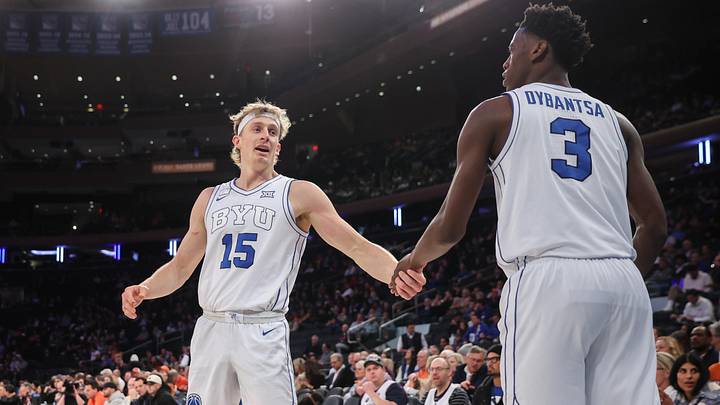
A total of 13 of this year’s 60 NBA draftees came from Big 12 schools—the most of any conference and the most in the conference’s three-decade history.
The Big 12’s lucky 13
Players from the conference taken Tuesday and Wednesday in Brooklyn are as follows. (Some players involved in trades were technically drafted by other franchises.)
PICK | PLAYER | BIG 12 TEAM | REPORTED NBA TEAM |
|---|---|---|---|
1 | AJ Dybantsa | BYU | Wizards |
2 | Darryn Peterson | Kansas | Jazz |
8 | Kingston Flemings | Houston | Hawks |
10 | Brayden Burries | Arizona | Bucks |
18 | Christian Anderson | Texas Tech | Hornets |
24 | Cameron Carr | Baylor | Lakers |
27 | Chris Cenac | Houston | Celtics |
28 | Joshua Jefferson | Iowa State | Nets |
30 | Koa Peat | Arizona | Suns |
32 | Richie Saunders | BYU | Grizzlies |
36 | Baba Miller | Cincinnati | Clippers |
45 | Emanuel Sharp | Houston | Kings |
50 | Jaden Bradley | Arizona | Raptors |
The league producing 13 draftees is impressive enough on the surface, but look at the distribution—nine in the first round, four in the second round. NBA teams wanted a piece of the top of the league, and they got it.
Virtually every contender from the 2026 season sent a player to the pro ranks. Arizona, which spent all of midseason ranked No. 1 and made the Final Four, sent three. Houston, which finished two games behind Arizona in the regular-season standings, did the same after two recent alumni (Pistons guard Marcus Sasser and Raptors guard Jamal Shead) flashed considerable defensive muscle in the playoffs. The Cyclones sent Jefferson after an injury derailed his NCAA tournament; the Jayhawks sent Peterson after injuries derailed his entire season.
Even the Bears—a team that slogged its way through its worst season since 2007, and a team that made its most headlines in ’26 for signing 2023 NBA draftee center James Nnaji—produced a first-round pick in Carr. The SEC may have edged out the Big 12 in College Basketball Reference’s Simple Rating System, and the Big Ten may have played slightly harder schedules, but the Big 12’s talent won the day during an important week for recruiting and branding purposes.
The Big 12’s unity of vision sets it apart from the four other major conferences—and it’s showing

Like all of college sports, each of the five major men’s college basketball leagues—the ACC, Big 10, Big 12, Big East and SEC—find themselves at a crossroads. The Big 12, however, is in all likelihood the only conference standing at that crossroads and smiling.
The SEC is 14 months removed from the greatest season by a single conference in men’s hoops history, but football is king in the south, and the league’s slight gridiron recession in recent years rankles. The plutocratic Big Ten enjoyed a superb ’26, but also views football as priority one and continues to take criticism for its bicoastal lineup.
Among the (ostensibly) basketball-first leagues, the ACC remains mired in a longstanding identity crisis despite recent year-over-year improvement. The Big East, once reliably deep, sent just three teams to the NCAA tournament in ’26 and can be reasonably described as top-heavy.
The Big 12 is different. The league has the manufactured feel of modern conferences but less of their coldness, because it has maintained a number of rivalries. As alluded to previously, it’s geographically large but not imposingly so, with only one complete outlier if you pair off the Bearcats and West Virginia.
More to the point, every program in the league can credibly claim to be pulling their weight. In brief: Arizona is a near-blue blood and Arizona State has a deep sports tradition; BYU and the Utes are mortal enemies in a booming state; oft-forgotten Colorado has been to six tournaments in 15 years; Baylor, Houston and Texas Tech are among the most successful programs of the last decade; TCU has made five of nine tournaments under a respected coach; the Jayhawks need no introduction; Kansas State and Oklahoma State have long histories of success despite recent struggles; the Cyclones look like a perennial power under coach T.J. Otzelberger; Cincinnati and the Knights are situated in major metro areas; West Virginia, despite a rough few years, looks on the upswing.
That culture of success and (for the time being) unity, combined with the conference’s willingness to spend, makes the Big 12’s avalanche of NBA draft picks seem like a predictable event. Expect more of the same next year, with three of Sports Illustrated’s Kevin Sweeney’s top four 2027 prospects hailing from the league. It may not be the best or richest league on paper, but if you want to understand the college game in ’26, the Big 12’s is the language you’ll have to learn.
More College Basketball From Sports Illustrated
Listen to SI’s college sports podcast, Others Receiving Votes, below or on Apple and Spotify. Watch the show on SI’s College YouTube channel.
 Add us as a preferred source on Google
Patrick Andres is a staff writer on the Breaking and Trending News team at Sports Illustrated. He joined SI in December 2022, having worked for The Blade, Athlon Sports, Fear the Sword and Diamond Digest. Andres has covered everything from zero-attendance Big Ten basketball to a seven-overtime college football game. He is a graduate of Northwestern University's Medill School of Journalism with a double major in history .
Follow PAndres2001