%20%20--%3E%0A%3Csvg%20version%3D%221.1%22%20id%3D%22Layer_1%22%20xmlns%3D%22http%3A%2F%2Fwww.w3.org%2F2000%2Fsvg%22%20xmlns%3Axlink%3D%22http%3A%2F%2Fwww.w3.org%2F1999%2Fxlink%22%20x%3D%220px%22%20y%3D%220px%22%0A%09%20width%3D%2239px%22%20height%3D%2240px%22%20viewBox%3D%220%200%2039%2040%22%20enable-background%3D%22new%200%200%2039%2040%22%20xml%3Aspace%3D%22preserve%22%3E%0A%3Cpath%20fill%3D%22%23FFFFFF%22%20d%3D%22M38.5%2C7H28.2v26h10.3V7z%22%2F%3E%0A%3Cpath%20fill-rule%3D%22evenodd%22%20clip-rule%3D%22evenodd%22%20fill%3D%22%23FFFFFF%22%20d%3D%22M26.1%2C25.5c0%2C5.8-4.1%2C7.5-12.9%2C7.5C3.9%2C33%2C0%2C31.2%2C0%2C25.2v-1.1h11.6%0A%09v2.4c0%2C0.7%2C0.1%2C1.4%2C1.2%2C1.4c1%2C0%2C1.2-0.4%2C1.2-1.3v-0.9c0-1.6-0.9-1.6-3.5-2.2C2.2%2C21.7%2C0%2C19.7%2C0%2C15.3v-0.9C0%2C9.3%2C5.5%2C7%2C12.9%2C7%0A%09c10.2%2C0%2C12.8%2C2.6%2C12.8%2C7.4v1.8h-11v-2.9c0-0.6-0.4-1.1-1.2-1.1c-0.6%2C0-1.2%2C0.4-1.2%2C1.1v0.9c0%2C1.5%2C0.9%2C2%2C3.3%2C2.5%0A%09c8%2C1.6%2C10.5%2C3.3%2C10.5%2C7.5V25.5z%22%2F%3E%0A%3C%2Fsvg%3E%0A)
Braylon Mullins’s Miracle: Ranking the 12 Most Improbable Shots of March Madness
In this story:
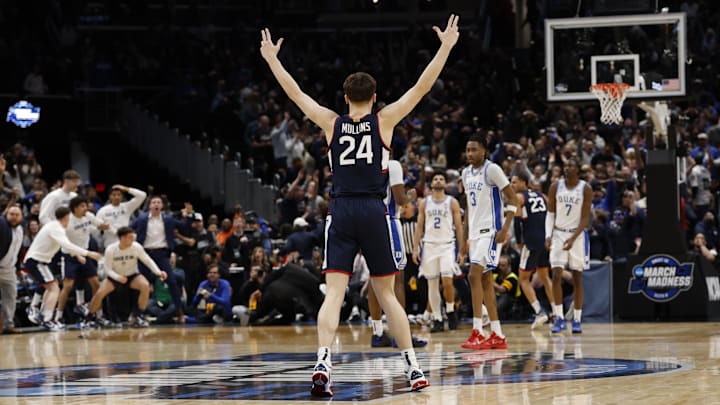
The debate began immediately and will rage in perpetuity: Where does UConn freshman Braylon Mullins’s 35-footer to beat Duke rank on the list of stunning, screaming, run-around-the-living room shots in NCAA men’s tournament history?
The immediate answer: We don’t know yet. If UConn ends up winning the national championship, that increases the payload. But for now, let’s fit it snugly into a 12-shot pantheon—with the chance to move up when all is said and done. (I considered 30 notable buzzer beaters before whittling the list to a dazzling dozen.)
Here is one man’s attempt to rank them—largely in terms of shock value. Like, a play you could not see coming until it was suddenly happening. Added factors: historic impact, spontaneity, degree of difficulty, contextual drama and whether a season ended.
Feel free to disagree:
12. Jerome Whitehead’s layup, 1977 Final Four, Atlanta
The context: Marquette and UNC Charlotte (now simply Charlotte) were tied at 49 in the national semifinals.
The play: Coach Al McGuire called a timeout and drew up a play with guard Butch Lee heaving an 80-foot pass over a defender for center Whitehead in the opposite paint. Charlotte star Cedric “Cornbread” Maxwell leaped to intercept the pass, but the ball went through his hands, Whitehead corralled it, turned and laid it in with Maxwell defending as the clock expired. There was no immediate signal from the officials, which led to a pileup of players, coaches and even law enforcement personnel around the scorer’s table before the shot was ruled good. (There were no replay reviews back then, but with nearly 50 years of hindsight the layup appeared to be in time.)
Bonus points: Marquette went on to win the national title two days later. Lee’s long pass was impressive.
Points deducted: The game was tied, so overtime would have followed. There wasn’t much improvisation to the play.
11. Luke Maye’s jump shot, 2017 South Regional final, Memphis
The context: Kentucky and North Carolina were tied, with the Tar Heels having lost their grip on what seemed like a sure victory in the final minute.
The play: After a Malik Monk three-pointer tied the game with 10 seconds left, Theo Pinson pushed the ball upcourt and dished to Maye on the left wing. He took a step back and, with his feet on the three-point arc, dropped a dagger on the Wildcats.
Bonus points: This was a very decisive, live-action play with Carolina making it happen in the moment. The Tar Heels went on to win the title.
Points deducted: The game was tied, so it wasn’t a do-or-die shot. Maye’s shot, while supremely clutch, was not well-contested by Kentucky.
10. Tyus Edney’s drive, 1995 West Regional second round, Boise, Idaho
The context: Eight-seeded Missouri led No. 1 seed UCLA 74–73 with 4.8 seconds left, having just scored the go-ahead basket.
The play: Jim Harrick called timeout and drew up the simplest—and best—play he had: send jet-quick point guard Edney as far as he could go before he had to get a shot up. He used a behind-the-back dribble at midcourt to separate from defender Jason Sutherland, then hooked a layup over Mizzou big man Derek Grimm for the win.
Bonus points: UCLA went on to win the title. This was a moment of pure individual brilliance, from the sprint downcourt to the difficult finish, with the rest of the Bruins spectating and hoping.
Points deducted: The play came out of timeout, and UCLA had to win four more games thereafter.
9. Keith Smart’s jumper, 1987 national championship game, New Orleans
The context: Syracuse led Indiana by a point when the Hoosiers rebounded a missed Derrick Coleman free throw with 27 seconds left.
The play: Indiana worked deliberately in the half court, with star guard Steve Alford surprisingly a nonfactor on the possession. Finally, with seven seconds left, Smart got a pass on the wing and took one dribble to his left. He elevated from the baseline, not far from where Michael Jordan hit his famous shot for North Carolina five years earlier. Smart’s jumper ripped the net with four seconds left, then the clock drained to :01 before Syracuse called a timeout. Smart then intercepted the inbounds pass to end the game.
Bonus points: It was a do-or-die possession with the national title on the line.
Points deducted: The shot was not as hard as several others on this list. The miss by Coleman opened the door.
8. Kihei Clark’s pass and Mamadi Diakite’s shot, 2019 South Regional final, Louisville
The context: Virginia trailed Purdue by two with 5.9 seconds left with Cavaliers standout Ty Jerome at the foul line.
The play: Jerome short-armed the free throw, and Diakite batted it back toward half court—seemingly the death knell for Virginia. But Clark won the footrace to the ball, and reacted with brilliant instinct—he took two dribbles and whipped a one-handed pass back to Diakite, who caught it about 10 feet from the basket and flipped it up without gathering himself at all. The shot swished at the buzzer to force overtime.
Bonus points: This was true, heat-of-the-moment execution with no time to spare. If Clark had taken one more dribble, or Diakite had done anything other than catch and release, time would have expired and the Cavaliers’ tournament agony would have been extended. Instead, they won a couple more heart stoppers in the Final Four for their only national title.
Points deducted: The shot only forced overtime. Purdue missed some key free throws to give Virginia life. The Wahoos had to win two more games to win it all.
7. Braylon Mullins’s game-winner, 2026 East Regional final, Washington, D.C.
The context: UConn trailed Duke 72–70 with 10 seconds to play, having rallied from a 19-point deficit.
The play: The Blue Devils inbounded against full-court pressure and the ball found its way into the hands of freshman point guard Cayden Boozer, who made the ill-fated decision to try to pass over a looming double team instead of holding it and waiting to be fouled. UConn’s Silas Demary Jr. tipped the pass, Mullins retrieved it, then passed it to Alex Karaban. The senior astutely whipped it back to Mullins, who had a better look but was 35 feet out. Mullins rose, fired and splashed it for the win.
Bonus points: This was a pure scramble play, beauty created out of chaos, an improbable opportunity presenting itself and being seized in the moment. The shot, while uncontested (alas, Isaiah Evans) was an absolute launch from about 35 feet. This was a win-or-go-home moment, capping a preposterous comeback.
Points deducted: Duke’s three live-ball turnovers in the final 3:45 enabled UConn’s comeback. Mullins’s job, while not easy, was simple: catch and shoot. The final impact of the play is yet to be determined, but the Huskies will have to win two more games to maximize it.
6. Lamont Butler’s drive and jumper, 2023 Final Four, Houston
The context: San Diego State trailed Florida Atlantic 71–70 with nine seconds left.
The play: Center Nathan Mensah pulled down a defensive rebound and fired an outlet pass to Butler. The Aztecs guard drove downcourt to the right wing, maneuvered inside out to get space and sank a jump shot from the wing as the clock expired, sending SDSU to the national title game.
Bonus points: Aztecs coach Brian Dutcher didn’t use his last timeout, letting Butler go and create on the fly. This was a true walk-off, with the game ending as the ball was in flight. One of the color analysts (probably Grant Hill) emitted something that sounded like a bird screech when the shot went in.
Points deducted: San Diego State was easily handled by UConn in the title game.
5. Jalen Suggs’s 40-foot banker, 2021 Final Four, Indianapolis
The context: Gonzaga and UCLA were tied at 90 in overtime with 3.3 seconds left.
The play: After a tying basket by the Bruins, Gonzaga inbounded to freshman guard Suggs. He sprinted the ball upcourt in three dribbles, getting just past half court and launching. The shot caromed off the glass and through the net for the victory, advancing the Bulldogs to the national championship game.
Bonus points: No timeouts, just Suggs on the run displaying an excellent internal clock and navigational skills to get a clean (long) look.
Points deducted: If Suggs had missed, a second overtime awaited. The Zags were walloped in the championship game by Baylor.
4. Mario Chalmers’s three-pointer, 2008 national championship game, San Antonio
The context: Kansas trailed Memphis by three points with 10.8 seconds left.
The play: Bill Self didn’t call timeout, but communicated to his players to run “Chop”—a dribble handoff from point guard Sherron Collins to Chalmers coming off a curl on the right side. Collins nearly lost the handle but got the ball to Chalmers, who rose up and swished the shot that eventually forced overtime.
Bonus points: Kansas won it all in OT, completing a late comeback in regulation from nine points down.
Points deducted: Chalmers’s shot was with 2.1 seconds left, giving Memphis a surprisingly decent half-court attempt for the win. Then Kansas had to win the game in overtime. This was one of those situations where the losing team contributed to its own demise, missing several late free throws and failing to foul up three.
3. Christian Laettner’s jumper, 1992 East Regional final, Philadelphia
The context: Duke trailed Kentucky 103–102 with 2.1 seconds left in overtime. Wildcats guard Sean Woods had just hit a floating banker to put his team in position to make the Final Four. Mike Krzyzewski called a timeout to set up the final play.
The play: Grant Hill fired an 80-foot baseball pass to Laettner at the opposite free throw line. The center took a balancing dribble, then turned and fired in the winning shot at the buzzer. It completed a perfect scoreline for Laettner: 10 for 10 from the field, 10 for 10 from the foul line.
Bonus points: The bigger picture factors in heavily here. Laettner’s heroics were the climactic moment in a game rife with big shots and offensive artistry—it isn’t known as the greatest game ever simply for the final play. The number of college legends—players and coaches—in the game added gravity, as did the profile of the programs. Duke went on to repeat as national champions.
Points deducted: Kentucky contributed to its own demise by failing to guard the inbounds pass and giving Laettner ample room to get a clean look at the basket. The Blue Devils still had to win two more games thereafter to complete the repeat.
2. Kris Jenkins’s three-pointer, 2016 national title game, Houston
The context: North Carolina rallied to tie Villanova at 74 with 4.7 seconds left.
The play: In a timeout, Jay Wright drew up a familiar play called “Nova”—point guard Ryan Arcidiacono drove the ball off a midcourt screen by Daniel Ochefu, to near the three-point arc, drawing the defense to him. Then he shoveled it to trailing Jenkins for the pull-up from 27 feet. The ball hit the net after the horn sounded for the walk-off win.
Bonus points: This was the longest winning shot in championship game history, and it came on a perfectly executed play. Wright’s stoic one-word response as the shot fell—“Bang”—was an all-timer.
Points deducted: Overtime awaited if the shot missed. There was no real spontaneity to the play.
1. Lorenzo Charles’s dunk, 1983 national title game, Albuquerque
The context: Major underdog NC State was improbably tied with Phi Slama Jama Houston at 52 in the final minute.
The play: In the pre-shot clock days, the Wolfpack were free to kill time and shorten the game, hoping for a final shot. They passed the ball around the perimeter against a Houston zone until nearly losing it on a pass outside to Dereck Whittenburg. He gathered in the ball about 40 feet out with four seconds left and launched a shot that came up well short … only for Charles, a freshman center to rise up, grab it and dunk it in one motion with one second left. The clock ran out before the Cougars could inbound the ball.
Bonus points: This was the serendipity of March Madness, defined. For sheer shock value, an underdog winning the national title on an airball turned walk-off dunk is unsurpassed. There was no orchestration, just divine intervention and remarkable reaction from a player who was in the right place at the right time.
Points deducted: The game would have gone to overtime if NC State hadn’t converted. Houston was culpable the entire game in letting Jim Valvano dictate the tempo, and never more than in the final minute as it sat back in a fairly passive zone and never forced the issue.
Honorable mention
From the later rounds
- Laettner’s double-clutch jumper to beat UConn in the 1990 regional final
- Bob Heaton’s left-handed push shot for Indiana State against Arkansas in the 1979 regional final
- Scottie Reynolds’s drive to lift Villanova past Pittsburgh in the 2009 regional final
- Elgin Baylor’s 30-footer to carry Seattle past San Francisco in the 1958 Sweet 16
- Jordan Poole’s leg-splayed three for Michigan to beat Houston in the second round in 2018, on the way to the national title game
- Korie Lucious’s second-round three for Michigan State against Maryland off a feed from Draymond Green, as the Spartans went to the 2010 Final Four
First-round games
- Donte Ingram’s three for Loyola Chicago to beat Miami, starting the Final Four run of 2018
- Bryce Drew’s catch-and-shoot to lift Valparaiso to an upset of Mississippi in 1998
- Otega Oweh’s 40-footer to force overtime for Kentucky against Santa Clara in 2026
- JP Pegues’s three for Furman off a live-ball turnover by Virginia in the 2023 (a play eerily similar to UConn’s winner Sunday)
- U.S. Reed’s half-court shot, against a double team, for Arkansas to beat Louisville in 1981
- Paul Jesperson’s half-court-plus heave to push Northern Iowa past Texas in 2016, still the longest buzzer beater in NCAA tournament history
More March Madness From Sports Illustrated
Listen to SI’s college sports podcast, Others Receiving Votes, below or on Apple and Spotify. Watch the show on the SI College YouTube channel.
 Add us as a preferred source on Google
Pat Forde is a senior writer for Sports Illustrated who covers college football and college basketball as well as the Olympics and horse racing. He cohosts the Others Receiving Votes podcast for SI and is a regular contributor to the Tony Kornheiser Show podcast. He previously worked for Yahoo Sports, ESPN and The (Louisville) Courier-Journal. Forde has won 28 Associated Press Sports Editors writing contest awards, has been published three times in the Best American Sports Writing book series, and was nominated for the 1990 Pulitzer Prize. A past president of the U.S. Basketball Writers Association and member of the Football Writers Association of America, he lives in Louisville with his wife. They have three children, all of whom were collegiate swimmers.
Follow ByPatForde