%20%20--%3E%0A%3Csvg%20version%3D%221.1%22%20id%3D%22Layer_1%22%20xmlns%3D%22http%3A%2F%2Fwww.w3.org%2F2000%2Fsvg%22%20xmlns%3Axlink%3D%22http%3A%2F%2Fwww.w3.org%2F1999%2Fxlink%22%20x%3D%220px%22%20y%3D%220px%22%0A%09%20width%3D%2239px%22%20height%3D%2240px%22%20viewBox%3D%220%200%2039%2040%22%20enable-background%3D%22new%200%200%2039%2040%22%20xml%3Aspace%3D%22preserve%22%3E%0A%3Cpath%20fill%3D%22%23FFFFFF%22%20d%3D%22M38.5%2C7H28.2v26h10.3V7z%22%2F%3E%0A%3Cpath%20fill-rule%3D%22evenodd%22%20clip-rule%3D%22evenodd%22%20fill%3D%22%23FFFFFF%22%20d%3D%22M26.1%2C25.5c0%2C5.8-4.1%2C7.5-12.9%2C7.5C3.9%2C33%2C0%2C31.2%2C0%2C25.2v-1.1h11.6%0A%09v2.4c0%2C0.7%2C0.1%2C1.4%2C1.2%2C1.4c1%2C0%2C1.2-0.4%2C1.2-1.3v-0.9c0-1.6-0.9-1.6-3.5-2.2C2.2%2C21.7%2C0%2C19.7%2C0%2C15.3v-0.9C0%2C9.3%2C5.5%2C7%2C12.9%2C7%0A%09c10.2%2C0%2C12.8%2C2.6%2C12.8%2C7.4v1.8h-11v-2.9c0-0.6-0.4-1.1-1.2-1.1c-0.6%2C0-1.2%2C0.4-1.2%2C1.1v0.9c0%2C1.5%2C0.9%2C2%2C3.3%2C2.5%0A%09c8%2C1.6%2C10.5%2C3.3%2C10.5%2C7.5V25.5z%22%2F%3E%0A%3C%2Fsvg%3E%0A)
The Men’s Final Four Has One Massive Showdown and Plenty of Historic Storylines
In this story:
All due respect to UConn and Illinois. They earned their Final Four berths the hard way—the Huskies went through No. 1 overall seed Duke, fighting back from a 19-point deficit, while the Illini had to take out No. 2 seed Houston in Houston. Strong stuff. Indianapolis will be graced by your presence.
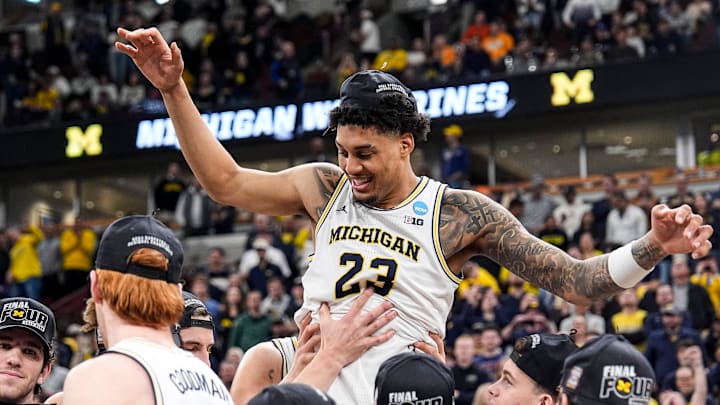
That said: Their matchup is the undercard in the national semifinals Saturday. Michigan vs. Arizona is the super-juicy headliner, a collision of No. 1-seeded runaway trains that should be the de facto national championship game.
Even if Duke had advanced instead of enduring a second annual massive NCAA men’s tournament collapse—Jon Scheyer, dude, yikes—the Wolverines and Wildcats had already established themselves as the title favorites. Their tournament runs to this point have been relentless domination. Arizona’s average winning margin in four games is 20.5 points; Michigan’s is 22.5. (The Wolverines are the first tourney team since UConn in 1995 to score at least 90 points in four straight games.)
This has happened several times before, where an epic semifinal matchup decides the title and turns the championship game into something of an anticlimax. An incomplete list: UConn-Duke in 2004, won by the Huskies; Kentucky-Massachusetts 1996, won by the Wildcats; NC State–UCLA 1974, won by the Wolfpack; and UCLA-Houston in both 1967 and ’68, won by the Bruins.
Some people would like to see the Final Four reseeded after the regionals, so that the top two remaining teams are not matched up in the semifinals. I say you let March Madness play out with no manipulation of the bracket at any point in time. If this is what the tourney gods give us, so be it.
Yet and still, Monday plot twists can happen. On a couple of memorable occasions, the winner of an epic semifinal ran out of gas two nights later: Houston beat Louisville in a dunkathon in 1983, then was shocked by NC State; and Wisconsin slayed the undefeated Kentucky dragon in 2015 and then came up empty in the final eight minutes of the final against Duke.
It feels weird to even characterize No. 2 seed UConn as an underdog, having won two of the previous three national championships. But these Huskies are not those Huskies—certainly not the 2024 juggernaut—beyond the immense pride and ferocity with which they compete. They don’t have the same offensive firepower or ability to warp the game inside.

Illinois, too, is an exceptional team. The Illini are the most efficient offensive unit in the country, according to KenPom’s metrics, and field the tallest lineup in the country. But they also lost five of their last nine before the NCAA tourney, including a thorough beating at home at the hands of Michigan.
So the Wildcats and the Wolverines are where the Final Four discussion starts. They have a combined five losses (three for Michigan, two for Arizona). They have a combined three conference championships—Michigan topped the Big Ten in the regular season, while Arizona won both regular-season and league tourney titles in the Big 12. They are 1-2 in KenPom and 1-2 in the Torvik Rankings. Bring on that Saturday night cataclysm.
Additional Final Four observations:
- The Big Ten’s much-discussed 26-year title drought has never been closer to ending. For the first time since 2015, the league has half the field, and Michigan and Illinois both are small favorites in their semifinals. Plenty of Big Ten teams have advanced to the championship game since Michigan State won it in 2000, only to find a powerhouse in their way. This year, the opportunity is there. Even if the league doesn’t end the drought, it can take immense pleasure in a 6–0 head-to-head beatdown of the rival SEC in this tourney.
- Programs wishing to get this far should get themselves a European big man. Or multiple Euro bigs. Illinois is Team Balkans, with 7-foot Croatian brothers Zvonimir and Tomislav Ivišić and 6' 9" Montenegrin David Mirković. Arizona has tapped Tommy Lloyd’s Lithuanian pipeline for 7-footer Motiejus Krivas (not to mention 6' 7" German wing Ivan Kharchenkov). Michigan’s 7' 3" tower in the middle, Aday Mara, hails from Spain. Eric Reibe, UConn’s 7' 1" freshman from Germany, doesn’t play much this season but could blossom next season.
Whether that’s a commentary on the quality of American prospects or a reflection of the NIL money available to attract European players who would otherwise be pros there is up for debate. But their impact is not debatable.

- Don’t buy any “overcoming adversity” talk at this Final Four. All four teams have been good all season, with none of them losing more than two games in a row at any point. All four were ranked in the top 17 preseason by the Associated Press and top 14 in the coaches poll. All were ranked in the top five at various points, with Michigan and Arizona both No. 1. None ever dropped lower than No. 20 in the polls or lower than No. 17 in KenPom.
- Old coaches were a big Sweet 16 storyline. Not so much at the Final Four, after Rick Pitino, Tom Izzo, Kelvin Sampson and Rick Barnes were sent packing by younger men. Illinois’s Brad Underwood is 62, but the other three—Michigan’s Dusty May, Arizona’s Tommy Lloyd and UConn’s Dan Hurley, average 51 years of age. Hurley has two titles, but the other three coaches are trying to grab their first ring. Of the three, only May has Final Four experience, with Florida Atlantic in 2023.
- With Cameron Boozer eliminated, the single best player in the Final Four is a 23-year-old who spent three seasons in junior college, two at UAB and now has blown up into a superstar at Michigan. That’s Yaxel Lendeborg, the Big Ten Player of the Year who has averaged 25.0 points, 8.3 rebounds and 4.3 assists in the last three NCAA tourney games. In that spree, the bouncy, 6' 9" Lendeborg has made 68% of his two-point shots and 52.6% of his threes.
- Despite the absence of Boozer, Darryn Peterson, AJ Dybantsa and other high draft picks from the stellar freshman class in the sport, there is some great first-year talent headed to Indy. Arizona starts three freshmen in Brayden Burries, Koa Peat and Kharchenkov. Illinois’s leading scorer is wing Keaton Wagler. Michigan brings guard Trey McKenney off the bench. And the biggest hero in Connecticut, Braylon Mullins—maker of one of the biggest shots in school history Sunday—is a freshman from Indy-adjacent Greenfield, Ind.
- One statistical common denominator among the Final Four teams is a dominant edge in effective field goal percentage vs. what they allow. Michigan is a +13.9%, Arizona +11.1%, UConn +9% and Illinois +7.7%. Most of that advantage is generated inside the arc, where all four teams convert at a much higher rate than they allow.
Three of the four also have an adjacent statistical advantage when it comes to the foul line. Arizona has outscored its opponents by 285 points there, Illinois by 249 and Michigan by 181. The outlier? UConn, which fouls a lot. The Huskies have been outscored at the stripe by 113 points, which could be a problem against the Illini.
- Indianapolis is the happy place for Arizona, which won its only national title there in 1997, upsetting Kentucky in overtime. All of UConn’s titles have come in the Sun Belt: Arizona, Texas (four times) and Florida. Michigan’s lone title was claimed in Seattle in 1989. Illinois, which has never won a men’s basketball natty, lost to the Wolverines in the semifinals of that tournament. With five previous Final Four appearances, Illinois is one of the most accomplished programs to have never won it all.
More March Madness From Sports Illustrated
Listen to SI’s college sports podcast, Others Receiving Votes, below or on Apple and Spotify. Watch the show on the SI College YouTube channel.
 Add us as a preferred source on Google
Pat Forde is a senior writer for Sports Illustrated who covers college football and college basketball as well as the Olympics and horse racing. He cohosts the Others Receiving Votes podcast for SI and is a regular contributor to the Tony Kornheiser Show podcast. He previously worked for Yahoo Sports, ESPN and The (Louisville) Courier-Journal. Forde has won 28 Associated Press Sports Editors writing contest awards, has been published three times in the Best American Sports Writing book series, and was nominated for the 1990 Pulitzer Prize. A past president of the U.S. Basketball Writers Association and member of the Football Writers Association of America, he lives in Louisville with his wife. They have three children, all of whom were collegiate swimmers.
Follow ByPatForde