%20%20--%3E%0A%3Csvg%20version%3D%221.1%22%20id%3D%22Layer_1%22%20xmlns%3D%22http%3A%2F%2Fwww.w3.org%2F2000%2Fsvg%22%20xmlns%3Axlink%3D%22http%3A%2F%2Fwww.w3.org%2F1999%2Fxlink%22%20x%3D%220px%22%20y%3D%220px%22%0A%09%20width%3D%2239px%22%20height%3D%2240px%22%20viewBox%3D%220%200%2039%2040%22%20enable-background%3D%22new%200%200%2039%2040%22%20xml%3Aspace%3D%22preserve%22%3E%0A%3Cpath%20fill%3D%22%23FFFFFF%22%20d%3D%22M38.5%2C7H28.2v26h10.3V7z%22%2F%3E%0A%3Cpath%20fill-rule%3D%22evenodd%22%20clip-rule%3D%22evenodd%22%20fill%3D%22%23FFFFFF%22%20d%3D%22M26.1%2C25.5c0%2C5.8-4.1%2C7.5-12.9%2C7.5C3.9%2C33%2C0%2C31.2%2C0%2C25.2v-1.1h11.6%0A%09v2.4c0%2C0.7%2C0.1%2C1.4%2C1.2%2C1.4c1%2C0%2C1.2-0.4%2C1.2-1.3v-0.9c0-1.6-0.9-1.6-3.5-2.2C2.2%2C21.7%2C0%2C19.7%2C0%2C15.3v-0.9C0%2C9.3%2C5.5%2C7%2C12.9%2C7%0A%09c10.2%2C0%2C12.8%2C2.6%2C12.8%2C7.4v1.8h-11v-2.9c0-0.6-0.4-1.1-1.2-1.1c-0.6%2C0-1.2%2C0.4-1.2%2C1.1v0.9c0%2C1.5%2C0.9%2C2%2C3.3%2C2.5%0A%09c8%2C1.6%2C10.5%2C3.3%2C10.5%2C7.5V25.5z%22%2F%3E%0A%3C%2Fsvg%3E%0A)
Dana Altman’s Retirement Undercuts College Sports’ Push for Stability
In this story:
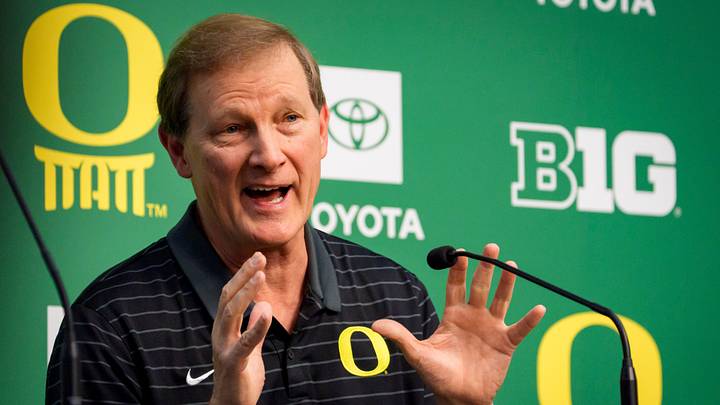
A pair of Oregon men’s basketball players will sit at a convention center podium in the shadow of Chicago O’Hare International Airport, answering questions Thursday as part of Big Ten media day. Guard Fred Payne and forward Sean Stewart will be forced to answer for news they’re likely still processing: Head coach Dana Altman is walking away into retirement less than a month before the Ducks tip off their season.
Altman on Wednesday became the latest to follow what has become a troubling trend for big-time college basketball coaches: fall retirements. Last year, Bruce Pearl stepped away from Auburn (in a clear power play to ensure his son replaced him) in late September. The year before, Tony Bennett retired from Virginia in mid-October, while Jim Larrañaga never came back after Christmas break to a disappointing Miami squad. Even if their moves are well-intentioned, the surprise retirements makes the college game even more unstable.
The decision is one Altman attributes to a lack of energy for the job. He told reporters in Eugene, Ore., that he tried to take a step back in September, delegating more responsibilities to his assistants, but that didn’t help enough for him to feel like he was the right man to lead the program.
“I always ask the players to look at themselves in the mirror and ask if they’re giving everything they have to be their best,” a tearful Altman said. “I looked in the mirror and I’d be a hypocrite if I lied to myself and said I was the best coach for the job. [Associate head coach] Tony [Stubblefield] will do a better job than I would with this team. He’s got more energy. He’s ready. The guys believe in him. I think he’ll do a great job.”
The 68-year-old Altman leaves college coaching just eight wins shy of 800 for his outstanding career. He’s the winningest coach in Oregon history, and he would have had a good chance of reaching the 400-win threshold with the Ducks had he coached out this season. He had every right to leave on his own terms and not get pushed out the door following a 20-loss season in 2026–27. The other three last-second retirees also earned that right.
But going out on your own terms shouldn’t mean putting the program and its players in a horrible spot. And these last-ditch retirements have done just that. Virginia had its worst season of the KenPom era in the 2024–25 season after Bennett walked away. Auburn missed the 2026 NCAA tournament after preseason Top 25 expectations. Miami won just three times once Larrañaga left and missed the 2025 ACC tournament. You can take Altman or Bennett at their word that they no longer felt like they were the right man for the job, but history says things usually go worse when the potential Hall of Fame coach abdicates his seat for an assistant, not better.
Altman and his staff recruited eight transfers this spring, selling them a vision of why Oregon was the right place for them to set their careers on the right trajectory. Instead, he has left those eight stuck in purgatory. Because Oregon is promoting Stubblefield on an interim basis, players who want to leave will have to wait 31 days to enter the portal … that’s after the season tips off. At best, they could enroll at new schools in December for conference play, but miss out on a third of the season in the process. And with the new age-based eligibility model, there’s no option for a player to redshirt and save the year of eligibility. Altman sounded genuine in his apology to his players (who all attended the news conference), but the damage is done.
Perhaps some will have less sympathy for trapped players making upper-six or low-seven figures to play college basketball this season. Playing at this level is ostensibly a job, and coaching changes beyond your control happen when this is your job. But every Oregon player, particularly the eight transfers, had other lucrative options than signing up to play for a program coming off 20 losses last season. Leaving the players who bought into your sales pitch right now just feels wrong.
Why not walk away after last season? Here was Altman’s explanation:
“[Last season] took a toll,” Altman said. “It was our first losing season in 30 years. I thought I was getting my energy back. It definitely was a tough year … I didn’t want to end on that. My ego isn’t a reason to come back and coach if you’re not at your best. Didn’t want to end that way, but that’s not a reason to stay if you’re not going to the job the best you can.”
But one of Altman’s other quotes should’ve applied: “If [I’m] not all in, how do you expect [the players] to be all in?”
When those players committed, they did so under the impression that Altman was, in fact, all in. With the way he spoke about his dwindling energy levels and inability to handle the rigors of the job, it’s hard to believe he truly was. And isn’t your head coach walking away in October the ultimate reason for a player to mail it in? Stubblefield may bring more spunk to practice, but forcing players into a lame-duck season with the inevitability of a new coaching staff next year will make it hard to get the players to be all in.
I take Altman at his word that this move wasn’t calculated. The incentives aren’t similar to Pearl’s obvious maneuver to force Auburn into hiring his son Steven; Stubblefield has almost no shot at being Altman’s full-time successor after a disastrous three-year run as head coach at DePaul. But Altman had to know the end was near after last season, and if so, he had a duty to walk away before putting a new crop of Ducks in this difficult position.
Altman by and large has a strong reputation in the business; other coaches often spoke highly of him as a leader in the profession, and seeing one of his former players, Jordan Bell, with a box of tissues in hand at Altman’s news conference illustrates his impact on those he coached. And you’d be hard-pressed to find anyone with a bad word to say about other last-ditch retirees like Bennett or Larrañaga (Pearl? That’s a bit more complicated).
The exits, though? Those are hard to stomach. Many of the sport’s elder statesmen have flocked to Capitol Hill to advocate for a bill that purports to “protect” college sports, preaching stability above all. Some of the best coaches of that generation leaving their teams high and dry at the last second would seem to undermine that argument.
PODCAST: Listen to Sports Illustrated’s college sports podcast, Others Receiving Votes, hosted by Pat Forde, on Apple and Spotify. Watch the show on SI’s college YouTube channel or on SI TV.
 Add us as a preferred source on Google
Kevin Sweeney is a staff writer at Sports Illustrated covering college basketball and the NBA draft. He joined the SI staff in July 2021 and also serves host and analyst for The Field of 68. Sweeney is a Naismith Trophy voter and ia member of the U.S. Basketball Writers Association. He is a graduate of Northwestern University’s Medill School of Journalism.
Follow CBB_Central