%20%20--%3E%0A%3Csvg%20version%3D%221.1%22%20id%3D%22Layer_1%22%20xmlns%3D%22http%3A%2F%2Fwww.w3.org%2F2000%2Fsvg%22%20xmlns%3Axlink%3D%22http%3A%2F%2Fwww.w3.org%2F1999%2Fxlink%22%20x%3D%220px%22%20y%3D%220px%22%0A%09%20width%3D%2239px%22%20height%3D%2240px%22%20viewBox%3D%220%200%2039%2040%22%20enable-background%3D%22new%200%200%2039%2040%22%20xml%3Aspace%3D%22preserve%22%3E%0A%3Cpath%20fill%3D%22%23FFFFFF%22%20d%3D%22M38.5%2C7H28.2v26h10.3V7z%22%2F%3E%0A%3Cpath%20fill-rule%3D%22evenodd%22%20clip-rule%3D%22evenodd%22%20fill%3D%22%23FFFFFF%22%20d%3D%22M26.1%2C25.5c0%2C5.8-4.1%2C7.5-12.9%2C7.5C3.9%2C33%2C0%2C31.2%2C0%2C25.2v-1.1h11.6%0A%09v2.4c0%2C0.7%2C0.1%2C1.4%2C1.2%2C1.4c1%2C0%2C1.2-0.4%2C1.2-1.3v-0.9c0-1.6-0.9-1.6-3.5-2.2C2.2%2C21.7%2C0%2C19.7%2C0%2C15.3v-0.9C0%2C9.3%2C5.5%2C7%2C12.9%2C7%0A%09c10.2%2C0%2C12.8%2C2.6%2C12.8%2C7.4v1.8h-11v-2.9c0-0.6-0.4-1.1-1.2-1.1c-0.6%2C0-1.2%2C0.4-1.2%2C1.1v0.9c0%2C1.5%2C0.9%2C2%2C3.3%2C2.5%0A%09c8%2C1.6%2C10.5%2C3.3%2C10.5%2C7.5V25.5z%22%2F%3E%0A%3C%2Fsvg%3E%0A)
Ranking Men’s NCAA Tournament Coaches Who Have Never Won National Championship
In this story:
John Wooden. Mike Krzyzewski. Adolph Rupp. These are the names in the upper echelon of men’s college basketball, the three winningest coaches of all time in terms of championships. Those three men are also part of an exclusive club with just 16 members: men’s college basketball coaches who have won multiple national titles.
Of that list, three coaches—Rick Pitino, Bill Self and Dan Hurley—are active coaches with 2025–26 teams capable of adding another trophy to the case. And while there’s something to be said for having the experience of already pacing the sideline for a championship-winning team, there are also plenty of talented men’s college basketball coaches who have never won a title.
In three of the last five men’s NCAA tournaments, a coach has broken through to win his first title. It happened just last year, when third-year Florida coach Todd Golden led the Gators to a championship, the first of his coaching career.
With plenty of talented teams in this year’s tournament led by coaches still seeking their first title, it’s possible that the recent trend continues.
Which coach could break through in 2026? Let’s rank them based on the likelihood of a championship run happening.
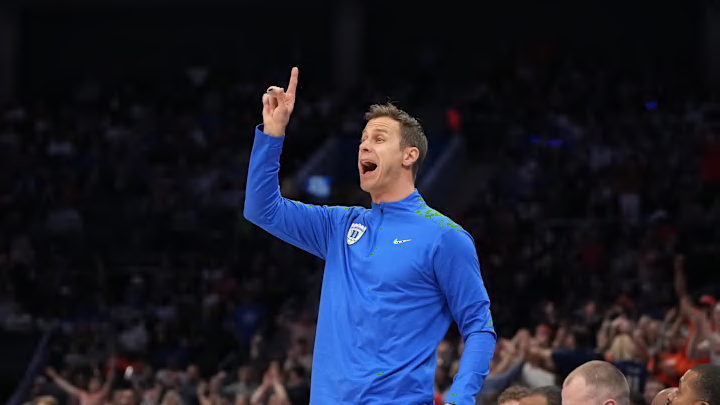
1. Jon Scheyer, Duke
Scheyer was tasked with succeeding a legend in Krzyzewski, something he’s been remarkably successful at so far. In just his fourth season, Scheyer has proven himself to be an elite recruiter and a very good coach, one who in December became the fastest coach in ACC history to 100 career victories. Scheyer also owns the most wins by a Division I men’s basketball coach in their first four seasons.
Scheyer has led the Blue Devils farther into the NCAA tournament with each passing season. After bowing out in the second round in his first season, they advanced to the Elite Eight in his second season. And this past year, he led the program to the Final Four.
Scheyer’s 2025–26 squad, led by the best player in college basketball, Cameron Boozer, and a strong supporting cast, is one of the best defensive teams in the country and led the nation in point differential. The Blue Devils are plenty good enough to go all the way.
If Scheyer’s remarkable year-over-year trend continues, his squad could do just that.
2. Dusty May, Michigan
If you’re doubting May’s reputation as a roster builder, look no further than his eye for talent and seamless ability to blend transfer portal stars Yaxel Lendeborg, Elliot Cadeau, Aday Mara and Morez Johnson Jr. into a dangerous and cohesive team, one of just three in the country to rank inside the Top 10 in KenPom’s offensive and defensive efficiency.
If you’re doubting May’s ability to coach, look no further than the 2022–23 NCAA tournament, where he led No. 9 seed Florida Atlantic all the way to the Final Four in just its second tourney appearance, becoming the first nine-seed to advance to the Final Four since 2013.
The expectations are much higher in 2025–26 for May than they were with his magical Owls squad three years ago. But May has the experience, as well as the deep and talented squad necessary to win a title.
3. Tommy Lloyd, Arizona
After spending 21 years as the top assistant to one of college basketball’s most consistent winners in Gonzaga coach Mark Few, Lloyd has taken the lessons he learned and applied them to revitalize an Arizona team that had missed the NCAA tournament in consecutive seasons for the first time since 1982–84 before his arrival.
Lloyd has led the Wildcats to the NCAA tournament in each of his first four seasons and the Wildcats are a No. 1 seed in the 2025–26 tourney. In a record that Scheyer is sure to challenge next season, Lloyd has won more regular-season games than any college basketball coach in their first five seasons on the job. He’s a strong recruiter who on March 10 landed his biggest fish yet: ’26 No. 4 overall prospect Caleb Holt.
And make no mistake. This year’s Wildcats team, led by the star backcourt duo of Brayden Burries and Jaden Bradley, as well as shot blocking center Motiejus Krivas and forward Koa Peat, is Lloyd’s best yet, giving him a very good chance of securing his first title.
4. Kelvin Sampson, Houston

There aren’t many coaches better than Sampson, who has won nearly 80% of the games he’s coached since arriving in Houston in 2015. Sampson’s teams are tough, physical and rarely beat themselves—and the 70-year-old has as good an eye for recruiting as ever, having landed arguably his best player yet in freshman Kingston Flemings.
Sampson has come oh so close to winning it all during his tenure with the Cougars, advancing to last year’s national championship game and the Final Four in 2020–21, both times losing to the sport’s eventual champion.
This year’s Cougars team could be the one that finally gets it done, partly because of the presence of Flemings, an explosive scorer who has proven this season that he can take over games. He’s the first freshman to average more than 15 points per game under Sampson since former Indiana guard Eric Gordon in 2008.
Traditionally, Sampson’s teams have leaned on veteran upperclassmen. Sampson went outside his comfort zone in trusting Flemings with running his offense—and the freshman has been more than up to the task. The blending of Sampson’s usual style coupled with this leap of faith could result in the coach’s first-ever title.
5. T.J. Otzelberger, Iowa State
Otzelberger in his first season with Iowa State in 2021–22 authored one of the most impressive turnarounds in men’s college basketball history, taking a Cyclones team that went 2–22 (0–18 in conference play) and leading the program to a 22-win season in his first year at the helm.
All he’s done since is turn the Cyclones into a yearly defensive powerhouse while compiling 96 wins and the most AP Top 10 wins in program history. Otzelberger’s Cyclones will be making their fifth straight NCAA tournament appearance in 2025–26. And while he’s never led the Cyclones past the Sweet 16, there’s reason to believe the Tamin Lipsey–Joshua Jefferson–Milan Momcilovic trio can get it done this season.
The difference? Iowa State has fielded a top-25-ranked defense in four of Otzelberger’s five seasons. This season’s team has the highest adjusted offensive efficiency (KenPom) of any of his squads. Plus, the 2025–26 squad has been able to shoot the three at an efficient clip—unlike his past teams—something that could swing games in their favor this March and potentially lead to his deepest tourney run yet.
6. Brad Underwood, Illinois
Before his tenure at Illinois, Underwood took the Stephen F. Austin men’s basketball team to new heights, leading the program to three consecutive NCAA tournament appearances for the first time in their history. And the Lumberjacks, utilizing pressure-heavy defenses and a spread offensive scheme, were a tough out in March as they pulled off upsets in Underwood’s first and third seasons at the helm. To be clear, he's also had some ugly exits early on in past tourneys.
But it’s all come together for Underwood with the Fighting Illini. After missing out on the Big Dance in his first three seasons, Underwood has taken the program to six consecutive NCAA tournaments. In 2023–24, he helped the Illini advance to the Elite Eight, where they were defeated by the eventual champion UConn Huskies.
In his 2025–26 squad, Underwood may have a team capable of netting him his first national title. Underwood’s offensive philosophy has evolved and is now predicated on positional size, versatility and spacing the floor.
Seven of the Fighting Illini’s eight leading scorers stand 6' 6" or taller. Nearly all of them, including the Illini’s pair of 7-foot twin Ivišić brothers, can shoot the three-ball. And freshman Keaton Wagler, a sharpshooter with superb playmaking skills, is the star of the show.
The result is an offense that ranked second in the nation in KenPom’s offensive efficiency and a physical team that tirelessly crashes the glass at every position.
If Illinois can find the defensive gear it seemingly unlocked in late December, early January, Underwood could have a real shot at his first title.
7. Mark Few, Gonzaga
Among men’s college basketball coaches with at least 20 years of experience, Few possesses the highest winning percentage of them all, having been victorious in 83% of his games during his 27 seasons at Gonzaga.
And in Few’s two-plus decades as coach, the Bulldogs have worn many hats. The lovable Cinderella teams in Few’s first two seasons, Nos. 10 and 12 seeds who improbably advanced to the Sweet 16 in consecutive years. The powerhouse teams of 2017 and ’21 that lost a total of three games all year combined and fell just short in the national title game.
While the faces and hats may have changed, Few has stayed true to his style of playing fundamentally sound ball on both ends of the floor. The Bulldogs tend to be efficient offenses that rarely beat themselves with turnovers.
This season’s team may not possess an offensive ceiling as high as Few teams of the past, but it’s still a program that ranked 10th in KenPom’s Net ratings while posting the fifth-highest field goal percentage in the country.
In a year where many teams are freshman led, Few’s three leading scorers are upperclassmen, giving him an experienced crew that knows how to win games at this time of year. Before bowing out in the second round of last year’s tourney, the Bulldogs had advanced to at least the Sweet 16 in each of the previous four years. Could another run to the second weekend be on the menu?
8. Matt Painter, Purdue
Painter has as high a ceiling—advancing to the national championship game in 2024—and as low a floor—becoming just the second No. 1 seed to lose to a 16 seed in tournament history in 2023—as any coach in the country.
But it’s hard to doubt his year-to-year consistency. Painter’s Boilermakers have made the NCAA tournament in 17 of 21 years as coach.
In his 2025–26 squad, an offensive powerhouse led by pick-and-roll maestro Braden Smith, Painter might have a case of a team peaking at the right time.
The Boilermakers soundly defeated Michigan in the Big Ten tournament final, thanks in large part to a dominant, low-post performance from big man Oscar Cluff. Smith, who had 46 assists and just 10 turnovers in the Big Ten tourney, is the kind of guard who could elevate a team all the way to the Final Four.
Purdue, positioned in a region with the mighty Arizona Wildcats, will likely have to go through the Big 12 champs if they want to advance to Indianapolis. But if Painter’s tenure has taught us anything about his teams, it’s to expect the unexpected.
9. Fred Hoiberg, Nebraska
Nebraska, forever a football school, has embraced Hoiberg’s so-called “Nebrasketball” team this season en route to the school’s highest seed in the NCAA tournament since 1991.
Hoiberg is a builder, having sent four Iowa State teams to the NCAA tournament from 2011 to ’15 thanks to his stellar work in the transfer portal prior to his tenure with the Cornhuskers.
Hoiberg has now built something with Nebraska, too. After back-to-back miserable, seven-win seasons in his first two years, the Cornhuskers went on to win 10, 16 and 23 games in the ensuing three seasons.
Hoiberg was working the portal before it became cool to do so—and he’s largely stuck to that formula in Lincoln. Leading scorer Pryce Sandfort and senior point guard Jamarques Lawrence are transfers. Second-leading scorer Rienk Mast transferred from Bradley two years ago.
It’s all come together in the form of a sound defensive team that can rain down threes on teams from multiple angles. Such a three-heavy blueprint could make the Cornhuskers susceptible to a cold shooting night, particularly given their struggles of the last month or so.
The Cornhuskers are the only power-conference team to never win an NCAA tournament game. Hoiberg has the program in position to do that and more.
10. Rick Barnes, Tennessee
Barnes is one of the best to ever do it, having won the 11th-most games all time while taking five different teams to the NCAA tournament in his 39 years as a coach. While he’s had plenty of teams bow out in the first or second round of the tournament, he led the 2002–03 Texas Longhorns to the Final Four and his Tennessee program has advanced to the Elite Eight in each of the last two seasons.
Barnes’s teams tend to be physical and tough units that dominate the glass and defend at a high level. This year’s Volunteers squad is no different. Tennessee ranked 15th in KenPom’s defensive efficiency and 32nd in opponent field goal percentage this season.
Shot blocking big man Felix Okpara was one of the best rim protectors in a loaded SEC, and, along with forwards Nate Ament, J.P. Estrella, Jaylen Carey and Cade Phillips form a lengthy, powerful frontcourt that crashed the offensive glass better than any team in the country.
In Ament and guard Ja’Kobi Gillespie, Tennessee has the starpower to make a run in March Madness. While its lack of perimeter shooting makes Tennessee a long shot to go all the way, Barnes’s squad still looks like one of the 20 best teams in the country, giving him a chance at winning that elusive first national championship.
More March Madness from Sports Illustrated
 Add us as a preferred source on Google
Tim Capurso is a staff writer for Sports Illustrated, primarily covering MLB, college football and college basketball. Before joining SI in November 2023, Capurso worked at RotoBaller and ClutchPoints and is a graduate of Assumption University. When he's not working, he can be found at the gym, reading a book or enjoying a good hike. A resident of New York, Capurso openly wonders if the Giants will ever be a winning football team again.
Follow TimCapurso