%20%20--%3E%0A%3Csvg%20version%3D%221.1%22%20id%3D%22Layer_1%22%20xmlns%3D%22http%3A%2F%2Fwww.w3.org%2F2000%2Fsvg%22%20xmlns%3Axlink%3D%22http%3A%2F%2Fwww.w3.org%2F1999%2Fxlink%22%20x%3D%220px%22%20y%3D%220px%22%0A%09%20width%3D%2239px%22%20height%3D%2240px%22%20viewBox%3D%220%200%2039%2040%22%20enable-background%3D%22new%200%200%2039%2040%22%20xml%3Aspace%3D%22preserve%22%3E%0A%3Cpath%20fill%3D%22%23FFFFFF%22%20d%3D%22M38.5%2C7H28.2v26h10.3V7z%22%2F%3E%0A%3Cpath%20fill-rule%3D%22evenodd%22%20clip-rule%3D%22evenodd%22%20fill%3D%22%23FFFFFF%22%20d%3D%22M26.1%2C25.5c0%2C5.8-4.1%2C7.5-12.9%2C7.5C3.9%2C33%2C0%2C31.2%2C0%2C25.2v-1.1h11.6%0A%09v2.4c0%2C0.7%2C0.1%2C1.4%2C1.2%2C1.4c1%2C0%2C1.2-0.4%2C1.2-1.3v-0.9c0-1.6-0.9-1.6-3.5-2.2C2.2%2C21.7%2C0%2C19.7%2C0%2C15.3v-0.9C0%2C9.3%2C5.5%2C7%2C12.9%2C7%0A%09c10.2%2C0%2C12.8%2C2.6%2C12.8%2C7.4v1.8h-11v-2.9c0-0.6-0.4-1.1-1.2-1.1c-0.6%2C0-1.2%2C0.4-1.2%2C1.1v0.9c0%2C1.5%2C0.9%2C2%2C3.3%2C2.5%0A%09c8%2C1.6%2C10.5%2C3.3%2C10.5%2C7.5V25.5z%22%2F%3E%0A%3C%2Fsvg%3E%0A)
South Carolina Forced UConn, Geno Auriemma Into the Worst Version of Themselves
In this story:
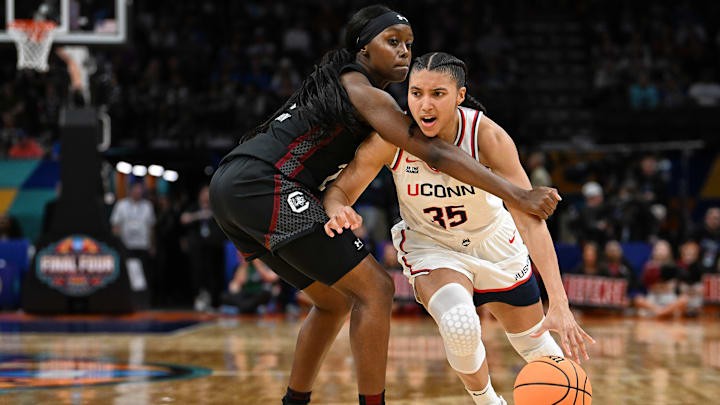
PHOENIX — If you peel away the animosity and grumbling and the end-of-game spat, you are left with this undeniable truth: The UConn–South Carolina Final Four game went exactly as both coaches knew it might go. Dawn Staley’s Gamecocks turned Geno Auriemma’s Huskies into the worst version of themselves, a stagnant jump-shooting team. From the first quarter, South Carolina looked like it could make a run or two, and UConn rarely did.
The better team won. The final score was 62–48, and the game was closer than that. But if this were boxing, South Carolina would have won by unanimous decision.
“We just played great team defense,” Gamecocks guard Ta’Niya Latson said. “We knew their tendencies, what they liked. I think we executed it really, really well.”
Staley said, “Our whole objective was to get them to shoot as inefficiently as possible. Make them put the ball on the floor.”
Coaches understand there is a big difference between games you could win and games you should win. A year ago, Staley entered the national championship game against UConn with the full understanding that the Huskies should beat them. She obviously couldn’t say that publicly or to her players. But as she said here Friday night, “You know.”

This was different. Staley knew it going in. Paige Bueckers was watching from the stands this time. This UConn group has tough, talented guards, but not as much playmaking as one would expect from an Auriemma team. If Staley’s Gamecocks played defense with discipline, they could force UConn’s offense to stall, and South Carolina had enough scoring to turn 38–0 UConn into 38–1 UConn.
Latson, who transferred from Florida State last summer, played fearlessly and scored 16 points. South Carolina outrebounded UConn 47–32. The Gamecocks got to where they needed to be more often than UConn did—on both ends, but especially on defense.
“We made them put the ball on the floor,” Staley said again Friday. “That’s disruption to UConn, because they’re a passing team. They did get 15 assists on 19 field goals. If they’re allowed to play that way throughout an entire game, they win.”
Auriemma had to know this, too. He talked a lot last week about how this team did not have the swagger of his previous unbeaten teams. They are just nice kids who play hard, he said. They get along great and keep winning, he said. But he had to know that if the Huskies lost, it wouldn’t be because of charm or confidence. It would be because somebody exposed their flaws.
As he said Friday night, “You try all year long to cover up those things and hide ’em from everybody.”
Coaches know—especially these coaches, two of the best to ever do it. One of Staley’s gifts is that she reads in-game situations with clear eyes and adjusts based on what she sees, not what she feels. In this game, her assistants suggested switching more defensively in the second half, presumably around the time that UConn went on a 9–0 run to cut South Carolina’s lead to 40–39. Staley believed the defense her team was playing had mostly worked, and would work, and they didn’t need to make a change. Her players proved her correct.
That is why South Carolina won, and that should be the entire story here.

It is not.
Auriemma complained to ESPN during the game that he could never berate refs like Staley does. He complained that the refs weren’t calling fouls on South Carolina. He and Staley shouted at each other as the game ended. Auriemma walked off, pissed.
There is some he said/she said to this story. I might end up as another ref that causes one or both coaches to feel jobbed, but here goes:
Auriemma said afterward that Staley never shook his hand before the game. I watched this in real time: The P.A. announcer introduced the coaches, Auriemma went over to shake Staley’s hand, and Staley never left her team. Auriemma waited there. He looked at a card he was holding. He waited a bit more.
I don’t know when Staley walked over and shook his hand. She might have shaken it earlier, but if so, she should have done it again when the announcer introduced the coaches. Auriemma was waiting there for a reason. I have no dog in that fight, but I was also wondering why Staley did not walk over. It was weird enough that it registered with me as weird, and I could tell at the time that Auriemma was irritated.
But when you lose to a better team, you have an obligation to shake everybody’s hand and be gracious afterward. Auriemma walked off the floor without shaking any Gamecocks assistants’ hands. He did acknowledge afterward that South Carolina played better, but he kept grumbling about the refs, and he kept saying that the Gamecocks ripped UConn star Sarah Strong’s jersey and nobody called it.
Strong said of her jersey rip: “It was an accident. I missed my shot. I ripped [it].” Auriemma insisted she did not say she ripped it. But there is video evidence of her doing so in the third quarter and saying so after the game.
Sarah Strong ripped her jersey LMAOOOOOO pic.twitter.com/7fYmTAWRlA
— Shabazz 💫 (@ShowCaseShabazz) April 4, 2026
He also complained, “There was not a single foul called on [South Carolina] in the third quarter.” He said of Strong: “You’re telling me there was never a time when she got fouled? I find that hard to believe.”
I find it extremely easy to believe, and this is why: Strong averaged 2.5 free throw attempts per game this season—one every 10 minutes and 48 seconds she spent on the court. She played 40 minutes Friday and shot four free throws. You can do the math there. I’m not saying the officials got every call right. They never get every call right. But this was not an aberrational game for Strong. In the Sweet 16, Strong played 38 minutes against North Carolina and shot four free throws.
UConn shot only six free throws because South Carolina consistently contested the Huskies’ shots without fouling. South Carolina could do that because the Gamecocks are athletic and tough—and because UConn is short on penetrators who can draw contact. An emotional Azzi Fudd said she felt “guilty” afterward for letting her team down. Fudd missed 12 of 15 shots, which is really uncharacteristic of her. She is a great shooter, even when guarded. But she does not play the kind of game that results in a bunch of free throws. Fudd averaged 1.2 free throws per game this season.
UConn dominated almost every team it played this season. You would figure that opposing defenses would have no choice but to foul the Huskies, right?

UConn finished 326th in the country in free throw attempts this season. When the Huskies hung 100 points on Creighton, 94 of those came from field goals and six came from free throws.
The Huskies’ three lowest scoring totals came in their last three games: 63 points against North Carolina, 70 against Notre Dame, 48 against South Carolina. The NCAA tournament revealed who the Huskies really are. A dogged defensive team with two offensive stars but limited playmaking. Against really good teams, they struggled to generate offense.
Auriemma tried all season long to cover up those things and hide them from everybody. Staley saw them, game-planned for them, and got her players to exploit them. UConn had a terrific season. This was a game the Huskies could have won. But it was a game South Carolina should have won—and did.
More March Madness from Sports Illustrated
 Add us as a preferred source on Google
Michael Rosenberg was a senior writer for Sports Illustrated, covering any and all sports. He writes columns, profiles and feature stories and has covered almost every major sporting event. He joined SI in 2012 after working at the Detroit Free Press for 13 years, eight of them as a columnist. Rosenberg is the author of “War As They Knew It: Woody Hayes, Bo Schembechler and America in a Time of Unrest.” Several of his stories also have been published in collections of the year’s best sportswriting. He is married with three children.
Follow rosenberg_mike