%20%20--%3E%0A%3Csvg%20version%3D%221.1%22%20id%3D%22Layer_1%22%20xmlns%3D%22http%3A%2F%2Fwww.w3.org%2F2000%2Fsvg%22%20xmlns%3Axlink%3D%22http%3A%2F%2Fwww.w3.org%2F1999%2Fxlink%22%20x%3D%220px%22%20y%3D%220px%22%0A%09%20width%3D%2239px%22%20height%3D%2240px%22%20viewBox%3D%220%200%2039%2040%22%20enable-background%3D%22new%200%200%2039%2040%22%20xml%3Aspace%3D%22preserve%22%3E%0A%3Cpath%20fill%3D%22%23FFFFFF%22%20d%3D%22M38.5%2C7H28.2v26h10.3V7z%22%2F%3E%0A%3Cpath%20fill-rule%3D%22evenodd%22%20clip-rule%3D%22evenodd%22%20fill%3D%22%23FFFFFF%22%20d%3D%22M26.1%2C25.5c0%2C5.8-4.1%2C7.5-12.9%2C7.5C3.9%2C33%2C0%2C31.2%2C0%2C25.2v-1.1h11.6%0A%09v2.4c0%2C0.7%2C0.1%2C1.4%2C1.2%2C1.4c1%2C0%2C1.2-0.4%2C1.2-1.3v-0.9c0-1.6-0.9-1.6-3.5-2.2C2.2%2C21.7%2C0%2C19.7%2C0%2C15.3v-0.9C0%2C9.3%2C5.5%2C7%2C12.9%2C7%0A%09c10.2%2C0%2C12.8%2C2.6%2C12.8%2C7.4v1.8h-11v-2.9c0-0.6-0.4-1.1-1.2-1.1c-0.6%2C0-1.2%2C0.4-1.2%2C1.1v0.9c0%2C1.5%2C0.9%2C2%2C3.3%2C2.5%0A%09c8%2C1.6%2C10.5%2C3.3%2C10.5%2C7.5V25.5z%22%2F%3E%0A%3C%2Fsvg%3E%0A)
Sports Illustrated’s 2025–26 Men’s College Basketball All-Americans
In this story:
We’ve reached the final days of the 2025–26 men’s college basketball season, and what a year it was. Between a freshman class for the ages, stars coming back to school instead of turning pro early and mid-major stars jumping up to the sport’s highest levels, this was as talented a year for the sport as we have seen in some time.
With that in mind, Sports Illustrated’s Bryan Fischer and Kevin Sweeney went to work building out All-America teams, honoring the best of the best in one of the best seasons in recent memory. With so much star power, there were bound to be some snubs, but these 10 players stood above the rest.
First Team
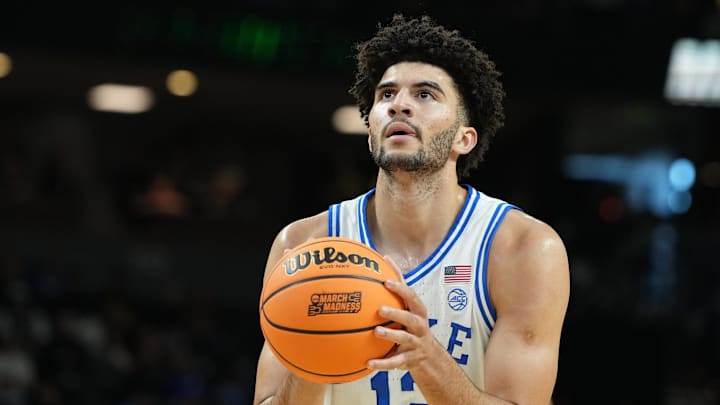
Cameron Boozer, Duke
Stats: 22.4 ppg, 10.3 rpg, 4.1 apg, 55.9% FG%, 39.6% 3FG%
Boozer is almost certainly going to make it two years running for a Duke freshman to win every national player of the year award, but you can easily make the case that he put together of the greatest campaigns for a first-year player in the modern age. The former five-star and serial winner truly did it all for the Blue Devils, from initiating the offense as a point-forward bringing the ball up, to scoring around the rim with a variety of polished low-post moves to consistently finding open teammates when the inevitable double team arrived to slow him down.
It wasn’t just against overmatched foes either as Boozer was the driving force behind Duke securing wins over a record-tying 11 ranked foes over the course of the season. He not only averaged a double-double during the season, but became the first underclassmen in over four decades to slash 20/10 while averaging more than four assists. Opposing coaches also spoke about his toughness, both on the low block with a head of steam attacking the basket as well as on the defensive end as he keyed one of the best units in the country. Though the ending came up just short of where he wanted it to in the NCAA tournament, there’s little question that Boozer earned every accolade thrown his way this season.
AJ Dybantsa, BYU
Stats: 25.5 ppg, 6.8 rpg, 3.7 apg, 51% FG%, 33.1% 3FG%
After arriving in Provo, Utah, with unmatched hype and attention as the rare five-star prospect to join the Cougars, Dybantsa proceeded to put together a season that did more than enough to make him the No. 1 overall pick in this summer’s NBA draft. The Massachusetts native could get a bucket in just about any way imaginable and became the nation’s leading scorer in 2025–26 largely based on his variety of ways he was able to find a sliver of space to cut through with his 6' 9" frame.
Dybantsa made more than half his shots from the field, which is doubly impressive given the volume he took for a team which was beset by injuries this season and by the amount of attention he drew from opposing defenses. While he didn’t quite deliver on his stated goal of taking BYU to its first Final Four, the prolific wing nevertheless put on a show in the Beehive State as the most talented player to step on campus.

Yaxel Lendeborg, Michigan
Stats: 14.9 ppg, 7 rpg, 3.3 apg, 52% FG%, 37.4% 3FG%
In a year dominated by freshmen, Lendeborg is the outlier, a 23-year-old in his sixth year of college. His decision to eschew NBA interest, return to college and transfer from UAB to Michigan proved to be one of the most impactful moves of the offseason, becoming the star of a Wolverines team that has dominated this season.
Lendeborg’s biggest value lies in his versatility. He guards teams’ best perimeter player, using his size and physicality to disrupt some of the nation’s best scorers. He’s lethal in transition when he can get a head of steam and has improved drastically as a three-point shooter from his time at UAB. Michigan doesn’t need him to put up the type of numbers that the other four players on this first team do, but he’s every bit as impactful and a huge reason the Wolverines are headed to Indianapolis.
Darius Acuff Jr., Arkansas
Stats: 23.5 ppg, 3.1 rpg, 6.4 apg, 48.4% FG%, 44% 3FG%
If folks were not talking about Acuff as much as some others on this list, that changed during a postseason run in which he averaged nearly 30 points per game to carry the Razorbacks to the Sweet 16 and their first conference tournament title in 26 years. As it stands, he showed a unique ability to create on the ball, pull up from beyond the arc during transition and still get to the basket despite everyone in the arena knowing he was going to get up a shot. Even with a loaded freshman class that sometimes overshadowed him, there were few guards who were as mesmerizing with the ball in their hands like the 6' 3" blur from Detroit.
Acuff was named SEC Player of the Year despite a crowded field of candidates in the league and was central to Arkansas’s impressive season on the offensive end when he wasn’t the one shooting by averaging over six assists per game. He was also one of just 10 high-major players to average better than 40% from three and was impressively the nation’s third-leading scorer on top of all that.
Keaton Wagler, Illinois
Stats: 17.9 ppg, 5 rpg, 4.3 apg, 44.5% FG%, 40.7% 3FG%
There isn’t a better story in college basketball than Wagler, an unknown three-star recruit from Kansas who quickly emerged into one of the nation’s best guards and has Illinois in the Final Four for the first time since 2005. Wagler amazingly has exceeded even the most lofty of preseason expectations in Champaign, Ill., where Brad Underwood tabbed him a potential one-and-done prospect in early October.
What Wagler lacks of raw athleticism he makes up for in intelligence and craftiness. He always makes the right play at the right moment, be it setting up teammates when defenses swarm him or creating for himself when he can take advantage of switches. He’s an elite shooter off the dribble and can really pass, becoming an elite pick-and-roll player this season after questions in high school whether his future was as an on-ball player or as a wing. His game reminds many around the NBA of Tyrese Haliburton, another skinny, underrecruited guard who blossomed late into a superstar.

Second Team
Braden Smith, Purdue
Stats: 14.3 ppg, 3.5 rpg, 8.8 apg, 44% FG%, 36.2% 3FG%
Smith became the NCAA’s all-time assists leader this March, helping cap a special career that featured a Final Four, three trips to the second weekend, two Big Ten titles, two Big Ten tournament titles and a Big Ten Player of the Year award. It’s a career that will be hard to match especially in this era of constant player movement, starting all 149 games he played, losing just 32 of those games and becoming an all-time great for the Boilermakers in his home state. Even in a slightly disappointing season overall for the Boilermakers, Smith was superb, willing the Boilers to the Big Ten tournament crown and a No. 2 seed in the Big Dance with his elite playmaking ability.
Jaden Bradley, Arizona
Stats: 13.3 ppg, 3.5 rpg, 4.4 apg, 46% FG%, 39.4% 3FG%
As much as the Wildcats were known for having terrific freshmen in Koa Peat and Brayden Burries or incredible depth around guys like Motiejus Krivas, it was Bradley who made it all work in synchronous harmony to get the program to their first Final Four in a quarter century. The New York native came up big at every turn for Arizona, averaging in double figures for the season and scoring in bunches when needed, dishing out assists with precious few turnovers, and contributing on both ends of the court as someone not afraid to hound opposing guards from the moment they received the ball. Bradley was also an incredible shotmaker even when he had a defender draped over him, always rising up to find just enough space to drop in a game-winner when needed. This has been one of the best seasons in school history down in Tucson, and their point guard is the reason why.

Joshua Jefferson, Iowa State
Stats: 16.4 ppg, 7.4 rpg, 4.8 apg, 47.1% FG%, 34.5% 3FG%
It’s cruel that Jefferson’s NCAA tournament run this season was cut short after just three minutes due to an ankle injury that kept him out against Kentucky and Tennessee. For much of the season, he had the strongest case of any player other than Boozer for national player of the year honors, stuffing the stat sheet with buckets, boards and assists and blossoming into a consistent threat from beyond the arc. His absence against Tennessee is among the biggest what ifs of the Big Dance: Could the Cyclones have given Michigan a run for its money in the Elite Eight with a healthy Jefferson? Regardless, his season was a huge reason for Iowa State pulling off its best finish of the KenPom era, continuing the program’s upward momentum under T.J. Otzelberger.
Thomas Haugh, Florida
Stats: 17.1 ppg, 6.1 rpg, 2.1 apg, 46% FG%, 32.6% 3FG%
Florida’s frontcourt was one of the best in the country, and at the heart of that was Haugh, the leading scorer for the Gators in their SEC championship campaign. He slid seamlessly down the lineup to play primarily as a wing this season after spending the first two years of his college career as a power forward. His competitiveness, nose for the ball and toughness made him a fan favorite in Gainesville, Fla., and helped solidify his standing as a lottery-level prospect in this summer’s NBA draft.
Zuby Ejiofor, St. John’s
Stats: 16.3 ppg, 7.3 rpg, 3.5 apg, 53.6% FG%, 30.5% 3FG%
Ejiofor was central to St. John’s capturing back-to-back Big East regular-season and tournament titles this season on top of reaching the Sweet 16 for the first time since 1999. He led the Red Storm in points, rebounds, assists and blocked shots during the season and was the team’s emotional leader on and off the court. Ejiofor was a unanimous pick as the Big East Player of the Year and had the rare ability to take over games from nearly every spot on the floor.

Honorable Mention
- Jeremy Fears Jr., Michigan State
- Labaron Philon Jr., Alabama
- Caleb Wilson, North Carolina
- JT Toppin, Texas Tech
- Kingston Flemings, Houston
- Graham Ike, Gonzaga
- Christian Anderson, Texas Tech
- Bennett Stirtz, Iowa
- Tyler Tanner, Vanderbilt
- Alex Condon, Florida
More March Madness From Sports Illustrated
Listen to SI’s college sports podcast, Others Receiving Votes, below or on Apple and Spotify. Watch the show on the SI College YouTube channel.
 Add us as a preferred source on Google
Bryan Fischer is a staff writer at Sports Illustrated covering college sports. He joined the SI staff in October 2024 after spending nearly two decades at outlets such as FOX Sports, NBC Sports and CBS Sports. A member of the Football Writers Association of America’s All-America Selection Committee and a Heisman Trophy voter, Fischer has received awards for investigative journalism from the Associated Press Sports Editors and FWAA. He has a bachelor’s in communication from USC.
Follow bryandfischer
Kevin Sweeney is a staff writer at Sports Illustrated covering college basketball and the NBA draft. He joined the SI staff in July 2021 and also serves host and analyst for The Field of 68. Sweeney is a Naismith Trophy voter and ia member of the U.S. Basketball Writers Association. He is a graduate of Northwestern University’s Medill School of Journalism.
Follow CBB_Central