%20%20--%3E%0A%3Csvg%20version%3D%221.1%22%20id%3D%22Layer_1%22%20xmlns%3D%22http%3A%2F%2Fwww.w3.org%2F2000%2Fsvg%22%20xmlns%3Axlink%3D%22http%3A%2F%2Fwww.w3.org%2F1999%2Fxlink%22%20x%3D%220px%22%20y%3D%220px%22%0A%09%20width%3D%2239px%22%20height%3D%2240px%22%20viewBox%3D%220%200%2039%2040%22%20enable-background%3D%22new%200%200%2039%2040%22%20xml%3Aspace%3D%22preserve%22%3E%0A%3Cpath%20fill%3D%22%23FFFFFF%22%20d%3D%22M38.5%2C7H28.2v26h10.3V7z%22%2F%3E%0A%3Cpath%20fill-rule%3D%22evenodd%22%20clip-rule%3D%22evenodd%22%20fill%3D%22%23FFFFFF%22%20d%3D%22M26.1%2C25.5c0%2C5.8-4.1%2C7.5-12.9%2C7.5C3.9%2C33%2C0%2C31.2%2C0%2C25.2v-1.1h11.6%0A%09v2.4c0%2C0.7%2C0.1%2C1.4%2C1.2%2C1.4c1%2C0%2C1.2-0.4%2C1.2-1.3v-0.9c0-1.6-0.9-1.6-3.5-2.2C2.2%2C21.7%2C0%2C19.7%2C0%2C15.3v-0.9C0%2C9.3%2C5.5%2C7%2C12.9%2C7%0A%09c10.2%2C0%2C12.8%2C2.6%2C12.8%2C7.4v1.8h-11v-2.9c0-0.6-0.4-1.1-1.2-1.1c-0.6%2C0-1.2%2C0.4-1.2%2C1.1v0.9c0%2C1.5%2C0.9%2C2%2C3.3%2C2.5%0A%09c8%2C1.6%2C10.5%2C3.3%2C10.5%2C7.5V25.5z%22%2F%3E%0A%3C%2Fsvg%3E%0A)
Congratulations, You’ve Made the NCAA Tournament. Now You’re Facing No. 1 UConn
In this story:
Early in her first NCAA tournament game as a head coach, Sue Troyan saw the flashes go off.
It felt as if every camera in the building was taking a picture of the scoreboard. The numbers were standard for the opening minutes of any first quarter: 6–4. But the young coach knew why they were all taking pictures, and frankly, she wanted to commit this scoreboard to memory, too.
The six points were for her No. 16 seed Lehigh. And the four were for No. 1 UConn.
“That was it,” laughs Troyan, who spent 27 seasons coaching women’s basketball at Lehigh and went on to lose that game, 103–35. “We never led again. But we could say we led for a minute.”
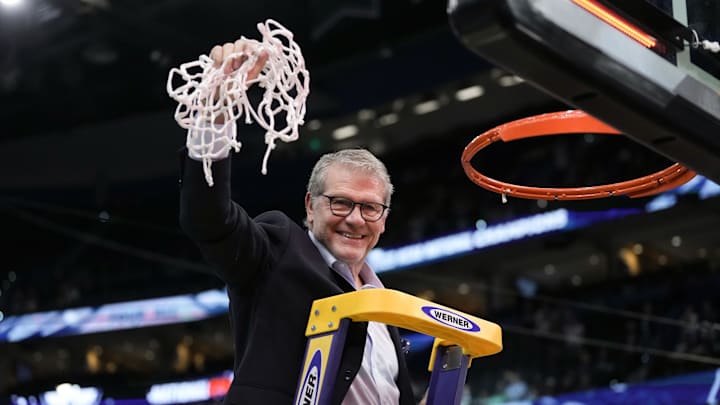
This was 1997, before UConn was UConn, a program whose name alone served as convenient shorthand for basketball excellence. But there was already a sense that something might be special here. Geno Auriemma and the Huskies had won their first national championship with an undefeated season that attracted unprecedented media attention in ’95. Outsiders may not have guessed the next three decades would hold 11 more championships (and counting) under Auriemma. Yet they could already see there was nothing quite like playing the Huskies in March.
It’s a dynamic that has led to a consensus here among coaches. Any first-round matchup between a top seed and a bottom seed will be tough. There’s pressure in facing any blueblood or sharing the sideline with any legendary coach. But when you’re that No. 16, and your assignment is historically dominant, fundamentally unstoppable, dynasty-is-too-small-a-word No. 1 overall seed UConn? It’s different.
Six of the 11 most lopsided wins in Division I tournament history for either men or women belong to Auriemma and UConn. (That list includes the 68-point win over Troyan and Lehigh in 1997.) How do you coach a team up for that kind of experience? What do you tell your players when you see the bracket? How do you keep them going when you look up and realize you have one more full quarter of this? The game may end up being the one and only tournament experience for many players on the roster. And that’s significant, no matter the final score, even (or especially) if that means a blowout loss to No. 1 UConn.
It can start with adapting the definition of success. Your players may not ever hold a lead, and they may not produce any notable highlights, but they can make sure they play hard. Former Robert Morris coach Sal Buscaglia happily recalls one particular moment from the fourth quarter of his 101–49 tournament loss to UConn in 2016. He remembers this a decade later as clearly as if he just saw it happen. Robert Morris was losing badly. And one of his players took a hard charge.

“One of the greatest things,” Buscaglia says with delight. “You’re down by 50 points or so, and you go out there and take a charge… I was really proud of that.”
That’s a consistent theme of these pregame speeches. Focus on what your players can do. There’s no use in fixating on anything else.
“You should never take the spirit away from your players, or the excitement they had of making the tournament, knowing they’re in a one-bid league,” says Buscaglia, who had told his players before the season that he planned to retire, meaning they all knew his final career game would be that matchup with UConn. “You have to tell them that, you know, we’re going to go in there, we’ll give it our best shot, and we’re going to play hard every possession.”
It’s the biggest stage that most of these players will ever see. And that’s a treat all its own. For this season’s tournament, UTSA holds the honor of playing the No. 1 overall seed Huskies at 3 p.m. ET on Saturday.
“Just embrace the experience,” says Margaret McKeon, who coached No. 16 seed Boston University to a 91–44 loss in 2003. “It’s a lot of fun, and it’s something that you’ll remember… Somebody’s got to play them, right? It might as well be us.”
That underscores something that might feel surprising. Many coaches actually want this draw. For a mid-major who is closer to “mid” than “major,” a No. 15 seed will result in a likely blowout loss for the program, too. It just comes with less buzz and fewer people watching. But a No. 16 seed playing UConn means a packed house and built-in audience for national television exposure. “We didn’t play as well as we would have liked, I’m sure, but not many people can say, Hey, I competed against Diana Taurasi,” McKeon says. Her players have carried that experience with them for the rest of their lives.
“I was hoping that we’d get UConn,” says Joe Haigh, who coached No. 16 seed Saint Francis in a 140–52 loss in 2018. “I knew that getting a UConn draw was going to put us on TV, and we’d have a two hour commercial for our university and our unique playing style. So I really wanted that UConn stage.”
That playing style meant Saint Francis pressed aggressively, shot a lot of threes and worked to generate as many possessions as possible. That worked very well for the Red Flash in the Northeast Conference. Haigh knew that it would look a bit different against UConn. He gathered his players after they saw the bracket. What did they want to do? They could play the same way they always played. But that would come with a real chance that UConn broke its press, maximized those extra possessions and hung 200 points on them for the worst loss in NCAA history.
“Were we going to change what we did all year?” Haigh says. “Or were we going to go down swinging, and take our shot, and be who we were the whole year?”
His players voted to stick with their style no matter what happened. “When you’re in that situation, you’re not worried about wins,” Haigh says. “I wanted us to enjoy it. This is a reward for the season that we had, we really had a great season, and we’re going to go have fun with it… You’ve got a full arena out here. You’ve got a bunch of people on TV. Let’s go have fun.” And so out they went.
UConn set a record for most points scored in the first quarter with 55. It set a record for most points scored in the first half with 94.
Haigh asked his players: Are you all sure about this?

“I walked into the locker room, I looked at the score, it’s like, Oh, geez, 20 more minutes of this. They really could score 200,” Haigh says. “The conversation at halftime was: Do you guys still want to do this? Are we going to still come out and play the way we play? They all said, whatever the score was, we’re coming out, we’re keeping doing what we’re doing. And I thought that was pretty cool.”
The game set a record for most scoring in a tournament contest and came within one point of the biggest loss in tournament history. (Saint Francis will be forever grateful it lost by 88 and not by 89.) “Most of it was a blur,” Haigh says. But he remembers calling a timeout in the third quarter when he felt his players were not adequately hustling: This isn’t you, he said. This is something you all can fix. He remembers learning that his players set a record for most threes attempted in a tournament game, 57 shots, keeping with their plan even though most of those shots did not fall. And he remembers the last few minutes. Haigh could not bring himself to rewatch the game in full. But he did eventually rewatch the back half of the fourth quarter. He wanted to make sure his team had still been playing hard.
“Could somebody watching our game see that our kids were still competing their butts off and playing as hard as they could?” Haigh says. “Because I think that was an important life lesson, whether we’re down 50, 60, 70 or 80, we wanted our players to play the same way and still compete… Anybody who happened to be watching it had to see that, you know, these kids have got a lot of guts and they don’t quit.”
And so a few months later, alone in his office, Haigh rewatched those last few minutes of the worst loss of his career, among the worst losses of any college coaching career, up against the greatest powerhouse in the sport in UConn. Saint Francis had been outscored in the fourth quarter 24–4. But the coach pulled up the film, and he watched their body language and their commitment on those last few plays of what ultimately was the only tournament experience for nearly all of them, and he was satisfied. Haigh could say that he liked what he saw.
More March Madness from Sports Illustrated
 Add us as a preferred source on Google
Emma Baccellieri is a staff writer focused on women’s basketball for Sports Illustrated. She previously covered MLB. She has also written for Baseball Prospectus and has been honored with multiple awards from the Society of American Baseball Research. A graduate of Duke University, she lives in Washington, D.C.
Follow emmabaccellieri