%20%20--%3E%0A%3Csvg%20version%3D%221.1%22%20id%3D%22Layer_1%22%20xmlns%3D%22http%3A%2F%2Fwww.w3.org%2F2000%2Fsvg%22%20xmlns%3Axlink%3D%22http%3A%2F%2Fwww.w3.org%2F1999%2Fxlink%22%20x%3D%220px%22%20y%3D%220px%22%0A%09%20width%3D%2239px%22%20height%3D%2240px%22%20viewBox%3D%220%200%2039%2040%22%20enable-background%3D%22new%200%200%2039%2040%22%20xml%3Aspace%3D%22preserve%22%3E%0A%3Cpath%20fill%3D%22%23FFFFFF%22%20d%3D%22M38.5%2C7H28.2v26h10.3V7z%22%2F%3E%0A%3Cpath%20fill-rule%3D%22evenodd%22%20clip-rule%3D%22evenodd%22%20fill%3D%22%23FFFFFF%22%20d%3D%22M26.1%2C25.5c0%2C5.8-4.1%2C7.5-12.9%2C7.5C3.9%2C33%2C0%2C31.2%2C0%2C25.2v-1.1h11.6%0A%09v2.4c0%2C0.7%2C0.1%2C1.4%2C1.2%2C1.4c1%2C0%2C1.2-0.4%2C1.2-1.3v-0.9c0-1.6-0.9-1.6-3.5-2.2C2.2%2C21.7%2C0%2C19.7%2C0%2C15.3v-0.9C0%2C9.3%2C5.5%2C7%2C12.9%2C7%0A%09c10.2%2C0%2C12.8%2C2.6%2C12.8%2C7.4v1.8h-11v-2.9c0-0.6-0.4-1.1-1.2-1.1c-0.6%2C0-1.2%2C0.4-1.2%2C1.1v0.9c0%2C1.5%2C0.9%2C2%2C3.3%2C2.5%0A%09c8%2C1.6%2C10.5%2C3.3%2C10.5%2C7.5V25.5z%22%2F%3E%0A%3C%2Fsvg%3E%0A)
Before Mike Ditka Became an NFL Legend, He Began to Transform the Tight End Position at Pitt
In this story:
With each year, the tight end position seems to take on increased significance in football. The modern stars who fill the role are among the most multifaceted players on the field—elite athletes with the speed to blaze down the field in the passing attack, the skill to beat safeties and linebackers for jump balls and the strength to help open holes in the running game and dominate the line of scrimmage.
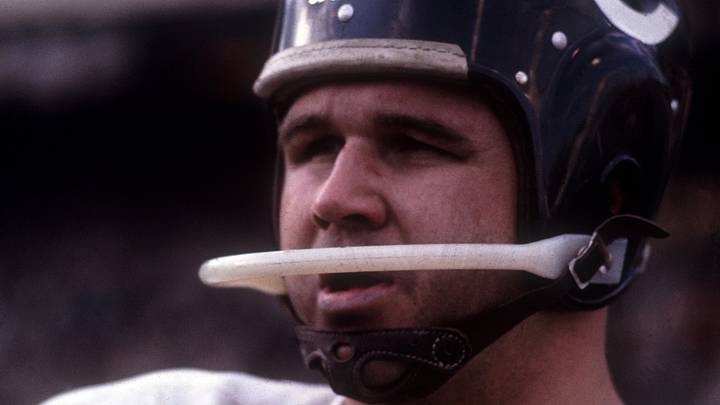
Football legend Mike Ditka, who died Friday at 86, was the first player to merge these two seemingly disparate skillsets, a blend of abilities that has made superstars of players like Rob Gronkowski, George Kittle and Travis Kelce in recent years.
Ditka was an instant star in the NFL, catching 56 passes for 1,072 yards and 12 touchdowns as a rookie with the Bears—the latter two numbers would prove to be career highs. The young pass catcher turned the position on its head under the tutelage of coach and owner George Halas and offensive coordinator Luke Johnsos, whom he credited with making him a true weapon as both a blocker and receiver.
But the evidence was there, from Ditka’s days at Pitt.
The Panthers were hardly a forward-looking pass-first offense under coach John Michelosen. During Ditka’s college career from 1958 to ’60, the program passed the ball just over 25% of the time, but when they went to the air, Ditka was the clear No. 1 option, leading the team in receptions and yards in each of his three seasons. Ditka would finish with 45 receptions for 730 yards and seven touchdowns for his career. He was also a standout defensive end, which some thought was his better position in college, and served as the team’s punter.
The numbers are pedestrian by today’s standards, but far more impressive in the run-first era in which Ditka played, as evidenced by the accolades he racked up with the Panthers: team captaincy as a senior in 1960, unanimous All-American honors and his second All-Eastern team selection that year, as well as a sixth-place finish for the Heisman Trophy, which ultimately went to Navy back Joe Bellino.
It was the combination of explosive talents as a receiver and Ditka’s embrace of the game’s inherent violence that made him such a unique presence at Pitt. Teammate Foge Fazio, who later became the Panthers’ head coach, likened him to a prize fighter who “couldn’t wait for that bell to ring and get back out there.”
Former Panthers assistant Ernie Hefferle added to that reputation, saying, “He used to complain that our practices weren’t tough enough. He wanted more hitting. All he wanted to do was hit, hit, hit.”
“I like contact. I just like to hit. And I don’t mind getting hit myself. You can get hit and knocked down and go back and hit the other guy harder,” Ditka himself told the Pittsburgh Press during his college career, before alluding to the skills that would turn him into one of the sport’s defining players.
“Maybe you think that sounds dumb, but it’s not just running into people. You have to outmaneuver and outsmart them, too. It’s an outlet.”
NEXT: Ranking the 50 Best College Football Players of All Time
In his statement after Ditka’s death Friday, current Pitt coach Pat Narduzzi said that the football legend was the perfect representative of what he wants from his players.
“When our players see Mike Ditka’s name, I want them to understand how he competed. He gave everything he had and expected the same from the guys beside him. That's Pitt,” he said. “He showed us that tough people find a way through tough times and taught us to fight for the names on the front and back of our jerseys. Our thoughts and prayers are with his family and everyone he impacted throughout his tremendous life. His toughness will forever be a part of this program.”
Ditka’s No. 89 is one of just 11 numbers retired by the Pitt program, which has turned out an impressive number of football’s all-time greats, like Dan Marino, Larry Fitzgerald, Tony Dorsett and Aaron Donald. He was inducted into the College Football Hall of Fame in 1986, two years before he would earn his gold jacket and enshrinement in the Pro Football Hall of Fame.
Today, most fans may know him more for his outsized personality as coach of the Bears and Saints, and as an analyst with ESPN into the 2010s. Non-football fans may even recognize the name, uttered in the most over-the-top Chicagoan accent possible, from the run of Saturday Night Live “Bill Swerski’s Super Fans” sketches, in which his name thoroughly deified. (He’d appear on the show himself twice.)
His coaching career and his brushes with fame beyond football may put his impressive playing career on the backburner for some, but his impact on the field can’t be overstated. Ditka was the early prototype for what a tight end could be, and that development began during his impressive college career.
PODCAST: Listen to Sports Illustrated’s college sports podcast, Others Receiving Votes, hosted by Pat Forde, on Apple and Spotify. Watch the show on SI’s college YouTube channel or on SI TV.
 Add us as a preferred source on Google
Dan Lyons is a staff writer and editor on Sports Illustrated's Breaking and Trending News team. He joined SI for his second stint in November 2024 after a stint as a senior college football writer at Athlon Sports, and a previous run with SI spanning multiple years as a writer and editor. Outside of sports, you can find Dan at an indie concert venue or movie theater.