%20%20--%3E%0A%3Csvg%20version%3D%221.1%22%20id%3D%22Layer_1%22%20xmlns%3D%22http%3A%2F%2Fwww.w3.org%2F2000%2Fsvg%22%20xmlns%3Axlink%3D%22http%3A%2F%2Fwww.w3.org%2F1999%2Fxlink%22%20x%3D%220px%22%20y%3D%220px%22%0A%09%20width%3D%2239px%22%20height%3D%2240px%22%20viewBox%3D%220%200%2039%2040%22%20enable-background%3D%22new%200%200%2039%2040%22%20xml%3Aspace%3D%22preserve%22%3E%0A%3Cpath%20fill%3D%22%23FFFFFF%22%20d%3D%22M38.5%2C7H28.2v26h10.3V7z%22%2F%3E%0A%3Cpath%20fill-rule%3D%22evenodd%22%20clip-rule%3D%22evenodd%22%20fill%3D%22%23FFFFFF%22%20d%3D%22M26.1%2C25.5c0%2C5.8-4.1%2C7.5-12.9%2C7.5C3.9%2C33%2C0%2C31.2%2C0%2C25.2v-1.1h11.6%0A%09v2.4c0%2C0.7%2C0.1%2C1.4%2C1.2%2C1.4c1%2C0%2C1.2-0.4%2C1.2-1.3v-0.9c0-1.6-0.9-1.6-3.5-2.2C2.2%2C21.7%2C0%2C19.7%2C0%2C15.3v-0.9C0%2C9.3%2C5.5%2C7%2C12.9%2C7%0A%09c10.2%2C0%2C12.8%2C2.6%2C12.8%2C7.4v1.8h-11v-2.9c0-0.6-0.4-1.1-1.2-1.1c-0.6%2C0-1.2%2C0.4-1.2%2C1.1v0.9c0%2C1.5%2C0.9%2C2%2C3.3%2C2.5%0A%09c8%2C1.6%2C10.5%2C3.3%2C10.5%2C7.5V25.5z%22%2F%3E%0A%3C%2Fsvg%3E%0A)
Forde-Yard Dash: 10 QBs With a Chance to Make the Mendoza Leap
In this story:
Forty names, games, teams and minutiae making news in college football, where it’s never too late to claim a new national championship. After some political grandstanding in Washington, D.C., Missouri has dialed it all the way back to 1960 to raise a banner. First Quarter: Welcome to the Pressure Cooker. Second Quarter: How Good Is Your New Coordinator? Fourth Quarter: Conference Call.
Third Quarter: Who Can Make the Mendoza Leap?
Last year, a low-profile quarterback rather notably went from good to great. His name was Fernando Mendoza, a former two-star recruit who had started 19 games at California and then transferred to Indiana. You know the rest of the story: Heisman Trophy, 16–0 national championship season, No. 1 NFL draft pick.
Along the way, Mendoza’s pass efficiency rating rocketed from 144.59 in 2024 at Cal to a nation-leading 182.91 at Indiana—year-over-year improvement of 38 points. While that might not be replicable, it got The Dash wondering who might be capable of a career-making Mendoza Leap this season. This list of candidates:
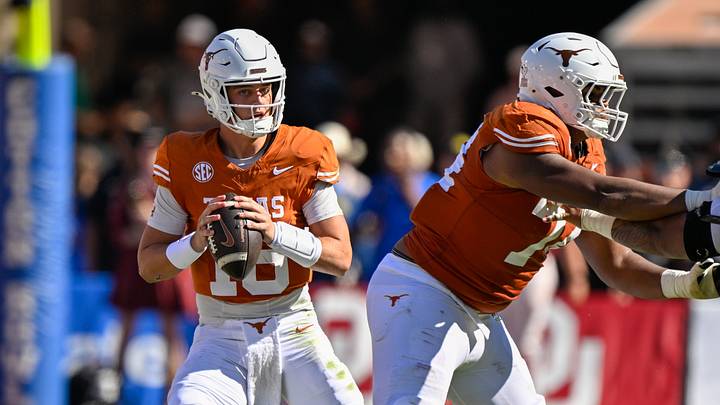
Arch Manning (21), Texas
They didn’t come up the same way at all, with Manning the ultimate recruiting prize and Mendoza headed to Yale until he got a late offer from Cal. But beyond that, the parallels are striking: Manning is a strapping 6'4", 219 pounds heading into his fourth year of college; Mendoza was 6'5", 225 going into his fourth year. Manning’s 2025 efficiency rating of 144.92 is almost identical to Mendoza’s in ’24 at Cal; and Arch is now armed with a much better supporting cast this season, just as Fernando was after transferring to Indiana. The biggest area of necessary improvement in order for Manning to make the Mendoza Leap: accuracy. Completing 61.4% of his passes like last year isn’t going to cut it.
Josh Hoover (22), Indiana
What’s the best way to make the Mendoza Leap? Go play for the same coaches. Hoover is doing that after transferring from TCU, where he threw for more than 9,600 yards. In a decade together at four different stops, head coach Curt Cignetti and offensive coordinator Mike Shanahan have developed a striking track record of QB improvement. New guys transfer in and get better, or holdover players stay and get better. What’s necessary for Hoover to make the Mendoza Leap and drastically improve last season’s 153.35 rating? Fewer interceptions. He was twice as likely as Mendoza to throw a pick last season, with a 3.2% interception rate to Fernando’s 1.6%.
Gunner Stockton (23), Georgia
He was a reliable QB last season for the SEC champions—slightly more than a game manager but certainly less than a game breaker. As was often the case with Mendoza, Stockton’s best friends last year were Georgia’s defense and running game, which lightened the burden on his shoulders. His efficiency rating of 150.59 was built largely on a high completion percentage (69.7) and a great touchdown-to-interception ratio (24 to five). The necessary area of improvement to make the Mendoza Leap: more downfield plays. Stockton had only four completions of longer than 40 yards in 14 games, with a yards-per-attempt average of 7.5. Mendoza has 11 passes of 40-plus and averaged 9.3 yards per attempt.

Conner Weigman (24), Houston
The five-star high school recruit revived his career in a big way last season after transferring in from Texas A&M, leading the Cougars to 10 wins. Weigman is a better runner than Mendoza, piling up 700 yards on the ground, but he had two instances of doing what Mendoza never did: multi-interception games. He threw two against West Virginia and then three the next week against Central Florida, pushing his season interception percentage to 2.5% and taking his efficiency rating down to 147.10.
Austin Simmons (25), Missouri
Simmons was the heir apparent to Jaxson Dart at Mississippi until getting hurt and being Trinidad Chambliss’d out of the lineup. Now we’ll see what Eli Drinkwitz can do with him. Simmons is a tantalizing raw talent, athletic and strong-armed, but has room to grow in terms of mechanics, accuracy and decision-making. He also doesn’t have near the amount of reps Mendoza had at this point last year. Simmons has thrown just 107 college passes, completing 64 of them with six touchdowns and five interceptions. Against SEC teams not named Arkansas, he has yet to throw a college touchdown pass.
Kevin Jennings (26), SMU
He has a performance variance that is as wide as his talent streak—capable of both spectacular and disastrous plays at any time. Jennings has an improvisational flair that Mendoza did not, allowing him to create something out of nothing. But that something is occasionally a very bad play—he’s thrown 24 interceptions the last two seasons, and has been known to fumble on occasion. To make the Mendoza Leap, Jennings will have to find greater consistency and decision-making, which could correspond to upgrading last season’s 146.82 efficiency rating.

Katin Houser (27), Illinois
There are some strong similarities between Houser’s last two seasons at East Carolina and Mendoza’s tenure at Cal. Both earned their way onto the field after starting the season on the bench for several games, then took over the starting job. Then, in Year 2 as the starter, they firmly took control—then hit the portal to the Big Ten. Houser’s two-year passing stats at ECU: 418 for 653 for 5,306 yards, with 37 touchdowns and 17 interceptions. Mendoza’s two-year passing stats at Cal: 418 for 629 for 4,712 yards with 30 TDs and 16 picks. We’lll see whether Houser can bump up last year’s very good completion percentage (65.9) to 70 or better.
Ethan Grunkemeyer (28), Virginia Tech
He stepped into a Penn State salvage operation at midseason last year and performed pretty well, starting the final seven games after the injury to Drew Allar, firing of James Franklin and general collapse of program aspirations. Grunkemeyer’s first three starters were at Iowa, at Ohio State and home against Indiana—welcome to college, kid. From that point on, he threw six touchdowns and no interceptions as the Nittany Lions closed with four straight victories. Season efficiency rating: 142.62. Grunkemeyer has an arm and some moxie, but isn’t much of a mobile threat.
John Mateer (29), Oklahoma
This is a different template than Mendoza’s, with Mateer arriving last season in Norman, Okla., as a highly paid and highly touted transfer and then being a mild disappointment. His efficiency rating dropped from 164.09 in 2024 at Washington State to 129.36 with the Sooners, but the big question is how much of that was attributable to a midseason thumb injury on his throwing hand that required surgery. Mateer still helped Oklahoma reach the College Football Playoff and has since packed on much-discussed muscle; if he regains his 2024 form he could definitely make the Mendoza Leap.
Alberto Mendoza (30), Georgia Tech
Who better to make the Mendoza Leap than another Mendoza? Fernando’s little brother was bypassed at Indiana for the starting job and transferred to Atlanta, where he will be a different type of QB than departed dual-threat workhorse Haynes King. Alberto has thrown a total of 25 college passes, none of them in critical situations, so he’s far from a known commodity. He lacks his big brother’s size (6'2", 207) but likely has many of the same positive intangibles. This could be the family’s second told ya so quarterback moment, after Fernando went from overlooked to the top of the mountain.
PODCAST: Listen to SI’s college sports podcast, Others Receiving Votes, hosted by Pat Forde, below or on Apple and Spotify. Watch the show on SI’s college YouTube channel or on SI TV.
 Add us as a preferred source on Google
Pat Forde is a senior writer for Sports Illustrated who covers college football and college basketball as well as the Olympics and horse racing. He cohosts the Others Receiving Votes podcast for SI and is a regular contributor to the Tony Kornheiser Show podcast. He previously worked for Yahoo Sports, ESPN and The (Louisville) Courier-Journal. Forde has won 28 Associated Press Sports Editors writing contest awards, has been published three times in the Best American Sports Writing book series, and was nominated for the 1990 Pulitzer Prize. A past president of the U.S. Basketball Writers Association and member of the Football Writers Association of America, he lives in Louisville with his wife. They have three children, all of whom were collegiate swimmers.
Follow ByPatForde