%20%20--%3E%0A%3Csvg%20version%3D%221.1%22%20id%3D%22Layer_1%22%20xmlns%3D%22http%3A%2F%2Fwww.w3.org%2F2000%2Fsvg%22%20xmlns%3Axlink%3D%22http%3A%2F%2Fwww.w3.org%2F1999%2Fxlink%22%20x%3D%220px%22%20y%3D%220px%22%0A%09%20width%3D%2239px%22%20height%3D%2240px%22%20viewBox%3D%220%200%2039%2040%22%20enable-background%3D%22new%200%200%2039%2040%22%20xml%3Aspace%3D%22preserve%22%3E%0A%3Cpath%20fill%3D%22%23FFFFFF%22%20d%3D%22M38.5%2C7H28.2v26h10.3V7z%22%2F%3E%0A%3Cpath%20fill-rule%3D%22evenodd%22%20clip-rule%3D%22evenodd%22%20fill%3D%22%23FFFFFF%22%20d%3D%22M26.1%2C25.5c0%2C5.8-4.1%2C7.5-12.9%2C7.5C3.9%2C33%2C0%2C31.2%2C0%2C25.2v-1.1h11.6%0A%09v2.4c0%2C0.7%2C0.1%2C1.4%2C1.2%2C1.4c1%2C0%2C1.2-0.4%2C1.2-1.3v-0.9c0-1.6-0.9-1.6-3.5-2.2C2.2%2C21.7%2C0%2C19.7%2C0%2C15.3v-0.9C0%2C9.3%2C5.5%2C7%2C12.9%2C7%0A%09c10.2%2C0%2C12.8%2C2.6%2C12.8%2C7.4v1.8h-11v-2.9c0-0.6-0.4-1.1-1.2-1.1c-0.6%2C0-1.2%2C0.4-1.2%2C1.1v0.9c0%2C1.5%2C0.9%2C2%2C3.3%2C2.5%0A%09c8%2C1.6%2C10.5%2C3.3%2C10.5%2C7.5V25.5z%22%2F%3E%0A%3C%2Fsvg%3E%0A)
Forde-Yard Dash: Michigan’s Bail Mary Exposes College Football’s Credibility Crisis
In this story:
Forty names, games, teams and minutiae making news in college football, where Rutgers’s blowout loss to Massachusetts is so bad it became a political issue.
First Quarter: All the Problems With the Bail Mary in the Big House
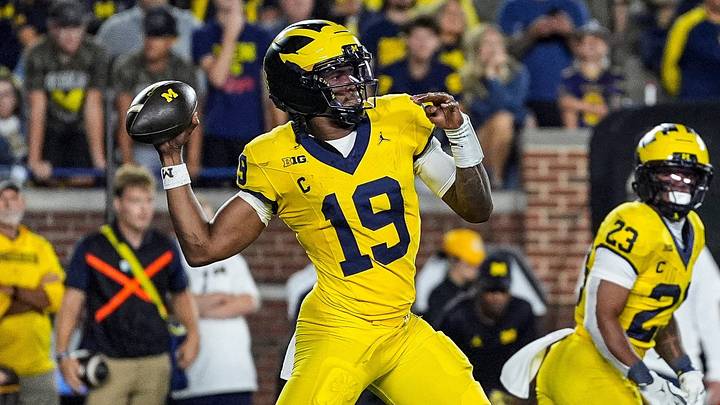
The miraculous discovery of a seemingly nonexistent second at the end of the Western Michigan–Michigan game (1) will go down in officiating infamy. It’s not as egregious as the 1972 Olympic men’s basketball final, in which the Soviet Union was allowed to rob the United States of a gold medal. Nor is it likely to have anywhere near the long-term ripple effect. Maybe it will matter if the Wolverines regroup after that embarrassing, 13–12 victory to have a championship-level season, but that will necessitate dramatic improvement.
Nevertheless, it was a bizarre moment that added massive amounts of fuel to the eternally roaring college sports conspiracy furnace (2). When a blueblood program gets a bailout that ends up beating an opponent with a fraction of the resources, cynicism grows. Even if it wasn’t nefarious, it was beyond curious.
One veteran of the college football replay space insisted Monday that the fix was not in on behalf of the Wolverines. With DVSport technology capable of breaking down images to 1/30th of a second, he said the Bryce Underwood incomplete pass appeared to contact the hands of Western Michigan defender Micah Davis with 2/30ths of a second remaining, or 1/15th of a second—an almost indecipherable amount of time.
But the source also tells Sports Illustrated that procedural errors “set [the Big Ten] up for a catastrophic procedural and operational mistake.” (3)
“All of this is very shocking,” says the source. “The game sure looked like it was over to me.”
The technical details can get very much into the weeds, but he described multiple deviations from NCAA replay protocol (4).
A big one: rule 12-6-1c, which states, “All reviews shall be based upon video evidence provided by and coming directly from the televised production of the game or from other video means available to the replay official that is also available to the television producer.” That didn’t happen in this case, and the respective time being shown on NBC and that being used by NBC and the Big Ten replay review center were not in sync.
As NBC’s John Fanta noted Sunday, “The official time of the game is kept by the Big Ten. Our cameras are not the official arbiter of timekeeping within the game. That is the Big Ten and game officials’ responsibility.”
How did the broadcast and officiating times get out of sync? That hasn’t been explained. The replay source speculated that it could be the difference between using a hardwired official game clock and a digital clock. He said hardwired clocks are more reliable, with less potential for lag time or variance.
But that they were out of sync is a significant error. And that discrepancy left a viewing public that has long believed in the authenticity of the clock on the TV screen bewildered. Which gets to the other credibility-eroding factors at play in this case.
- It would be wise for every broadcast crew to remind viewers during every game that the time it displays may vary from what the officials are using. That should be a well-known fact for fans, as opposed to a little-known fact.
- Conference-based officiating and replay review operations present an inherent conflict of interest in nonleague games. This is a problem the NFL doesn’t have, because it isn’t comprised of self-interested fiefdoms the way college football is. The sport should create a national officiating system (5), with a national replay review center staffed by a wide cross section of experts.
- It would be costly, but college football should consider copying basketball and having clocks that show remaining time to a tenth of a second (6). (Would 1/15th of a second have registered as :00.1 in the Big House? Don’t know.) If there is a means of employing something similar to the light-up backboards that clearly signal when a game is over, that should be considered as well.
- The Big Ten’s explanation of the replay review decision to add a second back on the clock was flawed. In the league’s social media post, it showed video of Davis that was shot from behind, making it difficult to tell when the ball touched his hands. “They used an image that was shot through his back,” says the replay source. “They had all the available replay angles, and for some reason they chose the one where you can’t see the ball.” (7)
A statement regarding the results of tonight's game between Michigan and Western Michigan. pic.twitter.com/DzJVN2ZLTc
— Big Ten Conference (@bigten) September 6, 2026
The Greater Credibility Crisis
The reason why so many fans are convinced that the games aren’t fair is because the entire college football industrial complex is built on unfairness. It always has been—haves vs. have-nots is hardly a new concept—but it has become more pronounced.
The most powerful programs have codified an uneven playing field. And they want to increase the slant.
Remember that the Big Ten (8) and SEC (9) took over control of the College Football Playoff format, as opposed to sharing decision-making equally with their brethren. They set up a revenue-sharing system that gives them a higher percentage of the money (29%, as opposed to roughly 17% for the ACC, 15% for the Big 12 and 9% for the entire Group of 6 combined). Big Ten commissioner Tony Petitti, in lobbying to expand the playoff, initially advocated for his league and the SEC to get four automatic qualifiers before the season even started.
There is no fairness in any of that. Add in that Big Ten and SEC schools almost never pay G6 schools on the road—and use their conference officiating crews when they play.
As Western Michigan learned in heartbreaking fashion Saturday night, even when an underdog defies everything going against it, there might be one more second put on the clock that keeps the scales tipped against them.
Dash Playoff Bracket As It Stands Today
Each week, The Dash ranks the 12 teams that should be in the College Football Playoff. As always, when the season starts anew, only the results at hand will be considered. Preseason predictions are now out the window. Games against lesser competition are given less weight—if your team blew out an FCS opponent or someone from the lower reaches of FBS, it won’t be ranked here. The 12 teams here have all played a noteworthy opponent (10):
- LSU (beat Clemson, 51–10)
- Miami (beat Stanford, 45–6)
- Notre Dame (beat Wisconsin, 41–13)
- Virginia (beat NC State, 34–8)
- Mississippi (beat Louisville, 41–38)
- UCLA (beat California, 45–24)
- Oregon (beat Boise State, 34–27)
- Louisville (lost to Mississippi, 41–38)
- North Carolina (beat TCU, 15–10)
- Colorado (beat Georgia Tech, 14–13)
- Boise State (lost to Oregon, 34–27)
- Tulsa (beat Oklahoma State, 24–10)
(Also considered: Auburn.)
First Round
- No. 12 Tulsa at No. 5 Mississippi
- No. 11 Boise State at No. 6 UCLA
- No. 10 Colorado at No. 7 Oregon
- No. 9 North Carolina at No. 8 Louisville
Quarterfinals
- Peach Bowl: No. 4 Virginia vs. Tulsa-Mississippi winner
- Fiesta Bowl: No. 3 Notre Dame vs. Boise State–UCLA winner
- Rose Bowl: No. 2 Miami vs. Colorado-Oregon winner
- Cotton Bowl: No. 1 LSU vs. North Carolina–Louisville winner
PODCAST: Listen to Sports Illustrated’s college sports podcast, Others Receiving Votes, hosted by Pat Forde, on Apple and Spotify. Watch the show on SI’s college YouTube channel or on SI TV.
 Add us as a preferred source on Google
Pat Forde is a senior writer for Sports Illustrated who covers college football and college basketball as well as the Olympics and horse racing. He cohosts the Others Receiving Votes podcast for SI and is a regular contributor to the Tony Kornheiser Show podcast. He previously worked for Yahoo Sports, ESPN and The (Louisville) Courier-Journal. Forde has won 28 Associated Press Sports Editors writing contest awards, has been published three times in the Best American Sports Writing book series, and was nominated for the 1990 Pulitzer Prize. A past president of the U.S. Basketball Writers Association and member of the Football Writers Association of America, he lives in Louisville with his wife. They have three children, all of whom were collegiate swimmers.
Follow ByPatForde