%20%20--%3E%0A%3Csvg%20version%3D%221.1%22%20id%3D%22Layer_1%22%20xmlns%3D%22http%3A%2F%2Fwww.w3.org%2F2000%2Fsvg%22%20xmlns%3Axlink%3D%22http%3A%2F%2Fwww.w3.org%2F1999%2Fxlink%22%20x%3D%220px%22%20y%3D%220px%22%0A%09%20width%3D%2239px%22%20height%3D%2240px%22%20viewBox%3D%220%200%2039%2040%22%20enable-background%3D%22new%200%200%2039%2040%22%20xml%3Aspace%3D%22preserve%22%3E%0A%3Cpath%20fill%3D%22%23FFFFFF%22%20d%3D%22M38.5%2C7H28.2v26h10.3V7z%22%2F%3E%0A%3Cpath%20fill-rule%3D%22evenodd%22%20clip-rule%3D%22evenodd%22%20fill%3D%22%23FFFFFF%22%20d%3D%22M26.1%2C25.5c0%2C5.8-4.1%2C7.5-12.9%2C7.5C3.9%2C33%2C0%2C31.2%2C0%2C25.2v-1.1h11.6%0A%09v2.4c0%2C0.7%2C0.1%2C1.4%2C1.2%2C1.4c1%2C0%2C1.2-0.4%2C1.2-1.3v-0.9c0-1.6-0.9-1.6-3.5-2.2C2.2%2C21.7%2C0%2C19.7%2C0%2C15.3v-0.9C0%2C9.3%2C5.5%2C7%2C12.9%2C7%0A%09c10.2%2C0%2C12.8%2C2.6%2C12.8%2C7.4v1.8h-11v-2.9c0-0.6-0.4-1.1-1.2-1.1c-0.6%2C0-1.2%2C0.4-1.2%2C1.1v0.9c0%2C1.5%2C0.9%2C2%2C3.3%2C2.5%0A%09c8%2C1.6%2C10.5%2C3.3%2C10.5%2C7.5V25.5z%22%2F%3E%0A%3C%2Fsvg%3E%0A)
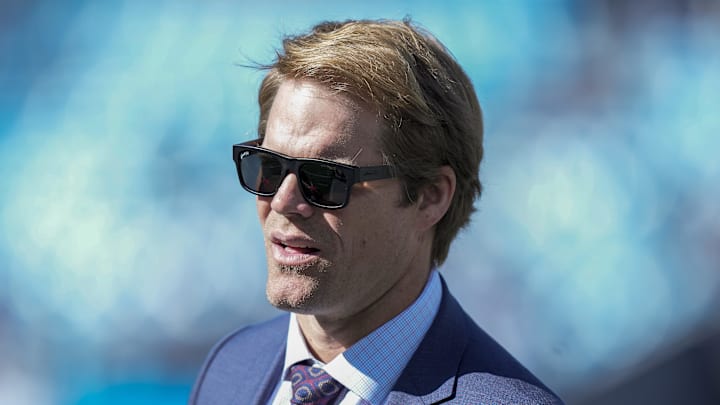
Greg Olsen Discusses How Changes to College Football Have Altered the NFL Draft
In this story:
Get NFL prospect scouting reports and team breakdowns in SI’s draft tracker.
Few North American sports—major or minor—have changed quite as drastically in the last 10 years as college football. The last decade of the game has seen all manner of alterations, from conference realignment to the liberalization of transfer rules to the advent of name, image and likeness rights to the direct compensation of players.
What might have flown under the radar to the casual fan is how these changes have created knock-on effects in the NFL. Ex-Panthers tight end and current Fox analyst Greg Olsen—renowned as one of the smartest commentators in all of sports—has had a front-row seat to these changes, which he said Tuesday “are certainly real and are playing out every single season.”
Olsen spoke to SI Tuesday on behalf of Novartis’s “Relax, It’s a Blood Test” campaign, which was launched during the Super Bowl to encourage men to undergo screening for prostate cancer. During the interview, he covered several NFL draft-related topics germane to both college and professional football in 2026.
The effects of a changing college game are trickling up to the NFL

The COVID-19 pandemic created a generation of older quarterbacks, and from Olsen’s point of view that phenomenon has yet to truly abate—especially because of the finances of staying in college vs. joining an NFL team as a mid-round selection.
“It’s a lot more common now to have rookies that are 23, 24, 25. Typically those guys at those ages were multiple years into their rookie contract. So that’s a little bit of a different animal,” Olsen said. “I think we’re seeing... a lot of quarterbacks that are actually fighting to stay in college longer because the prospects of earning are actually better for them as college players.”
One need only to look at the crop of quarterbacks staying in school this season to lend credence to that theory—Texas’s Arch Manning, Oregon’s Dante Moore and others. On the flip side, this year’s projected mid-round quarterbacks include Penn State’s Drew Allar (22) and Miami’s Carson Beck (23).
Olsen also suggested that this decade’s explosion of transfers has changed the feel of the draft—and not just at the quarterback position.
“I don’t think the development has been as good,” Olsen said. “Everyone always talks about quarterback, but you could say it about offensive line, you could say it about, really, any position. When you don’t play in the same program for multiple years, when you don’t stay consistent in that and you’re constantly starting over, it’s easy to skip over a lot of the basics.”
Miami’s return to glory will be on full display Thursday
The Bears drafted Olsen 31st in 2007, the third of three Hurricanes taken in the first round that year. That was the standard at Miami for much of the 2000s, even as the program itself declined in stature, going 7–6 in Olsen’s final season.
Eventually, the Hurricanes’ NFL output caught up with their stasis, and the program routinely began going multiple years without a first-round pick—until coach Mario Cristobal arrived and the winning began again. A 13–3 campaign in 2025–26 ended with Miami in the national championship game, and could bring the Hurricanes a trio of first-round picks Thursday.
“Mario Cristobal, I’m a huge fan. He was my tight end coach in college. He recruited me when I was a high school kid. So we go way back,” Olsen said. “It’s nice to see Miami now back having three potential first-round draft picks again—you know, that’s what it was like when I was there. That’s what it was like year in and year out.”
Defensive lineman Rueben Bain Jr., offensive lineman Francis Mauigoa, and defensive lineman Akheem Mesidor all have received first-round buzz. All contributed to the Hurricanes’ dramatic run to the CFP championship this season, which included wins over Texas A&M, Ohio State in the Cotton Bowl, and Ole Miss in the Fiesta Bowl.
“They were a possession away from a national championship in their home stadium, which would’ve been incredible,” Olsen said. “It’s certainly a lot better to be an [alumnus] when your team’s back near the top.”
One tight end—Oregon’s Kenyon Sadiq—stands out above the rest this year

After a season with 560 receiving yards and eight touchdowns that saw him garner All-America honors, Kenyon Sadiq absolutely tore up the NFL combine. He ran a 4.39 40-yard dash, broad jumped 11 feet and one inch, and vertical jumped 43 1/2 inches.
Olsen, a three-time Pro Bowler for Carolina, knows a thing or two about the tools that make a great NFL tight end—and he believes Sadiq has them.
“It’s just pretty rare for the tight end position—I mean, he put himself out there as one of the all-time best combine performances amongst any tight end,” Olsen said. “The year before I came out it was Vernon Davis, and he kind of took the league by storm with his physique and his power.”
Davis, a similar physical specimen coming out of Maryland, translated his gifts into a lengthy career where he made two Pro Bowl appearances—and blazed the trail for Sadiq two decades later.
“These guys are becoming more and more common as time goes on,” Olsen said. “It’s not hard to believe that [Sadiq] catches the league by storm.”
More College Football From Sports Illustrated
Listen to SI’s college sports podcast, Others Receiving Votes, below or on Apple and Spotify. Watch the show on SI’s College YouTube channel.
 Add us as a preferred source on Google
Patrick Andres is a staff writer on the Breaking and Trending News team at Sports Illustrated. He joined SI in December 2022, having worked for The Blade, Athlon Sports, Fear the Sword and Diamond Digest. Andres has covered everything from zero-attendance Big Ten basketball to a seven-overtime college football game. He is a graduate of Northwestern University's Medill School of Journalism with a double major in history .
Follow PAndres2001