%20%20--%3E%0A%3Csvg%20version%3D%221.1%22%20id%3D%22Layer_1%22%20xmlns%3D%22http%3A%2F%2Fwww.w3.org%2F2000%2Fsvg%22%20xmlns%3Axlink%3D%22http%3A%2F%2Fwww.w3.org%2F1999%2Fxlink%22%20x%3D%220px%22%20y%3D%220px%22%0A%09%20width%3D%2239px%22%20height%3D%2240px%22%20viewBox%3D%220%200%2039%2040%22%20enable-background%3D%22new%200%200%2039%2040%22%20xml%3Aspace%3D%22preserve%22%3E%0A%3Cpath%20fill%3D%22%23FFFFFF%22%20d%3D%22M38.5%2C7H28.2v26h10.3V7z%22%2F%3E%0A%3Cpath%20fill-rule%3D%22evenodd%22%20clip-rule%3D%22evenodd%22%20fill%3D%22%23FFFFFF%22%20d%3D%22M26.1%2C25.5c0%2C5.8-4.1%2C7.5-12.9%2C7.5C3.9%2C33%2C0%2C31.2%2C0%2C25.2v-1.1h11.6%0A%09v2.4c0%2C0.7%2C0.1%2C1.4%2C1.2%2C1.4c1%2C0%2C1.2-0.4%2C1.2-1.3v-0.9c0-1.6-0.9-1.6-3.5-2.2C2.2%2C21.7%2C0%2C19.7%2C0%2C15.3v-0.9C0%2C9.3%2C5.5%2C7%2C12.9%2C7%0A%09c10.2%2C0%2C12.8%2C2.6%2C12.8%2C7.4v1.8h-11v-2.9c0-0.6-0.4-1.1-1.2-1.1c-0.6%2C0-1.2%2C0.4-1.2%2C1.1v0.9c0%2C1.5%2C0.9%2C2%2C3.3%2C2.5%0A%09c8%2C1.6%2C10.5%2C3.3%2C10.5%2C7.5V25.5z%22%2F%3E%0A%3C%2Fsvg%3E%0A)
Inside Louisville’s Relentless Push to Keep Pace Amid College Sports’ Spending Spree
In this story:
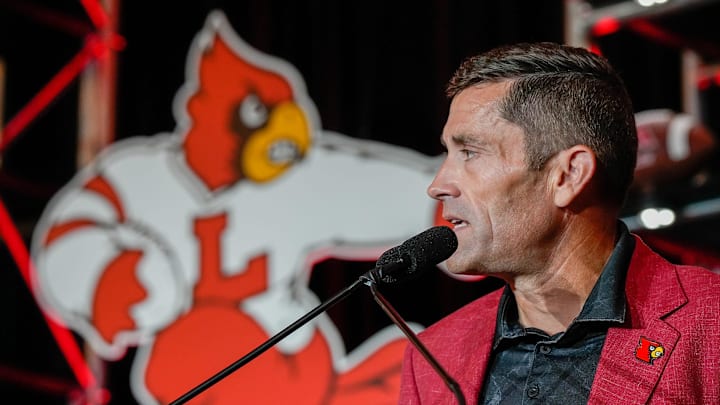
LOUISVILLE — Louisville athletic director Josh Heird is a runner, logging about 40 miles per week. He usually hits the road in the late afternoon or early evening, unspooling the workday in his mind as he goes. When the topics are stressful, his pace accelerates—Heird found himself running sub-6:30 miles one day last week, as contract negotiations with football coach Jeff Brohm reached a crucial stage.
There is a never-ending menu of pace-pushing, pulse-quickening issues in college sports today. That’s the case on every campus, but Louisville sits in the crosshairs of a financial conundrum as much as any school. Blessed with ACC affiliation and revenue but burdened by competing against some programs that will always have more resources, the Cardinals have chosen a seemingly quixotic path: embrace fiscal irresponsibility while advocating for a new revenue model.
Louisville ambitiously hustled its way into the power-conference club in 2014, a remarkable up-from-the-bootstrap accomplishment for a university that had wandered the league affiliation wilderness for decades. That upgrade seemed like a guaranteed half-century of club privileges then but is less certain now—the terrain has shifted in favor of the Big Ten and SEC, with more seismic changes possible in the 2030s. As with roughly 30 other programs of similar standing, the Cardinals’ future is not guaranteed.
“We just have to put ourselves in the best position possible,” Heird says. “It goes back to the old saying, It’s good to have opportunity and choices. Well, if we’re not successful, we don’t have opportunity and we don’t have choices.”
On March 2, Heird, Louisville president Gerry Bradley and board of trustees chairman Larry Benz published a white paper that declared, “College Athletics Is Running Out of Time.” Deficits are widespread across NCAA member schools, and Louisville is no exception. Its athletic program reported a $12.5 million loss for 2024–25; with revenue of $154.9 million and expenses of $167.4 million; a $34 million reserve fund has dwindled to $3.4 million; student athletic fees and institutional support have increased; and the department has taken out lines of credit with local banks.
“We’re not self-sustaining,” Benz says. “We’re doing the same thing everyone else is doing—we’re borrowing money.”
While advocating for systemic changes that would theoretically bring in more money in the future, Louisville’s present is all about big-dollar investments in players and coaches. Fewer than seven weeks after the publication of that sound-the-alarm white paper, Louisville might be the most aggressive buyer in the men’s basketball transfer market and is expected to approve an enhanced contract for Brohm this week.
They’re sparing no expense in the quest for the revenue-producing sports to produce even more revenue.
“It’s the old adage: It takes money to make money,” Heird says. “And I don’t think anybody’s making money in this industry right now, but it takes money to try to recoup as much as you possibly can.”
In men’s basketball, the Cardinals struck faster this month in the portal than anyone. Within days they landed Kansas center Flory Bidunga and Oregon point guard Jackson Shelstad, then followed up with Arkansas wing Karter Knox—three highly coveted power-conference transfers. Actual figures haven’t been disclosed, but the estimated price tag for those three players is $12 million.
The Cards are also in the thick of the fight for high-scoring Wisconsin guard John Blackwell and Iowa forward Alvaro Folgueiras, among others. If Louisville lands its top available targets, the 2026–27 payroll should easily exceed $15 million and could reach $20 million, which might end up being the national market leader.
With three national championships (one vacated by the NCAA for rules violations), 10 Final Fours (two vacated) and an arena that seats 22,000, the Cardinals consider themselves a basketball blueblood. That brings with it a spare-no-expense imperative to compete, especially after the ignominious two-year coaching tenure of Kenny Payne from 2022 to ’24.
“We have an administration that is leaning into this new era,” says basketball coach Pat Kelsey. “We don’t have anyone sitting around wishing it was still a bygone era. Josh and the leadership team are as forward-thinking and aggressive as any front office, if you will. Those guys put wind at our back.”
Louisville football, meanwhile, also upped its roster spending this offseason over 2025. As much as the school’s past is filled with basketball glory, football is vital to its future.
“The financial reality is, if you don’t win in football, nothing else matters,” Benz says.
The Cardinals did not splurge on a quarterback for 2026, taking Ohio State backup Lincoln Kienholz, but that freed up money to allocate elsewhere. Louisville isn’t spending on the same level as fellow ACC member and national runner-up Miami, but an estimated payroll in the range of $22 million to $25 million should be in the upper echelon of the league.
This much is sure: the $20.5 million “hard cap” of revenue sharing for an entire power-conference athletic department that was agreed upon in the House v. NCAA settlement has been blown past by many programs. Hyperbolic prophesies of inevitable $100 million budgets should be taken with a grain of salt, but the forecasts of a rev-share market correction in Year 2 of the post-House era were way wrong.
“What once was a number you try to stick with gets outdated fast,” Brohm says. “I think our people here do a great job of using all of our resources. We’ve got a pretty good nucleus of donors and supporters that do their part. Everyone knows me—we do try to not just spend to spend, at least football-wise, which is what I can speak for. But everyone’s trying to keep up with the race. I think our guys work really hard at it and we’re appreciative of everything we can get in that aspect because that’s kind of what recruiting has turned into now. Yes, relationships are important, but a lot of it is the bottom line: What can I get?”
Brohm’s bottom line has been a point of conversation in recent weeks. With a 28–12 record in three seasons and one berth in the ACC championship game, he’s elevated the program and drawn interest from other schools with more traditionally successful programs. At a program that has been a stepping stone for football coaches, Louisville fans hoped their native son would not be a flight risk—but sometimes coming home again is more complicated than it might have appeared at the beginning.
Brohm is a loyal guy who has surrounded himself with family and friends. Younger brother Brian is Louisville’s offensive coordinator. Older brother Greg is a hands-on chief of staff (he sat in on the interview for this story). Jeff’s son, Brady, has worked in recruiting and player personnel. His friend from Trinity High School days, Shawn Freibert, is his agent.

Contract extension talks between Heird, Brohm and Freibert reached an impasse during the winter. When that extended into April, things became a bit more contentious. Most fans would gladly fire Heird, the AD since 2019, if need be to keep Brohm. Others grumbled that Brohm’s penchant for following upset wins (Miami, Clemson, Notre Dame) with upset losses (California, Stanford, Pittsburgh) are indicative of a coach who isn’t championship material.
But renewed unity is at hand. An agreement that would increase Brohm’s compensation well beyond the current $6 million a year—plus other program enhancements—could be announced this week.
“I appreciate what I’ve had to this point,” Brohm says. “I think our goal here is to play at the highest level, and I think we can make progress to get that done. It’s a great city, great people. Basketball has won championships at the highest level. Football hasn’t, so it’s a goal that I want to be committed to try to get that done for us.”
Heird sat at a table outside the school’s Student Activity Center on a sunny morning last week with a cup of coffee, raising his voice at times to talk over landing planes and passing trains. Louisville Muhammad Ali International Airport is three miles south, and railroad tracks cut through campus. This is not a leafy, quiet Shangri-la in a small college town; it’s a busy university in a city footprint.
As such, Louisville’s hard-earned ascension to ACC membership is the greatest athletic success story by an urban public school in NCAA history. In the 1980s, the school considered dropping football, or at least downgrading it below the FBS level (then I-A). Many of its Olympic sports were only marginally competitive and dramatically underfunded.
What was to come under athletic director Tom Jurich was inconceivable.
Things changed when the school built a new football stadium, moving out of a Triple-A baseball stadium at the Kentucky Fairgrounds, and made a succession of winning hires in that sport. With the backing of liquor-distributing executive Owsley Brown Frazier, a string of Olympic sport facilities were built between Interstate 65 and campus, serving as an eye-catching university front porch. Louisville had Top 10 seasons in football, women’s basketball, baseball, volleyball, men’s soccer and both men’s and women’s swimming. Men’s basketball remained strong through the handoff from Hall of Famer Denny Crum to Hall of Famer Rick Pitino.
Jurich kept spending to make Louisville worthy of power-conference inclusion—even though the Big 12 rebuffed its entreaties. When the ACC had an opening following Maryland’s defection to the Big Ten, the Cardinals were ready. They’d moved into a downtown basketball arena that opened in 2010 and inflated the football stadium to more than 60,000—significantly too big to fill regularly, but commensurate with the power-conference profile Louisville wanted to present.
Scandals followed, eventually reducing the men’s basketball program to rubble. But the financial commitment to athletic success has never wavered—if anything, it’s intensified.
“In terms of affecting the culture and mood of the city, Louisville athletic success is a 9 ½ out of 10,” Benz says. “It is critical that the University of Louisville be competitive. Our major league is the University of Louisville, and athletics is the most recognizable feature of the university. Athletics gets 8% or 9% of the overall university budget, but it’s 90% of the optics.”
Given that imperative, how does an athletic department running a deficit upgrade its financial commitment to revenue sports while maintaining competitiveness in an array of Olympic sports? Instead of finding new ways to slice the pie, you try to create a bigger pie.
Louisville’s March white paper was largely a response to the SEC and Big Ten opposition of the Save College Sports movement spearheaded by Texas Tech regent and billionaire Cody Campbell. One of the primary tenets of that movement is rescinding the Sports Broadcasting Act of 1961, in hopes of replacing it with a pooling of broadcast revenue that would, in theory, create more revenue for everyone.
The SEC and Big Ten, which have the most favorable media-rights deals, are not in favor for obvious reasons. (Additionally, there is some doubt about how well such an arrangement would work.) For similarly obvious reasons, many schools outside those two leagues (and even a few inside) are open to a legal change that would supply more money across the board.

Louisville will continue to champion the Save College Sports plan, but it’s far from a sure thing—and, if it does come to pass, could be many years down the road. Given that, the Cardinals are also kicking the tires on private equity agreements. Conferences have considered it as a whole, while Utah has entered into a deal specific to its own athletic department.
“There’s no lack of meetings where people want to give us money,” Benz says, while declining to discuss specifics.
Heird similarly preferred to talk in generalities.
“The one thing I would tell you is that we are looking at every option under the sun,” he says. “We’ll entertain any conversation as long as it makes an inkling of sense, because expenses aren’t getting reduced anytime soon. But on the flip side, [investors] aren’t going to be willing to have these conversations relative to debt, equity, whatever it may be, providing capital, if they don’t think there’s opportunity there.”
Louisville’s leaders freely admit that the current economics of college sports are unsustainable. But giving up in the arms race, and potentially losing the hard-earned privilege of ACC membership and national competitiveness, is considered intolerable.
“The success of the Louisville Cardinals impacts the morale of our city more than any city our size in America,” Kelsey says. “The most important person in Louisville is the starting quarterback or starting center or starting point guard for the Cardinals. When we win, the sun is out. When we lose, it’s gloomy and people yell at their dog and the pizza doesn’t taste as good. It freakin’ matters.”
More College Football From Sports Illustrated
Listen to SI’s college sports podcast, Others Receiving Votes, below or on Apple and Spotify. Watch the show on SI’s College YouTube channel.
 Add us as a preferred source on Google
Pat Forde is a senior writer for Sports Illustrated who covers college football and college basketball as well as the Olympics and horse racing. He cohosts the Others Receiving Votes podcast for SI and is a regular contributor to the Tony Kornheiser Show podcast. He previously worked for Yahoo Sports, ESPN and The (Louisville) Courier-Journal. Forde has won 28 Associated Press Sports Editors writing contest awards, has been published three times in the Best American Sports Writing book series, and was nominated for the 1990 Pulitzer Prize. A past president of the U.S. Basketball Writers Association and member of the Football Writers Association of America, he lives in Louisville with his wife. They have three children, all of whom were collegiate swimmers.
Follow ByPatForde