%20%20--%3E%0A%3Csvg%20version%3D%221.1%22%20id%3D%22Layer_1%22%20xmlns%3D%22http%3A%2F%2Fwww.w3.org%2F2000%2Fsvg%22%20xmlns%3Axlink%3D%22http%3A%2F%2Fwww.w3.org%2F1999%2Fxlink%22%20x%3D%220px%22%20y%3D%220px%22%0A%09%20width%3D%2239px%22%20height%3D%2240px%22%20viewBox%3D%220%200%2039%2040%22%20enable-background%3D%22new%200%200%2039%2040%22%20xml%3Aspace%3D%22preserve%22%3E%0A%3Cpath%20fill%3D%22%23FFFFFF%22%20d%3D%22M38.5%2C7H28.2v26h10.3V7z%22%2F%3E%0A%3Cpath%20fill-rule%3D%22evenodd%22%20clip-rule%3D%22evenodd%22%20fill%3D%22%23FFFFFF%22%20d%3D%22M26.1%2C25.5c0%2C5.8-4.1%2C7.5-12.9%2C7.5C3.9%2C33%2C0%2C31.2%2C0%2C25.2v-1.1h11.6%0A%09v2.4c0%2C0.7%2C0.1%2C1.4%2C1.2%2C1.4c1%2C0%2C1.2-0.4%2C1.2-1.3v-0.9c0-1.6-0.9-1.6-3.5-2.2C2.2%2C21.7%2C0%2C19.7%2C0%2C15.3v-0.9C0%2C9.3%2C5.5%2C7%2C12.9%2C7%0A%09c10.2%2C0%2C12.8%2C2.6%2C12.8%2C7.4v1.8h-11v-2.9c0-0.6-0.4-1.1-1.2-1.1c-0.6%2C0-1.2%2C0.4-1.2%2C1.1v0.9c0%2C1.5%2C0.9%2C2%2C3.3%2C2.5%0A%09c8%2C1.6%2C10.5%2C3.3%2C10.5%2C7.5V25.5z%22%2F%3E%0A%3C%2Fsvg%3E%0A)
Jon Sumrall—Florida’s Unlikely Choice—Has ‘the Beast Stirring’
In this story:
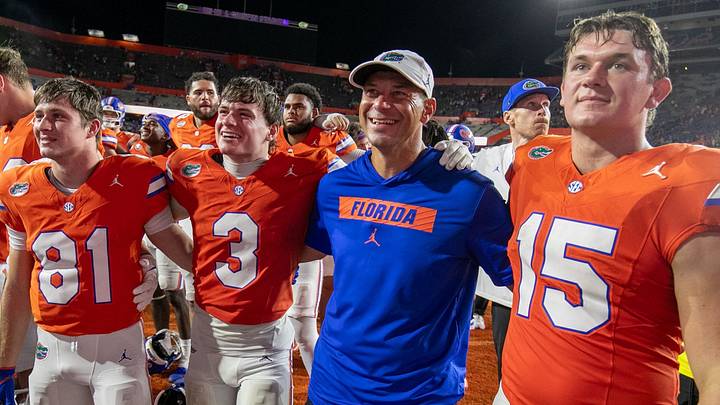
Jon Sumrall hugged his wife and four children on the Pat Dye Field at Jordan-Hare Stadium after Florida’s 44–39 victory at Auburn on Sept. 19, his first landmark victory at the school. Then he started shouting and moving toward a man standing a few feet away.
“Hey! Hey! Hey!” Sumrall yelled, then ripped a hat off the head of a Super Bowl–winning coach.
Jon Gruden has become a friend of the first-year coach of the Gators. But the former coach of the Raiders and Tampa Bay Buccaneers attended the Florida-Auburn game as a guest of the home team and was on the sideline in the first half wearing a Tigers hat. Sumrall noticed. After the game, when Gruden had switched into a neutral, tan hat, Sumrall approached him like the former SEC linebacker he is and forced a wardrobe change.
“You abandoned ship that easy?!” Sumrall said as he removed the tan hat from Gruden’s blonde head with his left hand and replaced it with his own blue Florida hat. Then Sumrall swallowed Gruden in an aggressively celebratory hug.
Jon Sumrall celebrates his first SEC win with his family and Jon Gruden pic.twitter.com/W8QH3jcD1D
— Rosie Langello-Hodgens (@RosieLangello) September 20, 2026
The two met at the Manning Passing Academy years ago in Louisiana, when Sumrall was the coach at Tulane. A relationship began and has deepened between a 44-year-old on the rise in the profession and the 63-year-old Gruden. After Sumrall got the Florida job, he invited Gruden and Urban Meyer to do a coaches’ clinic in the spring, then he had Gruden speak to the team.
“It was a very similar speech to one that I gave to the Raiders in 1998,” Gruden says. “There’s a great tradition, a great history here. This is the school of Emmitt Smith, Lomas Brown, Tim Tebow, Steve Spurrier, Urban Meyer. Somebody’s got to come in and freaking wake the beast up. This program should be a beast.”
Gruden believes that Sumrall is that somebody. Sumrall, for his part, liked Gruden’s message enough to echo it in an April news conference.
“This is a sleeping giant,” he said. “I’m telling you right now, it ain’t a matter of if we’re going to win here. It’s how fast we’re going to win.”
That timetable has been clarified. After a multiyear malaise, Florida is winning immediately.
For the first time since 2019, the Gators are 4–0. At No. 8 in the AP poll, they have their highest ranking since 2020. The 52 points Florida hung on Mississippi and 44 on Auburn marked the first time since Spurrier’s last season, in 2001, that the program scored more than 40 in its initial two SEC games.
It was an emphatic September, but some perspective is needed: At varying points, it appeared that Will Muschamp, Jim McElwain and Dan Mullen were all capable of recreating the glory days Spurrier and Meyer oversaw between 1990 and 2009. Muschamp won 11 games in his second season at Florida, McElwain won 10 in his first and Mullen was 29–6 in his first 35 games. They all wound up being fired.
Only time will tell whether Sumrall is truly different than his predecessors. But his start isn’t just good—it’s dominant.

The Gators haven’t trailed for a second against FBS competition. And the teams they have beaten—Florida Atlantic, Campbell, Mississippi and Auburn—are otherwise undefeated, a combined 13–0. Their 24-point beatdown of then-No. 4 Mississippi stands as the largest margin of victory over a top-10 team this season.
Gruden’s assessment of Florida’s serve-notice September: “I feel the beast stirring.”
The setting was Sumrall’s New Orleans living room. The time was late last November. The participants in the meeting were the Tulane coach and the inner circle conducting Florida’s coaching search—athletic director Scott Stricklin, Heisman Trophy–winning Gators quarterback Danny Wuerffel and associate athletic director Dave “Duke” Werner.
The question was hanging in the air, unspoken, so Sumrall gave voice to it.
“You hired Sun Belt Billy and that didn’t work out,” he said. “Now you’re going to hire G6 Jon?”
Billy Napier had been an abysmal failure in four seasons at Florida after moving up from Louisiana, where he had ruled the Sun Belt Conference. College coaching searches are often reduced to formulas, with schools going the opposite way when the last hire failed, and the postmortem on the Napier era was that the Florida job was simply too big for him.
Thus it was widely assumed that the Gators would go big-game hunting for his successor. Hiring a coach from the American Conference, which is not part of the sport’s Power 4 inner sanctum, would not qualify.
Sumrall was sufficiently self-aware to know the potential blowback if he got the job. He also possessed the sense of humor to give himself a pejorative nickname. Was Florida really willing to go back down a similar road to the one that left the program in a ditch?
Truth be told, Sumrall’s candidacy already had progressed further than he expected. After an initial Zoom call with Gators brass weeks earlier, he told his wife, Ginny, that was one job he would not get. He was in demand elsewhere and he also was comfortable with the possibility of staying at Tulane—his family loved New Orleans.

Also, truth be told again, Florida had very publicly gone big-game hunting to fill its opening. The primary quarry was Lane Kiffin. The hunt was a circus.
Kiffin was in the process of his November melodrama at Mississippi—staying or going somewhere, with several somewheres in the mix, a black hole of attention sucking in all heat and light. He’d had an interest in Florida for years. Florida was certainly willing to entertain the possibility, with many fans and some prominent boosters all aboard the Lane Train. But it was complicated.
A Stricklin-Kiffin arrangement would always be something of a forced marriage—two very different personalities, with very different appetites for chaos and controversy. But both believed they could make it work. Stricklin’s job was conceivably on the line with this hire, and Kiffin wanted to go somewhere with championship pedigree.
There was a meeting in Oxford, Miss. Reports were that it didn’t go well, though some sources with knowledge of the sit-down dispute that. Regardless, Kiffin and agent Jimmy Sexton shifted their sights to LSU, which could offer a more coach-friendly contract and Kiffin-friendly autonomy. Put it this way: Florida would not have been nearly as receptive to Kiffin’s push to add NFL players to the roster, in direct conflict with the rest of the SEC.
“LSU was going to give him anything he wanted,” says a source familiar with the process as it was unfolding.
Panic and outrage peaked in Gainesville, Fla., with Stricklin bearing the brunt of it for allegedly “blowing” the Kiffin interview. The Florida search turned, perilously, to G6 Jon.
While Florida was vetting many candidates, Sumrall was sorting through many suitors. In 2024 he turned down overtures from Central Florida and West Virginia, with eyes on North Carolina. When the Tar Heels made the dubious, out-of-left-field turn to Bill Belichick, Sumrall pulled out and focused on a second season at Tulane.
In 2025 the SEC jobs started to come open—Auburn and Arkansas, and Sumrall’s alma mater, Kentucky. Oklahoma State inquired. So did Virginia Tech. And, of course, Florida. While the Gators were involved with Kiffin, Auburn was pushing hard to land Sumrall, and making progress.
But Auburn moves in mysterious ways, and one of those was a request that the new coach retain defensive coordinator DJ Durkin. South Florida’s Alex Golesh, who got the job, wound up doing that. Sumrall was less enthusiastic about having his coaching staff dictated to him.

Sumrall was, however, open to Florida independently hiring Dave Caldwell as its football general manager. Caldwell had a straight NFL pedigree, including seven years as the GM of the Jacksonville Jaguars, and came with a push from Jake Rosenberg of The Athlete Group—himself a former NFL executive now working in the college search space. Having someone established in that role was a vital component with Sumrall doing what Kiffin would not at Ole Miss—vowing to stay at Tulane through the Green Wave’s College Football Playoff run.
“Florida allowed me to leave Tulane the way I want to leave Tulane, and the way I had to leave Tulane,” Sumrall says. “That place has meant a great deal to me. If I was going to leave, it had to be for a place that believed in my vision.”
With Sumrall’s candidacy gaining momentum, Stricklin asked Meyer to give Sumrall a call and apply a vision check. It was partially to gauge Meyer’s belief in Sumrall at Florida and partially to further woo Sumrall to the job. The result: Meyer came back raving about Sumrall. So did national championship–winning men’s basketball coach Todd Golden, who also put in a call to Sumrall.
On Nov. 30, the day after Tulane defeated Charlotte to end its regular season with a victory and lock up a berth in the American championship game, Florida announced the hiring of Sumrall. That was also the day Kiffin officially accepted the LSU job.
LSU fans celebrated. Florida fans fumed.
“The first 48 hours, the fans were pissed,” says a Florida source. “It was bad. Then once they heard from Jon, it was, ‘Let’s go!’ Lane’s a great fit at LSU and Jon’s a great fit at Florida.”
Sumrall won the news conference on Dec. 1, just the way he won the interview with Stricklin and won the conversation with Meyer. More importantly, he quickly won the locker room.

Sumrall comes across as a red-meat football guy (“He’s one of us,” Gruden says, “just an old-school football coach”) but there is a savviness and intelligence within. Combine all the elements of Sumrall’s magnetic personality and it can be distilled to one word: charisma.
“Having Jon Sumrall at Florida is a real blessing,” Stricklin says. “He’s authentic, relatable, energetic and incredibly competitive. A lot of people don’t have all those things. He can connect with people from any walk of life.”
Among those he connected with was the program godfather, Spurrier, who gave this assessment:
“He talks about winning a lot. He’s going to win.”
Sumrall displayed innate leadership qualities for much of his life. He was a three-time president of his high school class in Huntsville, Ala., and as his football career progressed he could see himself in a coaching role. But it was forced upon him before he was fully prepared.
Sumrall was a high-collision linebacker at Kentucky, first under Guy Morriss and then Rich Brooks. He was the team’s leading tackler in 2004, but collisions left him with stingers—tingling and pain shooting down one arm. Testing the following spring revealed cervical spinal stenosis, a narrowing of the spine. The diagnosis ended his career on the spot.
“I was honestly kind of crushed,” Sumrall says. “I made myself good enough to play at that level. I had given the game everything I had to give, then had that rug pulled out from under me.”
Suddenly adrift, Sumrall did what many college kids before and after have done—he went to Destin, Fla., and “tried to drink as much as I could.” On a sunny day at the beach, Brooks’s assistant Rich Hellyer called Sumrall and asked if he was interested in a graduate assistant role. The next day he drove back to Lexington, Ky., and threw himself into his life’s work.
Sumrall had a degree in finance, challenging himself to get outside the typical athlete clustering majors, but knew he was never going to work in a bank. Football was his passion, and coaching was the next dimension.
“I fell in love with the grind of it,” he says.

Sumrall worked his way through the ranks for 16 years before getting his first head coaching opportunity, at age 40. He took over a Troy program that had success under Neal Brown but had fallen off under Chip Lindsey. The rebound was immediate.
After starting 1–2, Troy won its last 11 games to capture the Sun Belt title and earn its first postseason Top 25 ranking. The Trojans went 11–3 the next season and again won the conference championship. A gritty program identity was established, one that carried over with Sumrall to Tulane, where he won 20 games in two seasons.
“My first team at Troy was not very good on offense,” Sumrall says. “We beat people 10–9 [Army] and 10–6 [South Alabama]. It was a rock fight every week. My second year we started to score more and have some fun, but we were blue-collar tough. It didn’t matter if it was a back alley or the biggest venue in college football, those guys were going to come out and fight.
“Tulane, we were a little sexier athletically. I think we still needed to be tough. Those teams at Troy and Tulane, you knew every time you played them, they were going to bring it.”
At Florida, G6 Jon knew he had to provide some immediate proof of concept to a skeptical fan base. Importantly, he and Caldwell held together the vast majority of the high school recruiting class and retained several key players from the Napier era. None was more important than running back Jadan Baugh.

Baugh gained more than 1,800 yards in his first two seasons at Florida, highlighted by a bell cow, 38-carry, 266-yard effort against Florida State to end the 2025 season. To build the kind of offense Sumrall and new coordinator Buster Faulkner envisioned, with a heavy run emphasis, Baugh was a must-keep player.
“They don’t just have a good back, he’s a great back,” Gruden says of Baugh. “He’s got Ricky Watters twitch and can run with power. It’s a run-first operation, and you would do that, too, if you had that back.”
The offensive line was another matter. Coming off a 4–8 season in which the Gators were often pushed around, there were major questions about how well that unit would perform. To address them, Sumrall overhauled Florida’s strength program—both the actual equipment and the mentality.
From January to August, Florida’s team collectively improved its max lifts by almost 14,000 pounds across four main categories: power clean, squat, bench and dead lift. The players—particularly the offensive linemen—reported to preseason camp in much more imposing shape.
“I had some concerns the first couple months,” Sumrall says. “We got through spring and I still didn’t feel comfortable about it. But now I can say that our offensive line has made as big a transition as any position group on our team. I firmly believe that the line of scrimmage is where you establish toughness, and we’ve built up some callouses there.”
That line growth, coupled with perimeter blocking by the Florida wideouts, has powered the Gators to 275.3 rushing yards per game against FBS competition—fourth best in the nation, and tops among SEC teams. The ability to ground and pound has given Faulkner the latitude to create a perfect formula for quarterback Aaron Philo.

The two arrived together from Georgia Tech, where Faulkner built everything around battering ram quarterback Haynes King. Thus far at Florida, Baugh is the centerpiece while Philo is the highly efficient second option, with a perfectly defined passing attack.
Philo’s stats look like something out of a simulation: 16 of 21 for 275 yards in the opener; 16 of 21 for 242 yards in the second game; 15 of 22 for 204 yards in the third game; 16 of 23 for 196 yards in the fourth game. Faulkner’s offense is simply going to do what it does until circumstances dictate otherwise.
“I’m very impressed with Philo,” Gruden says. “This guy is tough as hell. He’s got a very quick arm. He’s accurate. He’s productive. He’s a way better player than everyone’s talking about.”
Last Saturday in The Swamp, it all came together. The Gators dominated the No. 4 team in the country, with the venue rocking like peak Meyer and Spurrier years. And they didn’t need Kiffin to make it happen. They did it with G6 Jon, who arrived from a similar level of football as Napier but is cut from entirely different cloth.
“That’s a great start,” Gruden says. “They haven’t arrived yet, but they’re on the way. The effort they play with is above the line.”
The blue-and-orange beast is stirring. If it awakens fully, the balance of power in the SEC could shift with it.
PODCAST: Listen to Sports Illustrated’s college sports podcast, Others Receiving Votes, hosted by Pat Forde, on Apple and Spotify. Watch the show on SI’s college YouTube channel or on SI TV.
 Add us as a preferred source on Google
Pat Forde is a senior writer for Sports Illustrated who covers college football and college basketball as well as the Olympics and horse racing. He cohosts the Others Receiving Votes podcast for SI and is a regular contributor to the Tony Kornheiser Show podcast. He previously worked for Yahoo Sports, ESPN and The (Louisville) Courier-Journal. Forde has won 28 Associated Press Sports Editors writing contest awards, has been published three times in the Best American Sports Writing book series, and was nominated for the 1990 Pulitzer Prize. A past president of the U.S. Basketball Writers Association and member of the Football Writers Association of America, he lives in Louisville with his wife. They have three children, all of whom were collegiate swimmers.
Follow ByPatForde