%20%20--%3E%0A%3Csvg%20version%3D%221.1%22%20id%3D%22Layer_1%22%20xmlns%3D%22http%3A%2F%2Fwww.w3.org%2F2000%2Fsvg%22%20xmlns%3Axlink%3D%22http%3A%2F%2Fwww.w3.org%2F1999%2Fxlink%22%20x%3D%220px%22%20y%3D%220px%22%0A%09%20width%3D%2239px%22%20height%3D%2240px%22%20viewBox%3D%220%200%2039%2040%22%20enable-background%3D%22new%200%200%2039%2040%22%20xml%3Aspace%3D%22preserve%22%3E%0A%3Cpath%20fill%3D%22%23FFFFFF%22%20d%3D%22M38.5%2C7H28.2v26h10.3V7z%22%2F%3E%0A%3Cpath%20fill-rule%3D%22evenodd%22%20clip-rule%3D%22evenodd%22%20fill%3D%22%23FFFFFF%22%20d%3D%22M26.1%2C25.5c0%2C5.8-4.1%2C7.5-12.9%2C7.5C3.9%2C33%2C0%2C31.2%2C0%2C25.2v-1.1h11.6%0A%09v2.4c0%2C0.7%2C0.1%2C1.4%2C1.2%2C1.4c1%2C0%2C1.2-0.4%2C1.2-1.3v-0.9c0-1.6-0.9-1.6-3.5-2.2C2.2%2C21.7%2C0%2C19.7%2C0%2C15.3v-0.9C0%2C9.3%2C5.5%2C7%2C12.9%2C7%0A%09c10.2%2C0%2C12.8%2C2.6%2C12.8%2C7.4v1.8h-11v-2.9c0-0.6-0.4-1.1-1.2-1.1c-0.6%2C0-1.2%2C0.4-1.2%2C1.1v0.9c0%2C1.5%2C0.9%2C2%2C3.3%2C2.5%0A%09c8%2C1.6%2C10.5%2C3.3%2C10.5%2C7.5V25.5z%22%2F%3E%0A%3C%2Fsvg%3E%0A)
Notre Dame’s College Football Playoff Blame Game Is Missing One Critical Member
In this story:
Hell hath no fury like a blueblood scorned. Notre Dame has spent 48 hours with its tartan plaid underwear in a bunch, dishing disparagement in all directions after being left out of the College Football Playoff.
The Fighting Irish have blamed the playoff system. They have blamed the weekly ESPN TV show. They have blamed the Atlantic Coast Conference. They have bailed on a bowl game because what football team could possibly go on playing football after being so grievously wronged?
The one thing I haven’t heard anyone at the school do yet? Blame themselves.
Starting 0–2 is on Notre Dame. Scheduling two really difficult games at the beginning of the season is on Notre Dame. Stumbling early in three out of four seasons under Marcus Freeman, with September losses to Northern Illinois last year and Marshall in 2022, is on Notre Dame. Mismanaging the team’s strengths and weaknesses in the first few weeks is on Notre Dame.
I certainly haven’t heard anyone in South Bend come close to the accountability articulated by former Irish defensive coordinator and current Vanderbilt head coach Clark Lea, whose team was also denied entrance to the playoff. “We happened to be on the wrong side of that in this moment, but look, that’s no one’s fault except our own,” Lea said Monday. “We had our opportunities and we didn’t do enough. We are not victims in this process. Our ownership is in coming up short.”
What a concept, this ownership thing.
The situations are not identical. Notre Dame was in the theoretical 12-team field in each of the five televised rankings, until all of a sudden it wasn’t at the end. Vanderbilt was close but never in, spending weeks with its overachieving nose pressed against the glass.
But wow, what a difference in tone. At 10–2 Vandy, the message is that the Commodores have to get better. At 10–2 Notre Dame, the message is that the Irish have been betrayed, fleeced, robbed and left heartbroken.
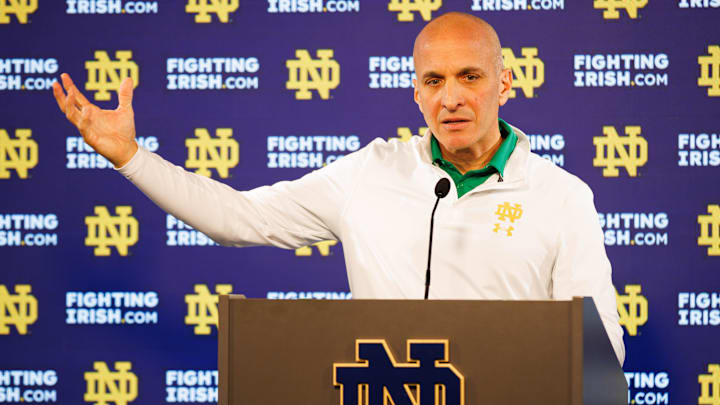
Since Sunday, Irish athletic director Pete Bevacqua has made the complaint circuit on a variety of platforms. His press conference in South Bend, Ind. on Tuesday was thorough and interesting, and a lot of what he said has merit (which we’ll get to). But the disconnect came when Bevacqua was asked by Pete Sampson of The Athletic what the school can do differently internally to avoid being playoff rejects in the future.
“Hey, let’s go back in time and beat Miami and beat Texas A&M,” Bevacqua said. “Sure, but okay, we didn’t—early season, two great games, heartbreakers, three points (against Miami), one point (against A&M). But what could we do differently? From that moment forward, [we] couldn't have done anything better.”
So much for rigorous internal reflection.

Bevacqua’s extended answer circled back to blaming the weekly rankings, and the last-minute shift to elevate Miami and downgrade Notre Dame. “We felt like we had the rug pulled from underneath us,” he said. “We thought we knew where we stood week in and week out. And then, ‘Oh, by the way, here’s the selection show, just kidding.’”
Bevacqua is certainly not wrong in terms of the selection committee painting one picture and then delivering another. But any student of playoff history would have known this was possible, even inevitable, based on the penultimate Top 25.
In the first year of the playoff, 2014, the final CFP rankings dropped No. 3 TCU three spots after a 52-point victory, moving Ohio State into the field and Baylor ahead of the Horned Frogs as well. In 2023, No. 4 Florida State won the ACC championship game to finish 13–0 and was dropped out of the field, while Alabama moved up four spots to take the Seminoles’ place.
Nothing is final until it is final. And the Irish should have seen the Alabama Okie Doke coming.
The favoritism shown to the Crimson Tide, not Miami, is where the outrage should lie if you’re Notre Dame. Alabama ended the regular season with a major struggle to beat 5–7 Auburn, yet was rewarded by the committee with a one-spot improvement in the rankings from No. 10 to No. 9. The team they displaced from ninth to 10th was the Irish, who had just bludgeoned Stanford by 29. It made no sense, and it set up what was to come five days later.
At that point, the only team between No. 10 Notre Dame and No. 12 Miami was BYU, and the Cougars were not going to stay there. They were either joining the field as the Big 12 champions or dropping after a second loss to Texas Tech. When the latter happened, the Irish and Hurricanes were side by side, and the committee brought the head-to-head meeting into play.
It should have been the deciding factor when comparing two teams with the same records. Why wasn’t it considered earlier? Because the process is overly complicated and bogged down by protocol that, sometimes, stands in the way of common sense. But the bigger problem, once again, was the committee not dropping Alabama at all after its 21-point loss to Georgia in the SEC title game.
So, yes, Notre Dame has some complaints with the process. But there remains a refusal to acknowledge that its playoff chances were imperiled early on. I wrote at the time that the Irish had kissed the playoff goodbye by starting 0–2, with not enough quality wins left on the schedule.
Giving star running back Jeremiyah Love 10 carries against Miami, while first-game starter C.J. Carr threw 30 times, was a self-inflicted wound. New defensive coordinator Chris Ash bewildering his own unit from a scheme standpoint, allowing Texas A&M receivers to be wide open all night, was a self-inflicted wound. Signing off on the most difficult opening two games in the country was a self-inflicted wound.
As for the rising hostilities with the ACC: Bevacqua repeated the saber-rattling, bring-in-the-lawyers buzzword Tuesday by declaring that the conference had “damaged” Notre Dame.
“It has created damage,” he said. “I mean, I’m not going to shy away from that, and that’s just not me speaking. People a lot more important at this university than me feel the same way. So I think it has done some real damage and I think the ACC knows that.”
Later, however, he turned down the temperature on the league where his school plays 24 sports a tad.
“All things can be healed,” he said. “I’m not going to be overly dramatic here. But it strained the relationship.”
Notre Dame has accused the ACC of specifically targeting it with negative campaigning on behalf of full league member Miami, and some of the league’s tactics could be considered excessive. For instance, televising that season-opening game 13 times—literally—on the ACC Network last week is pretty provocative. I don’t recall the ACC going after Alabama’s résumé in a similar fashion.
STATEMENT from ACC commissioner Jim Phillips on Notre Dame: pic.twitter.com/nNqmDDbphW
— Matt Fortuna (@Matt_Fortuna) December 8, 2025
But the straightest path to getting Miami into the playoff was via comparison to Notre Dame, and reinforcing the clearest differentiation between them—the Hurricanes beat the Fighting Irish. The ACC championed the school that is a full family member over part of the extended family. The league should be embarrassed for having a tiebreaker that kept its best team out of its championship game, but it doesn’t have to apologize for using the best weapon in its arsenal to push for that team to make the playoff.
Notre Dame and the ACC have had a friends-with-benefits relationship for a long time, with five guaranteed games between the football independent and the league’s members. It has helped both. The Irish pack ACC stadiums and boost ACC TV ratings. The ACC provides largely beatable teams to fill schedule slots later in the season, when that might be harder for Notre Dame to do if it partnered with, say, the SEC or Big Ten.
And during the pandemic season of 2020, when the Irish schedule teetered on the brink of collapse as most everyone lined up conference-only games, the ACC rolled out the welcome mat. It gave Notre Dame a full schedule and a one-season football membership, with the Irish making the league title game.
And still, the Irish got their feelings hurt by social media and the selection committee. So hurt that the poor things simply couldn’t bring themselves to play in a bowl game.
In this playoff field, as in every playoff field, someone was going to be the first team out. It was a hard call—one of the hardest ever—but somebody had to go. When Notre Dame is done blaming everyone else, it can look inward and figure out next year how to start a season better and avoid being on the bubble.
More College Football on Sports Illustrated
Listen to SI’s new college sports podcast, Others Receiving Votes, below or on Apple and Spotify. Watch the show on SI’s YouTube channel.
 Add us as a preferred source on Google
Pat Forde is a senior writer for Sports Illustrated who covers college football and college basketball as well as the Olympics and horse racing. He cohosts the Others Receiving Votes podcast for SI and is a regular contributor to the Tony Kornheiser Show podcast. He previously worked for Yahoo Sports, ESPN and The (Louisville) Courier-Journal. Forde has won 28 Associated Press Sports Editors writing contest awards, has been published three times in the Best American Sports Writing book series, and was nominated for the 1990 Pulitzer Prize. A past president of the U.S. Basketball Writers Association and member of the Football Writers Association of America, he lives in Louisville with his wife. They have three children, all of whom were collegiate swimmers.
Follow ByPatForde