%20%20--%3E%0A%3Csvg%20version%3D%221.1%22%20id%3D%22Layer_1%22%20xmlns%3D%22http%3A%2F%2Fwww.w3.org%2F2000%2Fsvg%22%20xmlns%3Axlink%3D%22http%3A%2F%2Fwww.w3.org%2F1999%2Fxlink%22%20x%3D%220px%22%20y%3D%220px%22%0A%09%20width%3D%2239px%22%20height%3D%2240px%22%20viewBox%3D%220%200%2039%2040%22%20enable-background%3D%22new%200%200%2039%2040%22%20xml%3Aspace%3D%22preserve%22%3E%0A%3Cpath%20fill%3D%22%23FFFFFF%22%20d%3D%22M38.5%2C7H28.2v26h10.3V7z%22%2F%3E%0A%3Cpath%20fill-rule%3D%22evenodd%22%20clip-rule%3D%22evenodd%22%20fill%3D%22%23FFFFFF%22%20d%3D%22M26.1%2C25.5c0%2C5.8-4.1%2C7.5-12.9%2C7.5C3.9%2C33%2C0%2C31.2%2C0%2C25.2v-1.1h11.6%0A%09v2.4c0%2C0.7%2C0.1%2C1.4%2C1.2%2C1.4c1%2C0%2C1.2-0.4%2C1.2-1.3v-0.9c0-1.6-0.9-1.6-3.5-2.2C2.2%2C21.7%2C0%2C19.7%2C0%2C15.3v-0.9C0%2C9.3%2C5.5%2C7%2C12.9%2C7%0A%09c10.2%2C0%2C12.8%2C2.6%2C12.8%2C7.4v1.8h-11v-2.9c0-0.6-0.4-1.1-1.2-1.1c-0.6%2C0-1.2%2C0.4-1.2%2C1.1v0.9c0%2C1.5%2C0.9%2C2%2C3.3%2C2.5%0A%09c8%2C1.6%2C10.5%2C3.3%2C10.5%2C7.5V25.5z%22%2F%3E%0A%3C%2Fsvg%3E%0A)
Tony Petitti Is Quietly Becoming College Sports’ Most Powerful Figure
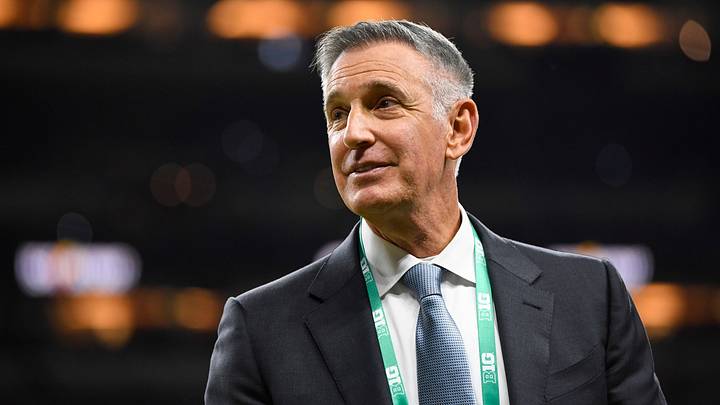
ROSEMONT, Ill. — A few minutes before the Week 10 slate of college football games kick off, Tony Petitti is in his element at the heart of a control center.
There is fast-paced movement all around, but his calm demeanor is ever present. He spews evaluations of quarterback play that many coaches would agree with. There’s a keen eye for the action, catching a player stepping out of bounds early or noting a review that should take place well before it’s buzzed in.
There is also an air of gravitas around Petitti. The Big Ten commissioner recounts how halftime breaks work during NFL Sundays and a humorous story about taking a local market to the wrong game during the NCAA tournament. He injects an appropriate level of levity into the professional setting. While he can come off as stiff in formal settings, he knows how to make sure everyone leaves work with a smile and the thought it was not work at all.
Petitti frequents in-person games early in the season, meeting his constituents to hear issues, concerns and ideas. But the Big Ten command center is best suited for him for the closing stretch of the regular season. That is entirely strategic. Here, he can see everything across the country in real time in case an athletic director or a coach calls him later to discuss an issue.

“I had been around a lot of commissioners for so many years going back to my first programming jobs with ABC Sports in the early ’90s,” Petitti says after nearly 12 hours of football. “What became obvious after a few months is that this is almost like two different jobs. There’s the traditional things that commissioners always had to deal with—scheduling, officiating, running championships, managing your media partners, finding opportunities to do things across the league.
“But there’s this other part, because of the changing nature of the landscape, where it’s almost like a different job right now. Most of that job requires incredible collaboration with the other commissioners of the [Power 4], the NCAA, Congress. I think all of that, it was hard to predict the volume of it.”
Few seem to be handling it better, or more adeptly, than the most powerful figure in the sport.
His formal title is enough to bestow to him plenty of influence across college athletics. He is tasked with guiding the 130-year-old institution with lucrative media contracts distributing more than $1 billion to its members. Other school presidents practically beg to be a part of the club. Few others hold comparable sway on how the landscape is evolving amid a turbulent time for change. His influence outpaces even that of NCAA president Charlie Baker and SEC commissioner Greg Sankey.

What Petitti wants for his conference is, ever increasingly, what Petitti gets.
Barely 48 hours after first stepping into his office on Saturday, that became crystal clear as the College Football Playoff formally announced it was expanding from 12 to 24 teams beginning in 2027.
Detractors of doubling the sport’s postseason format sometimes painted Petitti as something of a Captain Ahab, chasing after the whale-sized proposal fans are displeased with because it foundationally alters the regular season. Many have derided it as the misguided brainchild of a former baseball executive, attempting to lower the bar on access for good, but not great, teams that will feel less pain over going 8–4 or 9–3 and spending upwards of $30 million on their rosters.
“You’ve gotta be willing to put things out there knowing that criticism might come,” Petitti says. “There’s an immediate reaction to every idea, whether the idea is going to happen or not, and you have to just get used to that. You have to have a thick skin about that.”
FBS commissioners, some publicly but many more privately, questioned Petitti’s insistence on 24 teams. They cited a lack of grand monetary gain over the current 12-team format while stripping away conference title games. For many, there was real meaning to handing out trophies and bestowing a title schools could cherish forever. While there is some excitement over the possibility of getting more of their teams into the CFP, there is more resentment, if not outright regret, over handing the Big Ten and SEC control of the format as part of a memorandum of understanding signed in early 2024.
Even then, the 24-team format was passed unanimously.

Petitti says he’s simply advocating for what his conference arrived at after giving plenty of consideration to different formats. There was a 16-teamer with automatic qualifiers as well as the format that will commence next season.
“These ideas get kicked around, you have conversations with your colleagues. We talked a lot about it inside the league about what the right number would be,” Petitti says matter-of-factly. “Twenty-four in our league just kind of took hold. Pretty quickly among coaches, 24 was the right number and we kind of locked arms around that between the ADs and the coaches. I think that our approach was so united that I think it had an impact across how other leagues eventually thought about it.”
He became akin to a salmon swimming upstream, meeting pushback from all corners likely exacerbated by his lack of publicly trying to gin up support. It is not in Petitti’s modus operandi to negotiate through the media. Instead, he spread his message constantly across CFP meetings and when the opportunity presented itself. Staying flexible helped, too. He backed off on an insistence for automatic qualifiers to win over the ACC and Big 12’s support while showing it would be financially viable for everyone.


In the spring, Petitti pegged Power 4 conference championships at roughly $200 million in value while noting the gate receipts from first-round games could generate nearly $70 million a season. In negotiating over the past few weeks, Petitti, Sankey and Notre Dame’s Pete Bevacqua were largely responsible for securing roughly $340 million out of ESPN on top of the $1.3 billion per year the network was already paying for the CFP. The event’s revenue distribution isn’t changing either, resulting in another win for the Big Ten. The bulk of such payments will still flow back to the league’s coffers.
Petitti continues the drumbeat that a bigger bracket will allow for more compelling nonconference matchups. Part of the new format requires teams to play at least 10 Power 4 opponents. The league that may need to accommodate more changes to meet that threshold? It’s the Big Ten where schools like USC and Indiana suddenly must rearrange their 2027 slate.
“If the 18 members of the Big Ten are behind something, whether it’s our coaches or ADs, and if we’re united and believe in what we’re doing, that’s my job to get it done for the league,” he says. “Of course you want and expect to do things your fans are going to love and engage with, but you also have to understand that the way it works now is you’re going to get criticized in real time. A lot of that comes from the passion people have.”
While that comes with such a prominent position, it runs counter to Petitti’s inclination to stay behind the cameras. He isn’t going on Paul Finebaum’s daily talk show as Sankey is accustomed to or jumping on morning news shows like Baker, a former politician, when they need to state their case.
Instead, Petitti operates behind the scenes directly with stakeholders.
“The pace at which his mind works, he’s always six or seven steps ahead. He does an incredible job navigating the crazy landscape of college athletics, and even within the conference, understanding how to represent the diversity of schools one through 18,” says Iowa’s Beth Goetz, who chairs the Big Ten athletic directors group. “I think it may take others a little while to catch up with his concepts, but they come around eventually, even if it’s maybe a little longer than we would like.
“I think you can see his influence in a lot of different places, and he’s not about needing to take the credit or any of that. He just wants to make sure he continues to position the Big Ten where he thinks we need to go.”
Many within the Big Ten would love for the public, and especially his critics in the media, to see the side of the commissioner they do on a regular basis. Petitti has become far more front-facing and revelatory as the conference has captured the last three national titles in football and ended long championship droughts in men’s and women’s basketball.

Petitti believes there is an obligation to be available in the job to his membership above all else. One Big Ten athletic director joked he has an almost telepathic ability to know when to reach out about issues and Petitti is sending text messages to (or calling) commissioners, athletic directors, coaches and staff members on a daily basis. It’s not unusual for him to show up at local Northwestern sporting events if he’s in town to catch up with visitors.
“His willingness to overcommunicate is really effective with his leadership style. His willingness to be creative and innovate, to come up with ideas that actually have a chance of being implementable, I think that’s what separates Tony from probably a lot of other people in similar roles,” Washington athletic director Pat Chun says. “He has an energizing style to him. He’s got a motor that has one speed, but it’s not the type of speed that’s a bull in a china shop. It’s for the greater good, working at this fast pace with everyone in and around our league.”
Petitti has been listening to feedback and isn’t afraid to make changes. He backed off on pursuing a private capital deal for the league after Michigan and USC leadership objected. He moves swiftly to advance the league’s interests while managing upward with university presidents and downward to those in the trenches.
“Extremely transparent, very communicative and a tremendous leader,” says Hawkeyes coach Kirk Ferentz, who has navigated the differing styles of the last three Big Ten commissioners. “... He asks questions, he’s a great listener. The best leaders I’ve been around are great listeners, not that you’re going to do everything they say or lean in your direction, but we appreciate people that listen.”
Petitti’s influence is growing through the soft power he has become remarkably adept at using the further into his tenure he gets.
“It’s a pretty steep learning curve in the job, it’s definitely very different and it has evolved, but I definitely feel more settled,” he says. “I don’t think about [personal legacy], I think about the Big Ten having an incredible legacy. It’s been playing since 1896 and you take that responsibility on. If you do a good job of gathering information, working with coaches and ADs, listening and working collaboratively, that stuff will take care of itself.”
PODCAST: Listen to Sports Illustrated’s college sports podcast, Others Receiving Votes, hosted by Pat Forde, on Apple and Spotify. Watch the show on SI’s college YouTube channel or on SI TV.
 Add us as a preferred source on Google

Bryan Fischer is a staff writer at Sports Illustrated covering college sports. He joined the SI staff in October 2024 after spending nearly two decades at outlets such as FOX Sports, NBC Sports and CBS Sports. A member of the Football Writers Association of America’s All-America Selection Committee and a Heisman Trophy voter, Fischer has received awards for investigative journalism from the Associated Press Sports Editors and FWAA. He has a bachelor’s in communication from USC.
Follow bryandfischer