%20%20--%3E%0A%3Csvg%20version%3D%221.1%22%20id%3D%22Layer_1%22%20xmlns%3D%22http%3A%2F%2Fwww.w3.org%2F2000%2Fsvg%22%20xmlns%3Axlink%3D%22http%3A%2F%2Fwww.w3.org%2F1999%2Fxlink%22%20x%3D%220px%22%20y%3D%220px%22%0A%09%20width%3D%2239px%22%20height%3D%2240px%22%20viewBox%3D%220%200%2039%2040%22%20enable-background%3D%22new%200%200%2039%2040%22%20xml%3Aspace%3D%22preserve%22%3E%0A%3Cpath%20fill%3D%22%23FFFFFF%22%20d%3D%22M38.5%2C7H28.2v26h10.3V7z%22%2F%3E%0A%3Cpath%20fill-rule%3D%22evenodd%22%20clip-rule%3D%22evenodd%22%20fill%3D%22%23FFFFFF%22%20d%3D%22M26.1%2C25.5c0%2C5.8-4.1%2C7.5-12.9%2C7.5C3.9%2C33%2C0%2C31.2%2C0%2C25.2v-1.1h11.6%0A%09v2.4c0%2C0.7%2C0.1%2C1.4%2C1.2%2C1.4c1%2C0%2C1.2-0.4%2C1.2-1.3v-0.9c0-1.6-0.9-1.6-3.5-2.2C2.2%2C21.7%2C0%2C19.7%2C0%2C15.3v-0.9C0%2C9.3%2C5.5%2C7%2C12.9%2C7%0A%09c10.2%2C0%2C12.8%2C2.6%2C12.8%2C7.4v1.8h-11v-2.9c0-0.6-0.4-1.1-1.2-1.1c-0.6%2C0-1.2%2C0.4-1.2%2C1.1v0.9c0%2C1.5%2C0.9%2C2%2C3.3%2C2.5%0A%09c8%2C1.6%2C10.5%2C3.3%2C10.5%2C7.5V25.5z%22%2F%3E%0A%3C%2Fsvg%3E%0A)
Jayden Maiava’s Remarkable Rise From Hawaiʻi to Heisman Contender Is Rooted in ʻOhana
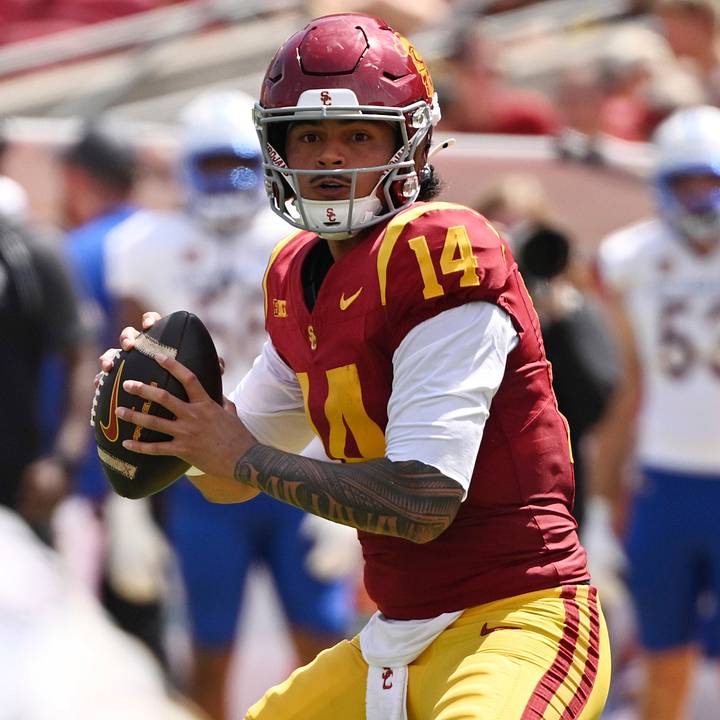
LOS ANGELES — Jayden Maiava is sitting in the most opulent, modern and expensive real estate in college athletics. He’s on a third-floor terrace at USC’s gleaming Bloom Football Performance Center, the centerpiece of a $225 million athletic development on campus. The downtown skyline sprawls in front of him, with the famed Griffith Observatory to the left and the city’s iconic Hollywood sign to the far left.
Behind Maiava, the interior of the building offers every football amenity imaginable. The weight room, meeting rooms, indoor walk-through area, lounges and fueling stations are all best in class and brand new. The recovery areas include float beds, infrared therapy beds, sleep pods, hot and cold plunge pools, zero-gravity chairs and AI-powered massage chairs from Japan.
“We’re spoiled here,” the Trojans quarterback says with a smile. Nobody in the building is more keenly aware of his privileged existence than Maiava, having come to the literal lap of luxury from nearly nothing.

Maiava grew up in Hawaiʻi sleeping on floors. Or outdoors. He lived in Pālolo Valley Homes public housing on the island of Oʻahu, just one piece in a human jigsaw puzzle of extended family that somehow fit into a three-bedroom house.
How many people lived in the Maiava home at any given time?
“About 15?” William Maiava, Jayden’s father, guesses.
“Sometimes 20,” Jerushua, Jayden’s mother, suggests.
Jerushua’s parents, original owners of the house, slept in the carport. She and William were in one bedroom, along with some of their eight children (oldest to youngest: Heaven, Jahssiah, Jayden, Jacob, Justice, Henna, Hinena, Jaestin). Two of Jerushua’s siblings, and some of their kids, occupied the other bedrooms. The older children? They scattered out wherever they could find room, or relocated to the yard.
Meal time was an exercise in teamwork and sacrifice—whoever was available pitched in to cook, but sometimes not every plate was filled. Bathroom use was an exercise in patience—the kids lined up, with girls getting priority while boys were occasionally sent outside. That’s sometimes where they showered as well, utilizing the garden hose.
“Fun times,” Jerushua says with a laugh.
“We’re good at Tetris,” jokes William. “We made it work, man.”
It took work to make it work. Hard work, in a poverty-stricken part of an expensive island. The picturesque Pālolo Valley is just inland from bustling Honolulu and Waikīkī—within sight of world-famous Diamond Head Beach but removed enough to have some pastoral vibe. Big-city problems mingle with random chickens roaming the roadsides.
William, a large and imposing man, was a prison guard who moonlighted doing security at clubs and events. Jerushua worked the front desk at a Hilton, routinely taking on double shifts. They often left home for work at 5 a.m. and returned at 10 p.m. There were days when Jayden and his siblings never saw their parents.
To go from there to this place—this Taj Mahal of a football facility, status as the star quarterback of a blueblood program, Heisman Trophy candidate, NFL prospect, riches already beyond anything he’d known—would be dizzying for someone less grounded. But when a naturally quiet young man views growing up in a house with 15 to 20 others as a blessing, not a burden, he already has the gift of perspective.
“We had to work together,” Maiava says. “A lot of heads bumping together, but we figured it out. I mean, super blessed for that. I can think of so many people that would want to be in my spot, so I’m just being grateful for the moment and understanding where I come from, understanding my roots. That’s super huge just for the Polynesian culture, just remembering where you come from and never forget the standard of what it takes to be a Polynesian.”
ʻOhana is a Hawaiian term for family. It’s as much a cultural commitment to togetherness as anything, extending beyond a household to a community—a village, if you will. It is a concept the Maiavas embrace in both quantity and quality.
“At the end of the day,” William says, “we all we got.”
Kawehi Moefu grew up in Pālolo Valley with William Maiava, playing sports with him and marveling at his ability to move gracefully on the football field and basketball court.
“He could do amazing things in his big frame,” says Moefu, now the football coach at their alma mater, Kaimuki High School. “And he didn’t even train.”
But then as now, few career avenues led out of the valley and off “the rock,” as natives call Oʻahu. Geography and demographics conspired against big dreams. Athletes were not discovered by college recruiters, and both crime rates and dropout rates were problematic. Many people grew up and stayed right where they’d always been, often living in the same housing projects.
“Everyone’s in need,” Moefu says. “Everyone’s without something, missing something. There’s a lot of crime as well. But we didn’t really feel it because it was home for us. Nobody from outside wanted to go in the valley, but that was a place we felt we belonged.”
Given the day-to-day struggle, belonging was the connective thread.

Casey is the beloved local “manapua man,” as food truck vendors are known on the islands. He’s parked his truck near Pālolo Valley Homes for nearly 40 years, serving cheap pork hash and fried noodles. Moefu says Casey accepted food stamps—or, if lacking those, he allowed some regular customers to open a line of credit. Kids could occasionally eat for free. If anyone needed an update on the local gossip, the manapua man usually had the skinny.
This was ʻOhana at work. Those in the Valley looked after each other as best they could.
“Everyone took care of each other’s kids,” Moefu says. “If a kid’s hungry and at someone else’s house, they fed you. But if you’re out in the street, they also yelled at you to get your butt home. Tough love.”
Jayden Maiava didn’t need a lot of that. He grew up in the same projects where his parents did, went to the same schools his parents attended, and adhered to the standards they set. Watching other neighborhood kids get into trouble helped keep him on a straight path, as did a genuine love of football.
He was also a big kid—not as thick as his father, but one who was taller than his peers and on a path to being a strapping 6'4" and 230 pounds. After playing wide receiver and catching passes over the top of defensive backs, Maiava made the transition that often comes with being the best player on a team—to quarterback.

Hawaiian quarterbacks like Marcus Mariota and the Tagovailoa brothers, Tua and Taulia, went on to become stars. But the path out of Pālolo did not look as promising as going to the mainland for high school, so William moved the family to the Las Vegas area.
Jayden spent his freshman year at Sierra Vista High School. Moefu, who had worked with him as he grew up, watched video of Jayden and saw something special in the making.
“The way he was slinging it, I just said, ‘Holy smokes,’ ” Moefu recalls.
But the pull of Pālolo remained. Maiava came home for his sophomore year to live with some uncles, Moefu says, and to wear the uniform he grew up cheering for.
When in Vegas, he missed home. When in Hawaiʻi, he missed his parents.
“It was tough for that boy,” Moefu says.
Not on the field, though—Maiava excelled in 2019 at Kaimuki. The pandemic canceled his junior season and put his senior year in jeopardy as well, so he returned to the Las Vegas area to Liberty High School. UNLV, then coached by Marcus Arroyo, offered him a scholarship before his senior season, and the three-star prospect committed to the local school without much recruiting hoopla.
Maiava had other options at power-conference schools, but UNLV seemed like a perfect setup. He could be near family and still play college ball.
Perhaps Arroyo would have kept his job past 2022 if he’d played Maiava instead of redshirting him. Perhaps Maiava wasn’t ready. But new coach Barry Odom was the beneficiary, even though he also failed to fully appreciate Maiava’s ability right away. Senior Doug Brumfield started the first two games of the 2023 season before getting hurt in the third game, against Vanderbilt. What happened thereafter changed the trajectory of all involved parties.
Trailing 17–0, Maiava led a comeback for a 40–37 upset of the Commodores. He started the rest of the season, leading the Rebels to their first nine-win season since 1979 and the Mountain West Conference championship game. Odom coached one more year at UNLV before jumping to Purdue, while Maiava entered the transfer portal as a red-hot commodity after the 2023 season.
The tampering was underway during the season, of course, but Maiava let things play out in January 2024. He committed to Georgia a week after entering the portal, then regretted it and flipped to USC the next day.
Once again, though, Maiava was not viewed as any kind of game-changing recruit. He came in as a backup to Miller Moss and barely played until the Trojans were 4–5 in their first Big Ten season. Maiava started the final four games, three of them wins, sending Moss into the portal and off to Louisville.
Last year was his first time Maiava entered a season as a college starter, and he lived up to the task. USC went 9–4, a tangible step forward, with Maiava throwing for a Big Ten–leading 3,711 yards with 24 touchdowns and 10 interceptions.
That set the stage for this season. A confluence of events has presented the Trojans with the chance to return to national prominence—an enhanced NIL war chest, an elite coaching staff, a talented transfer group, the nation’s No. 1 freshman class and the opening of the Bloom Football Performance Center. Improbably enough, it’s happening with a three-star, Pālolo Valley boy as the leading man.
“Of all the guys I’ve been fortunate enough to coach, I don’t know that I’ve had any that have improved from Day 1 to this point as much as Jayden has,” USC coach Lincoln Riley says. “It’s been fun to see him grow as a player and leader, starting to embrace what it means to be the starting quarterback at USC. I think a guy that’s just going to get better and better in his prime to play his best football.”

Maiava is off to a career-best start. He leads the nation in touchdown passes with 12 and is sixth in pass efficiency, despite throwing to a startlingly young cast of receivers. USC’s top eight pass catchers are all either freshmen (five of them) or sophomores (three).
“These freshmen are phenomenal,” Maiava says. “They don’t shy away from the moment.”
The biggest moment of the season arrives Saturday, when No. 20 Oregon comes to Los Angeles. It’s a massive game in the Big Ten and College Football Playoff race, but also in terms of the Heisman and NFL draft. Oregon is led by the quarterback who started the season as the perceived No. 1 draft pick, Dante Moore.
The Maiava family certainly knows everything that is at stake Saturday. But their attention is also on Jayden’s younger brother, Jacob, a redshirt freshman center at Central Florida who earned his first college start last Saturday.
One thing they have learned: As long as there are no fumbled snaps, it’s easier being the parents of a center than a quarterback. Every time there is an incompletion, an interception or any kind of offensive miscue, the Maiavas know how fans are going to react.
“I just try to stay positive, close my eyes and say a little prayer,” William Maiava says about when the Coliseum critics start to chirp about the quarterback. “We moved our seats up to the top to be with the old folks who hardly yell.”
Jayden, they say, pays little attention to it. Nor is he caught up in NFL speculation, Heisman discussion or the glamour of being the USC starting quarterback. He’s hardly lighting up the L.A. party scene.
“After games, this dude just stays in his apartment and studies film,” William says of his son. “He gets out his tablet and goes through the game. He believes in God and he’s humble. My wife and I are just speechless thinking about one of our kids being in this position.”

The Maiava family home is currently in Nevada, but there are dreams of at least one more. William and Jerushua Maiava are already planning a 2028 trip back to the family’s ancestral homeland of Samoa. The whole family—all the kids, all the grandkids. William has a plot of land where he’d like to build a place for everyone. Like the Pālolo Valley days, but far more comfortable.
“To this day, our goal is to make the Maiava compound,” William says. “We want everyone with us. We want to keep everyone together.”
Last spring, the family traveled back to its roots. Jayden put on a football clinic at Pālolo Valley District Park where he grew up playing. He spoke at all the schools he attended—elementary, middle and high school. A boy from the projects came home a man of the world, a hero to the young kids who heard his story.
“For me, growing up, I didn’t really have something like that,” Jayden says. “Giving back to the younger generation is like, especially in the community I was raised up, that was important to me.”
There was some pomp and ceremony involved, including a visit from the governor, Josh Green. But what was supposed to be a 20-minute talk in the Kaimuki High library turned into an hour, and the clinic ended up with more than 300 kids in attendance. Some of them were Maiava’s cousins, others were children of kids he grew up with in the projects.
“He’s the best athlete and role model in recent times from here for these kids to see,” Moefu says. “It was such a good thing for the community. And the best thing about it wasn’t all the attention; it was that Jayden just wanted to work with the kids.”
The ancillary benefit to the visit: The whole Maiava clan went home with him. William and Jerushua said the reminiscences ran heavy as they went back through their old schools, old neighborhoods and old housing project.
The family has come a long way since then, but in an important way hasn’t gone anywhere at all. The ethos that carried them through the days and nights with 20 people in a three-bedroom house remains.
ʻOhana made Jayden Maiava. ʻOhana wouldn’t let him fail, when so many others from Pālolo Valley Homes did. ʻOhana will not let him forget where he started. In repayment, he is lifting his family name as high as he can in the City of Angels.
PODCAST: Listen to Sports Illustrated’s college sports podcast, Others Receiving Votes, hosted by Pat Forde, on Apple and Spotify. Watch the show on SI’s college YouTube channel or on SI TV.
 Add us as a preferred source on Google
Pat Forde is a senior writer for Sports Illustrated who covers college football and college basketball as well as the Olympics and horse racing. He cohosts the Others Receiving Votes podcast for SI and is a regular contributor to the Tony Kornheiser Show podcast. He previously worked for Yahoo Sports, ESPN and The (Louisville) Courier-Journal. Forde has won 28 Associated Press Sports Editors writing contest awards, has been published three times in the Best American Sports Writing book series, and was nominated for the 1990 Pulitzer Prize. A past president of the U.S. Basketball Writers Association and member of the Football Writers Association of America, he lives in Louisville with his wife. They have three children, all of whom were collegiate swimmers.
Follow ByPatForde