%20%20--%3E%0A%3Csvg%20version%3D%221.1%22%20id%3D%22Layer_1%22%20xmlns%3D%22http%3A%2F%2Fwww.w3.org%2F2000%2Fsvg%22%20xmlns%3Axlink%3D%22http%3A%2F%2Fwww.w3.org%2F1999%2Fxlink%22%20x%3D%220px%22%20y%3D%220px%22%0A%09%20width%3D%2239px%22%20height%3D%2240px%22%20viewBox%3D%220%200%2039%2040%22%20enable-background%3D%22new%200%200%2039%2040%22%20xml%3Aspace%3D%22preserve%22%3E%0A%3Cpath%20fill%3D%22%23FFFFFF%22%20d%3D%22M38.5%2C7H28.2v26h10.3V7z%22%2F%3E%0A%3Cpath%20fill-rule%3D%22evenodd%22%20clip-rule%3D%22evenodd%22%20fill%3D%22%23FFFFFF%22%20d%3D%22M26.1%2C25.5c0%2C5.8-4.1%2C7.5-12.9%2C7.5C3.9%2C33%2C0%2C31.2%2C0%2C25.2v-1.1h11.6%0A%09v2.4c0%2C0.7%2C0.1%2C1.4%2C1.2%2C1.4c1%2C0%2C1.2-0.4%2C1.2-1.3v-0.9c0-1.6-0.9-1.6-3.5-2.2C2.2%2C21.7%2C0%2C19.7%2C0%2C15.3v-0.9C0%2C9.3%2C5.5%2C7%2C12.9%2C7%0A%09c10.2%2C0%2C12.8%2C2.6%2C12.8%2C7.4v1.8h-11v-2.9c0-0.6-0.4-1.1-1.2-1.1c-0.6%2C0-1.2%2C0.4-1.2%2C1.1v0.9c0%2C1.5%2C0.9%2C2%2C3.3%2C2.5%0A%09c8%2C1.6%2C10.5%2C3.3%2C10.5%2C7.5V25.5z%22%2F%3E%0A%3C%2Fsvg%3E%0A)
USC and UCLA Football’s Biggest Problem Is Hiding in Plain Sight
In this story:
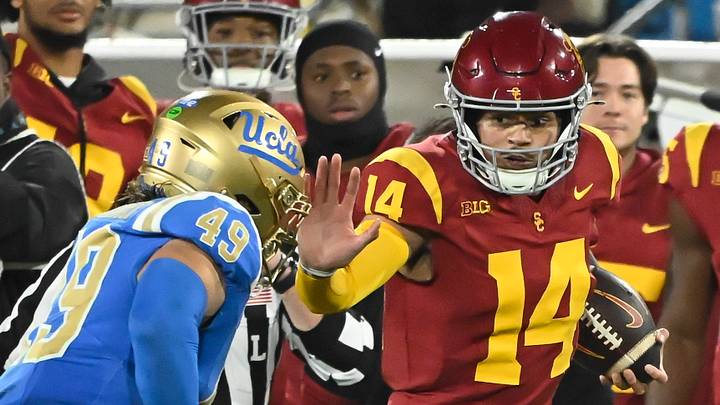
The last three days have not been banner days for college football in Los Angeles.
On Saturday, USC opened its season with a 42–26 win over San José State at the Memorial Coliseum—but the win came in front of a widely remarked upon fractional crowd in sweltering heat. On Monday, UCLA dismissed athletic director Martin Jarmond—and cited financial challenges in doing so.
From a pure cultural cache standpoint, this era is far removed from college football in Los Angeles’s glorious past. Remember when the Trojans were getting screen time in The Godfather Part II and Die Hard and The Sopranos and their band was playing on Tusk? USC’s current players don’t and neither, in all likelihood, do many of their parents.
Armchair athletic directors have proposed a number of causes for the Trojans and Bruins’ stasis. Among them: that Los Angeles is too socially liberal (doesn’t explain Michigan and Washington’s strong support), that the two teams don’t win enough (true, but USC is four years removed from an 11-win season), that there’s too much to do in Los Angeles (a little warmer, but still off target), that Los Angeles just doesn’t love football.
The problem is not that Los Angeles doesn’t love football. The problem is the options available to those in that city who do.
The killers of USC and UCLA football’s joint aura have names: the Los Angeles Rams and the Los Angeles Chargers
The 2015 season was the last football fall in Los Angeles before the return of the NFL, and it was a pretty poor one for Trojans and Bruins teams that both entered the season with high expectations. USC, which opened No. 8, finished 8-6. UCLA, which started No. 13, went 8–5 and also finished unranked.
And yet! The Trojans drew 75,358 home fans per game in 2015—a noticeably higher total than the 67,783 they drew 10 years later. The Bruins drew 66,858—a universe apart from their 37,282 clip last season—and they reeled in that total without hosting any team currently in the Big Ten or SEC.
In 2016, the Rams returned from St. Louis, ending a two-decade period in which the NFL did not field a Los Angeles-based team. Immediately—immediately!—USC’s attendance fell to 68,459 (the Rams also played in the Memorial Coliseum at the time), while UCLA’s increased slightly to 67,459.
MORE: Forde-Yard Dash—Gauging College Football’s 10 Biggest 2026 Pressure Points
Looking back, it’s clear that this wasn’t a case of the Rams simply plucking fans out of the Coliseum or Rose Bowl stands and converting them. What happened was probably subtler: the NFL franchise weaned casual fans of capital-F Football off the college game, banking on the (correct) notion they had the best football product in Los Angeles. The Trojans and Bruins do not seem to have responded quickly enough to this process of habit formation.
The next year, the Chargers followed from San Diego—that a sizable chunk of their disillusioned fanbase abandoned them didn’t matter; all that mattered was they were available to eat area football fans’ money. The year after that (2018), the Rams won the NFC title. Soon, if you were a celebrity wanting to see and be seen, chances are you were doing that at the Rams’ shiny new home, SoFi Stadium.
If the NFL’s arrival was poison to USC, the opening of SoFi Stadium was an arrow to UCLA’s heart. The school’s Westwood campus is about 13 miles from the stadium by car, where the Rose Bowl is about 27—a world of difference in an automotive city. Picture yourself as an affluent UCLA student looking for a fun weekend activity—which venue are you going to choose?
Precedent for Los Angeles: what happened in New York
In New York, college football used to be big business. Columbia, Fordham, Manhattan, NYU—the Big Apple was absolutely lousy with teams that could draw crowds of all sizes in the early 20th century. That’s to say nothing of Army (with its strong regional following) and Notre Dame (with its strong ethnoreligious following), whose battles in the city were front-page news.
However, World War II came, and its aftermath brought two economic developments that relegated college football to New York’s sports margins: the rise of the car (which coaxed the Dodgers and Giants across the country, dooming two historic college football venues in Ebbets Field and the Polo Grounds), and the rise of television (which favored pro football’s regimented schedule). The Giants advanced in wisdom and age and favor, the Jets joined them in winning New York’s loyalties, and after the 1981 season, Columbia and the Ivy League bowed out of Division I-A altogether.
The Trojans and Bruins dropping down to FCS: not likely! Los Angeles remains full of college football talent and passion. However, as long as the Rams and Chargers stick around, the two teams will have competition. The mandate is clear: win in the attention economy capital of the world, or face the consequences of a downsized future.
PODCAST: Listen to SI’s college sports podcast, Others Receiving Votes, hosted by Pat Forde, below or on Apple and Spotify. Watch the show on SI’s college YouTube channel or on SI TV.
 Add us as a preferred source on Google
Patrick Andres is a staff writer on the Breaking and Trending News team at Sports Illustrated. He joined SI in December 2022, having worked for The Blade, Athlon Sports, Fear the Sword and Diamond Digest. Andres has covered everything from zero-attendance Big Ten basketball to a seven-overtime college football game. He is a graduate of Northwestern University's Medill School of Journalism with a double major in history .
Follow PAndres2001