%20%20--%3E%0A%3Csvg%20version%3D%221.1%22%20id%3D%22Layer_1%22%20xmlns%3D%22http%3A%2F%2Fwww.w3.org%2F2000%2Fsvg%22%20xmlns%3Axlink%3D%22http%3A%2F%2Fwww.w3.org%2F1999%2Fxlink%22%20x%3D%220px%22%20y%3D%220px%22%0A%09%20width%3D%2239px%22%20height%3D%2240px%22%20viewBox%3D%220%200%2039%2040%22%20enable-background%3D%22new%200%200%2039%2040%22%20xml%3Aspace%3D%22preserve%22%3E%0A%3Cpath%20fill%3D%22%23FFFFFF%22%20d%3D%22M38.5%2C7H28.2v26h10.3V7z%22%2F%3E%0A%3Cpath%20fill-rule%3D%22evenodd%22%20clip-rule%3D%22evenodd%22%20fill%3D%22%23FFFFFF%22%20d%3D%22M26.1%2C25.5c0%2C5.8-4.1%2C7.5-12.9%2C7.5C3.9%2C33%2C0%2C31.2%2C0%2C25.2v-1.1h11.6%0A%09v2.4c0%2C0.7%2C0.1%2C1.4%2C1.2%2C1.4c1%2C0%2C1.2-0.4%2C1.2-1.3v-0.9c0-1.6-0.9-1.6-3.5-2.2C2.2%2C21.7%2C0%2C19.7%2C0%2C15.3v-0.9C0%2C9.3%2C5.5%2C7%2C12.9%2C7%0A%09c10.2%2C0%2C12.8%2C2.6%2C12.8%2C7.4v1.8h-11v-2.9c0-0.6-0.4-1.1-1.2-1.1c-0.6%2C0-1.2%2C0.4-1.2%2C1.1v0.9c0%2C1.5%2C0.9%2C2%2C3.3%2C2.5%0A%09c8%2C1.6%2C10.5%2C3.3%2C10.5%2C7.5V25.5z%22%2F%3E%0A%3C%2Fsvg%3E%0A)
Four Reasons Why This Is a Pivotal Year for ESPN’s College Football Coverage
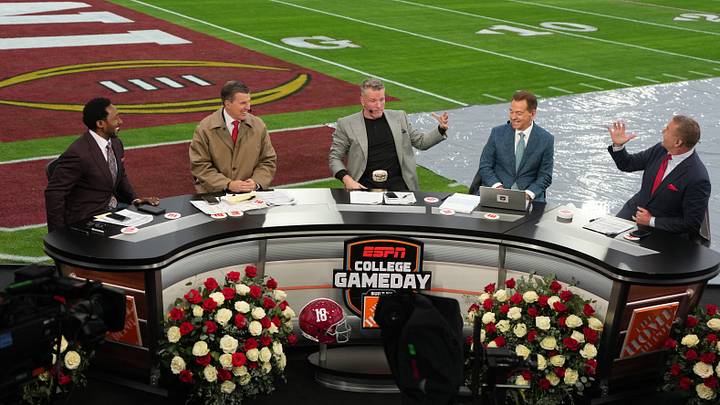
If you watched College GameDay Saturday, you were treated to a special sight: two figures of widespread hate commiserating about how they are hated.
“Between you and I, we’re about the two most hated people there are,” LSU coach Lane Kiffin told GameDay panelist Pat McAfee. “You told me just focus on it, don’t worry about the noise. A lot of times, to do great things, you’re going to be hated.”
This is what passes for analysis nowadays on what once was one of the most formidable sports television programs in the United States, and what remains a powerful driver (and occasional outright antagonist) of sport-wide public opinion.
Unintentionally, Kiffin and McAfee’s discussion spelled out an under-the-radar reality for ESPN: this is an important year for its college football coverage. The network has dominated how Americans perceive the game for decades, and will continue to do so in the immediate future. However, it is possible now to envision a time further down the road where that’s not the case.
Here's a look at four issues facing college football on ESPN as it leaves the first week of 2026 behind.
1. The network’s CFP monopoly could break soon—bringing other networks into the fray
In the late 2010s, Fox invested heavily in college football and made serious gains in the sport’s pecking order—but the network never felt like a true threat to ESPN because of its lack of CFP inventory (a reversal of the 2000s, when Fox had the BCS but relatively little regular-season inventory).
Could that change? A 24-team CFP appears closer than ever, and it feels unlikely that such a system would stay entirely on ESPN and TNT’s airwaves (at least not without burying games on ESPN2). Should the CFP eventually broker a new TV deal, any number of networks could join the fray. Fox has infrastructure galore. CBS debuted a strong new No. 1 team in Brad Nessler and Charles Davis Saturday, and NBC’s ringside view of the Western Michigan-Michigan fiasco was the TV moment of the weekend. What if a streamer like Amazon or Netflix wants in?
The point: if ESPN wants to maintain its college football primacy, it has to prove itself worthy of it—because the CFP, conferences not affiliated with ESPN, and viewers eager for different voices have all the incentive in the world to break it down.
2. Public opinion of McAfee remains, generously speaking, shaky—and his mode of coverage has a new counterweight
The pros of McAfee, unchanged for the last decade: he’s irreverent. He’s opinionated. He’s a populist. In small doses, he can be wittier than given credit for. And now the cons, which seem to grow more sinister every year: he seems to harbor a genuine anti-intellectual streak. He repeated a juvenile college rumor on ESPN’s airwaves, and narrowly avoided defamation litigation from a student in the process. His presence has, to a degree, captured ESPN whole.
When it comes to television—an invention less than a century old—no one lives forever, and timing is everything. McAfee has been in the lives of most sports fans for an eternity by the standards of the medium, having ridden to the stratosphere the late-2010s Barstool wave that nuked sports’s technocratic blog era. On TV, the cultural sea changes that make you can break you—take the example of Chris Hansen, a buttoned-up NBC darling 20 years ago now weeks away from being portrayed on the silver screen as an unhinged sociopath.
The challenge for ESPN is twofold: can McAfee remain relevant while avoiding overexposure on College GameDay and elsewhere? And can he strike that balance while justifying what is thought to be one of the highest salaries in sports media history?
3. ESPN’s college coverage could serve as a testing ground for NFL innovations with the Super Bowl and a new rights cycle looming
What do media executives and the worst fans you know have in common? They both view college football as but a stepping stone to the professional ranks.
If you’ve watched any ESPN in the last six months, you’ve seen the network eagerly touting the fact that, for the first time in history, it will air the Super Bowl. It has been generations since anything in college football has approached the NFL championship in profile, so you can forgive the network’s suits for looking ahead to February.
However: the college game’s lower profile could make it fertile ground for experimentation ahead of a have-to-have-it broadcast. An example: ESPN’s much-discussed elimination of the ticker during college football games. While a ticker is rarely seen on ESPN’s NFL broadcasts, the lessons of a cleaner presentation can easily be applied to that sport. ...
...and not just for the Super Bowl. The clock is ticking on the NFL’s entire media-rights apparatus, and it seems almost certain that ESPN will be a player at the end of this decade. Can the network keep up with the Joneses on Sundays, presentation-wise? It can start by blowing the competition out of the water on Saturdays.
4. Josh Pate feels like a bet on the future
In August, ESPN gave Pate (in conjunction with ex-Titans Will Compton and Taylor Lewan, of Bussin’ With the Boys fame) a regular gig on its airwaves. That was significant for three reasons. The first two are related to McAfee: Pate represents both a break with and an embrace of the ex-Colts kicker’s way of doing business. The break: Pate’s approach is more cerebral than McAfee’s. The embrace: he operates firmly in McAfee’s little-c conservative milieu, having interviewed President Donald Trump on his show in July.
The third has to do with ESPN’s full-throated embrace of Nashville, where Pate’s show moved in 2024. Everything is coming up Milhouse for the Music City: country music is booming, Tennessee is building a new stadium, Vanderbilt is better at all three major sports, and an MLB team could be coming down the pike. It’s a good place for the network to have a foothold, and it’s a good place for Pate to have a foothold, because it certainly feels like he’s being groomed as Paul Finebaum’s successor.
Finebaum is 71 and has flirted with leaving his longtime ESPN home in the recent past, kicking around a Senate run in 2025. When he eventually steps away, the college football media job of “authoritative Southern populist who knows his stuff—and isn’t afraid to stick his neck out” will be wide open.
Pate can irk, but there is genuine inspiration to be found in his rise from a warehouse job to ESPN without resorting to cheap shtick. The question is whether he can wear a new level of mainstream fame as well as Finebaum did in the 2010s while maintaining his apparent aversion to strong stances. If he can square those propositions, his star bears watching.
 Add us as a preferred source on Google
Patrick Andres is a staff writer on the Breaking and Trending News team at Sports Illustrated. He joined SI in December 2022, having worked for The Blade, Athlon Sports, Fear the Sword and Diamond Digest. Andres has covered everything from zero-attendance Big Ten basketball to a seven-overtime college football game. He is a graduate of Northwestern University's Medill School of Journalism with a double major in history .
Follow PAndres2001