%20%20--%3E%0A%3Csvg%20version%3D%221.1%22%20id%3D%22Layer_1%22%20xmlns%3D%22http%3A%2F%2Fwww.w3.org%2F2000%2Fsvg%22%20xmlns%3Axlink%3D%22http%3A%2F%2Fwww.w3.org%2F1999%2Fxlink%22%20x%3D%220px%22%20y%3D%220px%22%0A%09%20width%3D%2239px%22%20height%3D%2240px%22%20viewBox%3D%220%200%2039%2040%22%20enable-background%3D%22new%200%200%2039%2040%22%20xml%3Aspace%3D%22preserve%22%3E%0A%3Cpath%20fill%3D%22%23FFFFFF%22%20d%3D%22M38.5%2C7H28.2v26h10.3V7z%22%2F%3E%0A%3Cpath%20fill-rule%3D%22evenodd%22%20clip-rule%3D%22evenodd%22%20fill%3D%22%23FFFFFF%22%20d%3D%22M26.1%2C25.5c0%2C5.8-4.1%2C7.5-12.9%2C7.5C3.9%2C33%2C0%2C31.2%2C0%2C25.2v-1.1h11.6%0A%09v2.4c0%2C0.7%2C0.1%2C1.4%2C1.2%2C1.4c1%2C0%2C1.2-0.4%2C1.2-1.3v-0.9c0-1.6-0.9-1.6-3.5-2.2C2.2%2C21.7%2C0%2C19.7%2C0%2C15.3v-0.9C0%2C9.3%2C5.5%2C7%2C12.9%2C7%0A%09c10.2%2C0%2C12.8%2C2.6%2C12.8%2C7.4v1.8h-11v-2.9c0-0.6-0.4-1.1-1.2-1.1c-0.6%2C0-1.2%2C0.4-1.2%2C1.1v0.9c0%2C1.5%2C0.9%2C2%2C3.3%2C2.5%0A%09c8%2C1.6%2C10.5%2C3.3%2C10.5%2C7.5V25.5z%22%2F%3E%0A%3C%2Fsvg%3E%0A)
11 Burning Questions Following the PGA Tour’s Big Reveal
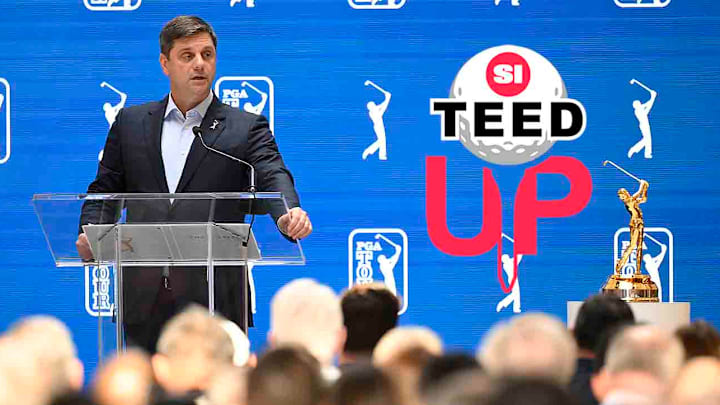
PONTE VEDRA BEACH, Fla. — The new CEO of the PGA Tour, Brian Rolapp, generally received high praise for his remarks last week during a news conference at PGA Tour headquarters. He outlined six areas of emphasis for the future of the PGA Tour, took questions for more than 35 minutes and was straightforward when he didn’t have an answer.
Still, there’s a lot remaining to decipher.
The process of overhauling the PGA Tour in a for-profit world is likely proving to be more complicated than he anticipated. He can’t just will decisions into existence, given the boards of PGA Tour Inc. and PGA Tour Enterprises being comprised of more players than executives.
Good luck getting a group of players to agree on future business dealings along with competitive considerations that are the core of their existence.
This was never going to be easy.
And yet, Rolapp promised answers by June, following the board meeting at the Travelers Championship. That sounds like a line in the sand, meaning “we need to have some answers by then.” And, quite likely, he’ll need a plan for the 2027 schedule to be completed, even if it doesn’t encompass the enormity of what Rolapp and the Future Competition Committee are hoping to accomplish.
There are many questions that remain. Here are my top 11:
11 Burning questions regarding the PGA Tour’s future
1. What about FedEx?
The shipping company that has been the sponsor of the PGA Tour’s playoff race and bonus structure since its inception in 2007 was never mentioned. Perhaps it was an oversight, but it seems odd that Rolapp would not say anything about the Tour’s biggest sponsor, one that pumps $100 million or more a year into a bonus pool. The deal runs through 2027 and it’s likely the Tour would want to renew.
2. What has been decided?
Well, nothing really. There is clearly a plan going forward, but Rolapp essentially said on more than one occasion, “No decisions have been made.” Still, Rolapp said the Future Competition Committee’s “focus has been on the competitive model build on meritocracy. This is not a closed shop. We are aiming to go create a more cohesive schedule with a simpler point system, one where the best players compete against one another more frequently.”
3. How will signature events work?
There appears to be significant changes ahead. The limited-field, no-cut events that evolved as a payoff for the stars in the aftermath of LIV Golf seem headed for the 120-player range with cuts. And Rolapp said he’d like to see the current eight events “at least double that number.” So that’s the potential to go from eight 72-player fields to 16 120-player fields or approximately some 45 to 50 more playing opportunities for 16 tournaments outside of the majors, the Players and the playoff events.
That should be welcome news to the large group of players who are currently not eligible for signature events.
4. What is the second track of events?
Rolapp referred to the majors, the Players, the signature events and the playoff events as the “first track.” The second track didn’t get much explanation and it’s unclear how those events would be staged. In a roughly 32-week span from late January to late August, the first-track events would potentially take up 24 weeks (or more). That leaves eight other weeks for a second tier. There are also eight weeks this year in the fall. Would those 16 weeks become a path for players to earn their way into first-track events? Rolapp said those 21 to 26 first-tier events would not be staged every week.
5. What will relegation and promotion entail?
This one is likely a subject of considerable internal discussion. “They will be tied together in a competitive system that is much easier to understand, standings that are much easier to understand, the terms of promotion and relegation between the two tiers is easy to understand,” Rolapp said.
6. How will the playoffs be different?
Rolapp did not refer to them as FedEx Cup playoffs and he didn’t say how they will work. He did say he’d like to see three events, as is the case now, but “I don’t think the number of players has been decided.” Today the top 70 qualify for the playoffs, with 50 getting to the second event and 30 to the Tour Championship.
7. What about the ‘strategic alliance’ with the DP World Tour?
The Guardian reported last week that the PGA Tour is not happy with the amount of money it gives to the DP World Tour to prop up purses annually. The agreement can be reassessed next year and Rolapp said “we would like to extend that” and added that a proposal has been made. Does that proposal satisfy the DP World Tour? There has long been speculation that the DP World Tour would be open to offers from the Public Investment Fund of Saudi Arabia, which backs LIV Golf. That will be something to watch.
8. What about LIV Golf?
Rolapp has been dismissive. He’s said his goal is to make the PGA Tour the best it can be, and it appears there have been no serious talks about reunification. When asked about LIV players being invited to future Players Championships—from which they are now barred—Rolapp said: “That’s not something I’ve sort of considered to date. There’s other priorities other than that.”
9. How will the SSG investment be spent?
It’s been more than two years since Strategic Sports Group was formed and invested some $1.5 billion into PGA Tour Enterprises. Little has been said about how the investment will be used. “I think one of those ideas that you’ll see is in service of this change in competitive model,” Rolapp said. “We do need to invest in better events and bigger markets. Where do we need to invest to get courses to where we need them to get ... I think there’s a lot of uses for the capital to effectuate the long-term value of the PGA Tour.”
It sounds like the money would not go into purses, but if you’re doubling the number of signature events, where do the funds come from?
10. Is SSG looking to cut costs?
Rolapp wasn’t asked this question but made a point to say that he thinks there is a “misconception” about SSG and private equity and “people who want to cut costs and get out of their investment in five years. While that might be some people in private equity, I can tell you for sure, that is not our investors.”
While the SSG investors, including John Henry, Arthur Blank and Steve Cohen, might have a long-term vision, as Rolapp said, it’s also true there have been significant cutbacks. The Tour has undergone a few under-the-radar rounds of layoffs and early retirement buyouts. If the goal is to make money, one way is to cut expenses.
11. Did Rolapp hint at collecting fees from the majors, or the Ryder Cup?
In a question about his view on the PGA Tour not owning any of the five biggest properties in golf (including the majors and the Ryder Cup), Rolapp answered by saying he thinks it would “be a benefit for the entire golfing ecosystem to work closer together commercially.” The PGA Tour owns the media rights to its players, which is why it requires releases for conflicting events or gets paid for specialty events.
Rolapp added: “If you look at all those golf organizations, at the end of the day, they are entirely financed by professional golf and professional golfers. The entire ecosystem is funded by the success ... or quite frankly it wouldn’t successful without the success of professional golf. That to me just lends that there should probably be more collaboration in that regard.”
It’s an interesting take. Certainly it’s possible to believe that collectively all of them might do better if they sell their media rights product together. But it’s quite possible the Tour sees its labor—player media rights—being used without any financial benefit to the Tour.
A tough (but lucrative) LIV Golf defeat
Bryson DeChambeau was the winner in a playoff at the LIV Golf Singapore event on Sunday, but even he felt bad for Richard T. Lee, the playoff loser who missed a 2-foot putt on the first hole of a sudden death playoff to hand the title to the two-time major winner.
Lee is a veteran pro from Canada who has played all over the world and made his way onto the LIV Golf League this year by winning LIV’s Promotions event in Florida. He was bidding to become the first wildcard player to win an event. He still ended with the highest finish.
“I think the adrenaline was pumping, but I feel like I had it this week and I played really well,” Lee said. “Hopefully next week I can try again.”

Lee and the rest of the LIV Golf League head to South Africa for the first LIV event in that country. And he will go there with the knowledge that the $2.25 million he earned for finishing second nearly matched his career earnings. In 15 years playing mostly in Asia, where he had three victories, Lee earned approximately $2.5 million. This year he has surpassed $3 million in four LIV events.
Perhaps just as important, Lee is in seventh place in the overall individual standings, which all but assures that he is going to keep his spot at LIV Golf next year. The top 34 are assured of a place in 2027.
This week’s event is LIV’s last tournament prior to the Masters, which makes it difficult for anyone new to move into the top 50 in the Official World Golf Ranking.
But the top points-earner through May 18 not otherwise exempt earns a U.S. Open spot. (Last year it’s how Joaquin Niemann earned a tee time in the U.S. Open.) Following Jon Rahm and DeChambeau, who are both exempt, Elvis Smylie currently holds down the third spot, with Anthony Kim, Thomas Detry and Thomas Pieters right behind. LIV has events in South Africa, Mexico City and Virginia before the deadline.
Unruly fans pipe up again at Sawgrass
It wasn’t anywhere near as bad as it was at the Ryder Cup—how could it be?—but some of the partisan cheering that plagued the event at Bethpage was back at the Players Championship, although in a more toned-down way.
With European Ryder Cup players Ludvig Aberg and Matt Fitzpatrick in the final two groups with American competitors, the situation lent itself to that sort of situation, even though the country of origin had no effect on the outcome of the tournament.
But Sawgrass is a place that made it hard on Sergio Garcia over the years, so it’s probably no surprise it happened again. Rory McIlroy heard some catcalls at times, too.
“Listen, the crowd, that was literally child's play compared to Bethpage,” said Fitzpatrick, an Englishman who was the subject of considerable taunting at the Ryder Cup. If they think that that was anything, then they need to reassess. Get yourself up to New York.
“That's how it is. I would hope it's the exact same if—well, it probably wouldn't be because we're a little bit more polite in Europe, I would say—but I would hope it would be of similar intensity in Europe [next year in Ireland].
“I knew it was coming. I had it with Jordan Spieth in 2023 [here]. Yeah, it's funny to me. I find it hilarious.”
More Golf from Sports Illustrated
 Add us as a preferred source on Google
Bob Harig was a senior writer covering golf for Sports Illustrated. He has more than 25 years experience on the beat, including 15 at ESPN. Harig is a regular guest on Sirius XM PGA Tour Radio and has written two books, “DRIVE: The Lasting Legacy of Tiger Woods” and “Tiger and Phil: Golf’s Most Fascinating Rivalry.” He graduated from Indiana University where he earned an Evans Scholarship, named in honor of the great amateur golfer Charles (Chick) Evans Jr. Harig, a former president of the Golf Writers Association of America, lives in Clearwater, Fla.
Follow bobharig