%20%20--%3E%0A%3Csvg%20version%3D%221.1%22%20id%3D%22Layer_1%22%20xmlns%3D%22http%3A%2F%2Fwww.w3.org%2F2000%2Fsvg%22%20xmlns%3Axlink%3D%22http%3A%2F%2Fwww.w3.org%2F1999%2Fxlink%22%20x%3D%220px%22%20y%3D%220px%22%0A%09%20width%3D%2239px%22%20height%3D%2240px%22%20viewBox%3D%220%200%2039%2040%22%20enable-background%3D%22new%200%200%2039%2040%22%20xml%3Aspace%3D%22preserve%22%3E%0A%3Cpath%20fill%3D%22%23FFFFFF%22%20d%3D%22M38.5%2C7H28.2v26h10.3V7z%22%2F%3E%0A%3Cpath%20fill-rule%3D%22evenodd%22%20clip-rule%3D%22evenodd%22%20fill%3D%22%23FFFFFF%22%20d%3D%22M26.1%2C25.5c0%2C5.8-4.1%2C7.5-12.9%2C7.5C3.9%2C33%2C0%2C31.2%2C0%2C25.2v-1.1h11.6%0A%09v2.4c0%2C0.7%2C0.1%2C1.4%2C1.2%2C1.4c1%2C0%2C1.2-0.4%2C1.2-1.3v-0.9c0-1.6-0.9-1.6-3.5-2.2C2.2%2C21.7%2C0%2C19.7%2C0%2C15.3v-0.9C0%2C9.3%2C5.5%2C7%2C12.9%2C7%0A%09c10.2%2C0%2C12.8%2C2.6%2C12.8%2C7.4v1.8h-11v-2.9c0-0.6-0.4-1.1-1.2-1.1c-0.6%2C0-1.2%2C0.4-1.2%2C1.1v0.9c0%2C1.5%2C0.9%2C2%2C3.3%2C2.5%0A%09c8%2C1.6%2C10.5%2C3.3%2C10.5%2C7.5V25.5z%22%2F%3E%0A%3C%2Fsvg%3E%0A)
6 Burning Questions As LIV Golf Fights to Survive
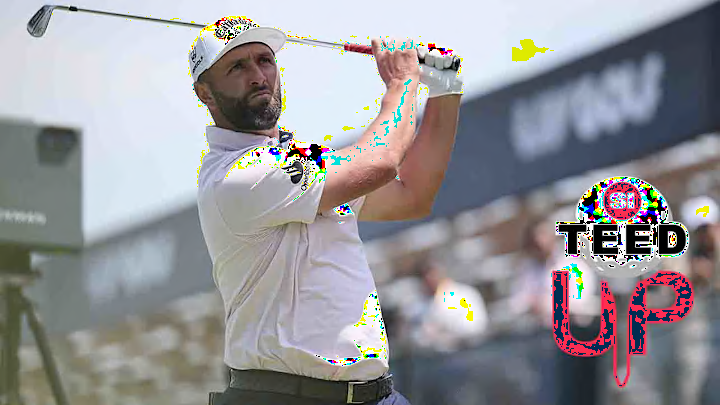
Following several weeks of negativity surrounding its future, the LIV Golf League gets back between the ropes this week with its LIV Golf Virginia event outside of Washington, D.C.
In recent days, LIV Golf postponed/canceled its late June Louisiana event, confirmed that the Saudi Arabia sovereign wealth fund would no longer be backing it beyond this year and set up an independent board of directors to tackle the challenge of getting new funding.
All of it leads to what should be an interesting week at Trump National D.C., where the league will attempt to return to some sense of normalcy during a period that has been anything but normal.
With that in mind, here are several pertinent questions as LIV Golf attempts to play on.
1. Are the Saudis really done with LIV?
Three weeks ago at the LIV Golf Mexico City event, amid the first reports that the Public Investment Fund of Saudi Arabia would be pulling its funding, Sergio Garcia said: “That is not what Yasir told us at the beginning of the year, that he is behind us, that they have a project of many years.”
Things obviously changed. Yasir Al-Rumayyan, the governor of the PIF, stepped down from his role on the LIV board last week as the PIF announced that it was moving on from LIV. Although the Iran war has been cited as one of the reasons for a Saudi pullback, the PIF had announced on March 1—a day after the war began—that it would shift to a more local focus in its investments. That could not have been a knee-jerk decision. While it didn’t mention LIV Golf, it did lead to conjecture.
Scott O’Neil, LIV’s CEO, was at the Masters last month and bullish on LIV’s future, saying the PIF investment was several years into the future—all of which suggests the news of the last few weeks blindsided the LIV staff and players.
While the PIF appears done with LIV, it is unclear if it will continue support in any way through various sponsorship deals with PIF-oriented companies such as Aramco and Riyadh Air. And if player contracts go beyond this year, is the PIF responsible?
2. Can LIV survive without Saudi funding?
It won’t be easy and that is in part due to the fact that this decision came so abruptly. O’Neil was put in charge in early 2025 to take LIV Golf on a direction of sustainability after Greg Norman helped woo players and get the league off the ground. O’Neil undoubtedly believed he had more time. And to his credit, he has brought on more sponsorship such as Rolex and HSBC and Under Armour and several others. The league claims revenue is $100 million more than it was a year ago and boasts about big support in places like Australia and South Africa.

But how much of LIV’s sponsorship income was tied to Saudi companies? And how do you begin to bridge the enormous gap that exists with events that are spending in the neighborhood of $40 million to $50 million a tournament (each purse is $30 million) without a hefty television media rights contract and more sponsorship? The challenge will be immense.
3. Can LIV continuing without Saudi involvement be a good thing?
This is likely far outweighed by the funding issue, which is the reason LIV Golf got into its fifth year. But it’s fair to point out that the stigma of being associated with the Saudi Arabia regime and its poor human rights record—among many things—has undoubtedly thwarted LIV Golf. There are unquestionably companies that simply did not want to be affiliated with LIV because of that. Some, too, did not want to be involved for fear of repercussions from the PGA Tour. Whether companies want to associate with LIV minus that baggage remains to be seen, but O’Neil will have some freedom he didn’t possess before and it’s possible that creates some pathways.
4. What about the rest of this year?
Three weeks ago O’Neil said the league would continue on “without interruption” but since then it has already dropped the New Orleans event, a decision made more by Louisiana government officials who weren’t keen on pouring money into a tournament to see it disappear after a year. Could others follow? LIV likely wants to maintain some normalcy but it might be wise to bail on another event or two if that is contractually possible. While players might have a contractual grievance over purses lost, LIV might be wise to cut its losses and direct its efforts toward successful tournaments in the future. That said, where would it bail? South Korea, Spain and the U.K. have been solid events. And its season-ending U.S. swing includes its team championship.
5. Will LIV overhaul its format?

It should, but don’t expect a change to the team concept. From the beginning, the business model has included selling teams as franchises and LIV leaned into that idea last week in announcing its board restructuring. But there could be other changes. A reduction in the schedule from 14 events would seem inevitable. So, too, a decrease in purses. You might see many of the bells and whistles associated with LIV events—skydivers, concerts, pre-event parties—scaled back. LIV’s excess has been one of its hallmarks to this point. That needs to shift to thriftiness. Does LIV lean into its association with the Asian Tour? Look to have clearer pathways and qualification which might help it attract players? All to be determined.
6. What happens to the LIV players?
Amid reports that several are exploring their options as it relates to returning to the PGA Tour or DP World Tour, it doesn’t seem likely that much will happen for the rest of this year as long as LIV is playing its schedule. Other than the biggest names, most of the players will have no status on either circuit. It makes no sense to walk away from guaranteed money, assuming it will all remain as-is for the rest of the year. And even if money is reduced or tournaments are cut, it is still better than the alternative, which is a good bit of unknown. But once the season ends in August? That is, perhaps, when the real drama begins.
The PGA Tour Sees a Tepid Return to Doral
For all the talk about the PGA Tour returning to one of its all-time iconic venues after a 10-year absence, the revived Cadillac Championship was a discernable dud, lacking much buzz.
Cameron Young didn’t help with his wire-to-wire victory but that was but a tiny part of the issue and certainly not fault of his. Nobody showing up for the first few rounds knew how it would play out and that would be unlikely to impact a decision whether to attend on the weekend.
But it’s clear the Tour rushed its return to Doral as early May is probably not the best time for the event and there really should not have been the urgency to get on the schedule this year when a better date could have been secured for 2027.
It is certainly fair to wonder if the Tour was desperate to appease President Trump, who was so critical when the PGA Tour left—because its then title-sponsor Cadillac did not renew—following the 2016 event won by Adam Scott.
Doral hosted a LIV Golf event four consecutive years through 2025 and Trump’s courses will do so again this week in Virginia and later this year in New Jersey.
Some of the poor fan issues could be attributed to the rushed nature of the tournament. Organizers had approximately six months to get the event off the ground when typically tournaments are a year-round operation. The Tour announced it last fall before even signing Cadillac, which suggests it wanted a tournament there. It was also quick to make a signature event, when doing so meant back-to-back $20 million tournaments (this week’s Truist Championship is also a signature event) prior to the PGA Championship next week.

That was never a good idea and Doral paid for it with five players—the most of any signature event to date—missing from last year’s top 50 automatic qualifiers off the FedEx Cup points list.
Masters champion Rory McIlroy skipped Doral and Scottie Scheffler will skip this week’s Truist, meaning neither of the top two players in the world competed in the same signature events over a month-long period.
That, of course, would have been obvious when the schedule was announced.
Going forward, it would make sense to schedule Doral in its traditional March time slot when a slew of snowbirds are in South Florida and the heat is nowhere near as intense.
That will lead to other issues as Florida already has four events in March, including the Arnold Palmer Invitational and the Players Championship.
A Ryder Cup Plan
A little more than a week after being named the 2027 U.S. Ryder Cup captain, Jim Furyk named Stewart Cink and Justin Leonard as his first two assistants for next year’s match at Adare Manor.
The fact that he did so while attending the Kentucky Derby was a bit odd—some corporate and television synergy at work—but the appointments make sense and make you wonder why they weren’t part of the 2025 team. And if they’ll be part of this year’s Presidents Cup team captained by Brandt Snedeker.
Jim Furyk, Stewart Cink and Justin Leonard will lead the United States in the 2027 Ryder Cup! 🏆 pic.twitter.com/ttFF8AJYAc
— NBC Sports (@NBCSports) May 2, 2026
If Furyk brings continuity after a previous stint as captain and a Presidents Cup captain, then it makes sense that he’d bring along guys as assistants who have also been there and could possibly be involved in the future.
Both Cink and Leonard were thought to possibly be in consideration this time—both served as assistants under Furyk at the 2024 Presidents Cup. Cink, who played on five U.S. Presidents Cup teams and assisted in 2023 for Zach Johnson, was also interested in the captaincy when Tiger Woods turned it down in 2024.
Leonard has not been part of a Ryder Cup since he played on the 2008 U.S. team but has been viewed as one of those possible captains who has been overlooked. His assistant captaincy at the 2024 Presidents Cup might have been a sign that he’s got a shot at it.
“Those guys are certainly guys that they’re going to look at in the future and they’re great guys,” said the 2025 captain, Keegan Bradley, who was part of the Ryder Cup committee that selected his successor. “Justin Leonard, I told him this probably more times than he wants to hear, but, like, his putt at Brookline, it changed my life. I was obsessed with golf, but, like, that ... I was there. And that really altered the course of my life. He hit the most famous shot in Ryder Cup history for the United States. I think they’ll all be great captains.”
Bradley acknowledged he’s not likely to have a say in that future decision but his admiration for Leonard—who holed a long birdie putt at the 1999 Ryder Cup at Brookline—makes curious his decision to not anoint him an assistant last year at Bethpage.
Perhaps one of those former Ryder Cup players could be the next Presidents Cup captain in 2028. And it will be interesting to see who Snedeker appoints, if Furyk is part of assistant lineup later this year at Medinah and if the U.S. side gets back to trying to groom future captains.
More Golf from Sports Illustrated
 Add us as a preferred source on Google
Bob Harig was a senior writer covering golf for Sports Illustrated. He has more than 25 years experience on the beat, including 15 at ESPN. Harig is a regular guest on Sirius XM PGA Tour Radio and has written two books, “DRIVE: The Lasting Legacy of Tiger Woods” and “Tiger and Phil: Golf’s Most Fascinating Rivalry.” He graduated from Indiana University where he earned an Evans Scholarship, named in honor of the great amateur golfer Charles (Chick) Evans Jr. Harig, a former president of the Golf Writers Association of America, lives in Clearwater, Fla.
Follow bobharig