%20%20--%3E%0A%3Csvg%20version%3D%221.1%22%20id%3D%22Layer_1%22%20xmlns%3D%22http%3A%2F%2Fwww.w3.org%2F2000%2Fsvg%22%20xmlns%3Axlink%3D%22http%3A%2F%2Fwww.w3.org%2F1999%2Fxlink%22%20x%3D%220px%22%20y%3D%220px%22%0A%09%20width%3D%2239px%22%20height%3D%2240px%22%20viewBox%3D%220%200%2039%2040%22%20enable-background%3D%22new%200%200%2039%2040%22%20xml%3Aspace%3D%22preserve%22%3E%0A%3Cpath%20fill%3D%22%23FFFFFF%22%20d%3D%22M38.5%2C7H28.2v26h10.3V7z%22%2F%3E%0A%3Cpath%20fill-rule%3D%22evenodd%22%20clip-rule%3D%22evenodd%22%20fill%3D%22%23FFFFFF%22%20d%3D%22M26.1%2C25.5c0%2C5.8-4.1%2C7.5-12.9%2C7.5C3.9%2C33%2C0%2C31.2%2C0%2C25.2v-1.1h11.6%0A%09v2.4c0%2C0.7%2C0.1%2C1.4%2C1.2%2C1.4c1%2C0%2C1.2-0.4%2C1.2-1.3v-0.9c0-1.6-0.9-1.6-3.5-2.2C2.2%2C21.7%2C0%2C19.7%2C0%2C15.3v-0.9C0%2C9.3%2C5.5%2C7%2C12.9%2C7%0A%09c10.2%2C0%2C12.8%2C2.6%2C12.8%2C7.4v1.8h-11v-2.9c0-0.6-0.4-1.1-1.2-1.1c-0.6%2C0-1.2%2C0.4-1.2%2C1.1v0.9c0%2C1.5%2C0.9%2C2%2C3.3%2C2.5%0A%09c8%2C1.6%2C10.5%2C3.3%2C10.5%2C7.5V25.5z%22%2F%3E%0A%3C%2Fsvg%3E%0A)
The Best New Golf Courses and Renovations of 2025
If your idea of a good time revolves around crisscrossing the country in search of outstanding new golf courses and superb renovations, you’re in luck: fistfuls of such creations opened in 2025.
The best of the best wasn’t quite as top-heavy as in 2024, nor as we anticipate 2026 to be, yet these past 12 months gifted traveling golfers and architecture buffs a plethora of dazzling accomplishments. Familiar design names are prevalent among this year’s honorees: Think Gil Hanse, Coore/Crenshaw, David McLay Kidd and Rees Jones.
Nevertheless, they share top billing with up-and-comers who have absolutely arrived: Bill Bergin, Jay Blasi, Jeff Stein and Brian Ross. Kudos to Kidd, John Fought, Davis Love III and Kyle Franz, whose work is honored twice. For this year, we enlisted architects, PGA professionals, superintendents and other industry insiders to share their insights about the best courses to open in the past 12 months.
So, settle in: here are the top 10 new and newly renovated American courses of 2025—plus seven bonus selections.
2025 Golf Course Awards
- Best New Course (Overall): McLemore Resort (The Keep), Rising Fawn, Georgia
- Best New Private Course: Apogee (North), Hobe Sound, Florida
- Best Classic Private Course Restoration: Baltusrol (Upper), Springfield, New Jersey
- Best New Short Course: Big Cedar Lodge (Cliffhangers), Hollister, Missouri
- Best New Resort Course: Gamble Sands (Scarecrow), Brewster, Washington
- Best New Public Course: Cabot Citrus Farms (Roost), Brooksville, Florida
- Best New Private Resort Course: Watersound (The Third), Lake Powell, Florida
- Best Public Course Renovation: Poppy Ridge, Livermore, California
- Best New Private Course (Most Imaginative Land Use): Windsong Farm (North), Maple Plain, Minnesota
- Best New Private Course (Designed by a future Hall of Fame Architect): Loraloma, Spicewood, Texas
- Best Reimagined Public Course: Great Dunes at Jekyll Island, Jekyll Island, Georgia
- Best New Private Course (Hybrid Division): Broomsedge, Rembert, South Carolina
- Best Reimagined Private Course: The International (Pines), Bolton, Massachusetts
- Best Private Resort Course Renovation: Omni Amelia Island Resort (Oak Marsh), Fernandina Beach, Florida
- Best Resort Course Renovation: Indian Wells Golf Resort (Players), Indian Wells, California
- Best Modern Private Course Restoration: Desert Highlands, Scottsdale, Arizona
- Best PGA Tour Course Restoration: Harbour Town, Hilton Head Island, South Carolina
- More Golf from Sports Illustrated
Best New Course (Overall): McLemore Resort (The Keep), Rising Fawn, Georgia
If it weren’t for a hidden hillside cloaked in thorny briars, our Best New Course of 2025 may never have come to life. Back in 2017, developer Duane Horton, president of Scenic Land Company, changed the name of the property he had just purchased from Canyon Ridge Golf Club to McLemore, but to make room for a new clubhouse, he asked his golf renovation architect Bill Bergin to move the existing 18th hole.
Bergin, who paired with Rees Jones for a makeover of the Canyon Ridge course, descended a steep slope 400 feet to the east of the old finishing hole, a slope full of trees, rocks and nasty briars. Amid the rocks and brambles, Bergin located a shelf for a green site. When he emerged, soaked in sweat and scratched with briars, the plan was hatched for a new 18th hole that quickly became one of golf’s most spectacular closers. Golfers flocked to play what would be known as the Highlands course—and its unique finishing hole.
Bergin acknowledges that without the fanfare and accolades accorded to that one golf hole, it’s unlikely a resort hotel or second golf course would have been built.
That second course, called The Keep, is another collaboration between Bergin and Jones. After months of preview play, it formally opened in October. It’s a wonder in its own right. And it is our Best New Course of 2025.
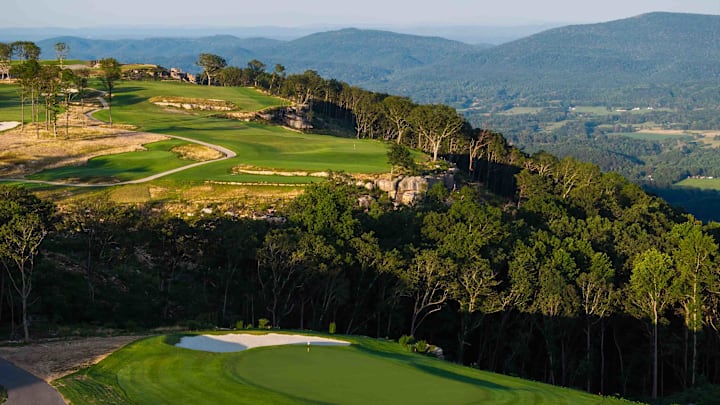
Located in the mountains of northwest Georgia, 45 minutes south of Chattanooga, the mountaintop headlands course measures 7,722 yards from the tips, par 72 and features five cliffside holes overlooking McLemore Cove, an unfathomably deep, attractive, forested valley nestled between Pigeon Mountain and Lookout Mountain. It’s not an ocean, but as natural attractions go, it’s a one-of-a-kind setting.
What’s in a name? Inspired by the majesty of Europe’s imposing castles, the mountaintop course and cliffside views invoke the identity of those historic fortresses. The name honors that idea and establishes The Keep as a powerful but reserved entry into the golf landscape.

Imposing—in an awe-inspiring way—is an apt term for golf at The Keep. “The only thing about The Keep that’s like the Highlands is there are rock outcroppings on both courses,” Bergin told me in 2024. “Otherwise, The Keep lays on basically a mountain plateau, an amphitheater overlooking the valley.”
Bergin described the western Georgia terrain as more like being in Wyoming or Colorado. “It’s big views, it’s rugged, bold, with lots of rock. You have a down view of 1,200 feet to McLemore Cove. The reveals on this course are massive. You can look straight over the edge of the mountain and in all different directions, 180 degrees.”
The Keep rolls out vast fairways, which works well for resort play, as well as to accommodate windy conditions. By clearing 200 acres on the edge of a mountain, wind is usually a factor. However, the fairways narrow as they get closer to a green complex, to keep big hitters on their toes.
Many reviewers agree with Bergin, that the stretch of holes that best showcases the course’s virtues is 8, 9 and 10. “The par-3 8th is huge, 266 yards, but it’s got this Redan green that matches the mountain in the background,” Bergin said. “It’s got a little mystery to it, with a rock outcropping short of the green. Number 9, a 452-yard par 4, is on the edge of the ridgeline. When you look to the putting surface, the back corner is elevated and again it matches the mountains that you see probably 20, 30 miles down the ridgeline. Then you continue along the ridge with a 614-yard, par-5. It was the hole I had to have in the routing. The edge hole has tons of room to the right, but the better angles are actually down the left side.”
Collaborator Rees Jones has seen more than his share of amazing sites and courses in more than six decades of course design. He knows when something is truly special. “The Keep Golf Course is truly unparalleled,” he said. “Its dramatic cliffside setting inspired a one-of-a-kind golfing experience. It’s designed to offer a balance of challenge and playability for everyday golfers while at the same time it is championship ready.”
The Keep at McLemore is private, with several categories of membership, but if you stay at the Cloudland Hotel, a Hilton property, access is granted. McLemore Club’s tagline is “Life Above the Clouds.” Winning our Best New Course of 2025 puts McLemore and The Keep in rarefied air.
Best New Private Course: Apogee (North), Hobe Sound, Florida
To refresh from 2024, Apogee is a low-key retreat in south Florida’s Martin County, approximately 30 miles north of Palm Beach International Airport. Co-owners Michael Pascucci, founder of Long Island’s Sebonack and Stephen Ross, the real estate construction magnate who owns the Miami Dolphins, Apogee is a golf club for golfers. There is no real estate except for member villas.
And as of December 2025, Apogee is now home to three championship courses, following the opening of the Kyle Phillips-designed North course. The Phillips-North course might have been late to the party, but what a welcome arrival. The whispers are growing louder: The North might be the best of the bunch.
Phillips might have been an unusual choice as architect of Apogee’s third course, as he’s been more prominent as a solo designer in Europe and Asia, with such world top 100 courses to his credit as Scotland’s Kingsbarns, UAE’s Yas Links, and South Korea’s South Cape Owners Club. The Californian has also toiled on acclaimed renovations at France’s Morfontaine, Spain’s Valderrama and closer to home, the California Golf Club of San Francisco, three additional top 100s. This is his first design in Florida and he completely validated the selection by delivering a splendid, walkable, course-I-could-play-every-day layout that sparkles with individual holes and also conforms to Pascucci’s edict that stresses playability and fun.
It also clearly distinguishes itself from its predecessors, the West, by Gil Hanse and Jim Wagner and the South our 2024 winner in the private category, designed by Mike Davis and Tom Fazio II.
Working alongside Mark Thawley, his lead associate and vice president of Kyle Phillips Golf Course Design, and with Davis and Fazio overseeing day-to-day operations, Phillips unveiled a big layout of 7,728 yards from the Tour tees, though it never feels beat-down brawny. This is partly due to seven sets of tees that permit you to pick a comfortable number. It’s also due to the superb connectivity between holes, as there’s no real estate to navigate. There’s almost an intimacy established, rare in Florida and for courses with such back-tee beefiness.
Many of the approaches are played to low-profile green entrances and are never encumbered by forced water carries. The near total absence of water hazards is almost shocking by Florida standards.
Instead golfers encounter different environments ranging from Old Florida pine-topped sand to almost Midwest prairie to natural wetlands, all built from flat farmland, each with seamless transitions. “I love how the North course moves in and out of distinctly different zones or landscape rooms,” said Thawley. “The holes near the clubhouse (1, 12-14, 17-18) are big and bold. At the far end of the property, holes 4-7 are very low profile ‘on the ground’ holes surrounded by pine forest. The land in between, holes 2-3, 8-11, 15-16, is very open, with more medium scale landforms. It makes for a great mix.”

Indeed, you won’t find vast sandy waste areas, eroded dune blowout bunkers or elaborate water features and shaping.
What you will find are holes that make you think.
Old World grass-faced bunkers, deployed to emphasize strategic play. Firm, TifGrand Bermudagrass fairways which encourage the running game. Wiry but find-your-ball Bahiagrass rough and exemplary variety from one putting surface to the next. It’s truly traditional looking golf, in an unlikely setting.
Highlights include a fishhook-shaped double green that serves two meaty par 4s, the 494-yard 14th and the 492-yard 16th; a green complex raised 25 feet at the 241-yard, par-3 13th and the Dell-style, 217-yard, par-3 17th, the left side of the fallaway putting surface obscured by a sandy dune. Cunningly contoured fall-offs edging the greens, an exceptional quartet of par 3s and a remarkably good back nine have brought Kyle Phillips’ late-in-year-entry, Apogee North, into the winners circle.
Best Classic Private Course Restoration: Baltusrol (Upper), Springfield, New Jersey
If its brawnier sibling, the Lower, has long been considered the premier tournament track, this mountainside A.W. Tillinghast-designed layout was thought to be more fun, with more variety, with its beguiling set of sloping greens and sidehill lies all parts of the puzzle to be solved. Byron Nelson, Gene Sarazen and Tommy Armour were all in the field when the Upper hosted the 1936 U.S. Open, but little-known Tony Manero emerged the winner.
The Upper also has hosted the 1985 U.S. Women’s Open, the 2000 U.S. Amateur and the 2018 U.S. Junior Amateur. Perhaps that slate pales compared to the Lower, which has witnessed legends such as Jack Nicklaus, Phil Mickelson and Mickey Wright capture majors here, but somehow, the perception isn’t quite fair. After all, Tillinghast employed a revolutionary concept, designing “Dual Courses” in 1922, intending both courses to be of equal strength and character. After a Gil Hanse-Jim Wagner restoration opened in May, many club members will quietly tell you that the Upper is better. It is also the winner of our Best Classic Private Course Restoration.
Much of the Upper’s character—and variety—comes via the fact that it’s essentially a mountain course, or at least what passes for mountains in New Jersey. The first six holes play along the edge of what’s long been known as Baltusrol Mountain, providing a difficult run of sidehill lies on right-to-left sloping fairways for the first third of the round. Its proximity to the mountain and location on higher ground than its sibling gives rise to its name.
Hanse restored the Lower course in 2021, and while he is diplomatic about the merits of each course, he didn’t hold back in one assessment: “The Upper is a much more natural golf course. It occupies a better piece of ground.” That was enough to get him and his team revved up for bringing back the greatness Tilly instilled at the onset.
Collectively, Hanse restored every green complex, putting back green configurations and slopes lost through time, which also yielded hole locations unseen in years. He yanked out several hundred trees, many which crowded the left side of the opening mountain holes. The new look afforded gorgeous vistas of the Upper’s remarkable topography. Hanse’s team rebuilt every bunker, and in some cases, relocated them to accommodate today’s game, while honoring Tillinghast’s intent. All infrastructure was updated with state-of-the-art irrigation, drainage and turfgrass. In mid-July, one day after a record storm dumped five inches of rain on northern New Jersey, the Upper was not only open and playable, but only one puddle could be found and it was near the snack hut.

Restoring two holes in particular, 9 and 14, really moved the needle. The petite par-4 9th, just 355 yards from all the way back, had carried on for decades with its green propped up above the original grade, but he struggled to find historical evidence of Tillinghast’s green in the archives. When he dug into the dirt to make an on-site determination, he found his answer, a layer of the original green.
At the 410-yard, par-4 14th that heads straight back up towards Baltusrol Mountain, Hanse fought to restore an original green which had been prone to flooding. The club built a new higher green to its left ahead of the 1936 U.S. Open and that was the one members played for most of the past 70 to 80 years. Hanse pled his case—and won—restoring the long gone green and lowering the newer green, so that they now sit cohesively side by side, the left green protected by bunkers, the right one by a creek.
“It was a joy working on the Upper,” said Hanse. “I 100 percent believe that golf course could host any championship that it wanted to, from an architectural and playability standpoint. Infrastructurally, I’m not sure.”
Indeed, there’s the rub. Those wonderful mountainside holes aren’t ideal for galleries and television equipment. But now that they’ve been restored to perfection, they’re perfect for golfers.
Best New Short Course: Big Cedar Lodge (Cliffhangers), Hollister, Missouri
Johnny Morris, Founder and CEO of Bass Pro Shops, knows a little something about lures. He also owns another Ozarks institution, Big Cedar Lodge, that hooks you with scenery, hospitality and for serious golfers, a fistful of enticing, endlessly varied tracks. With Big Cedar’s newest course, however, he has reeled in anyone who has ever touched a golf club—or dreamed of doing so. Cliffhangers absolutely rocks.
Few courses have ever been so aptly named. Comprised of 18 par-3 holes, ranging from 65 to 157 yards, Cliffhangers is a design collaboration between Morris and his son John Paul (“J.P.”), the latter a low-handicap golfer. What did Johnny Morris learn from working with architects such as Jack Nicklaus, Tiger Woods, Tom Fazio, Gary Player, Bill Coore and Ben Crenshaw? “It’s a lot easier to build a golf course in sand than it is in limestone,” said Morris with a smile. “Bill Coore always said, ‘You have to work with the land.’ We had to work with the cliffs.”
The course tagline is “Golf on the edge,” a catch phrase that is entirely appropriate. Holes cling to limestone cliffs, plunge with dizzying drops over lakes and bunkers and play adjacent to and sometimes through actual waterfalls. Purely a golf cart experience due to the climbs, drops and switchbacks, the cart path journey itself is worth the price of admission, with frequent forays through cascades of water.

Why build such an obviously expensive short course on such a difficult site? “We just tried to form around nature and beauty,” said Johnny Morris. “It was a driving force.” Added J.P.: “No golf designer would ever pick that ridge to do a golf course on. What a challenge! But my dad said, ‘It’s too pretty, we’ve got to do it.’”
Cliffhangers isn’t necessarily a course for beginners, given that most holes demand a forced carry, though a handful of greens offer open entrances—notably the first, “Horizons,” a veritable ski slope where players putt the ball downhill.
Nonetheless, if you can get it airborne, you will be amazed and amused for the entire round. The showstopper arrives early, at the 115-yard 3rd hole, “Lion’s Den” where golfers literally tee off from a cave opening, complete with water falling directly in front of you.
If we had handed out an award for most unforgettable new golf adventure, Big Cedar Lodge’s Cliffhangers would win, hands down. “From the Bass Pro Shop side of things, my dad has always broken out of the mold by investing in quality and once-in-a-lifetime experiences for people,” said the younger Morris.
“If you bring that to golf, you get the same result. When people come and they see something they don’t see in other places, they remember it.”
Best New Resort Course: Gamble Sands (Scarecrow), Brewster, Washington
A difficult task confronted David McLay Kidd when it came time to crafting a second championship course for Gamble Sands Resort in central Washington. How do you compete with—or complement—one of the most distinctive and popular American designs that had opened in the past two decades? That acclaimed course was the original layout at Gamble Sands, which Kidd designed in 2014. Kidd found a solution. He enlisted his longtime design associate Nick Schaan to lead the way in creating the new Scarecrow course, with Kidd functioning more as an editor. With a different internal team at work, Kidd challenged the new crew to meet the challenge.
They did.
Set onto 300 acres of former cornfield—hence the name—Scarecrow shares key components with the original Gamble Sands course, such as the wide, fescue fairways, ground-game fun through kick-slopes and bold, lay-of-the-land contouring.
But in other respects, the courses are markedly different. The fairway corridors on Scarecrow are a bit tighter, with steeper topography; the greens are somewhat smaller, with jacked up contours; overall, penalties for missed shots are more severe. Still, if Scarecrow is a stroke or three tougher than its elder sibling, it’s still a joy ride.

The first hole sets the appropriate tone. At 395 yards from the Medal (back tees), the downhill par-4 opener has all kinds of room to the center-left in your field of vision. Don’t hit it there. It will likely scoot hard left and leave a blind second. To the center-right off the tee is a smallish bunker etched into a sideslope. Hit it over that bunker to a blind fairway, and your ball will catch a downslope and leave a mere flick into the green. Ah, the green. The enhanced contouring on Scarecrow’s greens starts here. A ridge separates the putting surface into upper and lower areas, making chipping and putting an adventure if you leave it in the wrong spot.
With a more traditional scale than the Gamble Sands course—though still massive in its own right—reading the ground and risk-reward encounters are constant parts of the Scarecrow show. Nevertheless, it’s the eye candy moments that truly resonate, especially at holes 9, 10, and 11, which boast glorious views of the Columbia River and of the apple and cherry orchards owned by the Gebbers family, the same folks that developed Gamble Sands. As evidenced by the reception to Scarecrow, we can declare a bumper crop of great new golf holes in 2025.
Best New Public Course: Cabot Citrus Farms (Roost), Brooksville, Florida
In 2024, the text in this category began as follows:
“We think we can do better.” That was the apparent operating philosophy in 2022 when Canadian-based Cabot purchased World Woods in 2022 with the intent of taking its courses to greater heights. Perhaps no public facility anywhere could compare with World Woods after its 1993 debut with two Tom Fazio championship layouts: Pine Barrens, modeled after Pine Valley, and Rolling Oaks, which meant to invoke Augusta National, plus a nine-hole par-3 course, a three-hole practice course and a 22-acre, four-sided range.
Unfortunately, its remote location, 60 minutes from Tampa, 90 from Orlando, in the middle of nowhere, and a lack of on-site lodging proved to be substantial drawbacks. Cabot reasoned there was untapped potential and bought the place, eventually changing its name to one that better reflects its setting.
As the cliché-meisters would say, why reinvent the wheel? Last year’s winner for Best New Public Course was Karoo at Cabot Citrus Farms, newly transformed from World Woods’ old Pine Barrens layout. This year’s king? Karoo’s sibling, Roost.
Designed by Mike Nuzzo, with help from Karoo’s architect, Kyle Franz, plus the Canadian who authored Cabot Links Rod Whitman molding the greens and architecture scholar Ran Morrissett consulting, Roost’s created-by-committee layout succeeds brilliantly as a less dramatic, but less over-the-top sibling to Karoo.

Measuring 7,400 yards, par 72, Roost’s rippled fairways rise and fall so gracefully through the journey that the 50-foot elevation change—rare for Florida—almost goes unnoticed, because it doesn’t smack you in the face. The bunkering is varied and prodigious, yet never overwhelming, the way sand-squeezed Karoo can be.
A handful of holes, such as the par-4 7th and par-4 12th, possess not a single formal bunker or sand feature. The latter hole, a monster from the tips at 530 yards, could well be one of finest bunker-less holes in the country. Green complexes feature pronounced undulations, without being as chaotically contoured as those on Karoo. Standout holes include the 478-yard, par-4 13th, another bunker-less wonder that arcs to the right around a pond and the 150-yard, par-4 14th, which calls for a short iron over a 40-foot-deep natural sinkhole.
Opened in January 2025, after preview play late in 2024, Roost can surely stand on its own merits, without constant, if inevitable comparisons to its slightly older sibling. Admittedly, the course could qualify as a makeover, a transformation, or land in the resort course category, given Cabot Citrus Farms’ burgeoning lodging component. We’ll call it what it is, the Best New Public Course of the year.
Best New Private Resort Course: Watersound (The Third), Lake Powell, Florida
Watersound Club in the Florida panhandle is quietly turning into a golf mecca. Already home to private courses designed by Tom Fazio (Camp Creek in 2001) and Greg Norman (Shark’s Tooth in 2002), the club took its time to introduce number three. It was worth the wait.
Davis Love and Love Golf Design’s latest creation opened at Watersound in spring 2025, called The Third. It’s a nice play on words—as the third championship layout for resort guests, as well as a nod to his own name—Davis Love III. Designed by Love, his brother Mark and lead designer Scot Sherman, the 7,252-yard, par-71 spread is located just north of Shark’s Tooth and east of the Origins development—home to a 10-hole public par-3 course designed by the Love team in 2007. As for Love Golf Design’s ability to forge golf that compares to the work of Fazio and Norman, let’s just say The Third doesn’t take a backseat to either of them.
Large, boldly contoured greens complement the serene environment and playable tee-to-green journeys. “Indeed,” said our correspondent Art Stricklin, “the feeling from the par-4 1st tee is a sense of space and vastness to unleash your driver on many of the holes and blast your tee shot into the great emptiness.”

It certainly didn’t hurt to start with such a compelling canvas as developer St. Joe Company provided. “First, the fact it was basically a ‘core’ piece of property meant you see very little real estate on the golf course—a very secluded piece of property,” Love told us in May. “Second, the sandy soils and native vegetation and wetland areas allowed us to create a course which fits very naturally and appears it has been there a long time from the first day.”
One wouldn’t think that the mostly flat terrain at The Third would yield much variety, but that’s where the routing and feature shaping proves everybody wrong. Some holes do deliver space and vastness, but in and out you go through mature longleaf pines to break up the routine. In addition, Sherman and the Loves concocted an admirable collection of greens and bunkers, with tremendous diversity. That helps keep things fresh, with each new reveal. Finally a smattering of wetlands amps up the drama quotient.
As with the other Watersound Club courses, The Third is private, but guests of the nearby Camp Creek Inn have access. It’s definitely worth the freight. One of our reviewers concluded, “The ‘Florida Links’ style was very fun. This is probably my favorite course of the three. Great presentation from every tee box. Huge bunkering but very fair. The greens were very fun to putt on. The whole group finished the round so pumped up, we played another 9!”
Golf clap for The Third for rising to the top.
Best Public Course Renovation: Poppy Ridge, Livermore, California
Yet another genre-bending shining star that doesn’t fit neatly into a category, Northern California’s Poppy Ridge is a winner no matter how it’s labeled. Located 45 miles east of San Francisco’s Golden Gate Bridge, and one of two courses owned and operated by the Northern California Golf Association, Poppy Ridge opened in 1996 as a Rees Jones-designed 27-hole spread. After nearly 30 years, infrastructure had reached the end of its useful life. Rather than simply update irrigation, drainage and turfgrass, the NCGA tasked architect and Bay Area resident Jay Blasi with an extreme makeover. Blasi delivered.
Opened May 31, Blasi crafted a standalone championship 18, a par-72 measuring 7,010 yards and used part of the remaining acreage for the par-34 Ridge nine, a gentler test of 2,781 yards. The championship layout has been reimagined with an entirely new routing, with much shorter green-to-tee walks. “If you had a death wish, you could have pulled it off, but the old version was quite unwalkable,” said Blasi with a grin. “One of the main guiding lights as we went through the process was to try to make the course walkable.”
Blasi succeeded on the walkability front, positioning the next tee in proximity to the previous green throughout the round, which reduced the walk by almost 2,000 yards. Yet, he accomplished so much more on the design front. In the California postcard setting with golden hillsides dotted with oak trees, amid 200 feet of elevation change, Blasi basically built a new golf course on the site of the old one. He carved out wide, contoured fairways to accommodate the windy nature of the site and draped them in Santa Ana Bermuda, a warm-weather grass that requires less water and allows for more bounce and roll. Golfers are grateful for the width although given how the bunkers intrude and how the greens are angled, finding the appropriate portion of the fairway is a must.

Old greens were almost universally propped up, requiring an aerial approach. Now there’s short grass around the lower-profile greens, so ground game options are there for all who choose them. Blasi installed contours and slopes in front of and next to the greens, some that will funnel a ball closer to the hole, others that will direct it elsewhere. Bottom line—there’s variety from hole to hole, especially on approaches.
Blasi’s soft spot is reserved for the 389-yard, par-4 6th, which curves right-to-left and crosses over four holes of the old golf course. Its distinctive green setting was inspired by a modest country course he encountered in New Zealand called Waverly, whose 12th green, like Poppy Ridge’s 6th, sits in a volcano-like setting. Call Poppy Ridge a renovation, a reimagination, maybe even a new course—but definitely call it one you’ll want to play if you’re out west.
Best New Private Course (Most Imaginative Land Use): Windsong Farm (North), Maple Plain, Minnesota
John Fought knows how to build bold, brawny championship-caliber layouts: Witness his 2003 co-design (with Tom Lehman) at Windsong Farm (South), a 7,191-yard, par-71 layout ranked in Minnesota’s top 10 that can flex to 7,600-plus for tournaments. Apparently, Fought can scale things down effectively as well. That’s why his effort at Windsong Farm (North), all 6,492 yards of it, wins the award for most imaginative land use. It may be short on the scorecard, but Windsong North delivers near-equal doses of scenery, variety and shotmaking challenge as its more muscular sibling.
Two decades after Fought left his calling card with the South, Windsong Farm’s new owner Dave Meyer rang him up. “I had looked at a piece of property across the street property and it had a lot of potential,” said Fought. “There just wasn’t a lot of property—125 acres, compared to the 220 acres we used for the South. When Dave said, ‘let’s do something on it,’ I really got fired up.”
Fought took his cue from Meyer, who told him that he had to build a golf course that would entice members to play at least half the time, otherwise, it wouldn’t work. Fought took a year to study how he could maximize every feature of the small plot. He settled on a retro theme with holes that pay homage to Golden Age, and even pre-Golden Age design. He took inspiration from Seth Raynor’s work at Chicago’s Shoreacres, H.S. Colt’s creations in suburban London and from the architecture at Merion.

Windsong Farm is set on a former horse farm 20 miles west of Minneapolis. Both courses offer just enough elevation change to stretch the legs, while making for a comfortable walk. Vistas of Fox Lake and nearby horse pastures lend a rustic, relaxed ambience to the proceedings. Fought infused his throwback design with so much variety in the par 36-34 layout that you don’t encounter consecutive holes with the same par until you get to the par-4 15th.
Among the classics referenced are a Biarritz green at the 211-yard, par-3 4th and a Cape hole that tangles with water on the 486-yard, par-4 18th. Neither hole would look out of place on a course 1,000 yards longer—which is the key to the North’s appeal. There are multiple opportunities to play smash-mouth golf if you prefer, but there’s also an extra number of shortish, thought-provoking holes, such as the 149-yard, par-3 8th, a Dell hole, the 304-yard, par-4 9th, a nod to Riveria’s fabled 10th, and the Redan-type par-3 17th of 166 yards.
“I wanted to show that it’s not just length that makes a golf course great. It’s forcing someone to actually think their way around. I loved the challenge of building a course of this nature that everybody would want to play.” Challenge, met.
Best New Private Course (Designed by a future Hall of Fame Architect): Loraloma, Spicewood, Texas
It is very possible—mind-boggling as it sounds—that David McLay Kidd is the greatest Scottish architect since Donald Ross. For further proof, look no further than his new Texas links, Loraloma, which opened in October. Located 35 miles northwest of Austin, Loraloma is draped atop rocky, scrub-studded terrain typical of central Texas and serves as the centerpiece of a new golf and residential community.
Half the holes at Loraloma yield dazzling views of the Pedernales River, which feeds into nearby Lake Travis, and others ascend ridges, yet all eyes are trained straight down for much of the journey on the 7,410-yard, par-72 layout, such is the spunky variety provided by the humpy-bumpy, links-like fairways. Critical to the success of the course was what SI Golf Managing Editor Jeff Ritter called, “Loraloma’s defining decision” which centered on the grass choice that would allow for the course to play firm and fast. That decision—choosing Zoysia wall-to-wall—was a risk that paid off. With a low mow and judicious irrigation, bouncy conditions prevail that emphasize the roll of the ball, the same characteristic one encounters in Scotland.

Memorable holes abound, starting early with the par-4 2nd, which shares a double green with the par-3 13th. The 2nd is short enough to be drivable, but push the tee shot and impenetrable cabbage awaits. A profusion of forced carries off the tee, especially from the back tees, comprise the aerial component of the round. Still, Kidd winks at the notion from time to time, such as at the shortest hole on the course, the par-3 9th, where a set of forward tees perched on a plateau allow for players to simply putt it downhill for 100 yards to the green. Whatever club you choose, lake, cliffs and more Hill Country scenery are on display.
With Nebraska’s GrayBull, David McLay Kidd took the prize in this same category in our 2024 awards. Loraloma won’t make you forget St. Andrews or Kidd’s own Machrihanish Dunes across the pond, but Kidd’s design stands on its own for a Texas version of golf that’s full of ground game options, shots influenced by the wind and strategy-infused fun. Whether or not that’s technically a links, it’s still a winner.
Best Reimagined Public Course: Great Dunes at Jekyll Island, Jekyll Island, Georgia
In truth, Great Dunes at Jekyll Island could have won an award in any one of six or seven categories—partly because it nearly defies categorization. Crafted partly from a long-neglected Walter Travis course from 1928 that was known as Oceanside from the 1960s on, and partly from a 1961 Dick Wilson-Joe Lee creation called Oleander, Great Dunes is a renovation, a restoration and essentially a new course all in one. And if we had established a Best Value category, it would have triumphed in that one as well.
Great Dunes opened in November at the Jekyll Island Golf Club, part of an idyllic, historic retreat that once served as a vacation getaway for Gilded Age families such as the Rockefellers, Morgans, Astors and Macys. After shuttering in 1942 due to World War II, the old club and hotel were purchased in 1947 by the state of Georgia, which opened the facilities to the public. In the mid-1950s, inattention, beach erosion and funding issues closed the back nine of Travis’ creation. For seven decades, the Great Dunes/Oceanside nine limped along mostly as a curiosity, taking a back seat to three other courses that the resort destination constructed in the 1960s and 1970s. Finally, around 2015-17, the Jekyll Island Authority took note that it might have a hidden jewel in its midst. They retained architects Brian Ross and Jeffrey Stein to pull off a resurrection.
Ross and Stein, longtime friends and past collaborators who each helm their own firm, joined forces to bring back the Golden Age greatness of Walter Travis. To do so, they studied archived ground level and aerial images and visited some of Travis’s best-preserved designs, Garden City Golf Club on Long Island among them. Travis, a three-time U.S. Amateur champion, was a superb player and a superior putter, so his green designs were renowned for their imaginative shapes and contours. Ross and Stein knew they could reproduce, or at least pay homage to Travis’ handiwork, but they were further handicapped in that the shuttered Travis nine had been lost forever to development. The solution: appropriate golf holes from Wilson’s respected but underwhelming Oleander course.
Ross and Stein cleared overgrown vegetation, reclaimed views, exposed long-hidden dunes and equally significant, knocked down trees after Oleander’s 3rd hole that provided a visual and walking connection between the Oleander course and the Great Dunes. Now, Ross and Stein could add the character needed to the flat Oleander holes so they would mesh with the restored or recreated holes of Great Dunes.

Sand dunes once again dot the property and classic holes have reappeared, such as the short par-5 4th, a “Mae West” hole—unless you’re an old movie buff, you’ll have to google it. The green is built up atop a dune with two much larger dunes protecting it front left and front right. The green on the par-3 3rd conjured up images of Garden City Golf’s 12th green complex, with its inverted bunkers, and internal mounding. As for the other nine holes on the old Oleander? Those 100-plus acres will revert to what will be a wetland conservancy.
In short, this new trip to the shore is both a history lesson and a joyful romp among newly restored dunes. At $135 to ride, $110 to walk in high season, Great Dunes at Jekyll Island is shout-from-the-rooftops great.
Best New Private Course (Hybrid Division): Broomsedge, Rembert, South Carolina
Located 35 minutes east of Columbia, capital of the Palmetto State, Broomsedge is named for a sturdy plant that thrives unattended in loose, sandy soils in the eastern U.S. Yet, in some ways, the club feels quintessentially English. It’s a combination that works.
Inspired by George Crump of Pine Valley fame, George Thomas who crafted Riviera, Bel-Air and L.A. North in Los Angeles and Donald Ross, design titan of the America’s Eastern Seaboard, architects Kyle Franz and Mike Koprowski have crafted an extraordinary lay-of-the-land spread that can stretch 7,500 yards and plays to a par of 70.
“Before we even started construction, I joked the place would look like Crump, Ross and Thomas had a baby in the Carolina sandhills,” said Koprowski, who also worked with Franz restoring sand-based classics such as Southern Pines in North Carolina and Eastward Ho! In Massachusetts. “I think my joke came to fruition! Broomsedge has burly Crumpian landforms, beguiling green complexes with endless short game options like Ross employed in Pinehurst, and tons of course-within-a-course options that I hope would make Thomas smile.”

Reflecting the modern preference for firm-and-fast conditions, Broomsedge rolls through the same vein of sandy soil that characterizes the North Carolina Sandhills region. At times it resembles a traditional layout, created in the field and full of topographical diversity that maximizes the natural attributes of the land. At other times, it defies convention, opening with four parallel holes, out-of-bounds stakes edging a fairway (at the par-4 4th, think England’s Royal Liverpool) and a green at the par-4 15th, plus back-to-back drivable par-4s at 14 and 15. It’s quirky, yet very effective.
While big, bold and open, Broomsedge manages to retain an Old World intimacy, because it’s routed on just 156 acres. Kudos for injecting so much strategy, where angles matter and risks and rewards are beautifully balanced in such a comparatively small space. With nearly 150 bunkers, fairways framed by pines and broomsedge-dotted waste areas, several Pine Valley-ish holes with two greens—notably the par-4 13th, Broomsedge is a true original.
Broomsedge opened in fall 2024 for member preview play and opened formally in spring 2025. As a final nod to the U.K. model, Broomsedge exists as a private club, yet permits outside play on Mondays, Wednesdays and Thursdays upon application. For taking the Muirfield/Sunningdale/Royal Birkdale approach—an esteemed membership that’s willing to share the course on occasion—Broomsedge takes a special prize, Best New Private Course—Hybrid Division.
Best Reimagined Private Course: The International (Pines), Bolton, Massachusetts
Once the longest golf course in the world, the Pines course at The International reopened in June as better, not bigger, following a reinvention from Bill Coore and Ben Crenshaw. Located 35 miles west of Boston, the course was known at the dawn of the 20th century as Runaway Brook. That course was abandoned in 1955 and a new one rebuilt by architect Geoffrey Cornish, with help from New England legends Francis Ouimet and Paul Harney into an 8,040-yard, par-72 monster, complete with steeply pitched greens and deep bunkers.
International Telephone and Telegraph (ITT), purchased the property in 1961 for use as a private club and corporate retreat. The name changed to the International Golf Club in 1967.
In 1972, Robert Trent Jones softened the greens and bunker, but stretched the course further to a 8,325-yard, par-73 layout that included a 270-yard par 3 and a 695-yard, par-6. After many more changes in club stewardship over the past 50 years, the newest owner, Escalante, decided to turn the focus away from length and difficulty. They engaged Bill and Ben to conjure up a spread that measures just 7,082 yards, par 71 from the tips and one that emphasizes beauty, strategy and playability. Only a few hole corridors and green sites were retained; the hole designs are entirely brand new.

“This was one of Mr. Cornish’s well-known designs and I went up there with the thought of ‘maybe we could restore this,” Coore told golfclubatlas.com. “He was a delightful man and very influential in the golf architecture world, but there had been a lot of people work on his golf course and mostly chasing yardage to be ‘the longest golf course in America.’ The more we got into it, the more we realized this wasn’t something we would usually try to restore, and I started peeking through the trees and seeing unique landforms, the soils, and the vegetation—seeing the potential. There was a bit of soul-searching [before we did the project], but we feel like Mr. Cornish would be O.K. with this.”
The result is a course that hews closely to its New England setting. Holes are replete with deep, tattered-edge bunkers, both dense and wispy native grasses—some green, others gold—pines that frame playable areas, rather than smother them and deftly contoured greens. These days it’s brains, not brawn that prevail at The International’s Pines.
Best Private Resort Course Renovation: Omni Amelia Island Resort (Oak Marsh), Fernandina Beach, Florida
An early effort from Pete Dye, circa 1972, the appropriately named Oak Marsh reminded many observers of its Lowcountry cousin (same designer and developer) 100 miles to the north, Harbour Town. Oak Marsh was always short, in the 6,500-yard range, and features tight fairways framed by moss-draped oaks, small greens, the aforementioned marshes, and variety in the sizes and shapes of bunkers.

In May, Oak Marsh reopened after a Beau Welling refresh. With all 18 greens rebuilt and new wall-to-wall turf and irrigation, playability and conditioning are the best they’ve been in five decades. Credit Welling for retaining the best of what Dye did so memorably—emphasizing the proper angle into the greens and propping up several holes with Dye’s signature railroad ties—but for also infusing the layout with his own sensibilities, meaning more short grass, a reduction in trees and less penal bunkers. Welling’s final product measures just 6,471 yards, par 70, but when the wind freshens on the back nine’s closing marshside holes, Oak Marsh is all the golf you could want.
Best Resort Course Renovation: Indian Wells Golf Resort (Players), Indian Wells, California
Celebrating its 36th anniversary in 2025, the 36-hole Indian Wells Golf Resort turned its focus this year to its newer 18, the Players Course, a 2007 design by John Fought. Owned by the city of Indian Wells, and ranked among America’s top ten municipal layouts, the Players was itself a complete makeover of an earlier Ted Robinson design. When a recent opportunity arose for the city to sell land that housed the 17th and 18th holes to accommodate a new resort hotel, they summoned Fought back for yet another redesign. Good decision.
“I hated that we had to keep those two original holes across the [Whitewater} wash, in between the existing hotels,” Fought said. “After we rebuilt them, they were good holes, but they were not connected to any part of the golf course. And when the wash flooded, there were times when you couldn’t even get to them.”
Fought was elated with the opportunity. Now every hole would be cohesively set north of the wash. He kept 11 holes from the old layout and redesigned seven, with several of them brand new. He combined front nine holes with back nine holes for a routing with better flow. He converted the old 396-yard, par-4 16th into the new 243-yard, par-3 17th, a hole that sports a friendly kickslope short-right a la Riviera’s long par-3 4th. The old 558-yard, par-5 1st hole was reversed and plays as the new 18th. Although the hole measures a similar yardage, its new direction now faces the glorious peaks of the San Jacinto Mountains.

And as for easing into the round? The new sequencing means that the round kicks off with a 620-yard par 5 (the old 9th), its green bracketed by water left and bunkers right.
In conjunction with the redesign, Fought and the project’s respective management and agronomy partners re-surfaced all 18 greens, enhanced the irrigation, expanded tees to their original dimensions and re-did bunkering, shallowing some bunkers, reducing the size of others and eliminating a few entirely.
The re-designed layout re-opened on a balmy sunny day in early December. For John Fought, a second bite of the apple with Indian Wells Golf Resort’s Players Course was especially sweet.
Best Modern Private Course Restoration: Desert Highlands, Scottsdale, Arizona
Desert Highlands Golf Club in North Scottsdale keeps a low-profile these days. It wasn’t always that way. Jack Nicklaus’ groundbreaking 1981 design took center stage on Thanksgiving weekend, 1983, when it played host to the first Skins Game. Nicklaus, Arnold Palmer, Gary Player and Tom Watson dueled in the desert, leading to a TV ratings bonanza. The event also introduced the world to a dramatic new style of course design: target golf, with green ribbons of fairway slashed by dry washes and framed by cactus-studded desert.
Club members sought to recapture the essence of this superb piece of period architecture—mounds, moguls, split fairways and transition bunkers—yet render the course more playable and maintainable for today’s tastes. Mission accomplished in mid-November, thanks to Nicklaus Design Senior Designer Chad Goetz, who worked with Heritage Links and the Desert Highlands Golf Course Maintenance team, led by Director of Agronomy Cody Horstman.
Every bunker and green underwent reconstruction, with greens expanded to their original sizes and carpeted in 007 XL Creeping Bentgrass. Formal bunkers that once touched the desert were encapsulated with turf, which shifted the aesthetic and reduced the maintenance. Also enhancing the aesthetics was the removal of trees and plant material that crowded the desert and impeded sight lines.

“Over time the course had become overgrown, blocking views of key elements of the holes as well as long-range views,” said Goetz. “So many great views were restored—that was one of the most notable results of the project.”
Individual holes touched in the restoration included the green complex at the 8th, which was reconfigured and recontoured to allow better views from the fairway. Additionally, mounding was moved closer to the putting surface to permit a bounce-and-roll approach on this long par 4. Goetz also removed a high ridge that had obscured the alternate fairway at the 13th, which provides additional risk/reward options on this drivable par 4.
With Pinnacle Peak, the Sonoran Desert and city lights in the Valley below, stunning scenery have always been ingredients in the tasty Desert Highlands recipe. Having those views restored, plus design tweaks that puts back a historic Jack Nicklaus creation, Desert Highlands earns 2025 Restoration glory, perhaps fitting in a year that the Skins Game reappeared on the calendar.
Best PGA Tour Course Restoration: Harbour Town, Hilton Head Island, South Carolina
When news broke that Harbour Town Golf Links would go under knife following the completion of the 2025 RBC Heritage, a gaggle of famous names materialized, pleading for restraint: Scottie Scheffler, Justin Thomas, Jordan Spieth and Patrick Cantlay were among those that approached ownership and management at Sea Pines Resort, imploring them not to change a thing.
“Tom Doak was here,” said John Farrell, director of sports operations for Sea Pines Resort, “and said ‘please tell me you’re not going to tinker with a course that revolutionized course design. You’ve got one of the few that didn’t mess up a Pete Dye design.’”
Fortunately, the powers-that-be respected those wishes. They enlisted Love Golf Design’s Davis Love III, a five-time winner of the RBC Heritage, as player consultant. All parties agreed with the ultimate goal: protecting the strategy and integrity of Pete’s design.
Love’s team and the other principals settled on a “Best of Pete Dye” theme in their approach. They pored over old photographs and relied on Shotlink data to make minor alterations and also took into account what Dye might do today if he were alive to restore and strengthen his 1969 masterpiece, designed with Jack Nicklaus as player consultant.

When Harbour Town re-opened in mid-November, tees, fairways and green complexes had been completely re-grassed, keeping the turf species—TifEagle on the greens, Celebration Bermuda everywhere else. All greens, bunkers and bulkheads were rebuilt. Cart paths were re-routed to enhance aesthetics. Green surfaces were restored, recontoured, raised or lowered to their original dimensions or intent.
Changes at the par-5 2nd hole included expanding the green by 200 square feet, adding a new bunker behind the green, repositioning a fairway bunker and installing a stacked-sod face to it. At the par 5 5th, a greenside live oak was relocated 18 feet to the left, so that its canopy will once again guard the right third of the green complex. Farrell was emphatic about maintaining the authenticity of Dye’s handiwork.
“Every ‘change’ we made had some documentation or images or video of what it was like previously,” he said.
The final course change involved widening the back bunker at 18, a spot the pros rarely find, but amateurs do. Unchanged at 18 is the iconic view of the candy cane-striped lighthouse from the fairway. For the diligence in respecting Pete Dye’s masterwork, while still improving it, Harbour Town is a deserving winner in our Restoration category.
More Golf from Sports Illustrated
 Add us as a preferred source on Google
Joe Passov, a.k.a. “Travelin’ Joe,” has been writing about golf since 1991, with a specialty in travel, history and golf course architecture. In 2019, the American Society of Golf Course Architects honored Passov with the Donald Ross Award, for contributions to golf and to golf course design. He lives in Cave Creek, Ariz., with his wife Betsy, whose favorite courses are Cypress Point, Whistling Straits and Ballybunion.