%20%20--%3E%0A%3Csvg%20version%3D%221.1%22%20id%3D%22Layer_1%22%20xmlns%3D%22http%3A%2F%2Fwww.w3.org%2F2000%2Fsvg%22%20xmlns%3Axlink%3D%22http%3A%2F%2Fwww.w3.org%2F1999%2Fxlink%22%20x%3D%220px%22%20y%3D%220px%22%0A%09%20width%3D%2239px%22%20height%3D%2240px%22%20viewBox%3D%220%200%2039%2040%22%20enable-background%3D%22new%200%200%2039%2040%22%20xml%3Aspace%3D%22preserve%22%3E%0A%3Cpath%20fill%3D%22%23FFFFFF%22%20d%3D%22M38.5%2C7H28.2v26h10.3V7z%22%2F%3E%0A%3Cpath%20fill-rule%3D%22evenodd%22%20clip-rule%3D%22evenodd%22%20fill%3D%22%23FFFFFF%22%20d%3D%22M26.1%2C25.5c0%2C5.8-4.1%2C7.5-12.9%2C7.5C3.9%2C33%2C0%2C31.2%2C0%2C25.2v-1.1h11.6%0A%09v2.4c0%2C0.7%2C0.1%2C1.4%2C1.2%2C1.4c1%2C0%2C1.2-0.4%2C1.2-1.3v-0.9c0-1.6-0.9-1.6-3.5-2.2C2.2%2C21.7%2C0%2C19.7%2C0%2C15.3v-0.9C0%2C9.3%2C5.5%2C7%2C12.9%2C7%0A%09c10.2%2C0%2C12.8%2C2.6%2C12.8%2C7.4v1.8h-11v-2.9c0-0.6-0.4-1.1-1.2-1.1c-0.6%2C0-1.2%2C0.4-1.2%2C1.1v0.9c0%2C1.5%2C0.9%2C2%2C3.3%2C2.5%0A%09c8%2C1.6%2C10.5%2C3.3%2C10.5%2C7.5V25.5z%22%2F%3E%0A%3C%2Fsvg%3E%0A)
Rory McIlroy’s Masters Coronation Is Over As a Fresh Group of Challengers Emerges
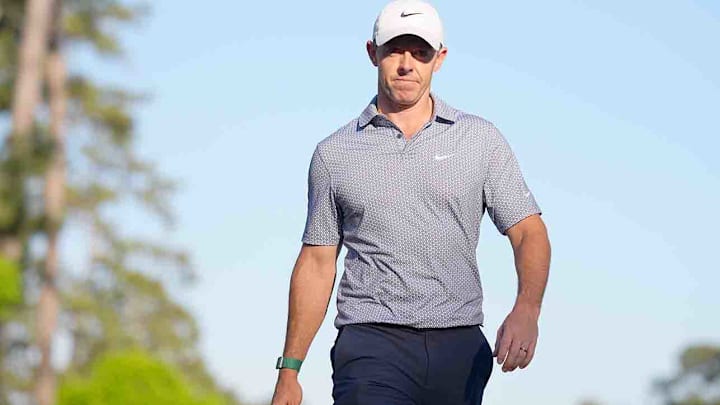
AUGUSTA — The coronation took a detour. Through the pine trees, onto the sand, into the water and all manner of places that Rory McIlroy did not want to go. The reigning Masters champion found his path to further glory impeded, with another anxious day ahead.
On a sun-splashed warm afternoon that saw Augusta National play easier than expected, with all manner of fireworks throughout the course, McIlroy couldn’t deliver the same sort of brilliance that saw him open with rounds of 67-65 and forge a six-shot lead, the biggest 36-hole advantage in Masters history.
Instead, McIlroy allowed a slew of players back into the tournament, shooting 1-over-par 73 to drop into a tie with surging Cameron Young, whose 65 matched the low round of the day and the tournament.
They will be grouped together in the final pairing at Augusta National on Sunday afternoon, with Sam Burns a shot back, Shane Lowry two back and both Jason Day and Justin Rose three strokes behind. Two-time Masters winner Scottie Scheffler also shot 65 to move into contention, four strokes back.
“Didn’t quite have it today,” said McIlroy, who made four birdies, three bogeys and a double bogey and began the round by missing the first green from 90 yards. “Even just starting at the first hole with that soft bogey, even though I hit a pretty good drive. The course was obviously gettable. There was a lot of good scores out there, and obviously the quality of the chasing pack is obvious. There was a lot of guys that shot good scores.
“There's a lot of guys in with a chance tomorrow. I'm still tied for the best score going into tomorrow, so I can't forget that, but I do know I'm going to have to be better if I want to have a chance to win.”
The scoring average of 70.630 was historically one of the lowest for the third round in Masters history, one of just three below 71, the others coming in 1986 and 2019.
Given the dry conditions all week and the expectation that there would be firm and fast conditions, some of the low scoring came as a bit of a surprise. There were 19 rounds in the 60s on Saturday and 10 that were 68 or better.
“I think the fact that there's no wind and the ball is going a long way, and I think the fairways are now running out,” said Rose, who shot 69 to give himself another chance after losing in a playoff to McIlroy last year. “You are hitting 9-iron into the front pin at 11. That's a 540-yard hole. If that's playing a little softer and wetter, you're a 4-iron in there, so it's a bit of a double-edged sword.
“When it's slow, it's long. Obviously now it's playing a bit shorter because it's firm. So if you are really on your game, there's a few more short irons, and the greens are just playable enough where with a 9-iron and a wedge, you can control your ball into certain pin locations.
“If it was playing as long as it normally is with the greens the way they are, that would be a pretty unplayable test to golf. I think what we're gaining off the tee is offsetting a little bit the firmness of the greens.”
It was clear early on that there were going to be some scoring opportunities.

Scheffler lamented a few missed opportunities despite shooting 65. Patrick Reed (who is now tied for ninth) birdied the first three holes to immediately cut the lead to two shots when McIlroy bogeyed the first. Burns, who played with McIlroy in the final group, was steady all day, making four birdies and no bogeys for a 68. Lowry made an ace—making him the first player in Masters history to have two holes-in-one in his career—at the sixth hole and shot 68.
A new lead challenger emerges
But the big move came from Young, the winner of the Players Championship last month who has come into his own since getting his first PGA Tour victory last year at the Wyndham Championship.
Young, who shot 40 for his first nine holes, played the ensuing 45 holes in 15 under par. He was eight strokes back of McIlroy at the start of the day but played the first nine in 32, added birdies at the 10th, 13th and 14th, overcame hitting his third in the water at the 15th by rebounding with a birdie at the 16th to get to 205, 11 under par.
To be sure, Young had his share of good fortune, the kind you need to prevail in these circumstances. He airmailed the ninth green, only to see the ball hit a spectator and bound back onto the green. At both the 13th and 17th holes, wayward tee shots caught tree limbs and fell into the fairway. On the 4th hole, his tee shot went long and then he chipped in for birdie.
“You’ll take anything you can get,” Young said. “We all get enough bad breaks. You're bound to get some good ones, and you're bound to get two or three good ones in a day. I feel, not that I'm owed anything, but when they do start going your way, take them and keep going because they're not always going to.”
McIlroy was missing the kind of good fortune he had the first two days, when despite ranking 90th out of 91 players in driving accuracy, he managed to make 15 birdies and forge that six-shot lead.
But he missed the green and made bogey at the first, failed to birdie the par-5 second, drove the green at the third and narrowly missed an eagle putt, found a bunker at the fourth but got it up and down for a par and then steamed to settle down, knocking an approach to 6 feet at the 10th for a birdie that got him to -13 and seemingly back in control.
Then came the par-4 11th, where McIlroy’s drawing second shot to the green surprised him by kicking left and into the water. After a penalty drop, he pitched to 6 feet but missed the putt and took a double bogey, his first of the tournament.
When he missed the 12th green and made another bogey, he had dropped to 10 under and was a shot behind Young.
“I kept committing to trying to make good swings, but yeah, there was probably a little—when I made the double at 11, I probably got a little bit uneasy on 12 and 13, which I think is understandable,” he said. “As I said, I bounced back well with the birdies on 14 and 15.”
McIlroy headed to the range on Saturday night to try and work out some of the issues in a swing that saw him hit several shots to the left.
Meanwhile, Young was drawing on the confidence that put him in position. Last month, he hit what he said was the tee shot of his life on the final hole at TPC Sawgrass to set up the clinching par for his biggest victory.
Now he’s in the final group at the Masters.
“I said in my press conference afterward (at the Players), that really what I was trying to do was get ready to be playing late on Sunday at Augusta,” he said. “Now I'm here with what will be a late tee time on Sunday at Augusta, and that's the best prep I could have asked for.”

For McIlroy, he got all the prep needed a year ago when he went through an emotional gauntlet on his way to completing the career Grand Slam, starting the day two shots ahead of Bryson DeChambeau, quickly falling behind, moving three shots ahead, imploding and then rebounding in time for a playoff win.
During that final round, he shot 73, much like the one he shot Saturday with a mix of good and bad. Perhaps in his mind, he got a rough one out of the way and can focus on victory now without the same kind of burden that dogged him for so long.
A sixth major win would put him in some elite company, tying him for 12th all time and making him just the fifth player in more than 40 years to reach that milestone.
“I'd like to think that I'll play a little bit freer and I'll play like I've already got a green jacket, which I do,” McIlroy said. “Sometimes I maybe just have to remind myself of that, but I think as well that the stakes in terms of, like, the pairing will be just a little bit easier. The atmosphere out there will be a little bit easier.
“I wish I was a few shots better off, but I'm comfortable. I played with Cam the first two days. Playing with him again. I think it's a comfortable group for both of us.”
That might be the only part of the day that is comfortable. Another warm day on a crusty golf course is ahead. The greens might not be as receptive, either. A green jacket is at stake and the stroll to another victory that seemed in McIlroy’s grasp at the start of the day is a far more daunting proposition.
Masters Sunday awaits.
More Masters coverage from Sports Illustrated
 Add us as a preferred source on Google
Bob Harig was a senior writer covering golf for Sports Illustrated. He has more than 25 years experience on the beat, including 15 at ESPN. Harig is a regular guest on Sirius XM PGA Tour Radio and has written two books, “DRIVE: The Lasting Legacy of Tiger Woods” and “Tiger and Phil: Golf’s Most Fascinating Rivalry.” He graduated from Indiana University where he earned an Evans Scholarship, named in honor of the great amateur golfer Charles (Chick) Evans Jr. Harig, a former president of the Golf Writers Association of America, lives in Clearwater, Fla.
Follow bobharig