%20%20--%3E%0A%3Csvg%20version%3D%221.1%22%20id%3D%22Layer_1%22%20xmlns%3D%22http%3A%2F%2Fwww.w3.org%2F2000%2Fsvg%22%20xmlns%3Axlink%3D%22http%3A%2F%2Fwww.w3.org%2F1999%2Fxlink%22%20x%3D%220px%22%20y%3D%220px%22%0A%09%20width%3D%2239px%22%20height%3D%2240px%22%20viewBox%3D%220%200%2039%2040%22%20enable-background%3D%22new%200%200%2039%2040%22%20xml%3Aspace%3D%22preserve%22%3E%0A%3Cpath%20fill%3D%22%23FFFFFF%22%20d%3D%22M38.5%2C7H28.2v26h10.3V7z%22%2F%3E%0A%3Cpath%20fill-rule%3D%22evenodd%22%20clip-rule%3D%22evenodd%22%20fill%3D%22%23FFFFFF%22%20d%3D%22M26.1%2C25.5c0%2C5.8-4.1%2C7.5-12.9%2C7.5C3.9%2C33%2C0%2C31.2%2C0%2C25.2v-1.1h11.6%0A%09v2.4c0%2C0.7%2C0.1%2C1.4%2C1.2%2C1.4c1%2C0%2C1.2-0.4%2C1.2-1.3v-0.9c0-1.6-0.9-1.6-3.5-2.2C2.2%2C21.7%2C0%2C19.7%2C0%2C15.3v-0.9C0%2C9.3%2C5.5%2C7%2C12.9%2C7%0A%09c10.2%2C0%2C12.8%2C2.6%2C12.8%2C7.4v1.8h-11v-2.9c0-0.6-0.4-1.1-1.2-1.1c-0.6%2C0-1.2%2C0.4-1.2%2C1.1v0.9c0%2C1.5%2C0.9%2C2%2C3.3%2C2.5%0A%09c8%2C1.6%2C10.5%2C3.3%2C10.5%2C7.5V25.5z%22%2F%3E%0A%3C%2Fsvg%3E%0A)
History-Making Horse Trainer Cherie DeVaux Isn’t for Everyone. But She Did It Anyway.
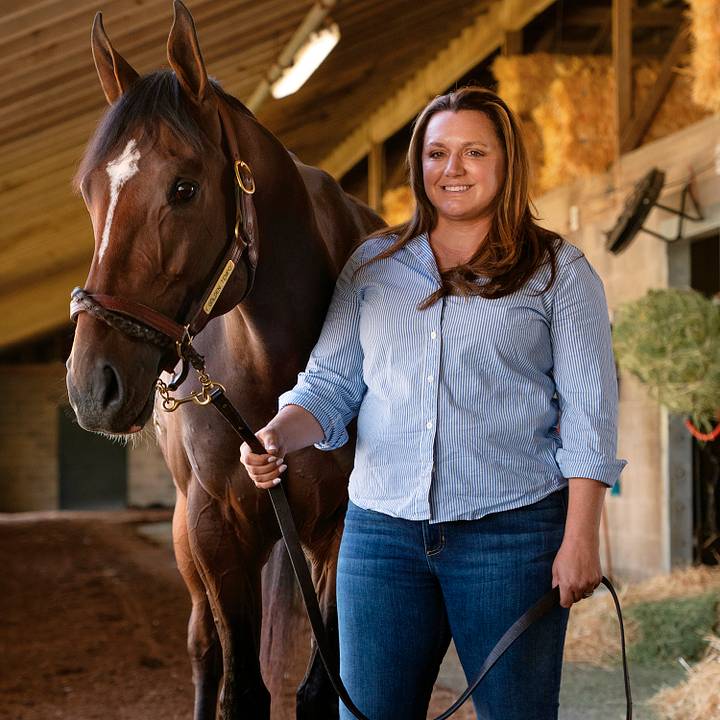
Cherie DeVaux is exhausted but hiding it well, running on Diet Coke and euphoria after a life-altering two minutes and two seconds in Louisville. Six days later, after being on the Today show and throwing out an opening pitch in Yankee Stadium and greeting a fresh media wave every morning outside Keeneland Race Course’s Barn 62, she rests her forearms on her desk and laughs at everything that has happened since the first Saturday in May.
“I don’t really think I’m that big of a deal, so it’s been very surreal,” she says. “Al Roker asked if he could have his picture with me. I was like, Are you kidding me? You’re asking me? Come on, man. You’re the famous one. I just watch horses go around in a circle.”
One of the 120 horses in her care went around in a circle more memorably than any of the others on May 2, creating the ongoing ruckus. He’s down the shed row in Stall 29, poking his head out to socialize with his stablemates and play with the red rubber ball tethered to the wall. Like all the horses in DeVaux’s barn, he has his name written in black Sharpie on silver electrical tape stuck to the cinder blocks: Golden Tempo.
The colt’s last-to-first charge to win the Kentucky Derby at 23–1 odds delivered a bundle of resounding storylines at once. It decided one of the wildest stretch drives in the 152-year history of the race, with four different horses looking like the winner in the final 220 yards; it gave jockey José Ortiz a neck-length victory over his big brother, Irad, who was riding morning-line favorite Renegade; and, oh yeah, it made DeVaux the first female trainer to win America’s greatest horse race. And she did it in her first attempt.

The pioneering element was a natural hook—“The Sport of Kings has its Queen,” social media posts quickly declared. But the other dynamic that catapulted DeVaux from racetrack famous to mainstream famous was her unrestrained reaction to the dramatic Derby finish. She lost herself in the moment—pounding the wall she was leaning against, jumping up and down, screaming, “Oh, my God!” and then nearly buckling to the ground. A lifelong dream and a six-month vision with Golden Tempo came out of the clouds in a matter of seconds.
“It’s very rare that a plan works out without any hiccups,” DeVaux says. “The objective was to win the Kentucky Derby and it effing worked out amazingly. And when I was saying, ‘Oh, my God,’ and I kind of collapsed, that was the whole weight of it. Like, Holy s---, that happened very quickly. It’s amazing how fast your brain works, but all of that just kind of flooded in.”
Then the emotion flooded out, in one of the greatest just-won-the-Derby reactions of all time. If the sweetest moment ever was trainer Carl Nafzger calling the stretch run for 92-year-old owner Frances Genter as their colt, Unbridled, won the 1990 Derby, then DeVaux’s reaction was arguably the most real. (She would like to clarify one thing she said on video amid the celebration: “I did not, in fact, pee my pants.”) But while the sporting world was falling in love with her, it would be simplistic, patronizing and frankly inaccurate to label Cherie DeVaux America’s sweetheart.
“She’s not afraid to motherf--- anyone,” says her younger sister, Adrianne, also a thoroughbred trainer. “If she sees something that’s wrong, she will call it out. She does things the right way. Once you get to know her, she will give you the shirt off her back. But man, she can kind of be a bitch. I love her to death, but any of her siblings would say the same thing.”

Case in point from her days as an assistant trainer under Chad Brown: DeVaux was on a companion pony with standout mare Stephanie’s Kitten one morning in 2015 when Triple Crown winner American Pharoah came out to the track for a gallop. A cameraman told DeVaux to move because she was ruining his shot of Pharoah.
“Excuse me, motherf----er,” DeVaux says she responded. “I don’t know who the f--- you think you’re talking to, but it is not me. I am not the one.”
She explains: “I don’t seek [confrontation], I try to be respectful, but I say what needs to be said. And I have a very colorful way of saying it. I’m a really secure person and that’s why I can be the way that I am. I’m not going to quiet myself to fit in somebody’s box so that they like me.”
There is a reason she keeps a hat handy in her barn that reads I’m not for everyone.
“She’s not afraid to motherf--- anyone. If she sees something that’s wrong, she will call it out. She does things the right way.”Cherie DeVaux’s younger sister, Adrianne
Horse racing is a tough business. The racetrack is a hard place. The day-to-day work is not glamorous, the hours are brutal and success rates are like batting averages—far more races are lost than won. Competition to land the best horses and jockeys can be cutthroat. After growing up in a harness racing family, going to college to study pre-med and then pivoting back to the track, navigating what she calls a “wild child” phase and launching her own stable eight years ago, the 44-year-old DeVaux has proven both gifted and strong enough to fight her way to the top.
Was her ascent easy to see coming? In glimpses, definitely. The determination to succeed at every endeavor was there from an early age. DeVaux has long been type A orderly—her desk features a couple of very new framed photographs from the Derby triumph, but also notepads with small, neat handwriting in black ink. Barn workers know they need to be on top of their business or they will hear it from the boss. (Even Adrianne weathered some tense times working for Cherie).
You could say she was born to make history. But the entire, rose-garland picture didn’t crystallize until a couple of years ago.

When Butch and Janet DeVaux were wed, they already had five children between them from previous marriages. Cherie was the first of five more they had together, creating what they refer to as a Brady Bunch blended family. Butch was a harness racing trainer and sulky driver working in the shadow of the thoroughbred industry in Saratoga Springs, N.Y., and the kids grew up as part of the family business.
“Good help is hard to find,” jokes Adrianne, “so they just made more help.”
Cherie was at home on horseback, competing in barrel racing and later working as a thoroughbred exercise rider. She also played volleyball and softball when the family moved to Englewood, Fla., earning a “Will to Win” award at Lemon Bay High. Always looking for another challenge, she later became enthralled with competitive bodybuilding.
Cherie enjoyed the discipline it took to sculpt her body. She says she still likes to lift to “blow off steam,” but doesn’t miss the deprivation that came with chasing perfect lean muscle mass. The weeks of ingesting no more than 1,000 calories a day—egg whites, broccoli, sweet potatoes, canned tuna—were not enjoyable.

“I love that you could look at a muscle and be like, I built that,” she says. “But at times I was eating less than jockeys. That whole thing was really not mentally healthy for me because of body dysmorphia. I’d have a little pooch on me and be like, Oh, my God, that’s so fat. So now I’m a normal-size person who’s healthy. It’s still a work in progress. Everything is a work in progress.”
Janet DeVaux was not a fan of the bodybuilding period in Cherie’s life. “We’d eat a whole meal and she would have an olive,” she says.
Then there was the Party Era, in which Cherie acknowledges she made plenty of youthful mistakes. She had left college at SUNY Albany to become an exercise rider, and at the time the racetrack life was fast, furious and shortsighted.
“I was always so serious about things, and that was my first time I didn’t have any sense of direction,” she says. “I would work at the barn in the morning, I’d come back in the afternoon [for the races], I’d take a long nap and then I would go out from sundown to sunup, basically. I was zero-to-60, but I’d always come to work the next morning. Thank God there were no cameras or Facebook.
“Now, on the flip side, I can say I never want to do that again. I’m not having a midlife crisis anytime soon.”

A riding accident and some firm advice from a mentor put DeVaux on her career path. She was galloping a horse named Hot Canary one morning in Florida when something spooked the animal.
“The horse stopped and I didn’t,” says DeVaux, who flew over Hot Canary’s head and fractured the plateau of her tibia upon impact with the ground. (A full knee replacement would come years later.)
Depressed, DeVaux went home to New York to convalesce. The trainer she was working for, Chuck Simon, used the injury as a reason to promote her to assistant trainer, accomplishing two things at once—curtailing her partying and putting her abundant insight into horses to greater use.
Janet remembers what the racing steward said when he handed Cherie her training license: “I think I’m giving this to the first woman to win the Kentucky Derby.”
The prophecy came true, but it took a while. DeVaux went out on her own in 2018 and promptly lost her first 29 races across nearly 11 months. Her husband, bloodstock agent David Ingordo, counseled patience. “Give it three years,” he said. She never stopped believing herself.
“I’m one of those thick-minded people that thinks it’s always going to work out,” DeVaux says.
Finally, a horse named Traveling took DeVaux to the winner’s circle at Gulfstream Park in a $39,000 maiden claiming race in March 2019. It was another four months until her second victory, but thereafter the wins started to come more frequently. By 2021 she topped the $2 million annual mark in earnings, and in ’24 she had more than $10 million. During that breakout year, More Than Looks won the Breeders’ Cup mile. Deep-pocketed owners took notice.
Among them: Daisy Phipps Pulito, owner and racing manager for Phipps Stable, a generations-deep blueblood operation. “I have been watching the way she trains,” Phipps Pulito said after the Derby. “She’s in Kentucky. I live in Kentucky. And I love the way she develops a horse.”
One of horses Phipps sent to DeVaux was Golden Tempo. He was not the flashiest 2-year-old in her barn in 2025—that was Englishman, who won his first two starts in dazzling fashion to stamp himself as a Derby contender before being sidetracked with a minor injury. (Englishman returned to racing on Derby Day, finishing second in a high-powered Pat Day Mile, and should be a factor in other major races this year.)
Golden Tempo came along more gradually, not racing until last December. But DeVaux was high on him, plotting a potential Derby path that went through Fair Grounds Race Course in New Orleans. When the horse won his first two starts there, including a stakes race in mid-January, DeVaux believed she simply needed to earn enough qualifying points for the Derby without pushing the horse too hard.
After third-place finishes in the Risen Star Stakes and the Louisiana Derby, the Golden Tempo bandwagon emptied out. But DeVaux was undeterred, relying on what she says is her greatest gift—being keenly attuned to her horses, reading their moods and reactions, studying details and trusting her gut instinct. She once surmised that one of her star horses, She Feels Pretty, would benefit from a calming influence at the barn. She brought in a goat and saw immediate benefits. (DeVaux is not the first trainer to employ a goat for those purposes with racehorses, but it’s not exactly commonplace.)
With Golden Tempo, the plan was to avoid squeezing too much out of him, too soon. Losses in February and March were tolerable when everything was a buildup toward the first Saturday in May. “We wanted him to keep improving and get experience, but the conversation after every race was, Did we achieve what we hoped to?” DeVaux says. “The answer was yes. Then we would take our big swing in the Derby.”

At Cherie’s request, 15 family members rented a sprinter van and made the drive from New York to Kentucky for the Derby. They stayed at her house in Lexington while she was in Louisville, keeping close to Golden Tempo and her other horses running at Churchill Downs that weekend. Derby Day is an interminable wait, leaving a trainer simmering in a stew of nerves, so Cherie’s best friend, Alysse Jacobs, helped kill time by singing karaoke outside the barn. Cherie sang along, sitting in a camp chair with her feet up and seeming far less anxious than she assuredly was.
Everyone in the DeVaux camp knew how the race would need to unfold for Golden Tempo to have a chance. Not blessed with tactical speed—“He’s lazy,” his jockey says—the slow-starting colt would be running late in the 1 ¼-mile Derby. He needed some help up front in the form of a stout pace and got it.
The fractions through the first half of the race were not suicidal, but they were fast enough to cook those on the front end. Meanwhile, after Ortiz guided his mount to the rail to save ground, Golden Tempo dawdled so far behind that he was at times not even in the NBC broadcast picture.
“I was afraid there was something wrong with him,” says Janet. “I knew he would be behind, but he was so far behind.”
Japan-based Danon Bourbon led by two lengths at the top of the stretch but gave way—first to 70–1 long shot Ocelli, and then to Renegade, who came surging in the middle of the track. But Ortiz had been tracking his brother from the far turn into the stretch, urging Golden Tempo along in Renegade’s path. When Irad came inward as he briefly dueled with a fading Incredibolt, it provided an opening for Golden Tempo to surge ever wider and swoop past.
With just five strides left before the wire, Golden Tempo finally stuck his head in front. The colt led for little more than the final two seconds of the race. “Timed it right,” Jose said with a smile after the race.
As the impact of the accomplishment landed on DeVaux’s shoulders and nearly took her to the ground, so did the weight of history. For her entire career, she’d resisted being labeled a “female trainer” and answering questions about the rarity of her place in a male-dominated sport. But when girls began asking for her picture outside her barn during Derby week, she gained a greater appreciation for a role she never asked to have.
“The thing that really has become apparent to me is that not everyone has the same constitution as I have mentally,” DeVaux says. “It really is an honor to be able to be that person for other women or little girls to look up to. You can dream big, and you can pivot. You can come from one place and make yourself a part of history.”
“You can dream big, and you can pivot. You can come from one place and make yourself a part of history.”Cherie DeVaux
After achieving that history, DeVaux had to make another big decision: bypassing the Preakness and forfeiting a shot at the Triple Crown. That’s been an easier call to make in recent years, as horses have become progressively less accustomed to racing twice in a span of two weeks. (Golden Tempo is slated to race in Saturday’s Belmont Stakes.) Once that decision was out of the way, she was free to go back to training the rest of her stable—or as free as the public would allow her to be. DeVaux was seemingly everywhere and graciously granting every photo request, but she still had a business to run.
On that Friday after the Derby, she put a whopping 36 horses through timed workouts at Keeneland, polishing their conditioning in advance of a variety of races. Getting some space from well-wishers on that busy morning brought out the “Not for Everyone” in Cherie DeVaux.
“I need things to quiet down so I can pay attention and focus,” she says. “So I just had to get everyone to shut the f--- up.”
More Horse Racing From Sports Illustrated
 Add us as a preferred source on Google
Pat Forde is a senior writer for Sports Illustrated who covers college football and college basketball as well as the Olympics and horse racing. He cohosts the Others Receiving Votes podcast for SI and is a regular contributor to the Tony Kornheiser Show podcast. He previously worked for Yahoo Sports, ESPN and The (Louisville) Courier-Journal. Forde has won 28 Associated Press Sports Editors writing contest awards, has been published three times in the Best American Sports Writing book series, and was nominated for the 1990 Pulitzer Prize. A past president of the U.S. Basketball Writers Association and member of the Football Writers Association of America, he lives in Louisville with his wife. They have three children, all of whom were collegiate swimmers.
Follow ByPatForde